



- Charles Leclerc
- Lewis Hamilton
- Max Verstappen
- Lando Norris
- Ayrton Senna
- Michael Schumacher
- Fernando Alonso
- Oscar Piastri
- George Russell
- Kimi Antonelli
- Nico Hülkenberg
- Gabriel Bortoleto
- Pierre Gasly
- Franco Colapinto
- Carlos Sainz
- Oliver Bearman
- Sergio Pérez
- Valtteri Bottas
- Isack Hadjar
- Alain Prost
- James Hunt
Ayrton Senna 1988 McLaren MP4/4 Helmet: A Collector’s Guide to an Iconic Livery
Posted by
 123Helmets Editorial Team
123Helmets Editorial Team
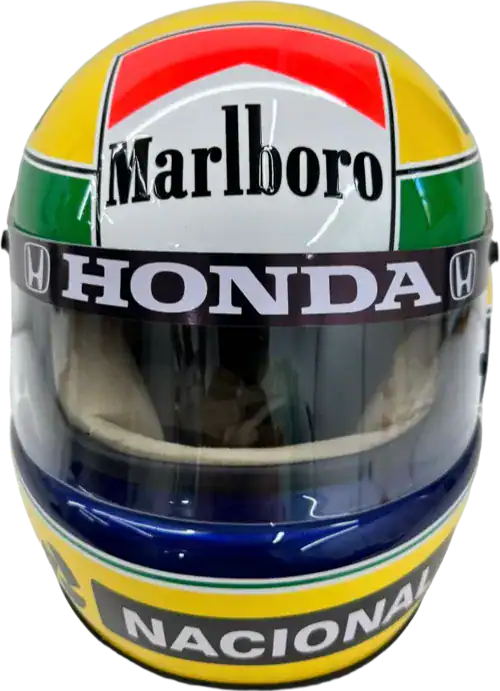
The Livery That Defined an Era
Few objects in motorsport history carry the visual weight of Ayrton Senna’s helmet from the 1988 Formula 1 season. That year, the Brazilian maestro piloted the McLaren MP4/4 to an almost incomprehensible championship — 8 wins from 16 races, a dominant performance that remains one of the most statistically overwhelming title campaigns the sport has ever witnessed. The helmet worn throughout that season is not merely a piece of racing memorabilia; it is a symbol of perfection, focus, and artistry at the absolute limit of human performance.
For collectors and display enthusiasts, the 1988 Senna livery occupies a singular position. It bridges the golden age of hand-painted helmet designs with the emergence of modern motorsport branding, making it a visually arresting centerpiece in any serious collection.
Breaking Down the Iconic Senna Livery Design
Senna’s helmet design throughout his career was instantly recognisable, and the 1988 specification represents one of its most refined iterations. The livery is anchored by a bold yellow base — a deliberate nod to the Brazilian national flag — that radiates warmth and confidence even in static display. Sweeping bands of vivid green and blue arc across the shell in a fluid, almost painterly motion, giving the design an energy that feels kinetic even when standing still on a display shelf or pedestal.
The Colour Palette and Its Symbolism
The yellow, green, and blue colour scheme was Senna’s lifelong tribute to his Brazilian heritage. He wore variations of this livery from his early karting days right through to his final season in 1994, but the 1988 version carries a particular purity. The graphics are clean, the transitions between colours are sharp yet organic, and the absence of heavy commercial sponsor branding on the helmet itself means the design speaks entirely for itself. For a display replica, this translates into a piece that commands visual attention without visual noise.
The McLaren MP4/4 Context
Part of what elevates this specific livery within Senna’s catalogue is its association with arguably the greatest racing car ever built. The McLaren MP4/4, powered by a turbocharged Honda RA168E engine, won 15 of the 16 grands prix that season — a record that still stands. Displaying a full-size 1:1 replica of Senna’s helmet from this campaign is, in essence, displaying the visual identity of that extraordinary machine’s driver at the peak of his powers. The helmet and the car are inseparable in the collective memory of Formula 1.
What Makes This Helmet a Stand-Out Display Piece
In the world of collector-grade motorsport replicas, not all liveries are created equal. Certain designs transcend their sporting context and become cultural artefacts — objects whose meaning extends beyond the race results they were associated with. Senna’s 1988 helmet is emphatically in that category.
- Instant recognition: Even to casual observers outside the hardcore motorsport community, the yellow-green-blue Senna livery is one of the most recognisable helmet designs in the world. It functions as a conversation piece in any setting, from a dedicated trophy room to a design studio or private office.
- Historical resonance: Displaying this livery is displaying a moment — the 1988 season — that is widely regarded as one of the defining chapters in the entire history of Formula 1.
- Aesthetic versatility: The warm, vibrant colour palette integrates naturally into a wide variety of interior design contexts, from minimalist contemporary spaces to richly appointed traditional studies.
- Collector community consensus: Among serious motorsport collectors, Senna helmets — and the 1988 iteration in particular — consistently rank among the most sought-after liveries. Owning a full-size exhibition quality replica is a credible and respected statement of collecting intent.
Displaying Your Senna 1988 Replica: Collector Considerations
A full-size 1:1 collector replica of this calibre deserves a presentation that honours its significance. Here are a few display principles that serious collectors apply when housing a piece of this stature.
Mounting and Presentation
A dedicated acrylic display stand or wall-mounted helmet bracket elevates the piece from shelf ornament to exhibition quality centrepiece. Positioning the helmet at eye level, slightly angled to catch available light, allows the contours of the shell and the visor to interact dynamically with the surrounding space. Many collectors choose to display the helmet alongside period photography or printed race data from the 1988 season to contextualise the piece within its historical moment.
Lighting
The yellow base of the Senna livery responds exceptionally well to warm directional lighting. A single focused spotlight or a warm-toned LED display light will bring out the depth of the colour bands and create subtle shadow play across the helmet’s surface. Avoid harsh cool-white fluorescent lighting, which can flatten the vibrancy of the yellow and desaturate the green and blue accents.
Pairing Within a Broader Collection
For collectors building a themed display around McLaren’s dominant late-1980s period, the 1988 Senna helmet pairs beautifully with replica items referencing the MP4/4 car itself. Equally, collectors focused on Senna’s career arc can display helmets from his 1991 McLaren season or his earlier Lotus years alongside the 1988 piece to trace the evolution of his iconic livery across time.
Display and collector replicas only. Not certified for protective use. Full-size 1:1 scale.