Isack Hadjar’s Japanese GP Helmet 2026 — The Molten Sun
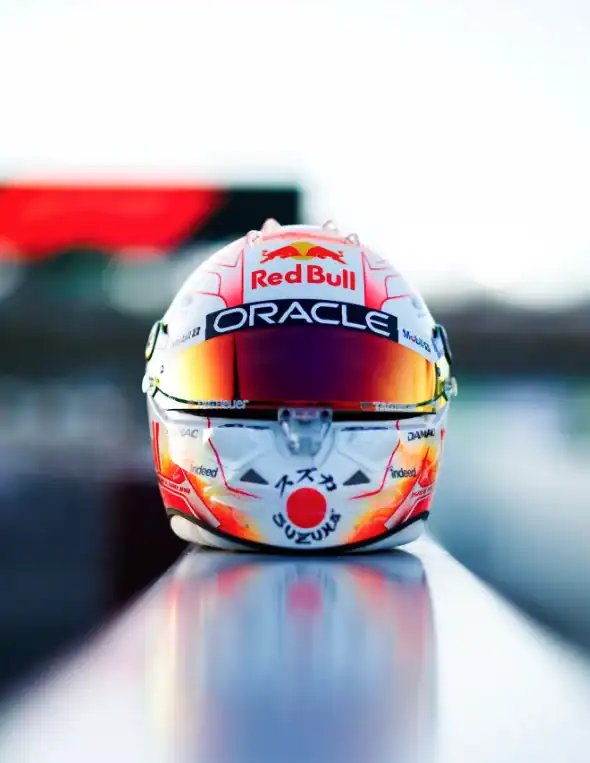
Red Bull’s rookie has arrived at Suzuka with a striking one-off helmet design that swaps his standard Senna-inspired yellow-and-purple livery for a white shell blazing with orange and red accents — crowned by a circular “molten sun” motif that pays direct tribute to Japan.
Isack Hadjar’s one-off helmet for the 2026 Japanese Grand Prix at Suzuka. Image via Paddock GP.
Quick Design Takeaway
Concept
Japan Tribute — Molten Sun
Base Finish
White shell
Primary Accents
Orange and red
Signature Detail
Circular sun motif on crown
Visor
Aggressive mirrored finish
Occasion
Japanese GP 2026 one-off
While many drivers opt for cherry blossom or manga-themed specials at Suzuka, Hadjar has gone in a different direction — a bold, graphic composition built around a single solar motif. The white base provides maximum contrast for the warm-toned accents, and the circular sun element on the crown reads as both a nod to the Japanese flag and a personal signature for a driver who has described the design as “something personal, but also connected to the place where we run.”
Visual Standouts
1
The White Shell
The helmet’s base is a clean white — a sharp departure from Hadjar’s standard 2026 season helmet, which runs a yellow-and-purple Senna-inspired livery. On a white canvas, every accent element hits harder: the orange radiates warmth, the red carries intensity, and the mirrored visor becomes a visual anchor. It is a deliberate reset from the everyday design, signaling immediately that this is a special-occasion helmet built for one circuit and one weekend only.
2
The Molten Sun Crown
The centrepiece of the design sits on the helmet’s crown: a circular motif described by Paddock GP as a “molten sun” or “fusion sun.” Visible from the overhead camera angle that F1 broadcasts favour during pit stops and formation laps, the sun motif transforms the top of the helmet into a direct visual tribute to Japan — evoking the rising sun while avoiding a literal flag reproduction. The circular form gives the design a focal point that the rest of the livery radiates outward from.
Detail view of Hadjar’s Suzuka special — the personal motifs and self-portrait visible toward the rear of the helmet.
3
Mirrored Visor
The visor carries an aggressive mirrored finish that amplifies the helmet’s visual presence on track. Under the Suzuka sun, the reflective surface acts as a second focal point alongside the crown motif — catching light and reflecting the circuit environment. The mirror treatment is a strong contrast against the matte-adjacent white shell, adding a layer of technical finish to an otherwise organic, warmth-driven design.
4
Rear Self-Portrait
In a distinctly personal touch, the back of the helmet features an animated cartoon self-portrait of Hadjar himself, surrounded by inscriptions and phrases. Sources describe the combination as mixing “self-parody with personal signature” — a playful counterpoint to the more reverent Japanese tribute on the crown. This rear detail is characteristic of Hadjar’s emerging style as a driver who brings humour and personality to his visual identity.
“I wanted something personal, but also connected to the place where we run.”
— Isack Hadjar, quoted by Paddock GP, March 2026
Hadjar’s standard 2026 season helmet — a yellow-and-purple design paying tribute to Ayrton Senna, with a physics equation on the back honouring his father’s work as a quantum physicist — has been one of the most talked-about rookiedesigns this year. The Suzuka one-off demonstrates that even in his debut season, Hadjar is already building a collection of distinctive helmet moments, with each design carrying a specific narrative tied to place, culture, or personal history.
The Collector’s Perspective
Hadjar’s Suzuka helmet is a compelling early entry in what could become a significant helmet portfolio over a multi-year F1 career. Several factors make this design noteworthy from a display standpoint:
Debut-season provenance. This is Hadjar’s first Japanese Grand Prix in Formula 1. Rookie-season specials carry a particular weight in any driver’s helmet history — they mark the very first encounter between driver and circuit at the highest level. If Hadjar goes on to build a long career with Red Bull, this Suzuka 2026 design becomes the origin point of his Japanese GP helmet lineage.
White-base display impact. White-shell helmets consistently deliver the strongest visual punch under display lighting. The clean surface throws every accent — the orange, the red, the sun motif — into high contrast. Under even basic LED illumination, the design reads clearly from across a room, which is exactly what collectors want from a display piece.
Narrative depth. The combination of a Japanese cultural tribute on the crown with a playful self-portrait on the rear gives this helmet two distinct viewing angles, each with its own personality. For collectors who rotate display orientation, that dual-character quality adds long-term interest.
One-off rarity. Confirmed as a single-weekend special. Hadjar’s standard season helmet returns for all subsequent rounds, giving the Suzuka design a time-stamped exclusivity.
Approximate palette values based on available imagery. Exact hex codes may vary from the physical helmet.
Shell White
Accent Orange
Accent Red
Mirrored Visor
Sponsor Black
The white base is not a bright paper white but carries a slightly warm tone that grounds the design. The orange and red accents work as a gradient pair, transitioning from warm to hot as they move across the shell. The mirrored visor introduces a metallic texture that none of the painted surfaces share, creating a material contrast between reflective and matte.
Frequently Asked Questions
What is the design concept behind Isack Hadjar’s Japanese GP 2026 helmet?
The helmet is a one-off tribute to Japan, featuring a white base with orange and red accents and a circular “molten sun” motif on the crown. The rear of the helmet carries an animated self-portrait of Hadjar surrounded by personal inscriptions. Hadjar described it as “something personal, but also connected to the place where we run.”
How is this different from Hadjar’s regular 2026 helmet?
Hadjar’s standard season helmet is a yellow-and-purple design inspired by Ayrton Senna, with a physics equation on the back honouring his father. The Suzuka special replaces that palette entirely with a white, orange, and red scheme built around the Japanese sun motif.
Will Hadjar use this helmet at other races?
No. This is a one-off design for the 2026 Japanese Grand Prix weekend at Suzuka. Hadjar reverts to his standard Red Bull livery helmet for subsequent rounds.
Where can I find display replicas of Isack Hadjar’s helmets?
Browse our Isack Hadjar collection for available full-size 1:1 display replicas. You can also explore our collector guide for advice on selecting and displaying replica helmets. All our products are display and collector replicas.
Explore the Collection
If Hadjar’s Suzuka helmet has caught your eye, explore our collection of full-size 1:1 display replicas — or browse the latest helmet design stories from the 2026 Japanese Grand Prix.
To provide the best experiences, we use technologies like cookies to store and/or access device information. Consenting to these technologies will allow us to process data such as browsing behavior or unique IDs on this site. Not consenting or withdrawing consent, may adversely affect certain features and functions.
Functional
Always active
The technical storage or access is strictly necessary for the legitimate purpose of enabling the use of a specific service explicitly requested by the subscriber or user, or for the sole purpose of carrying out the transmission of a communication over an electronic communications network.
Preferences
The technical storage or access is necessary for the legitimate purpose of storing preferences that are not requested by the subscriber or user.
Statistics
The technical storage or access that is used exclusively for statistical purposes.The technical storage or access that is used exclusively for anonymous statistical purposes. Without a subpoena, voluntary compliance on the part of your Internet Service Provider, or additional records from a third party, information stored or retrieved for this purpose alone cannot usually be used to identify you.
Marketing
The technical storage or access is required to create user profiles to send advertising, or to track the user on a website or across several websites for similar marketing purposes.



 123Helmets Editorial Team