Kimi Antonelli’s Japanese GP Helmet 2026 — The Y-3 Wolf Collection
Mercedes has partnered with Yohji Yamamoto’s Y-3 label for an unprecedented full-team visual takeover at Suzuka — placing a wolf graphic rooted in Japanese mythology across the W17 livery, race suits, and the helmets of both Kimi Antonelli and George Russell.
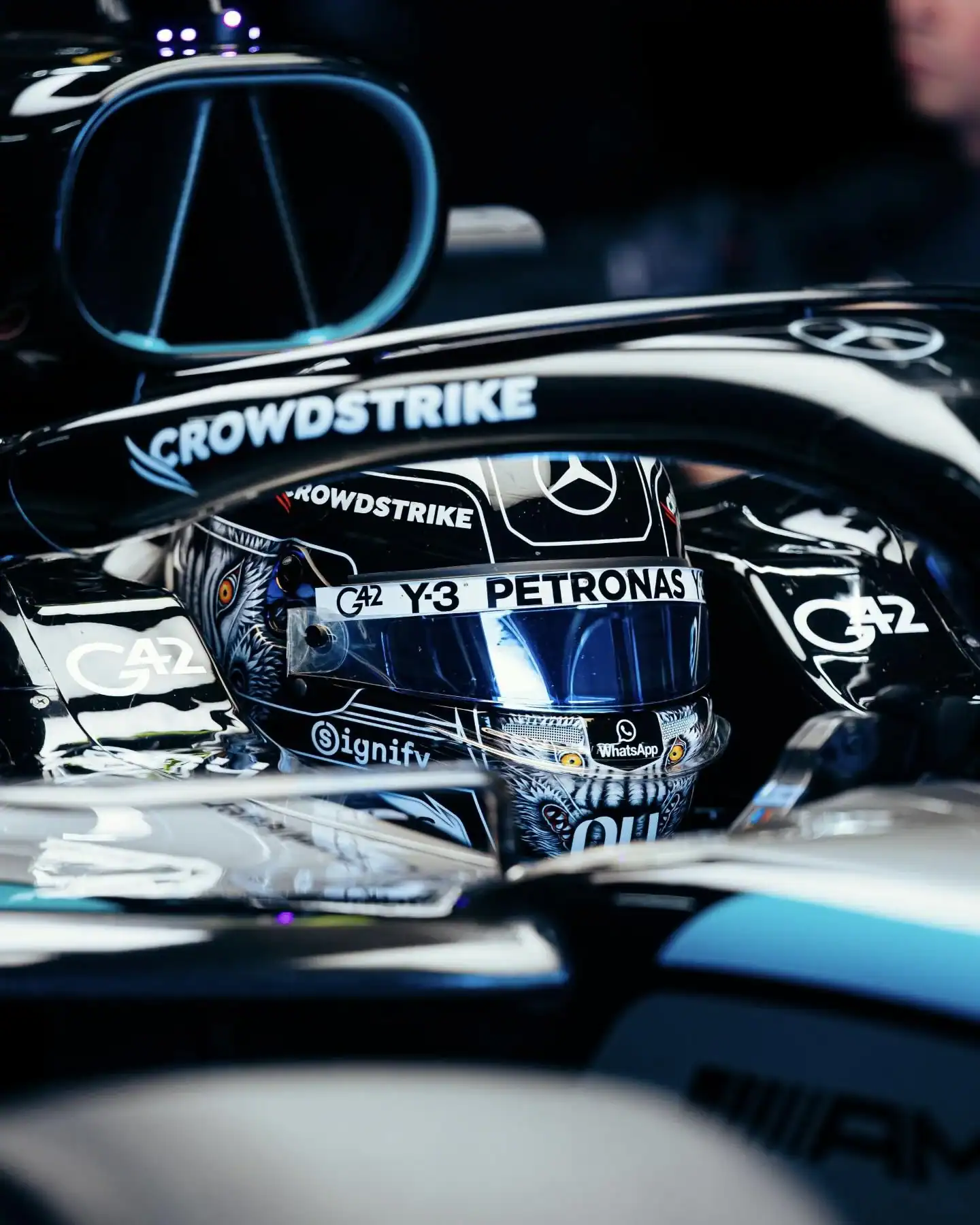
Kimi Antonelli’s Y-3 wolf helmet by Chikami Hayashi in the Mercedes W17 cockpit at Suzuka 2026.
Quick Design Takeaway
Collaboration
Y-3 × Mercedes-AMG PETRONAS
Designer
Yohji Yamamoto (82-year-old Japanese master)
Central Motif
Wolf — guardian in Japanese mythology
Scope
Car livery + race suits + helmets
Campaign
“Unleashing the Beast”
Occasion
Japanese GP 2026 — Suzuka
This is not simply a one-off helmet sticker or a paint change. The Y-3 collaboration encompasses the entire Mercedes visual identity for the Suzuka weekend: car livery, driver overalls, helmets, and team wear. For helmet collectors, the significance lies in having a design by Yohji Yamamoto — one of the most influential fashion designers of the past half-century — applied directly to an F1 driver’s helmet. That crossover between haute couture and motorsport is rare and collectible in its own right.
Visual Standouts
1
The Wolf Motif
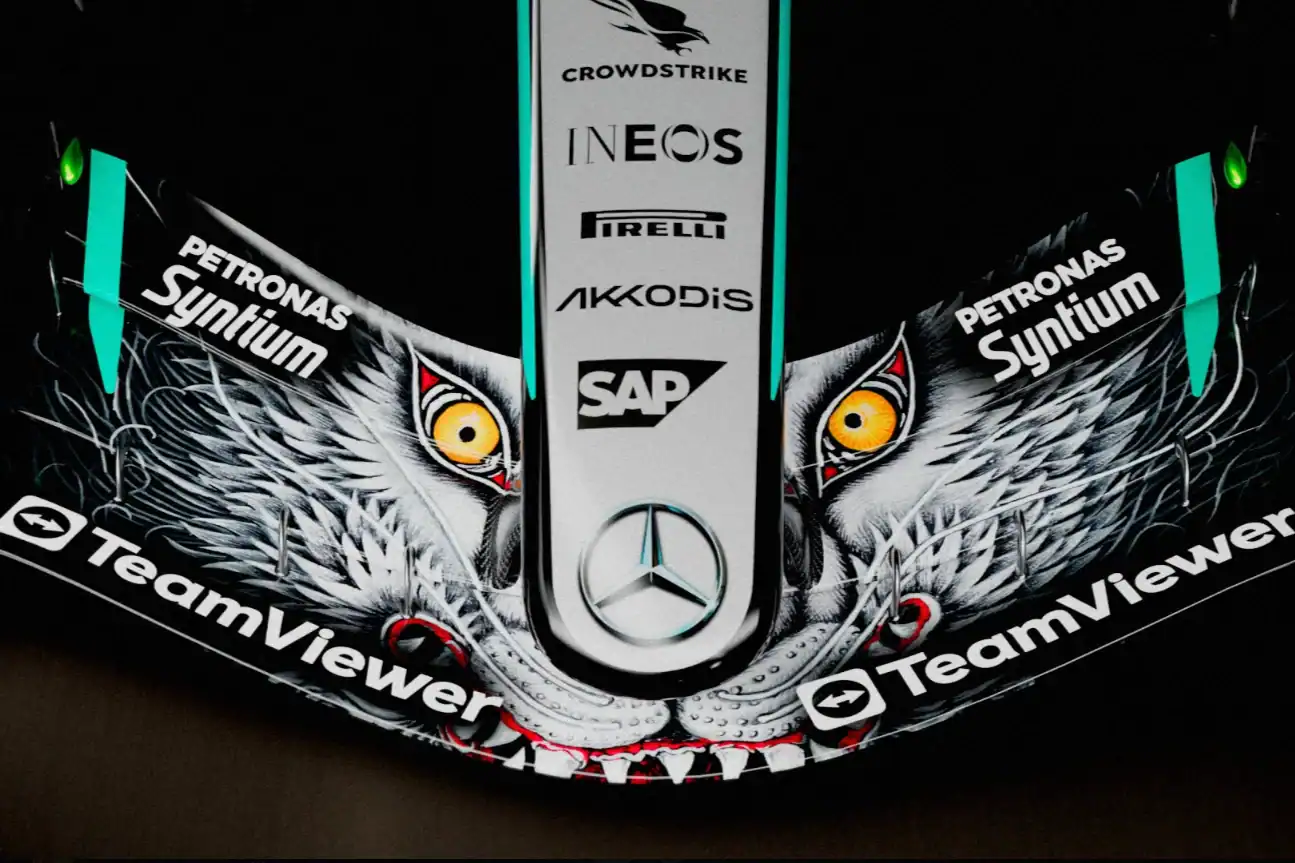
The centrepiece of the entire collection is a wolf graphic drawn from Japanese mythology, where the wolf (ōkami) is considered a guardian of the natural world. The wolf artwork originally appeared on adidas’ F50 Tunit football cleats in 2006 and has been reimagined for this F1 application. On the car, the wolf appears prominently on the front wing with piercing yellow eyes. On the helmets and overalls, the wolf motif is integrated as a repeating design element that ties every piece of the Mercedes visual identity together into a unified collection.
The wolf graphic in detail — rooted in Japanese mythology, where the wolf symbolises speed, instinct, and bravery.
2
Designer Pedigree
Yohji Yamamoto, now 82, is one of the defining figures in avant-garde fashion. Y-3 — his long-running collaboration with adidas, founded in 2001 — has always operated at the intersection of sport and high design. Having Yamamoto’s creative direction applied to an F1 helmet is a first in the sport’s history. The collection was previewed during Paris Fashion Week before its track debut at Suzuka, underscoring the fashion-world significance of this crossover.
3
Full-Team Visual Coherence
What distinguishes this from a typical one-off helmet is the scope. Both Antonelli and Russell wear Y-3 helmets. Both wear Y-3 race suits. The W17 itself carries the wolf livery. Even team principal Toto Wolff appeared in Y-3 team wear for the campaign shoot. The result is a unified visual system where the helmet is not an isolated design object but part of a larger artistic statement — the kind of total-package approach that fashion houses bring to their runway collections.
Confirmed Design Elements
Driver
Kimi Antonelli (and George Russell)
Team
Mercedes-AMG PETRONAS F1 Team
Race Number
#12 (Antonelli)
Event
Japanese Grand Prix 2026
Circuit
Suzuka Circuit, Japan
Collaboration
Y-3 (adidas × Yohji Yamamoto)
Campaign
“Unleashing the Beast”
Scope
Helmets, overalls, car livery, team wear
What Remains Unknown
While the Y-3 collaboration and wolf motif are extensively documented, specific helmet-level details have not yet been individually confirmed:
Exact placement and scale of the wolf motif on the helmet shell
Whether Antonelli’s and Russell’s helmet designs are identical or carry individual variations
Full colour palette of the helmet itself (as distinct from the car livery)
Whether this is a complete helmet repaint or an overlay on the standard season design
This article will be updated as helmet-specific close-up imagery emerges from the Suzuka weekend.
The Collector’s Perspective
The Y-3 × Mercedes collaboration creates a unique category of collectible — a helmet that exists at the intersection of Formula 1, Japanese mythology, and high fashion. Several factors make this notable:
Fashion-house provenance. Yohji Yamamoto is a name that resonates far beyond motorsport. A helmet carrying his design direction has appeal not only to F1 collectors but to the broader design and fashion collector community. That dual audience is unusual in helmet collecting.
Collection context. The Y-3 wolf collection extends beyond the helmet to include commercially available team wear and accessories. For display purposes, the helmet can be paired with collection pieces to create a comprehensive visual narrative — something that most one-off helmet designs cannot offer.
Antonelli’s trajectory. Kimi Antonelli is in his debut F1 season with Mercedes. Early-career special editions from drivers who go on to sustained success tend to appreciate in collector interest over time. The combination of a rookie season, a legendary designer, and a Japanese GP one-off makes for a compelling provenance story.
Approximate palette values based on the Y-3 collaboration imagery. Helmet-specific colours may differ from the car livery shown below.
Y-3 Black
Mercedes Silver
Mercedes Teal
Wolf Yellow Eye
Accent White
The Y-3 collaboration leans into Yamamoto’s signature dark palette — black dominates, with the wolf’s piercing yellow eyes providing the primary contrast point. Mercedes silver and teal remain present as brand anchors, while white accents frame the wolf graphic elements.
Frequently Asked Questions
What is the Y-3 wolf design on Kimi Antonelli’s Suzuka helmet?
The helmet is part of a broader Y-3 × Mercedes-AMG PETRONAS collaboration for the 2026 Japanese Grand Prix. Designed under the creative direction of Yohji Yamamoto, the collection features a wolf graphic rooted in Japanese mythology — symbolising speed, instinct, and bravery. The wolf motif appears on the car livery, race suits, and helmets of both Antonelli and Russell.
Who is Yohji Yamamoto and why is he designing F1 helmets?
Yohji Yamamoto is an 82-year-old Japanese fashion designer known for avant-garde clothing that blends Eastern and Western aesthetics. Y-3, his collaboration with adidas founded in 2001, bridges sport and high fashion. The Suzuka collection represents the first time a designer of Yamamoto’s stature has applied his creative direction to F1 driver helmets, race suits, and a car livery simultaneously.
Do Antonelli and Russell wear the same helmet design?
Both drivers are confirmed to wear Y-3 helmets as part of the collection. Whether the two designs are identical or carry individual variations has not yet been confirmed from available imagery.
Where can I find display replicas of Kimi Antonelli’s helmets?
Browse our Kimi Antonelli collection for available full-size 1:1 display replicas, or explore our collector guide for display advice. All products are display and collector replicas.
Explore the Collection
Discover Kimi Antonelli and Mercedes display replicas, or explore the full 2026 Japanese GP helmet coverage.
To provide the best experiences, we use technologies like cookies to store and/or access device information. Consenting to these technologies will allow us to process data such as browsing behavior or unique IDs on this site. Not consenting or withdrawing consent, may adversely affect certain features and functions.
Functional
Always active
The technical storage or access is strictly necessary for the legitimate purpose of enabling the use of a specific service explicitly requested by the subscriber or user, or for the sole purpose of carrying out the transmission of a communication over an electronic communications network.
Preferences
The technical storage or access is necessary for the legitimate purpose of storing preferences that are not requested by the subscriber or user.
Statistics
The technical storage or access that is used exclusively for statistical purposes.The technical storage or access that is used exclusively for anonymous statistical purposes. Without a subpoena, voluntary compliance on the part of your Internet Service Provider, or additional records from a third party, information stored or retrieved for this purpose alone cannot usually be used to identify you.
Marketing
The technical storage or access is required to create user profiles to send advertising, or to track the user on a website or across several websites for similar marketing purposes.


 123Helmets Editorial Team