Pierre Gasly’s Japanese GP Helmet 2026: The Kintsugi Masterpiece
Pierre Gasly has unveiled one of the most culturally resonant helmet designs of the 2026 season — a white porcelain shell fractured with blue veins and repaired with gold, paying tribute to the ancient Japanese art of kintsugi ahead of the Grand Prix at Suzuka.
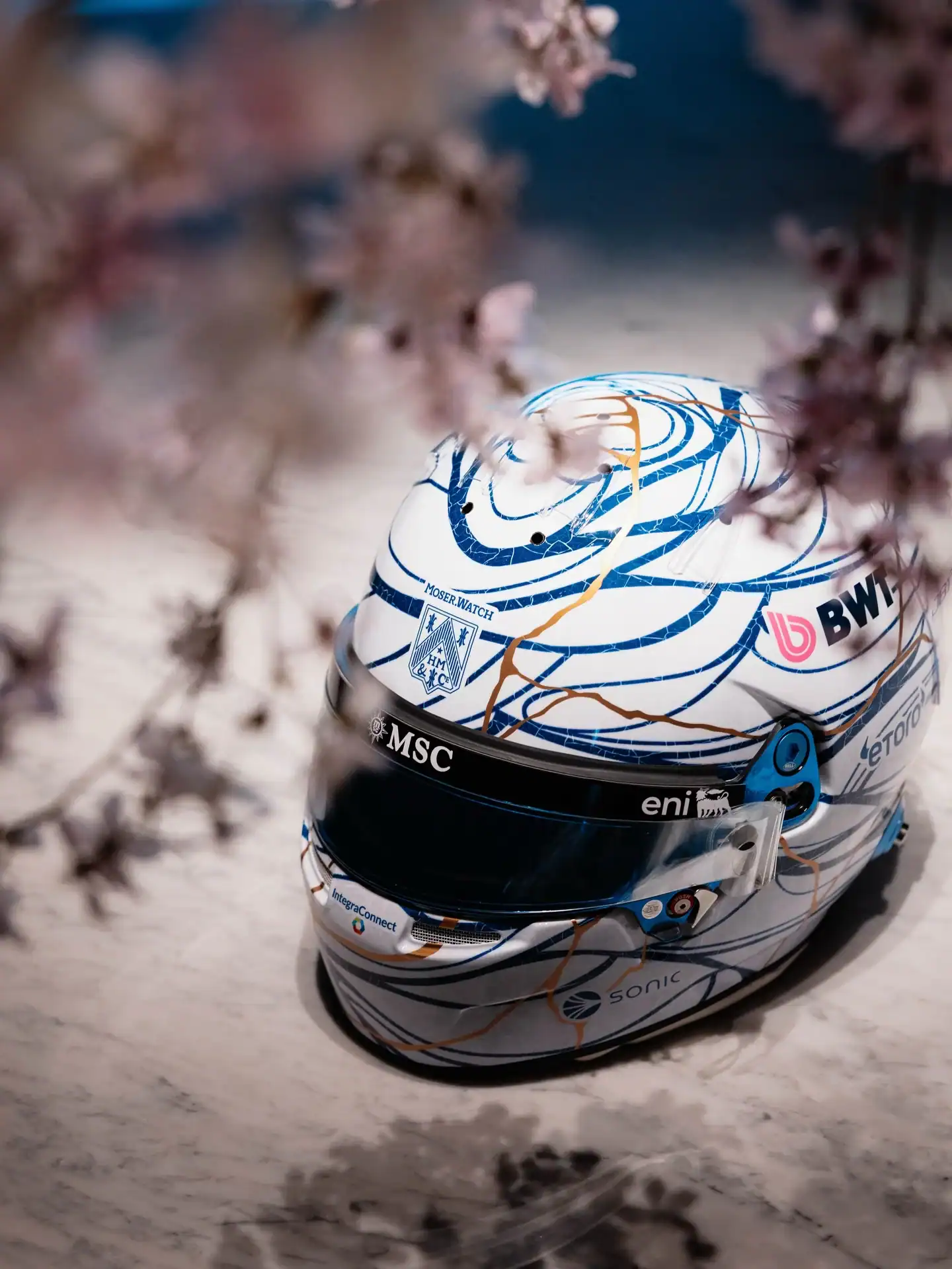
Pierre Gasly’s special kintsugi-inspired helmet for the 2026 Japanese Grand Prix at Suzuka. Image via Pierre Gasly / Instagram.
Quick Design Takeaway
Concept
Kintsugi — The Art of Golden Repair
Base Finish
White porcelain matte
Primary Pattern
Blue flowing crack lines
Signature Detail
Golden repair veins
Occasion
Japanese GP 2026 one-off
Fan Reception
117.4K likes in 24 hours
Where most Japanese GP specials rely on rising sun motifs or manga-style illustration, Gasly chose a quieter, more philosophical route. The kintsugi concept — repairing what is broken with precious metal rather than discarding it — transforms this helmet from graphic exercise into a statement about resilience and the beauty of imperfection. The result is visually arresting: a clean white shell that appears fractured and reconstructed, with veins of gold catching the light along every crack.
Visual Standouts
1
The Porcelain Base
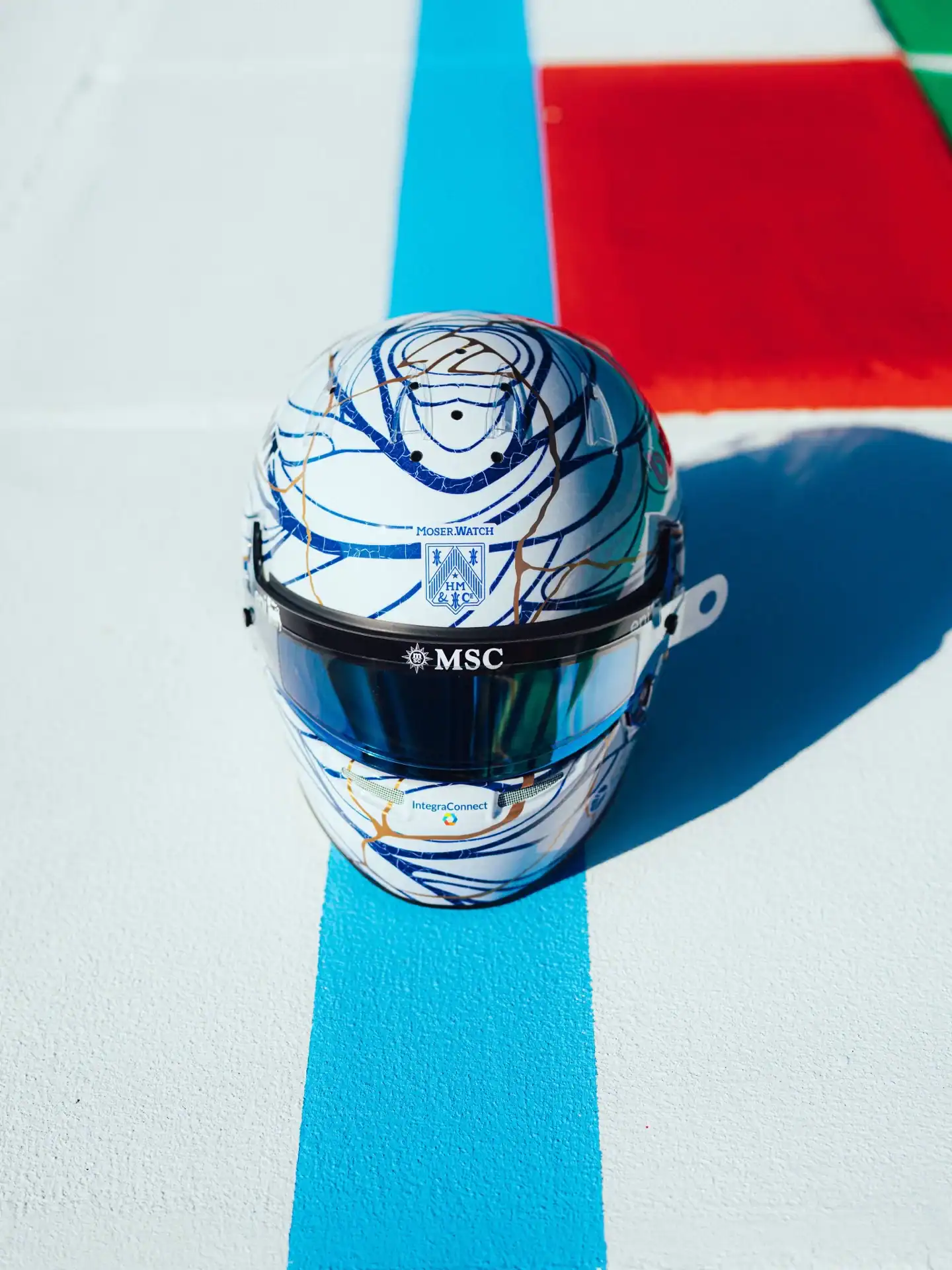
The helmet’s foundation is a luminous white that deliberately evokes fired ceramic — the starting material of all kintsugi work. Under track lighting and in the Suzuka photoshoots, the surface reads as smooth, delicate, and almost fragile, which is precisely the tension the design exploits. This is not a glossy racing white; it carries the muted warmth of traditional Japanese porcelain, creating a canvas that makes the fracture pattern all the more dramatic.
2
Blue Crack Network
Flowing across the white surface are deep blue lines — organic, asymmetric, and varied in width — that simulate the crack pattern of a broken vessel. The blue sits somewhere between cobalt and indigo, reminiscent of traditional Japanese aizome (indigo dyeing). These lines are not random: they converge toward the crown and fan outward across the sides, creating a sense of energy radiating from the top of the helmet. The visual effect is both chaotic and controlled, mirroring how real kintsugi cracks form along natural fault lines in the pottery.
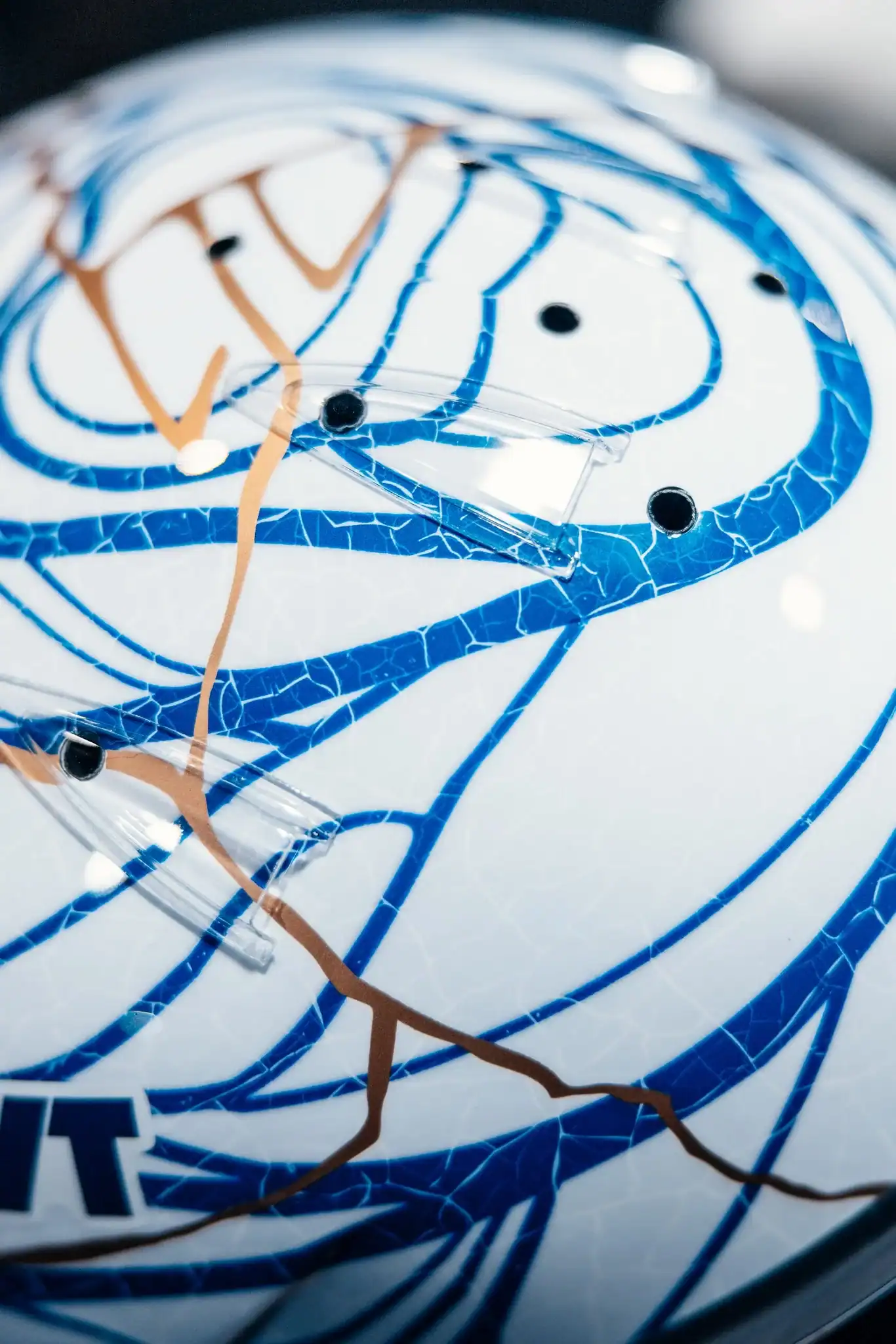
Macro detail: the gold repair veins trace along every blue fracture line, catching the light with metallic depth.
3
Golden Repair Veins
The element that elevates the entire design. Tracing along the blue fracture lines, metallic gold veins give the helmet its kintsugi signature — the sense that something once broken has been made more beautiful through repair. The gold has a warm, burnished quality rather than a flashy chrome finish, staying true to the lacquer-and-gold-dust technique used by kintsugi artisans. In the close-up photographs, the gold appears to sit slightly raised above the base surface, adding a textural dimension that flat paint simply cannot achieve.
4
Blue Visor Tint
The visor carries a blue-tinted finish that ties back to the crack pattern on the shell. When the visor is down, the blue creates a seamless visual bridge between the functional front aperture and the decorative shell — the entire helmet reads as one unified composition rather than a painted shell with a separate visor bolted on.
5
Crown Number 10
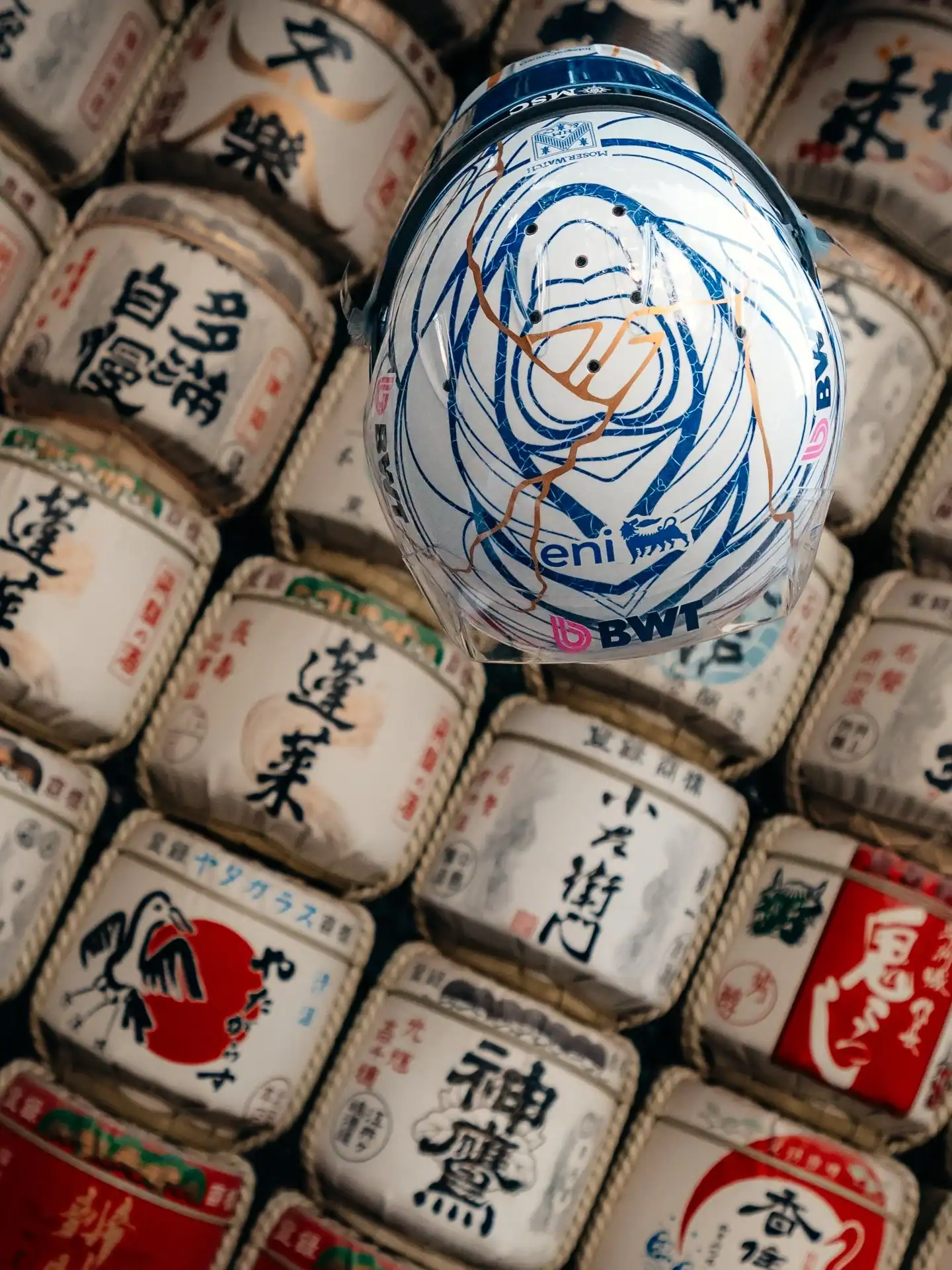
Gasly’s race number sits on the crown, integrated into the fracture network rather than floating above it. The number is visible in the overhead shots taken against the sake barrels at Suzuka, where it appears to be part of the ceramic piece itself — one more element bound together by gold.
Confirmed Design Elements
Driver
Pierre Gasly
Team
Alpine F1 Team
Race Number
#10
Event
Japanese Grand Prix 2026
Circuit
Suzuka Circuit, Japan
Edition
One-off special for the Japanese GP weekend
Revealed
March 25, 2026 — Instagram
Visible Sponsors
BWT, MSC, eni, eToro, Sonic
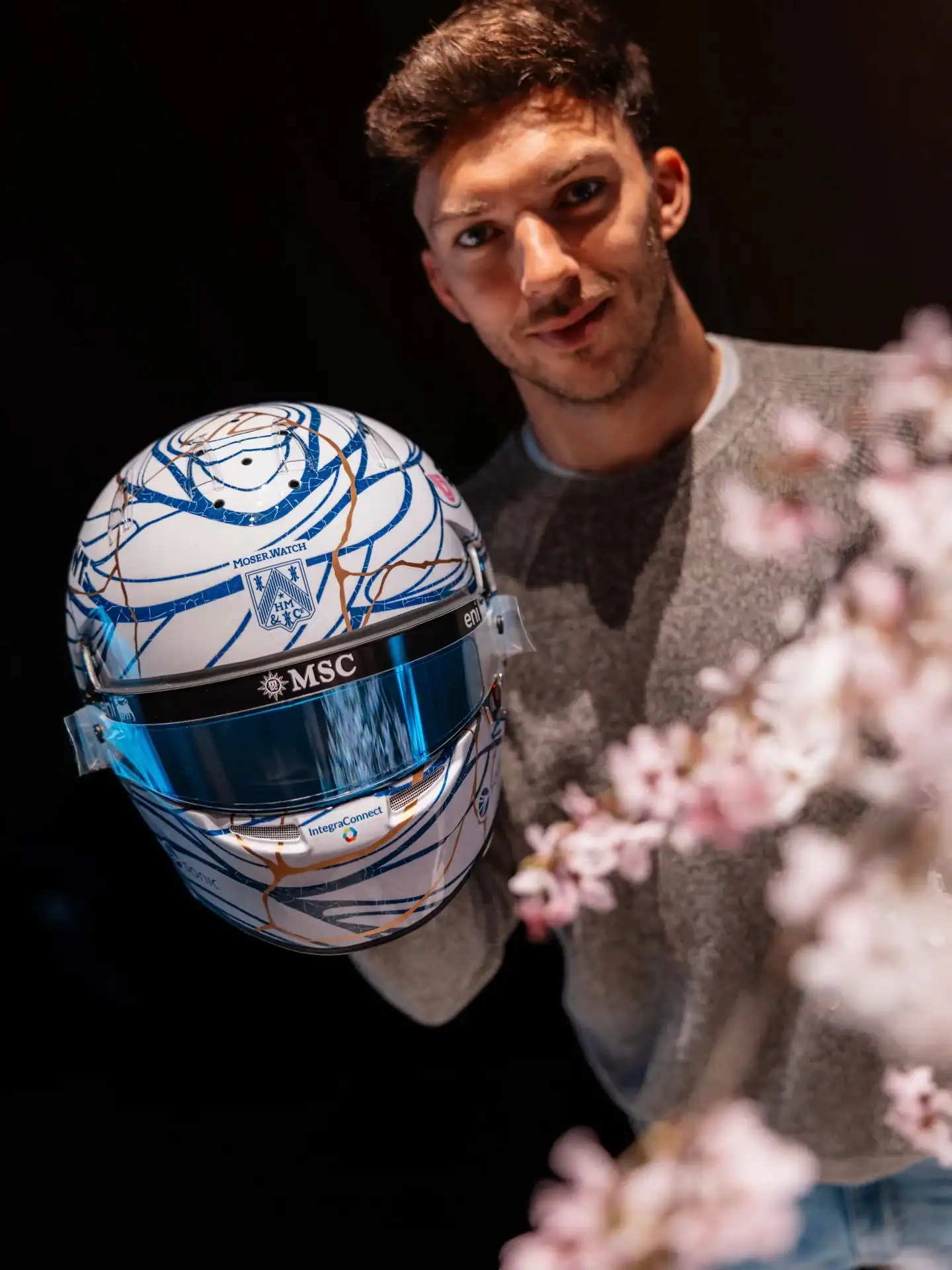
Pierre Gasly presents his Japanese GP 2026 helmet among cherry blossoms at Suzuka. Image via Pierre Gasly / Instagram.
“So pleased with my japanese helmet, inspired by kintsugi art! I wanted to bring some japanese culture into this year’s helmet as Japan is a country i truly admire and which means a lot to me. Kintsugi is the Japanese art of embracing imperfection. By repairing broken pottery with gold, it highlights the cracks rather than hiding them, symbolizing resilience, healing, and the beauty that can emerge through adversity.”
— Pierre Gasly, Instagram, March 25, 2026
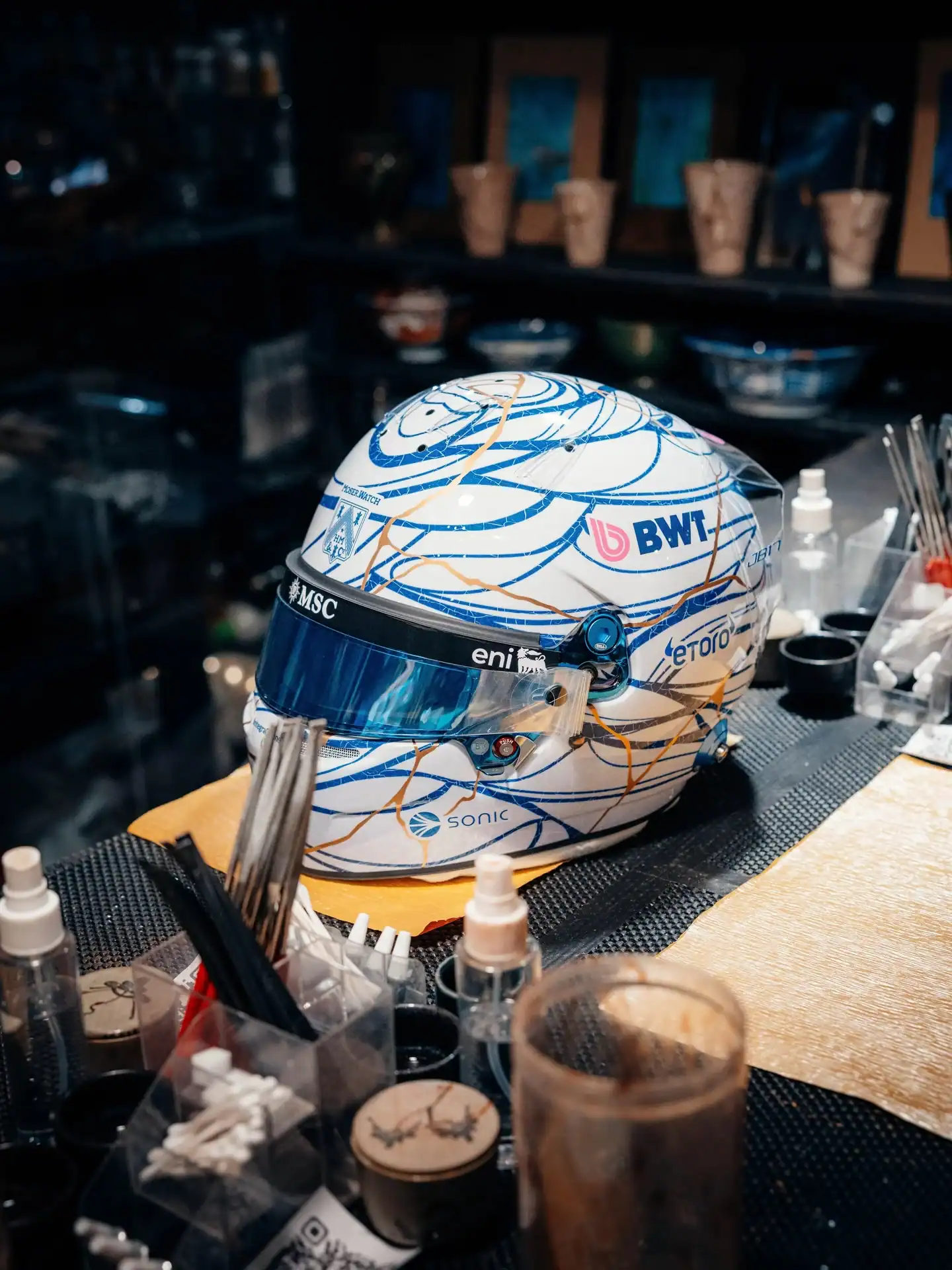
The reveal was accompanied by an elaborate photoshoot across multiple locations at Suzuka: Gasly posed with cherry blossoms in full bloom, the helmet was placed on Suzuka’s iconic kerbs for a front-on shot, photographed from above against rows of traditional sake barrels, and displayed inside what appears to be a kintsugi artisan’s workshop surrounded by traditional repair tools. The production quality signals a deep personal investment — this is not a last-minute decal swap but a design that was clearly planned well in advance and executed with genuine cultural care.
Overhead view of Gasly’s kintsugi helmet against traditional sake barrels at Suzuka — the crown number 10 visible amid the golden vein network.
The Collector Angle
Among the dozens of special-edition helmets revealed each season, Gasly’s kintsugi design stands out for what it does not do. There are no cartoon characters, no neon gradients, no pop-culture mashups. Instead, the design draws on a centuries-old Japanese philosophy and translates it into a helmet livery with genuine visual sophistication. That restraint — and the cultural depth behind it — is exactly what makes a design age well on a collector’s shelf.
Several factors make this design particularly interesting from a display perspective:
Cultural narrative. Kintsugi is one of the most recognizable and visually distinctive Japanese art forms. A display replica of this helmet becomes a conversation piece that bridges Formula 1 and Japanese craft heritage. It tells a story without needing a plaque beside it.
The white canvas effect. White-base helmets are consistently among the most visually striking under display lighting. The clean surface throws every detail — every blue crack, every gold vein — into sharp relief. Under a display case with even basic LED illumination, the gold veins will catch and refract light in a way that busier, darker designs simply cannot match.
One-off rarity. This is confirmed as a single-weekend special for the Japanese GP. Gasly will not run this design again at subsequent rounds, which gives it a time-stamped exclusivity — Suzuka 2026, and nowhere else.
Front view of the kintsugi helmet on the Suzuka kerbs. The blue visor, white shell, and gold accents form a strikingly cohesive composition.
Photoshoot depth. The elaborate multi-location reveal — cherry blossoms, sake barrels, circuit kerbs, artisan workshop — provides a rich visual archive that adds context and storytelling value to any display setup. Collectors increasingly value helmets with documented backstories, and Gasly delivered that in abundance.
Fan engagement as validation. Over 117,000 likes and nearly 300 comments within a single day, with Alpine’s official account among the first to react. Strong fan reception often correlates with long-term collector demand — the designs people remember are the ones they wanted at first sight.
For collectors who gravitate toward culturally informed, visually elegant designs rather than the loudest graphic on the shelf, this is a standout entry in the 2026 helmet season. See also our coverage of George Russell’s Chinese GP dragon helmet for another example of culture-forward F1 helmet design this year.
Color Palette
The kintsugi helmet operates on a deliberately restricted palette — three core colors, each carrying specific cultural weight.
Porcelain White
Indigo Blue
Kintsugi Gold
Visor Blue
Sponsor Black
The porcelain white is not a pure #fff but carries a warm, slightly cream undertone that evokes unfired clay. The indigo blue references traditional Japanese textile dyeing (aizome). The gold reads as warm and antique rather than metallic chrome — consistent with real urushi lacquer mixed with gold dust. The visor blue acts as a mid-tone bridge, while sponsor logos in black remain subordinate to the main composition.
The helmet displayed in a kintsugi workshop setting with traditional repair tools — a fitting backdrop for a design rooted in the art of golden repair.
Frequently Asked Questions
What is the design concept behind Pierre Gasly’s Japanese GP 2026 helmet?
The helmet is inspired by kintsugi, the Japanese art of repairing broken pottery with gold lacquer. The white porcelain base features blue flowing lines that represent cracks, traced by golden veins that symbolize repair and resilience. Gasly chose the concept as a tribute to Japanese culture and the philosophy that imperfection, when embraced, becomes a source of beauty.
Will Pierre Gasly use this helmet design at other races in 2026?
No. This is a one-off special edition created exclusively for the 2026 Japanese Grand Prix weekend at Suzuka. Gasly will revert to his standard Alpine livery helmet for subsequent rounds on the calendar.
What does kintsugi mean and why did Gasly choose it?
Kintsugi (literally “golden joinery”) is a centuries-old Japanese practice of mending broken pottery with lacquer mixed with powdered gold. Rather than disguising the damage, kintsugi highlights it — the repairs become part of the object’s history and beauty. Gasly stated that Japan is a country he “truly admires,” and he wanted the helmet to reflect Japanese culture’s embrace of resilience and the beauty that emerges through adversity.
What colors are on Gasly’s Japanese GP 2026 helmet?
The primary palette consists of a warm porcelain white base, deep indigo-blue flowing lines (representing cracks), and burnished gold veins (representing the kintsugi repair). The visor carries a blue tint that ties into the shell pattern, and sponsor elements appear in black. It is a deliberately restrained, three-color composition.
Where can I find display replicas of Pierre Gasly’s helmets?
Browse our Pierre Gasly collection for available full-size 1:1 display replicas. You can also explore our collector guide for advice on selecting, displaying, and caring for your replica helmets. All our products are display and collector replicas — not intended for any form of on-track or road use.
Collect the Design
If Gasly’s kintsugi helmet has caught your eye, explore our collection of full-size 1:1 Pierre Gasly display replicas — or browse the latest F1 helmet design stories for more collector-grade designs from the 2026 season.
To provide the best experiences, we use technologies like cookies to store and/or access device information. Consenting to these technologies will allow us to process data such as browsing behavior or unique IDs on this site. Not consenting or withdrawing consent, may adversely affect certain features and functions.
Functional
Always active
The technical storage or access is strictly necessary for the legitimate purpose of enabling the use of a specific service explicitly requested by the subscriber or user, or for the sole purpose of carrying out the transmission of a communication over an electronic communications network.
Preferences
The technical storage or access is necessary for the legitimate purpose of storing preferences that are not requested by the subscriber or user.
Statistics
The technical storage or access that is used exclusively for statistical purposes.The technical storage or access that is used exclusively for anonymous statistical purposes. Without a subpoena, voluntary compliance on the part of your Internet Service Provider, or additional records from a third party, information stored or retrieved for this purpose alone cannot usually be used to identify you.
Marketing
The technical storage or access is required to create user profiles to send advertising, or to track the user on a website or across several websites for similar marketing purposes.



 123Helmets Editorial Team