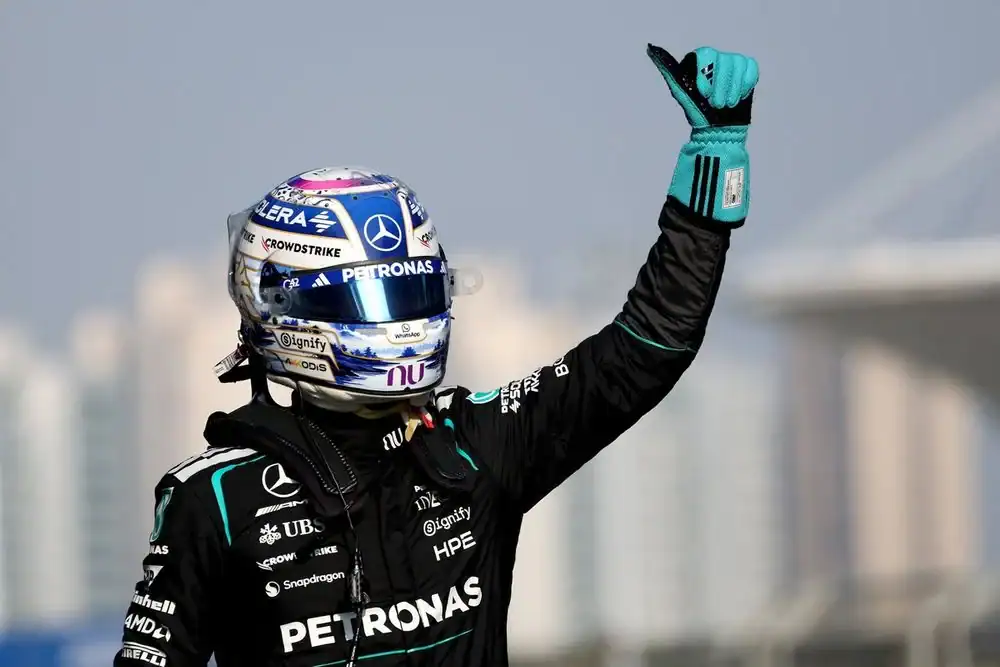
George Russell Channels ‘Tokyo Drift’ in Mercedes Japanese GP Promotional Shoot — What It Means for Collectors
Mercedes-AMG Petronas F1 staged one of the most visually striking pre-race promotional shoots of the 2024 calendar, sending George Russell through the streets of Japan in a recreation of the iconic ‘Tokyo Drift’ cinematic sequence. Beyond the spectacle, the campaign introduces a refined visual identity that carries direct implications for livery collectors and replica display enthusiasts tracking the evolution of Russell’s helmet and car graphics canon.
Key Takeaways
Mercedes deployed a cinematic ‘Tokyo Drift’ recreation with George Russell ahead of the Japanese GP, producing some of the most distinctive promotional imagery of the season.
The shoot unveiled subtle but meaningful updates to Mercedes’ Japanese GP visual identity, including locale-specific branding elements that distinguish this livery moment from standard race weekends.
For livery collectors, locale-specific promotional campaigns like this one represent a documented visual chapter in a driver’s helmet and livery history — highly sought in the collector-grade replica market.
No dedicated George Russell Japanese GP replica is currently listed in the 123Helmets collection, but the broader F1 replica catalogue offers premium full-size 1:1 display pieces for collectors building a livery-accurate archive.
The Setup: Why Mercedes Chose Tokyo Drift as Its Visual Language
When a works Formula 1 team invests in a location-specific promotional shoot, it rarely does so without layered strategic intent. Mercedes-AMG Petronas F1’s decision to frame George Russell’s Japanese GP content around the cultural touchstone of The Fast and the Furious: Tokyo Drift was a calculated act of brand storytelling — one that fuses the team’s German engineering prestige with the deep reverence Japanese automotive culture commands worldwide.
Japan occupies a singular position in motorsport geography. The Suzuka Circuit is considered by drivers, engineers, and fans alike as one of the sport’s most technically demanding and emotionally resonant venues. It is a race weekend that carries history in every chicane and every gravel trap. For Mercedes to anchor its pre-race content to this location, and to do so through the lens of one of cinema’s most iconic car-culture moments, is a statement of intent: this is not routine promotional material. This is a visual artefact.
Russell, seated low in a silver and black livery-matched vehicle, threading through rain-slicked Japanese streets illuminated by neon signage, produced imagery that immediately circulated beyond the standard F1 media ecosystem. Automotive communities, film enthusiasts, and street culture audiences all engaged — extending Mercedes’ reach far past the paddock’s traditional boundaries.
For collectors, this matters. Promotional shoots of this calibre produce reference imagery that becomes part of a driver’s official visual canon. Livery historians and replica collectors frequently cross-reference promotional campaigns when authenticating the graphic lineage of a particular helmet design or car livery chapter.
Livery Details: What Changed for Japan and Why It Matters
The Japanese Grand Prix has, in recent seasons, become a showcase for teams willing to deploy locale-specific livery accents. Mercedes’ approach in Suzuka has historically been restrained — the Silver Arrows identity is, by design, one of the sport’s most disciplined visual systems. Deviation, when it occurs, is therefore all the more significant.
For the 2024 Japanese GP campaign, Mercedes incorporated visual elements that nodded directly to Japanese aesthetic traditions. The promotional imagery captured Russell’s helmet in a configuration that reflected the ambient light and graphic language of the shoot’s urban Tokyo backdrop — a visual pairing that underscores how helmet design functions not merely as individual branding, but as a component in a broader, team-curated visual narrative.
Collectors who document livery evolution across a driver’s career understand that Japanese GP configurations — particularly those tied to major promotional campaigns — often represent limited-window visual states. A helmet graphic captured during a Tokyo Drift shoot exists in a specific, documentable moment: it is not the generic season livery, nor is it a one-off race-day special. It occupies a third category — the campaign livery state — that serious collectors treat as a distinct acquisition target.
The colour relationships between Russell’s helmet, the W15’s bodywork, and the urban environment chosen for the shoot create a cohesive visual document. Petrol teal accents against silver, framed by the saturated neon of urban Japan, produce a chromatic signature that any full-size 1:1 display replica aspiring to livery accuracy must capture with precision.
George Russell’s Helmet Design Evolution — A Collector Primer
George Russell’s helmet design journey from his Williams days to his tenure as a Mercedes works driver is a compelling study in how a driver’s visual identity scales with their competitive standing. At Williams, Russell’s helmet carried a deliberately personal graphic language — angular, high-contrast, and immediately legible at speed. The transition to Mercedes brought with it the expectation that his personal livery would negotiate with one of the sport’s most recognised team colour systems.
Russell has navigated this balance with notable skill. His current helmet retains personal identity markers — the asymmetric graphic structures and the deep blue and gold palette that reference his British roots and personal brand — while integrating cleanly with the Silver Arrows aesthetic. The result is a helmet that reads as distinctly his in still photography and broadcast footage alike.
For replica collectors, this design maturity translates directly into display value. A Russell helmet from his early Mercedes seasons captures a driver mid-ascent — competitive enough to challenge for race wins, established enough to carry a fully developed visual identity, but not yet at the canonical peak that tends to define a champion’s most collectible helmet designs. This is, historically, the window that produces the most interesting collector-grade pieces.
The Tokyo Drift shoot places Russell’s helmet design within a specific cultural and temporal context. Promotional imagery of this profile ensures that this particular visual state of his helmet — whatever its precise graphic configuration during this campaign — is preserved in high-resolution, widely distributed visual documentation. That is precisely the kind of reference material that informs collector-grade replica production and acquisition decisions.
The Collector Market Angle: When Promotional Campaigns Become Livery History
The collector-grade F1 helmet replica market operates on a clear hierarchy of documented moments. At the apex sit race-win helmets and championship-season designs. Below those, occupying a genuinely important middle tier, are the helmets associated with major promotional campaigns — the shoots, the unveilings, the cultural crossover moments that generate lasting visual documentation.
Mercedes’ Tokyo Drift campaign with Russell is, by any reasonable measure, a major promotional moment. The production values, the cultural reference point, the geographic specificity, and the driver profile all combine to ensure this imagery enters the long-term visual record of the 2024 season. Ten years from now, a collector assembling a comprehensive Russell display archive will reference this shoot as a key chapter.
This dynamic is not unique to Russell or to Mercedes. Lewis Hamilton’s multiple helmet special editions tied to cultural moments — from music industry collaborations to heritage race events — have consistently commanded collector attention precisely because they are documented, culturally embedded, and visually distinct. Russell is now building a similar archive of culturally resonant visual moments, and the Tokyo Drift campaign represents a meaningful entry in that record.
Full-size 1:1 display replicas that aspire to collector-grade authenticity must therefore engage seriously with the visual language of campaigns like this one. A replica that captures the precise graphic relationships visible in the Tokyo Drift shoot — the helmet’s colour relationships, the Mercedes branding geometry, the ambient visual context of the campaign — is a more complete collector document than a generic season representation.
For collectors operating at the premium end of the market, this level of specificity is not pedantry. It is the difference between a display piece that tells a precise story and one that offers only a general approximation. The former appreciates in perceived and market value. The latter does not.
Mercedes’ Visual Identity System and Its Implications for Display Collections
Mercedes-AMG Petronas F1 operates one of the most disciplined visual identity systems in the sport. The Silver Arrows palette — evolved from the legendary pre-war silver racing machines — is not merely a colour choice. It is a heritage statement, maintained through decades of competition and communicated through every graphic touchpoint the team controls, from car livery to driver helmets to hospitality design.
When Mercedes deviates from that system — even fractionally, even temporarily — the deviation carries weight. The Japanese GP campaign’s incorporation of locale-specific visual elements and the high-saturation neon urban environment of the Tokyo Drift shoot represents exactly this kind of calibrated deviation. It is not an abandonment of the Silver Arrows identity; it is an enrichment of it, achieved through careful contextualisation.
For display collectors, the Mercedes visual system presents a specific curation challenge. Because the team’s identity is so consistent, the moments of genuine visual variation — special liveries, campaign-specific graphic updates, locale-responsive design choices — become the most collectable chapters. A comprehensive Mercedes display collection is not simply a timeline of silver helmets. It is a record of the moments when the system expanded, adapted, or responded to a specific cultural moment.
The Tokyo Drift campaign is one such moment. Russell’s helmet, photographed against the visual backdrop of urban Japan, forms part of a specific chapter in Mercedes’ 2024 visual narrative. Collectors who document their acquisitions with reference to promotional campaigns — rather than simply race rounds — build more historically accurate and narratively compelling display archives.
This is the collector methodology that separates a display collection from a mere accumulation of objects. Context, documentation, and visual specificity are the variables that determine long-term collector value — and the Mercedes Japanese GP campaign provides all three in abundance.
Acquisition Strategy: Building a Russell Display Archive in 2024
For collectors actively building a George Russell display archive, the 2024 season represents a strategically significant acquisition window. Russell is entering the phase of his career where competitive results and cultural visibility are both increasing simultaneously — the precise condition that, historically, precedes the most significant appreciation in collector interest for a driver’s replica pieces.
The Tokyo Drift campaign accelerates this dynamic. Cultural crossover moments — where an F1 driver’s presence extends meaningfully beyond the sport’s core audience — tend to act as inflection points for collector demand. When a new audience discovers a driver through a cinematic, high-production promotional campaign, a proportion of that audience inevitably enters the collector ecosystem. Supply of exhibition-quality pieces rarely scales as quickly as that new demand.
Collectors approaching this moment strategically should consider several factors. First, visual specificity: does a given display piece accurately represent the graphic language of Russell’s 2024 Mercedes livery, including the design relationships documented in the Japanese GP campaign? Second, production quality: does the replica demonstrate the display-quality craftsmanship and visual fidelity that collector-grade full-size 1:1 pieces demand? Third, documentary completeness: is the piece accompanied by sufficient reference documentation to place it accurately within Russell’s livery history?
At 123Helmets, the curatorial standard for full-size 1:1 display replicas addresses all three dimensions. Every piece in the collection is evaluated against the documented visual record of the driver’s livery history, produced to exhibition-quality standards, and presented with the contextual information that serious collectors require. While a dedicated Russell Japanese GP piece is not currently listed, the broader F1 collection offers collector-grade display pieces across the sport’s most significant drivers and visual moments.
The Tokyo Drift campaign is a reminder that F1’s visual history is being written in real time — and that the collectors who document it most precisely will, ultimately, hold the most complete and valuable archives.
“Japan is a very special place for Formula 1. Every detail of this campaign was designed to reflect that — the visual language, the location, the energy. It was something different.”
— George Russell, Mercedes-AMG Petronas F1 (reported)
“When a team of Mercedes’ calibre invests in a campaign of this production quality, it becomes part of the documented visual record of the season. That is exactly what serious collectors need.”
— 123Helmets Editorial Team
FAQ
Q: What is the significance of the Mercedes Tokyo Drift shoot for F1 collectors? The campaign produces high-resolution, widely distributed visual documentation of George Russell’s helmet and Mercedes livery in a specific cultural and geographic context — precisely the kind of documented moment that collector-grade replica archives are built around. Locale-specific promotional campaigns represent a distinct visual chapter in a driver’s livery history, separate from standard race-weekend documentation.
Q: Does 123Helmets offer a George Russell Japanese GP display replica? A dedicated George Russell Japanese GP replica is not currently listed in the 123Helmets collection. However, the broader F1 display replica catalogue features exhibition-quality, full-size 1:1 collector pieces across the sport’s most significant drivers and visual moments. We recommend browsing the full collection for current availability.
Q: How do promotional campaign liveries differ from race-day liveries in the collector market? Promotional campaign liveries occupy a distinct category between standard season liveries and one-off race-day specials. They are documented in high-production visual material, tied to a specific cultural moment, and often feature graphic relationships not replicated elsewhere in the season. Serious collectors treat campaign-specific visual states as separate acquisition targets within a driver’s livery archive.
Q: Why is the 2024 season considered a strategically significant acquisition window for Russell collector pieces? Russell is in the phase of his career where competitive results and cultural visibility are increasing simultaneously — historically the condition that precedes the most significant appreciation in collector interest for a driver’s display pieces. Cultural crossover moments, like the Tokyo Drift campaign, tend to act as inflection points that bring new audiences into the collector ecosystem, increasing demand ahead of supply.
Q: What should collectors look for in a full-size 1:1 Russell display replica? Collector-grade Russell replicas should demonstrate accurate representation of his 2024 Mercedes graphic language — including the design relationships between his personal helmet palette and the Silver Arrows identity system — alongside exhibition-quality craftsmanship, precise visual fidelity to documented livery states, and sufficient reference documentation to place the piece accurately within his livery history.
To provide the best experiences, we use technologies like cookies to store and/or access device information. Consenting to these technologies will allow us to process data such as browsing behavior or unique IDs on this site. Not consenting or withdrawing consent, may adversely affect certain features and functions.
Functional
Always active
The technical storage or access is strictly necessary for the legitimate purpose of enabling the use of a specific service explicitly requested by the subscriber or user, or for the sole purpose of carrying out the transmission of a communication over an electronic communications network.
Preferences
The technical storage or access is necessary for the legitimate purpose of storing preferences that are not requested by the subscriber or user.
Statistics
The technical storage or access that is used exclusively for statistical purposes.The technical storage or access that is used exclusively for anonymous statistical purposes. Without a subpoena, voluntary compliance on the part of your Internet Service Provider, or additional records from a third party, information stored or retrieved for this purpose alone cannot usually be used to identify you.
Marketing
The technical storage or access is required to create user profiles to send advertising, or to track the user on a website or across several websites for similar marketing purposes.



 123Helmets Editorial Team