Antonelli Conquers Suzuka: The 2026 Japanese Grand Prix and What It Means for the Collector Market
Kimi Antonelli delivered a masterclass at Suzuka’s Cathedral of Speed, converting a dominant Mercedes performance into his most significant Grand Prix victory of the 2026 season. With Oscar Piastri threading a composed second place for McLaren and Charles Leclerc adding Maranello pride at third, the Japanese Grand Prix produced a podium of extraordinary collector significance — three of the sport’s most celebrated liveries and helmet canvases united on the Suzuka rostrum.
Kimi Antonelli lifts the winner’s trophy on the Suzuka podium — 2026 Japanese Grand Prix
Key Takeaways
Kimi Antonelli’s Suzuka victory cements his status as the defining young talent of the 2026 season, elevating his helmet livery to must-acquire collector territory.
The Piastri–Leclerc–Russell podium grouping represents three of the most visually distinct helmet designs on the 2026 grid, making this race a landmark moment for display-focused collectors.
Oliver Bearman’s high-profile incident at Suzuka adds dramatic race-day narrative to any 2026 Japanese GP commemorative display, underscoring the event’s historical weight.
With championship implications sharpening after Suzuka, 2026 race-specific replica helmets tied to this result are positioned to appreciate significantly in collector value over the coming seasons.
Suzuka Delivers: The Race That Rewrote the 2026 Narrative
There are Grand Prix circuits that merely host history, and then there is Suzuka — a track that manufactures legend with the precision of its own esses and spoon curve. The 2026 Japanese Grand Prix added another luminous chapter to that tradition when Kimi Antonelli, the young Italian prodigy at the heart of Mercedes’ ambitious rebuild, crossed the finish line first to claim what many paddock observers are already calling the most complete victory of his embryonic Formula 1 career.
From the moment lights went out on Sunday, Antonelli’s silver machine moved with a fluency that recalled the golden era of Mercedes dominance. The pace was not merely fast — it was controlled, metronomic and imperious. Suzuka’s technical complexities, from the compression at Degner to the high-speed demands of 130R, appeared to play entirely into the hands of the W16’s underlying architecture, and Antonelli exploited every advantage with a maturity that belied his age.
For the collector community, moments like these carry weight beyond the sporting result. A first Suzuka win is a permanent entry in the historical register — and the helmet that sat atop the rostrum on that Japanese Sunday afternoon becomes, from this moment forward, a display piece of genuine significance.
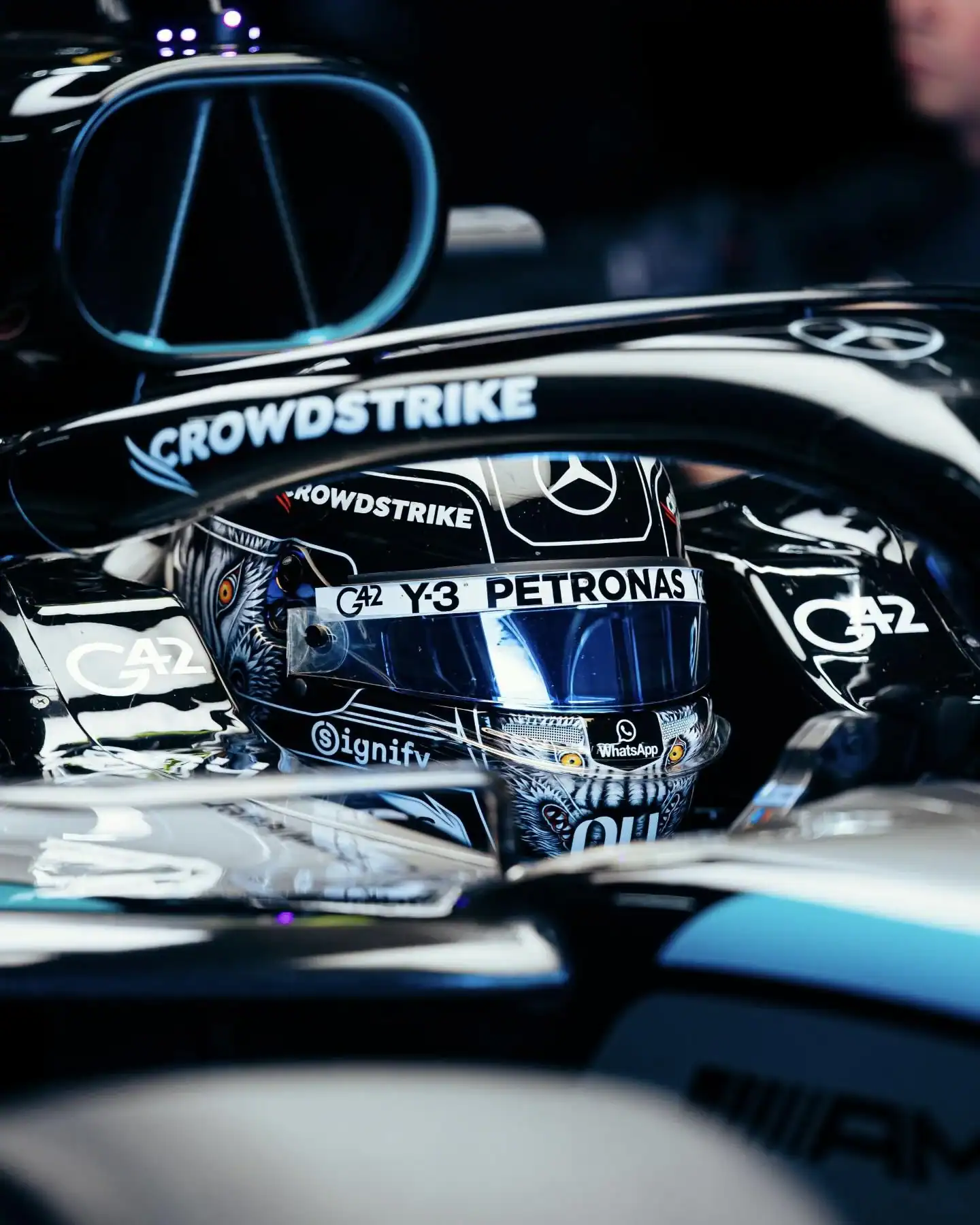
Antonelli in the Mercedes W17 cockpit at Suzuka
The Podium Canvas: Three Helmets, Three Stories
A Grand Prix podium is, at its finest, a gallery of design excellence — and the Suzuka rostrum delivered precisely that. Kimi Antonelli’s Mercedes-affiliated helmet livery, with its characteristically precise graphic architecture and carefully evolved personal iconography, stood at the summit in P1. For collectors who track livery evolution across a driver’s career, this specific 2026 Japanese GP iteration represents a pivotal chapter: the season in which Antonelli transitioned from celebrated prospect to bona fide race winner at one of the sport’s most storied venues.
Oscar Piastri’s second-place finish maintained his remarkable consistency across the 2026 campaign. The Australian’s helmet design has matured with considerable refinement this season — the McLaren papaya and chrome relationship expressed with greater confidence in Piastri’s personal graphic language than in any prior year. A Suzuka P2 for a driver firmly in the championship conversation renders this livery moment one of the most display-worthy of his still-ascending career arc.
Charles Leclerc completed the podium in third, and with it delivered the kind of Scuderia Ferrari result that the tifosi had desperately needed following a complicated mid-season stretch. Leclerc’s helmet design tradition — rooted in a visual vocabulary that draws from Monégasque heritage and Maranello’s scarlet identity — produced, in its 2026 Japanese iteration, a display-quality composition of exceptional visual authority. Three podium finishers, three helmet narratives of genuine collector resonance.
Russell and Bearman: Subplots That Sharpen the Collector Story
George Russell’s fourth-place finish at Suzuka occupied the precise space that collector history often overlooks in the immediate aftermath — yet the long view rewards attention here. Russell, operating as Antonelli’s senior Mercedes partner, drove a measured and strategically sound race to bring home valuable constructor points. His 2026 helmet livery, which continues to develop a personal graphic sophistication that distinguishes it from earlier iterations in his Mercedes tenure, earned another race-day chapter worthy of display consideration.
The day’s most dramatic subplot, however, belonged to Oliver Bearman. The young British driver’s high-profile crash injected the visceral unpredictability that defines Suzuka’s reputation into proceedings with considerable force. Incidents of this magnitude — particularly those involving drivers at a critical development juncture in their careers — invariably attract collector scrutiny in retrospect. The 2026 Japanese Grand Prix will be remembered, in part, as Bearman’s Suzuka moment, and replica helmets tied to his 2026 livery carry that narrative weight accordingly.
From a display perspective, the richness of this race’s cast of characters is exceptional. Suzuka 2026 was not a processional afternoon of limited dramatic value — it was a Grand Prix dense with implication, incident and achievement, and any collector display anchored to this event speaks to a moment of genuine sporting complexity.
Antonelli’s Arc: Why This Victory Changes the Collector Calculus
In the collector market for Formula 1 replica helmets, the moment of breakout victory is singular. It is the inflection point at which a driver transitions from promising acquisition to essential collection piece — the moment when demand begins to structurally outpace casual interest. Kimi Antonelli’s Suzuka victory is, by any reasonable analysis, that inflection point.
Consider the precedents. When young drivers of comparable talent profile — those who arrived at top-tier teams with expectation-laden fanfare and ultimately delivered on that promise — first won at iconic venues, the collector appetite for their liveries underwent a permanent upward revaluation. Suzuka is not merely an iconic venue in the generic sense. It is the circuit that the purist community within Formula 1 regards as the sport’s most demanding and beautiful examination. A first win there carries a specific and durable prestige.
Antonelli’s helmet design in 2026 has evolved across the season with deliberate intention. The graphic language references his Italian heritage while operating within the broader Mercedes visual ecosystem — a combination that produces display pieces of genuine compositional balance. The 2026 Japanese Grand Prix variant, now permanently associated with his Suzuka breakthrough, represents the edition that collectors of discernment will seek most actively as the season concludes and reflection on its defining moments begins.
Full-size 1:1 replica helmets that capture a driver at precisely this moment in their career — the breakthrough race, the circuit of maximum prestige, the season of emergence — are the pieces that collector retrospectives return to with the greatest frequency. Suzuka 2026 and the Antonelli helmet are now, irrevocably, part of that conversation.
Championship Implications and the Collector Horizon
A Grand Prix result does not exist in isolation. It reverberates through the championship standings, reshapes the competitive narrative and — for the collector community — determines which liveries and which race-specific display pieces will command the most attention when the season reaches its conclusion. Suzuka 2026 was precisely this kind of result: a race that moved the needle with meaningful force.
Antonelli’s victory tightens the championship picture around a small group of drivers whose helmets are consequently elevated to maximum collector relevance. Piastri’s P2 maintains his proximity to the summit. Leclerc’s P3, arriving for Ferrari at a circuit where Maranello’s recent record has been complicated, injects renewed credibility into the Scuderia’s season narrative. Each of these results compounds the display significance of the helmets worn by their principals on that Sunday afternoon at Suzuka.
For the collector who approaches the 2026 season with strategic intent, the Japanese Grand Prix represents a natural focal point. The race produced a podium of high individual prestige, a mid-field result of championship relevance from Russell, a dramatic incident involving Bearman, and — above all — a breakthrough victory by the driver most likely to define the sport’s next era. Exhibition-quality full-size 1:1 replica helmets associated with this result occupy a uniquely advantageous position in any collector portfolio constructed with the long view in mind.
Displaying Suzuka 2026: A Collector’s Framework
The acquisition of a collector-grade full-size 1:1 replica helmet is, at its most considered, an act of curation. The collector is not simply acquiring an object — they are acquiring a narrative node, a point at which the visual and historical dimensions of Formula 1 intersect in a specific and unrepeatable form. The 2026 Japanese Grand Prix offers an unusually rich set of such nodes.
A display centred on the Antonelli Suzuka victory helmet invites contextual companions: the Piastri P2 livery that captured McLaren’s 2026 design evolution at its most refined; the Leclerc P3 piece that represents Ferrari’s Suzuka comeback chapter; the Russell P4 helmet from a Grand Prix in which the Briton’s composure under team-mate pressure was quietly remarkable. Together, these form a Suzuka 2026 display of considerable depth and visual authority.
Exhibition-quality display solutions — purpose-built stands, low-UV presentation cases, climate-considered positioning — transform these full-size 1:1 replica helmets from individual acquisitions into a curated installation that honours the depth of the event they commemorate. The 2026 Japanese Grand Prix deserves nothing less. Suzuka, and the extraordinary afternoon of racing it delivered, has earned its place in the collector record.
“Suzuka has a way of revealing the absolute truth about a driver. What Antonelli showed there was not a lucky win — it was a statement of absolute quality.”
— 123Helmets Editorial Team
“The podium at the 2026 Japanese Grand Prix represents three of the most collectible livery moments of the entire season, concentrated in a single result.”
— 123Helmets Editorial Team
FAQ
Q: Why is the 2026 Japanese Grand Prix considered a significant event for F1 helmet collectors? The 2026 Japanese Grand Prix produced a podium of exceptional collector significance: Kimi Antonelli’s breakthrough Suzuka victory for Mercedes, Oscar Piastri’s composed P2 for McLaren, and Charles Leclerc’s Ferrari P3. Combined with George Russell’s P4 and Oliver Bearman’s high-profile incident, the race delivered a narrative of extraordinary depth. Full-size 1:1 replica helmets associated with events of this density tend to command enduring collector interest precisely because the race itself occupies a prominent position in the seasonal historical record.
Q: What makes Kimi Antonelli’s Suzuka victory helmet particularly collectible? A first victory at Suzuka — one of Formula 1’s most demanding and historically revered circuits — is a permanent entry in any driver’s career register. For Antonelli, Suzuka 2026 represents the definitive breakthrough moment of his early career, the race at which casual interest in his livery converts to serious collector demand. Full-size 1:1 replica helmets representing breakthrough victories at iconic venues consistently demonstrate the strongest long-term collector trajectory, making the 2026 Suzuka Antonelli edition a display piece of primary significance.
Q: Are there currently specific Antonelli helmet replicas available on 123Helmets.com? Our collection is continuously expanding to reflect the most significant moments of the current Formula 1 season. While specific Antonelli editions may not yet be listed, we encourage collectors to browse our full F1 helmet collection for the latest additions and to monitor new arrivals as we respond to the season’s most defining results.
Q: How should a collector display a Suzuka 2026-themed helmet grouping? A Suzuka 2026 display is best approached as a curated ensemble rather than a single-piece acquisition. The Antonelli victory helmet serves as the natural centrepiece, with companion pieces from Piastri, Leclerc and Russell providing narrative context. Exhibition-quality display stands and low-UV presentation cases preserve the visual fidelity of each full-size 1:1 replica while creating a coherent installation that communicates the depth and drama of this specific Grand Prix result.
Q: Does Oliver Bearman’s crash at Suzuka 2026 add collector relevance to his 2026 livery replicas? Dramatic race-day incidents — particularly those involving drivers at critical career junctures — invariably add narrative weight to livery replicas associated with the event. Bearman’s Suzuka incident is now part of the 2026 Japanese Grand Prix’s permanent story, and display pieces referencing his 2026 livery carry that chapter of the narrative with them. Collectors who take the long view on driver trajectories frequently prioritise early-career liveries associated with high-profile moments, making Bearman’s 2026 editions worthy of serious consideration.
To provide the best experiences, we use technologies like cookies to store and/or access device information. Consenting to these technologies will allow us to process data such as browsing behavior or unique IDs on this site. Not consenting or withdrawing consent, may adversely affect certain features and functions.
Functional
Always active
The technical storage or access is strictly necessary for the legitimate purpose of enabling the use of a specific service explicitly requested by the subscriber or user, or for the sole purpose of carrying out the transmission of a communication over an electronic communications network.
Preferences
The technical storage or access is necessary for the legitimate purpose of storing preferences that are not requested by the subscriber or user.
Statistics
The technical storage or access that is used exclusively for statistical purposes.The technical storage or access that is used exclusively for anonymous statistical purposes. Without a subpoena, voluntary compliance on the part of your Internet Service Provider, or additional records from a third party, information stored or retrieved for this purpose alone cannot usually be used to identify you.
Marketing
The technical storage or access is required to create user profiles to send advertising, or to track the user on a website or across several websites for similar marketing purposes.



 123Helmets Editorial Team