Blog
Valtteri Bottas’s ‘Nigel the Badger’ Cadillac Helmet for Monaco 2026: A Collector’s Visual Study
 123Helmets Editorial Team
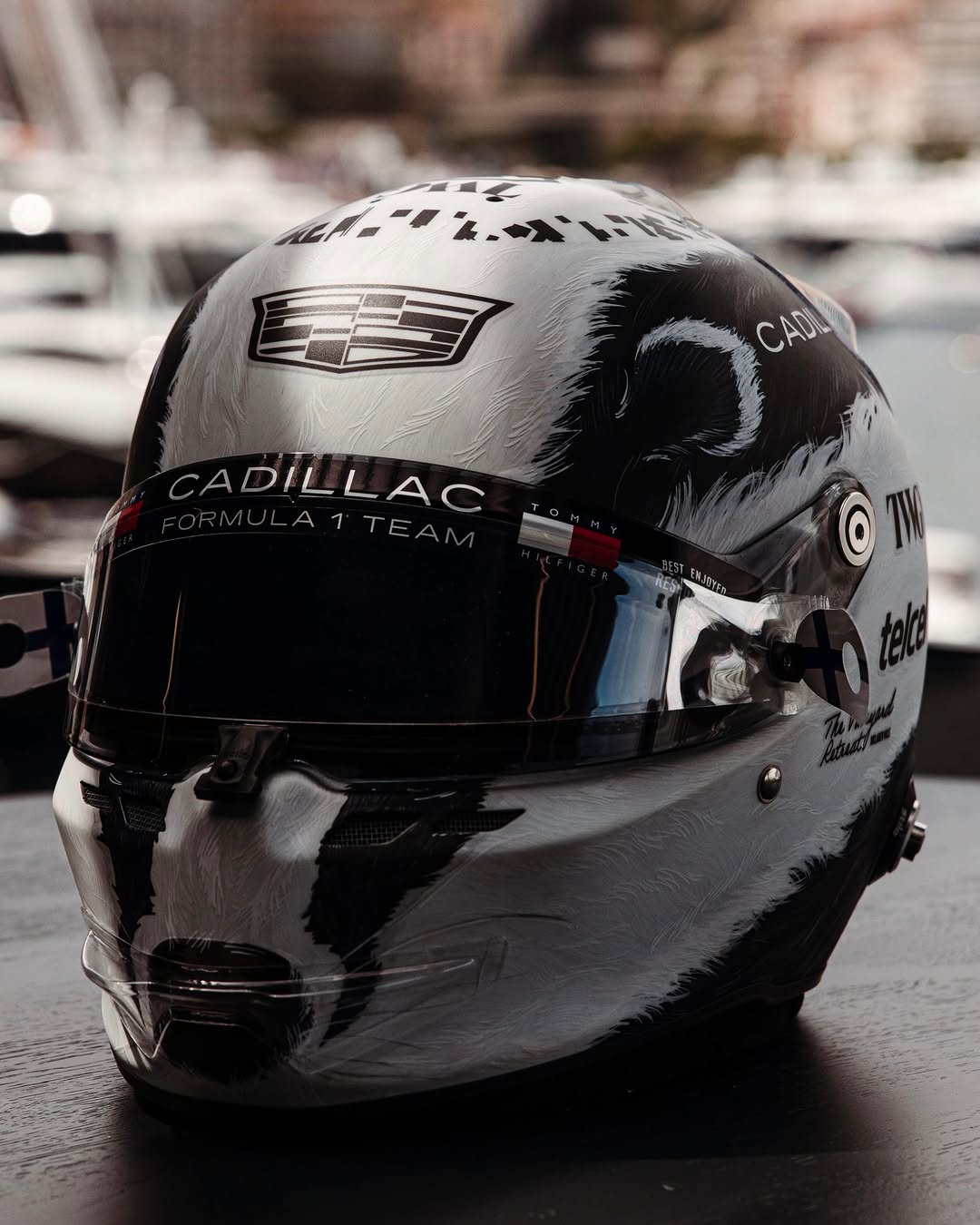
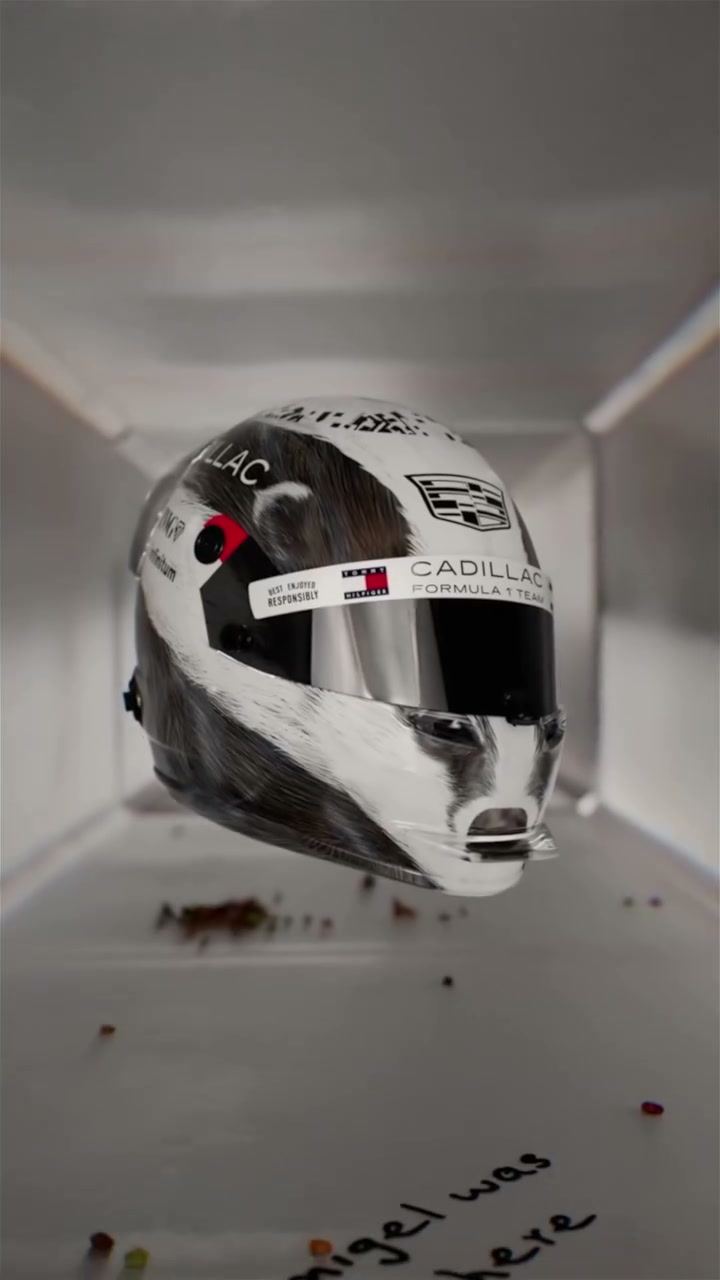
For the Cadillac Formula 1 Monaco debut on 7 June 2026, Valtteri Bottas pulls on a white-and-black Stilo shell wearing the face of ‘Nigel the badger’ — a one-off design by Tiffany Cromwell that turns the Finn’s long-running pet-persona joke into a full-size 1:1 collector centrepiece.
Key Takeaways
The helmet is a one-off Stilo shell finished in white and black for the 2026 Monaco Grand Prix on 7 June 2026.
Designer Tiffany Cromwell built the ‘Nigel the badger’ artwork around Bottas’s pet-persona joke, not around standard sponsor blocking.
Only three external identifiers appear: race number 77, the Cadillac crest and the Finnish flag.
As a display piece, the full-size 1:1 replica reads as a collector item first and a graphic design study second.
A Monaco one-off built around an inside joke
Most special helmets at the Monaco Grand Prix lean on the obvious: gold leaf, casino chips, princely crests. For 7 June 2026, Valtteri Bottas does the opposite. The Cadillac Formula 1 driver arrives in the Principality with a lid that puts a cartoon badger where a sponsor wall would normally sit, and treats the rest of the shell as a quiet white-and-black canvas.
The design is by Tiffany Cromwell, the Australian professional cyclist and Bottas’s long-time partner, who has handled several of his personal off-season visual projects. For this Monaco one-off she has worked directly with the Stilo shell shape, mapping the badger artwork to the crown, sides and chin so the character reads cleanly from every camera angle a Monaco weekend produces.
For collectors, this matters. A helmet built for one race only, on a brand-new team’s first appearance on the Monaco grid, with artwork tied to a personal joke rather than a commercial brief, sits in a very specific category of display piece: the unrepeatable livery. The full-size 1:1 replica format is the only practical way to study it at home, because the original will be retired after a single race weekend.
Why ‘Nigel’
The badger character is not new. Bottas has joked for several seasons about owning a pet badger called Nigel, a running gag that started as a social-media bit and has since spawned merchandise, charity calendars and cameo appearances on race-week graphics. Putting Nigel on the Monaco helmet is less a marketing decision than a continuation of that bit into the most photographed weekend of the season.
The shell, the finish and the white-black split
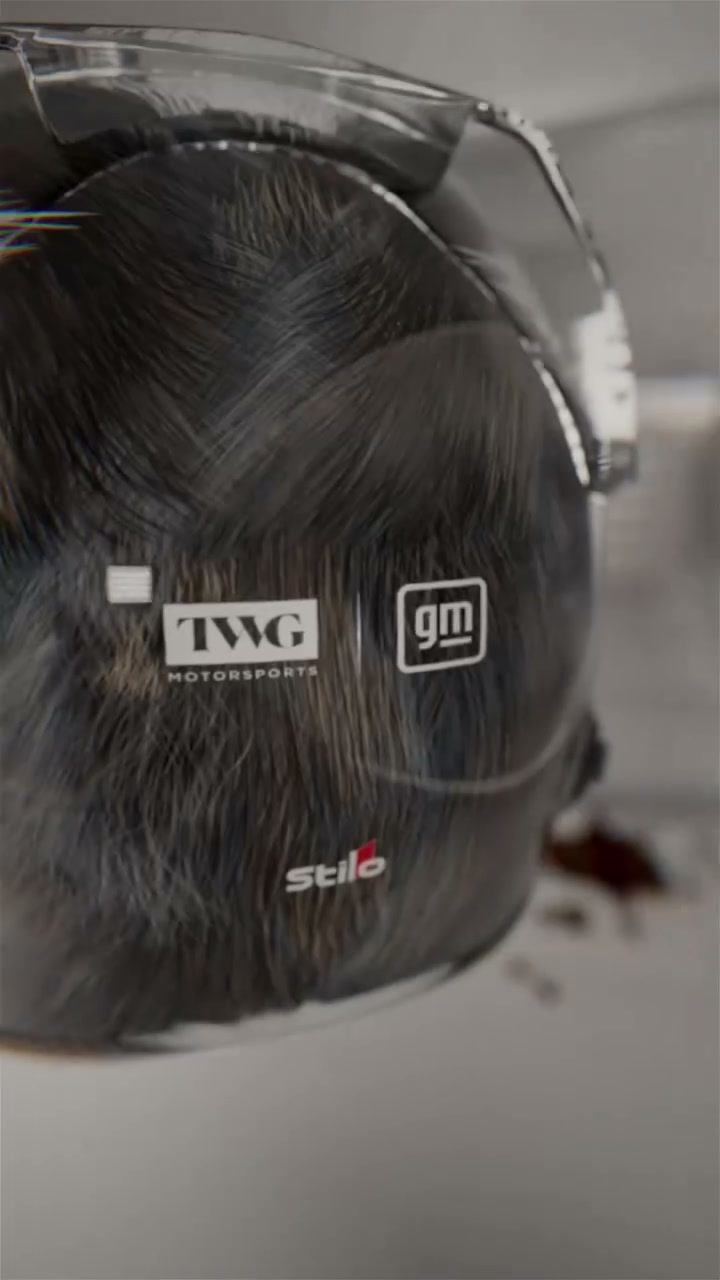
The base is a Stilo shell, the Italian-made shape Bottas has used through his recent F1 seasons. For the collector studying a 1:1 replica, the Stilo silhouette is recognisable from the sharper aero step above the visor and the more compact rear spoiler profile compared with the rival Bell shells worn elsewhere on the grid.
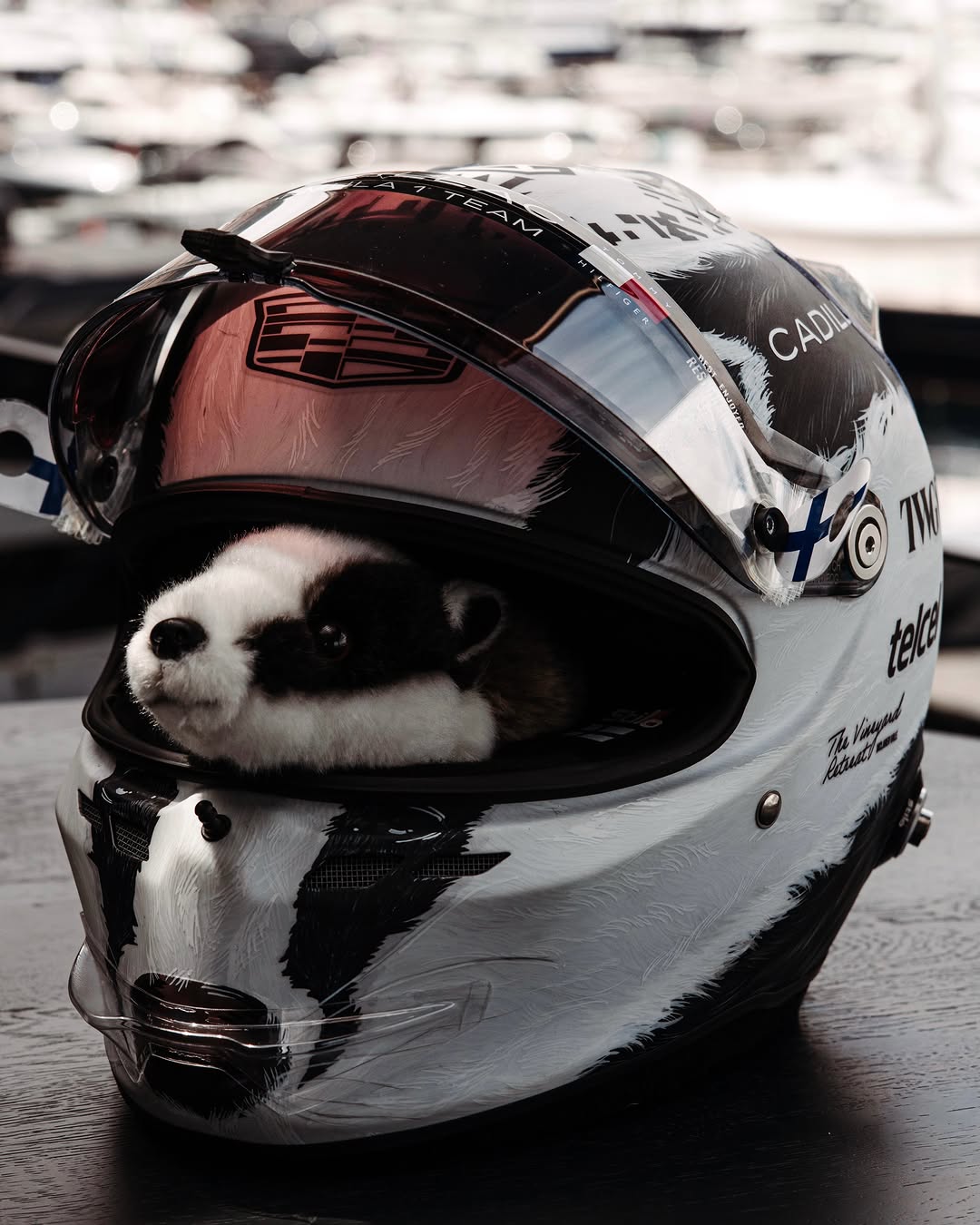
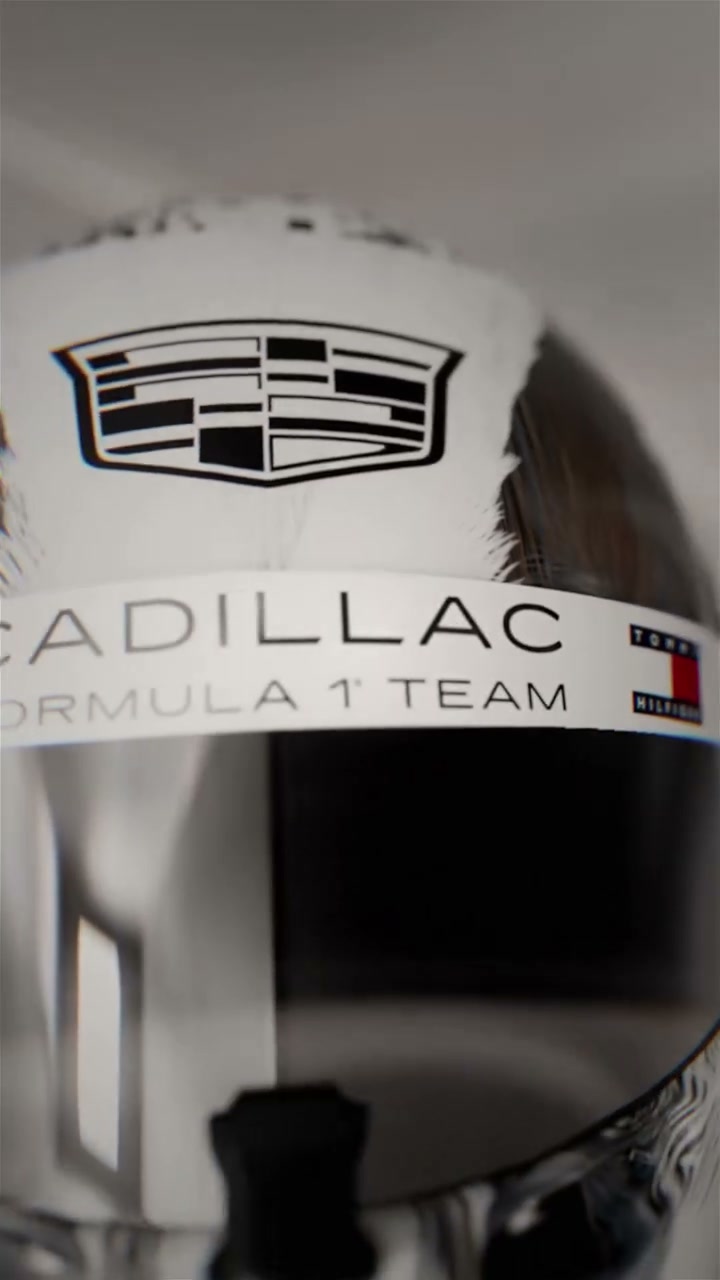
The finish is a two-tone white and black layout. White dominates the crown and upper sides, giving Cromwell a clean field for the badger illustration. Black takes the lower band, the chin bar and the rear, framing the artwork and tying the helmet visually to the Cadillac team’s race livery without copying it panel-for-panel.
How the badger sits on the shell
Nigel the badger is rendered as a stylised character rather than a photorealistic animal. The classic badger head — white centre stripe, two black bands running from nose to ears — is mapped so that the badger’s own stripe aligns roughly with the helmet’s centre line. From directly above, the effect is that the helmet itself reads as a giant badger head, with Bottas’s visor aperture sitting where the badger’s eyes would be.
On the sides, the character is shown in a more illustrative pose, giving the side-on broadcast shots a clear, single focal point. There is no busy pattern work, no fade, no carbon-weave reveal. The white space is left as white space, which is unusual on a modern F1 helmet and a large part of why this design will photograph well as a static display piece under gallery lighting.
Race number 77, the Cadillac crest and the Finnish flag
Cromwell has kept the external identifiers to three elements. That restraint is the design decision that separates this helmet from a novelty item and pushes it toward a serious collector object.
Number 77
Bottas’s race number 77 appears on the helmet in a black treatment against the white field. The number has followed him since his earliest F1 seasons and is one of the most recognisable two-digit marks on the current grid. On a 1:1 replica it sits at roughly eye level when the helmet is displayed on a standard plinth, which is the angle most collectors photograph from.
The Cadillac crest
The Cadillac crest marks this as a team helmet rather than a personal-brand exercise. The 2026 Monaco Grand Prix is the team’s competitive debut weekend in the Principality, so every piece of trackside equipment carries a first-appearance weight. Placing the crest on a helmet otherwise dominated by a cartoon badger is a confident move: it says the team is comfortable letting a driver’s personality lead the visual.
The Finnish flag
The blue-and-white Finnish flag is the third and final identifier. Bottas has carried Finnish flag detailing on every helmet of his F1 career, and its inclusion here ties the Monaco one-off back into the longer arc of his helmet history. For collectors building a Bottas shelf, the flag is the visual thread that links a 2026 Cadillac Monaco replica to earlier Williams, Mercedes and Alfa Romeo display pieces.
That is the entire external vocabulary of the helmet: badger artwork, 77, Cadillac crest, Finnish flag. No watch brand, no energy drink, no fuel partner blocked across the chin. The restraint is the point.
Reading the helmet as a display object
A full-size 1:1 replica of this helmet behaves differently on a shelf than a standard team-livery lid. Three things drive that.
Negative space
The large white field on the crown and upper sides means the helmet reads as a piece of graphic design from across a room. Most modern F1 helmets are dense with logos and fades and only resolve into a coherent image at close range. This one resolves instantly: badger, white, black. That makes it a stronger candidate for a lit display case or a wall-mounted shelf where the viewing distance is more than a metre.
Character-led artwork
Because Nigel is an illustrated character rather than an abstract pattern, the helmet invites the same kind of attention a piece of figurative artwork does. Collectors who already display animation cels, character maquettes or illustrated posters will recognise the visual logic. The helmet sits comfortably alongside non-motorsport collectables in a way that a heavily branded race lid does not.
A dated, single-race provenance
The helmet exists for one race day: 7 June 2026, in Monaco, for the Cadillac Formula 1 team’s appearance in the Principality. That single-date provenance is what collectors of one-off liveries look for. A replica catalogued with that race date carries a tighter story than a season-long design, and the badger artwork makes it immediately identifiable in photographs without needing a caption.
Where this fits in Bottas’s helmet history
Bottas has a long catalogue of personal helmet variations across his career, ranging from straightforward national-colour designs to more playful one-offs. The ‘Nigel the badger’ Monaco helmet is the most character-driven of the lot. It is also the first to put a non-human mascot at the centre of the design rather than as a small detail near the chin or the rear.
For a Cadillac-era Bottas collection, the Monaco 2026 helmet is the natural anchor. It is the team debut weekend in Monaco, the artwork is by a named designer with a personal connection to the driver, and the visual identity is distinct enough that it will not be confused with any other helmet on the 2026 grid. A 1:1 display replica preserves all of those layers at the scale they were designed for.
“The badger is the joke. Everything else on the helmet — the 77, the crest, the flag — is just there to remind you whose joke it is.”
— 123Helmets editorial note on the Cromwell design
FAQ
Q: When is Valtteri Bottas wearing this helmet?
The ‘Nigel the badger’ helmet is built for the 2026 Monaco Grand Prix on 7 June 2026, the Cadillac Formula 1 team’s appearance in the Principality. It is a one-race design.
Q: Who designed the helmet?
The artwork is by Tiffany Cromwell, an Australian professional cyclist and Bottas’s long-time partner, who has handled several of his personal visual projects.
Q: What shell is the helmet based on?
It uses a Stilo shell, the Italian-made shape Bottas has worn through his recent Formula 1 seasons.
Q: What markings appear on the helmet?
Externally, only three identifiers: race number 77, the Cadillac crest and the Finnish flag, set against a white-and-black base with the Nigel the badger artwork.
Q: Is the replica suitable for protective use?
No. This is a full-size 1:1 display and collector replica only. It is not intended for any protective, wearable or track-related use.
Browse F1 Helmet Collection
Display and collector replicas only. Not certified for protective use. Full-size 1:1 scale.