
Blog
Why Cadillac Ditched Its Split F1 Livery for 2026
 123Helmets Editorial Team
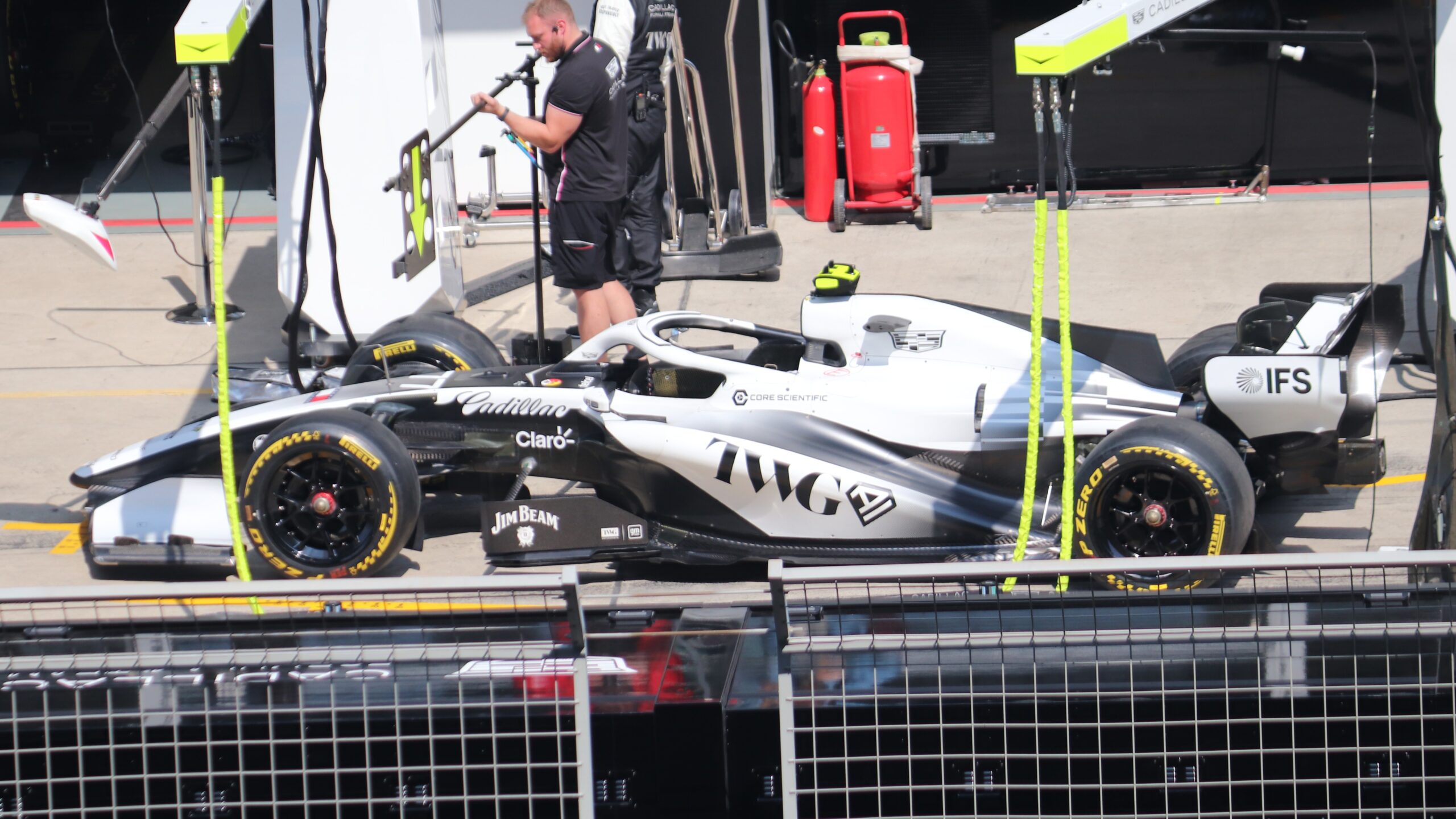
Cadillac has quietly retired the asymmetric black-and-white split livery that introduced its MAC-26 to the world, settling instead on a white-forward design born out of its Miami homecoming scheme. The switch, confirmed by team principal Graeme Lowdon, marks the first real identity decision of the American outfit’s debut F1 season and has immediate implications for collectors chasing exhibition-quality replicas of the marque’s earliest look.
Key Takeaways
Cadillac’s debut livery, revealed during a Super Bowl halftime broadcast, used an asymmetric black-and-white split across the MAC-26
A one-off Miami homecoming livery, leaning more heavily on white with stars and stripes detailing, proved the most popular version with fans
The team introduced a bespoke livery for the 250th anniversary of the Declaration of Independence before settling on its new standard scheme
Cadillac’s current symmetrical white-on-black livery debuted at the Austrian Grand Prix weekend and has since appeared at Silverstone and in Belgium
What was Cadillac’s original split livery?
Cadillac’s original livery used an asymmetric black-and-white split across the MAC-26, dividing the car unevenly rather than mirroring the design on both sides. The scheme was unveiled during a Super Bowl halftime advertisement, a launch platform chosen specifically to signal that the American manufacturer intended to do things differently as Formula 1’s newest entrant.
Team principal Graeme Lowdon described the thinking behind the reveal directly.
“We launched the asymmetric livery during the Super Bowl halftime show, which we thought was just another way of showing that the team wants to approach Formula 1 a little bit differently,” Lowdon said. “We said we would try and bring a few different things to Formula 1.”
The livery ran for a stretch of the early season before the team began experimenting with one-off variants at specific rounds, a pattern that ultimately reshaped its long-term identity.
How the Miami livery changed the plan
The Miami homecoming livery is the direct source of Cadillac’s new standard design. That one-off scheme kept a black-and-white base but shifted the balance toward the predominantly white left-hand side of the original split, while adding stars-and-stripes detailing for the team’s home race in the United States.
Fan reaction to the Miami look was strong enough that it changed Cadillac’s internal roadmap. Lowdon confirmed the connection between that one-off and the current livery.
“We then ran a livery in Miami, which was really well received by the fans, and we took account of that,” Lowdon explained. “The livery we have now is actually quite similar to that Miami livery.”
Rather than treating Miami as a single-weekend novelty, Cadillac used the response as data, effectively letting its fan base vote on the brand direction with their reaction to the car.
The 250th anniversary livery bridge
Cadillac ran a bespoke livery commemorating the 250th anniversary of the signing of the Declaration of Independence between the Miami scheme and the adoption of its new standard design. Lowdon placed this livery in the sequence of the team’s 2026 design evolution.
“Then, in the middle of that, we introduced the livery to commemorate the 250th anniversary of the signing of the Declaration of Independence,” he said.
That scheme functioned as another data point in Cadillac’s broader experiment with one-off liveries, reinforcing the pattern of testing patriotic, white-leaning designs before committing to a permanent identity. It also gave the team another round of fan feedback ahead of finalizing the symmetrical livery that followed.
When the new symmetrical livery debuted
Cadillac’s new symmetrical, white-on-black livery first appeared on the MAC-26 during the Austrian Grand Prix weekend. The updated design replaced the uneven split of the debut scheme with a mirrored layout that leans more heavily on white bodywork, directly carrying over the visual language introduced in Miami.
Since its Austrian debut, the livery has appeared with variation rather than total consistency. A bespoke 4th of July livery ran at Silverstone, and the standard symmetrical scheme returned for the Belgian round. This rotation shows Cadillac still treats certain calendar dates as opportunities for special-edition paintwork even after locking in its core design.
What the livery shift says about Cadillac’s approach
Cadillac’s livery changes reflect a team willing to treat its car’s paint scheme as a live, adjustable part of its brand rather than a fixed launch-day decision. Lowdon linked the visual identity directly to the team’s broader operating philosophy.
“While it’s just a colour scheme,” the team feels its approach to how it presents itself also translates to other parts of the business, including an aggressive upgrade strategy with a constant introduction of new parts.
For an entrant with no prior F1 history, using livery reaction as a proxy for wider brand decisions is a distinct approach compared to established teams that tend to lock a livery for a full season.
For collectors, the sequence matters. The debut split livery, the Miami one-off, the Declaration of Independence special, and the current Austrian-Grand-Prix-onward standard scheme each represent a distinct visual chapter in Cadillac’s first F1 season, and each is a candidate for a full-size 1:1 display piece documenting the team’s earliest identity shifts.
“We launched the asymmetric livery during the Super Bowl halftime show, which we thought was just another way of showing that the team wants to approach Formula 1 a little bit differently.”
— Graeme Lowdon, Cadillac Team Principal
“We then ran a livery in Miami, which was really well received by the fans, and we took account of that. The livery we have now is actually quite similar to that Miami livery.”
— Graeme Lowdon, Cadillac Team Principal
FAQ
Q: Why did Cadillac change its F1 livery?
Cadillac changed its livery because a one-off Miami homecoming scheme, which leaned more heavily on white than the original split design, was received strongly by fans and prompted the team to adopt a similar look as its standard design. Team principal Graeme Lowdon confirmed the current livery is closely modeled on the Miami version.
Q: What did Cadillac’s original F1 livery look like?
Cadillac’s original livery used an asymmetric black-and-white split across the MAC-26, unveiled during a Super Bowl halftime broadcast rather than a traditional launch event. It ran for part of the season before being phased out in favor of a symmetrical design.
Q: When did Cadillac’s new livery first appear on track?
Cadillac’s new symmetrical, white-on-black livery first appeared during the Austrian Grand Prix weekend. It has since been used again for the Belgian Grand Prix, following a bespoke 4th of July design run at Silverstone.
Q: Did Cadillac run any other special liveries in 2026?
Yes, Cadillac ran a livery commemorating the 250th anniversary of the signing of the Declaration of Independence, alongside a Miami homecoming design and a 4th of July scheme for Silverstone. These one-off liveries bridged the gap between the team’s debut split design and its current standard livery.
Q: Is the original Cadillac split livery still used?
No, the original asymmetric split livery has been replaced as Cadillac’s standard scheme, though its influence remains visible since the team continues to use one-off variants for specific rounds. The debut design is now considered a distinct early chapter of the team’s visual identity.
Browse F1 Helmet Collection
Display and collector replicas only. Not certified for protective use. Full-size 1:1 scale.