
Blog
Cadillac Upgrades: Austrian GP 2026 Qualifying Watch
 123Helmets Editorial Team
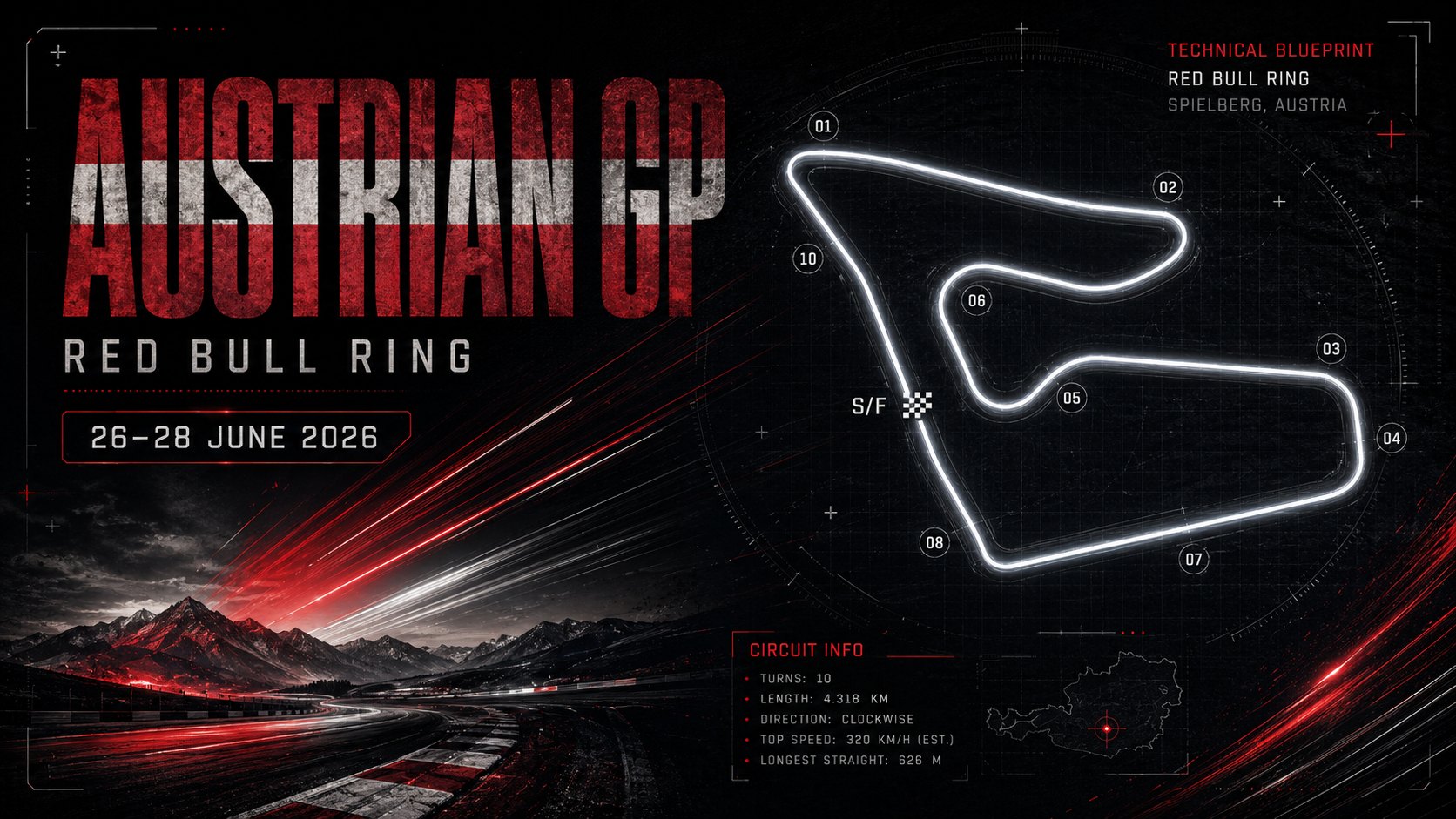
Cadillac arrives at the 2026 Austrian Grand Prix carrying a package of car upgrades that could mark a turning point in their debut season. Qualifying at the Red Bull Ring will deliver the first hard data on whether those changes actually work.
Key Takeaways
Cadillac has introduced multiple car upgrades ahead of the 2026 Austrian Grand Prix qualifying session.
Two experienced drivers give the team immediate, high-quality feedback on whether the upgrade package delivers real pace.
The Red Bull Ring’s short lap — historically under 1 minute 05 seconds in qualifying — amplifies every small gain or loss in aerodynamic performance.
A strong qualifying result at Austria would be a measurable milestone in Cadillac’s push to reach the midfield in their first full F1 season.
Why Austria Is the Right Track to Test Cadillac’s Upgrades
The Red Bull Ring is one of the shortest circuits on the F1 calendar, with a lap distance of just 4.318 km and typically fewer than 10 corners, meaning aerodynamic efficiency and mechanical grip are exposed quickly and clearly in lap-time data. There is very little room to hide a performance deficit — or to miss a genuine improvement — when each qualifying lap is over in roughly 64 seconds. That makes the Austrian Grand Prix weekend on 27–29 June 2026 an unusually honest environment in which to evaluate a new upgrade package.
Cadillac’s engineers would have known this when scheduling their development programme. Bringing parts to a short, low-downforce-friendly circuit compresses the feedback loop. If the upgrades work at the Red Bull Ring, the data arrives fast and the direction for the next batch of parts becomes clear almost immediately after qualifying ends.
The circuit’s layout — three long straights separated by heavy braking zones — also stresses a car’s drag level and brake stability more than most venues. Any aerodynamic changes Cadillac has made to the bodywork or floor will show up in straight-line speed traps as well as in the cornering sectors, giving the team two independent data streams to validate the package.
What Cadillac Is Bringing to the Red Bull Ring
Cadillac has introduced a number of car upgrades for the 2026 Austrian Grand Prix weekend, targeting performance gains that could help the team close to the midfield pack. The specific components have not been detailed publicly, but an upgrade package at this stage of a debut season typically touches the floor edge, the front wing, and cooling configurations — areas where a new team accumulates the most correlation data between wind tunnel and track.
For a team in its first full F1 season, the pace of development matters as much as the raw pace on any given weekend. Each upgrade package is also a test of the factory’s ability to design, manufacture, and homologate parts within the tight F1 production cycle. Arriving in Austria with multiple new components signals that Cadillac’s Silverstone-based operation is running its development pipeline at meaningful speed.
The two experienced drivers at the wheel are central to this process. Seasoned F1 drivers can separate genuine aerodynamic gain from setup-induced improvement, and they can describe handling changes with the precision that allows engineers to correlate physical data with subjective feedback. That combination — experienced drivers plus a multi-part upgrade — is the most efficient way for a new team to accelerate its learning rate in 2026.
The Midfield Gap: How Far Does Cadillac Need to Travel?
The midfield in 2026 F1 is defined by the teams consistently qualifying and finishing between P6 and P14, and closing that gap requires consistent qualifying improvements measured in tenths, not seconds. In early-season 2026 rounds, new teams typically begin the year 1.5 to 2.5 seconds off the pace of the front runners and around 0.8 to 1.2 seconds behind the established midfield — numbers that shrink as the season develops and upgrade parts accumulate.
At a track as short as the Red Bull Ring, a 0.1-second improvement in lap time is worth more in percentage terms than it would be at a 5.8 km circuit like Spa. That compression effect means Austria is a place where a well-executed upgrade package can visibly shift a team’s grid position by two or three places, which in championship-points terms is a meaningful step.
Cadillac’s gap to the midfield is also a commercial story. Every row of the grid the team advances adds value to the programme — for sponsors reading timing screens, for fans following the new American constructor, and for the technical staff in the factory whose confidence in their own process grows with each measurable result.
Two Experienced Drivers: Why That Matters for Development
Having two experienced Formula 1 drivers gives Cadillac a direct performance comparison across both sides of the garage, which is one of the most reliable tools available for separating car performance from individual driving style. When both drivers converge on the same feedback about a new component, the engineers can act on that information with much higher confidence than if only one data point existed.
Experienced drivers also understand the political and logistical side of a development programme — they know which battles to pick with the engineering team, how to structure a qualifying simulation run to extract maximum information, and how to manage tyre warm-up on a 4.318 km lap where there are only two or three meaningful corners before the timing sector closes.
At the Red Bull Ring in particular, the opening sector — including Turn 1 and Turn 2 — is where lap time is made or lost most sharply. A driver who has competed at Austria across multiple seasons knows instinctively how to position the car for the compression at the bottom of the hill and the crest at Turn 3. That track knowledge, combined with the new upgrade package, gives Cadillac the best realistic chance of understanding their car’s true performance level on 27 June 2026.
Collector Perspective: Why Cadillac’s 2026 Story Is Already Worth Preserving
Cadillac’s 2026 F1 season is a historically significant chapter in the sport — the first new American constructor to enter Formula 1 in decades — and the collector and display replica market responds to exactly this kind of milestone. A team’s debut season, complete with its development arcs, upgrade introductions, and first meaningful qualifying results, is precisely the narrative that makes a Cadillac F1 replica helmet from 2026 a long-term display piece rather than just a souvenir.
Full-size 1:1 display replica helmets capture the livery at a fixed point in a driver’s or team’s story. A replica associated with the Austrian GP weekend — the race where Cadillac’s upgrade programme was first publicly evaluated — carries the context of that development moment. In 30 years, when Cadillac may be a multi-championship constructor, the 2026 Austrian Grand Prix helmet will represent the exact weekend the team started closing the gap.
Display replicas of this type are exhibition-quality collector items, scaled at 1:1 full size, and are produced for display purposes only — not for protective use of any kind. They are made to sit on a shelf, in a case, or in a dedicated motorsport display, preserving the visual identity of a specific car and driver pairing at a specific point in time. For collectors who follow the technical side of F1, the Austrian GP 2026 represents a timestamp worth owning.
What to Look For in a 2026 Cadillac Display Replica
A quality 1:1 display replica should faithfully reproduce the helmet’s paint scheme, sponsor graphics, and visor tint as worn by the driver during the 2026 season. The visor on a full-size replica typically measures around 26 mm in depth at the centre and carries the correct tint level for the livery period it represents. Weight and shell geometry on exhibition-quality pieces match the outer dimensions of the race original, making them accurate display objects rather than scaled-down models.
What Qualifying Will Actually Tell Us on 27 June 2026
Qualifying on 27 June 2026 at the Red Bull Ring will produce a single definitive number: Cadillac’s gap to pole position and their gap to the last car in Q1 elimination. Those two figures, measured to three decimal places as standard in F1 timing, will confirm or challenge every internal simulation Cadillac’s engineers have run on the upgrade package since it left the factory.
If the upgrades work, the team’s qualifying time should improve relative to the field compared to their previous Austrian-equivalent track performance. If the package delivers less than simulated, the engineers will have real track data to refine the next iteration. Either outcome advances the programme — but only a lap time puts a number on it.
The session also places Cadillac under the specific scrutiny that comes with a team labelled as one to watch. A pre-qualifying note shared on social media — “all eyes on Cadillac” — reflects the attention the team is drawing from the wider F1 community heading into the session. That attention is a measure of the expectation Cadillac has built, and qualifying will answer it in the most direct way possible: a time on the timing screen, a position on the grid, and a delta that is either shrinking or not.
For everyone watching — whether from the grandstands at the Red Bull Ring, from a screen at home, or through the lens of what this season will one day mean to a collector — 27 June 2026 is the day Cadillac’s 2026 upgrade story begins to acquire its result.
FAQ
Q: What upgrades has Cadillac brought to the 2026 Austrian Grand Prix?
Cadillac has introduced a package of multiple car upgrades for the Austrian Grand Prix weekend at the Red Bull Ring, with qualifying on 27 June 2026 set to provide the first performance data on how effective the changes are. The specific components have not been publicly detailed by the team.
Q: Why is the Red Bull Ring a good circuit to evaluate a new upgrade package?
The Red Bull Ring’s 4.318 km lap length means qualifying runs are completed in roughly 64 seconds, so performance gains or losses appear in the data very quickly and clearly. The circuit’s three long straights and heavy braking zones also give engineers independent aerodynamic and mechanical data streams from a single lap.
Q: How far is Cadillac from the midfield in the 2026 F1 season?
New teams typically begin their first F1 season between 0.8 and 1.2 seconds behind the established midfield in qualifying, with that gap reducing as upgrade packages accumulate through the year. A successful Austrian GP upgrade package could visibly move Cadillac two or three grid positions closer to the midfield group.
Q: Are Cadillac F1 display replica helmets available for collectors?
Full-size 1:1 display replica helmets representing the Cadillac 2026 F1 season are collector and exhibition-quality items produced for display purposes only — not certified for protective use. They preserve the team’s 2026 livery at full scale as a permanent display piece. Browse the collection at 123Helmets.com to see current availability.
Q: Why does Cadillac having two experienced drivers help their development programme?
Two experienced drivers allow the engineering team to cross-reference feedback from both sides of the garage, making it far easier to separate genuine aerodynamic improvement from setup variation. When both drivers describe the same handling characteristic on a new component, the engineers can act on that information with much greater confidence.
Browse F1 Helmet Collection
Display and collector replicas only. Not certified for protective use. Full-size 1:1 scale.
This article was written with the help of AI tools. Editorial policy