Blog
Barcelona 2026: Why Tyre Management Is the Race Within the Race at Catalunya
 123Helmets Editorial Team
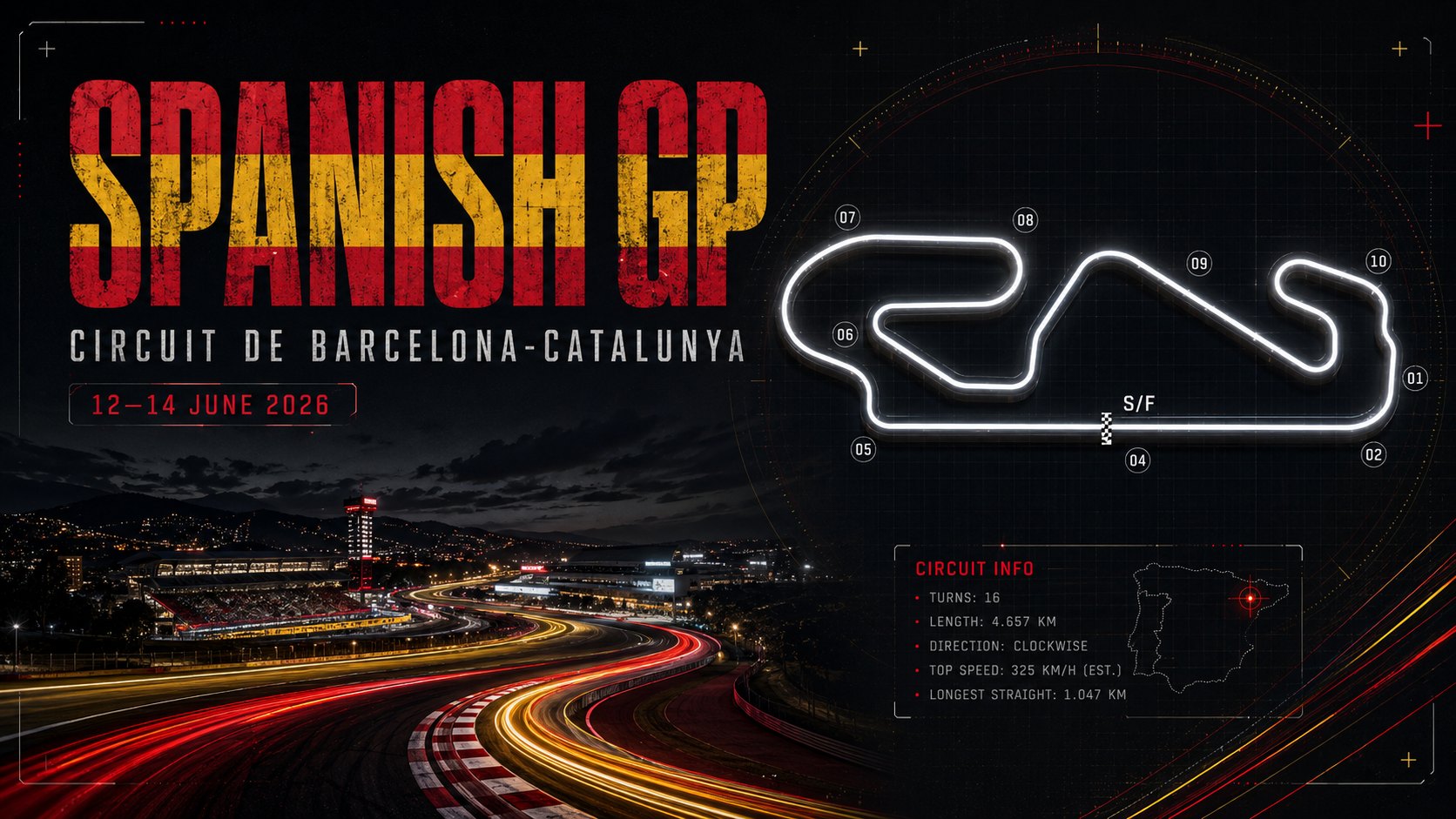
The Circuit de Barcelona-Catalunya has a long history of exposing tyre management weaknesses, and the 2026 Spanish Grand Prix is shaping up to follow that tradition. With Pirelli stepping one compound softer compared to 2025, and Friday practice already hinting at two or three stops on Sunday, the strategic battle at Catalunya could define where the season’s first clear performance picture truly emerges.
Key Takeaways
Pirelli has nominated the C2, C3, and C4 compounds for Barcelona 2026 — one step softer than the 2025 selection — to encourage hard-compound use and multiple pit stops.
In 2025, most drivers completed two stops before a late Safety Car pushed many to three; Red Bull’s drivers each visited the pit lane four times.
Friday practice showed that only Max Verstappen, Esteban Ocon, and Ollie Bearman ran the C2 hard tyre, with the rest of the field saving both sets for Sunday.
Pirelli’s Simone Berra admitted he was surprised teams leaned on the soft and medium in practice rather than testing the hard, signalling Sunday strategy is still very much open.
Barcelona’s Permanent Place on the Calendar — and in the Collection
Few circuits in the modern Formula 1 calendar carry the weight of Catalunya. It is a track engineers know by heart, a venue where simulator data correlates reliably with real-world behaviour, and a circuit whose high-speed corners and abrasive surface punish any car that is not well-balanced. For collectors and fans who follow the sport through its visual language — helmets, liveries, race-worn kit — Barcelona has repeatedly delivered podium images that belong on a shelf as much as in a results table.
The 2026 Spanish Grand Prix arrives with an added layer of significance. Pirelli is using the event to celebrate 500 Formula 1 races as the sport’s sole tyre supplier, marking the milestone with the launch of a dedicated book. The Italian company has also confirmed it will continue as the exclusive tyre partner through 2028, giving the sport certainty in one supply chain even as the new 2026 technical regulations continue to generate headlines. Those regulations — centred on the radical overhaul of power units and aerodynamic philosophy — have dominated paddock conversation since the season opened, with teams openly acknowledging that tyre understanding took a back seat in the early rounds as engineers prioritised making the new cars work at all.
Barcelona, though, does not forgive that kind of inattention. The circuit demands grip management across all four tyres, and the strategic decisions made on pit wall on Sunday afternoon will be as decisive as anything happening in the engine room.
The Compound Step Down: Why Pirelli Went Softer for 2026
The starting point for understanding this year’s tyre story at Barcelona is the choice Pirelli made before the cars even arrived in Spain. In 2025, the hard compound was so frequently selected and so consistently fast that it dominated race strategy. Teams leaned on it to complete long stints, and it was the red-walled tyre that appeared most often in the closing laps when track position mattered most.
For 2026, Pirelli has responded by nominating compounds one step softer across the full range. Where 2025 featured the C1, C2 and C3, this year the event uses the C2 as the hard, the C3 as the medium, and the C4 as the soft. The arithmetic of that decision is straightforward: a softer hard compound degrades faster, which means teams cannot simply load up on hard-tyre laps without paying a performance cost. The intended outcome is more pit stops and, therefore, more racing.
Pirelli chief engineer Simone Berra confirmed the direction explicitly on Friday evening: the goal is to encourage the use of the hard compound and promote multiple stops. Early signs from practice suggest the plan is working, with Friday’s long-run data pointing toward two or even three stops as the realistic race strategy options on Sunday.
Friday’s Surprise: The Hard Tyre Stays in the Wrapper
There was, however, a twist in how Friday unfolded. Despite Pirelli going one step softer precisely to make the hard tyre more relevant, the data from both practice sessions told a different story from what the tyre supplier expected.
Out of the entire field, only three drivers used the C2 hard compound during Friday: Max Verstappen, Esteban Ocon, and Ollie Bearman. Every other team chose to save both of their hard-tyre sets for Sunday, running exclusively on the softer C3 and C4 compounds during practice.
Berra was candid about his reaction. “Personally I was a bit surprised, because the teams decided to use mainly the soft and medium compounds rather than the hard,” he said. “We expected the hard to suffer a little bit more with sliding, with surface temperature, with overheating, so we didn’t think that the hard was a good race compound. But the teams decided to keep both the sets for the race on Sunday. Probably they tried to see what the other teams were doing, and they decided to change their plans during FP1. But anyway, it’s an interesting move.”
The implication is significant. Teams are arriving at Sunday’s race with a maximum of two hard-compound sets available — and minimal real-world data on how those sets will perform over a race stint in competitive conditions. That information vacuum makes Saturday’s final practice session and the long runs in qualifying preparation far more valuable than usual. It also means the first drivers to commit to the hard tyre in the race will be running a mild experiment on behalf of the entire field.
The 2025 Precedent: Stops, Safety Cars and Strategic Chaos
To understand why teams are treating Barcelona strategy with such care, it helps to look back at the 2025 race at the same circuit. The default strategy for most of the field was two stops — a reasonable expectation given the compound characteristics and the historical pace of degradation at Catalunya.
A late Safety Car intervention changed the arithmetic for much of the grid, forcing or encouraging a third pit stop for drivers who had been managing toward a two-stop finish. The disruption was not uniform: both Red Bull drivers ended up making four pit stops across the race, an unusually high number that reflected either strategic overreaction or genuine tyre trouble on a day the team described as tricky.
Four stops in a single race at a circuit that does not naturally produce extreme degradation is a notable data point. It underlines how quickly the tyre situation at Barcelona can escalate, and why the 2026 choice to go one step softer deserves to be taken seriously by every strategist in the paddock.
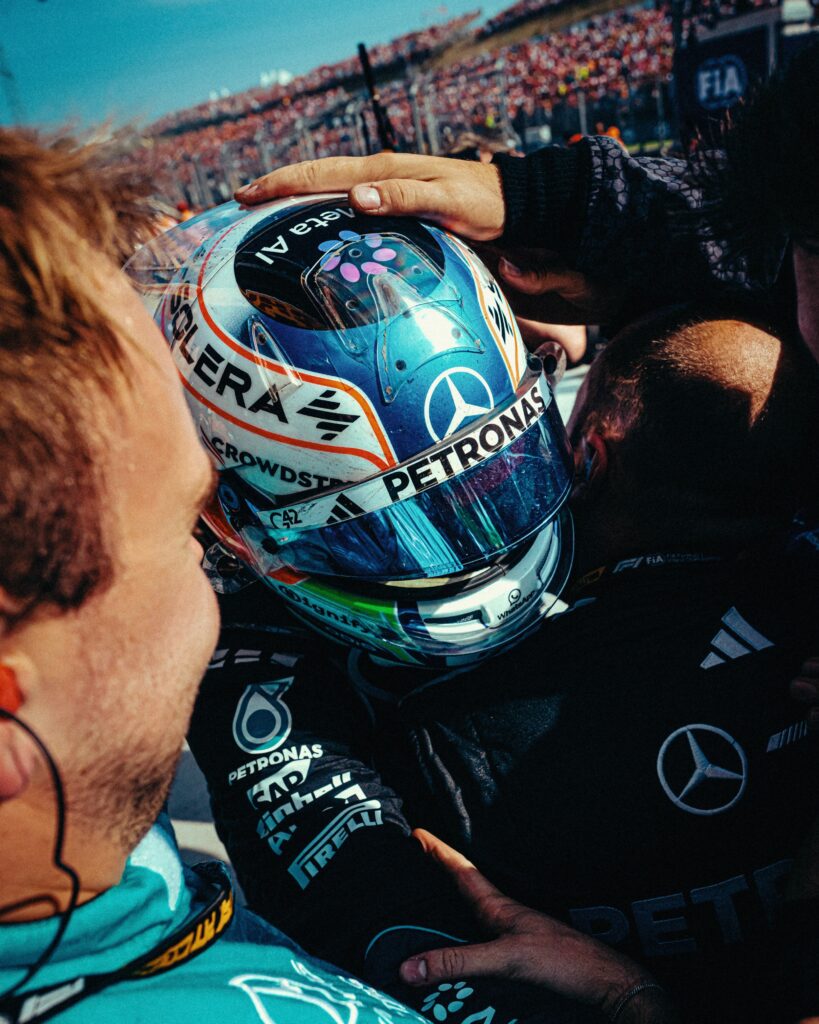
For those building a visual record of the season — whether through photography, replica helmets, or livery reference material — the 2025 Spanish GP also delivered podium imagery that reflected the chaotic afternoon. Helmets that arrived on the top step looking race-worn and marked by a genuinely hard afternoon carry a different kind of authenticity than clean podium finishes at circuits where the result never seemed in doubt.
Podium Visuals and the Display Case Argument
Barcelona has a specific aesthetic for collectors. The late-afternoon light that falls across the circuit’s main straight, combined with the blue and yellow branding of the circuit itself, creates a colour environment that tends to make liveries photograph well. When a helmet emerges from a race like Barcelona — where the driver has spent 66 laps managing degradation, reacting to safety cars, and potentially pitting four times — the wear marks and the physical evidence of effort add a layer of storytelling that clean display pieces can only hint at.
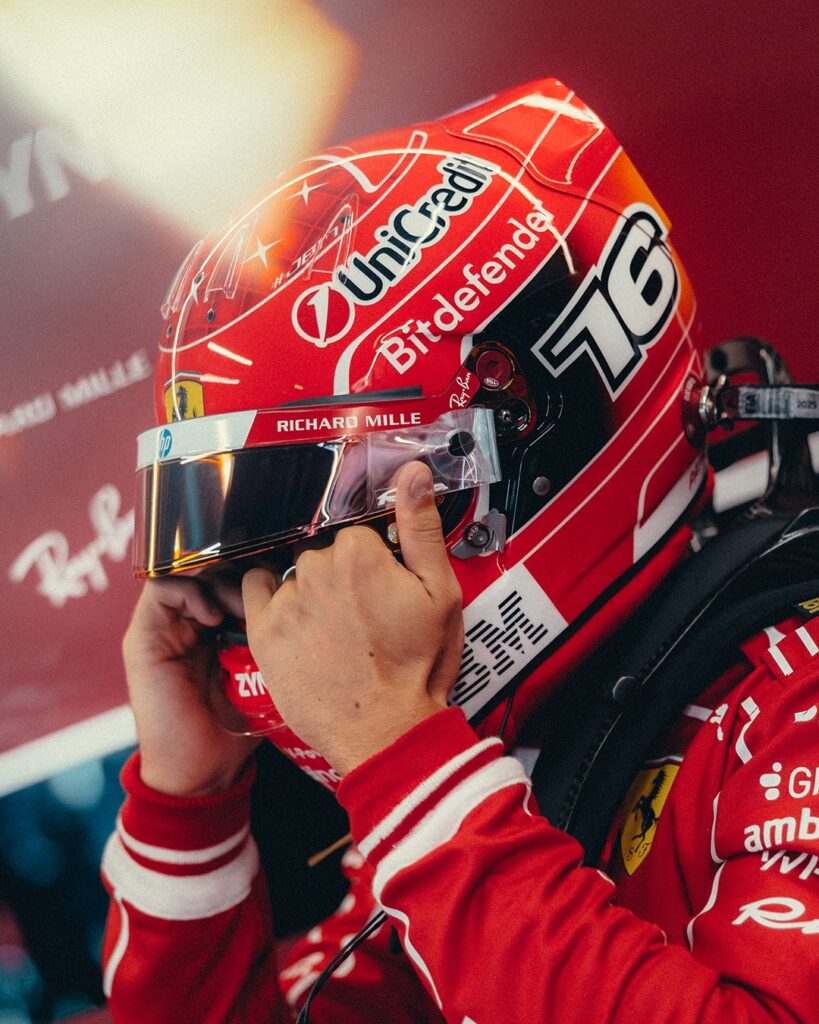
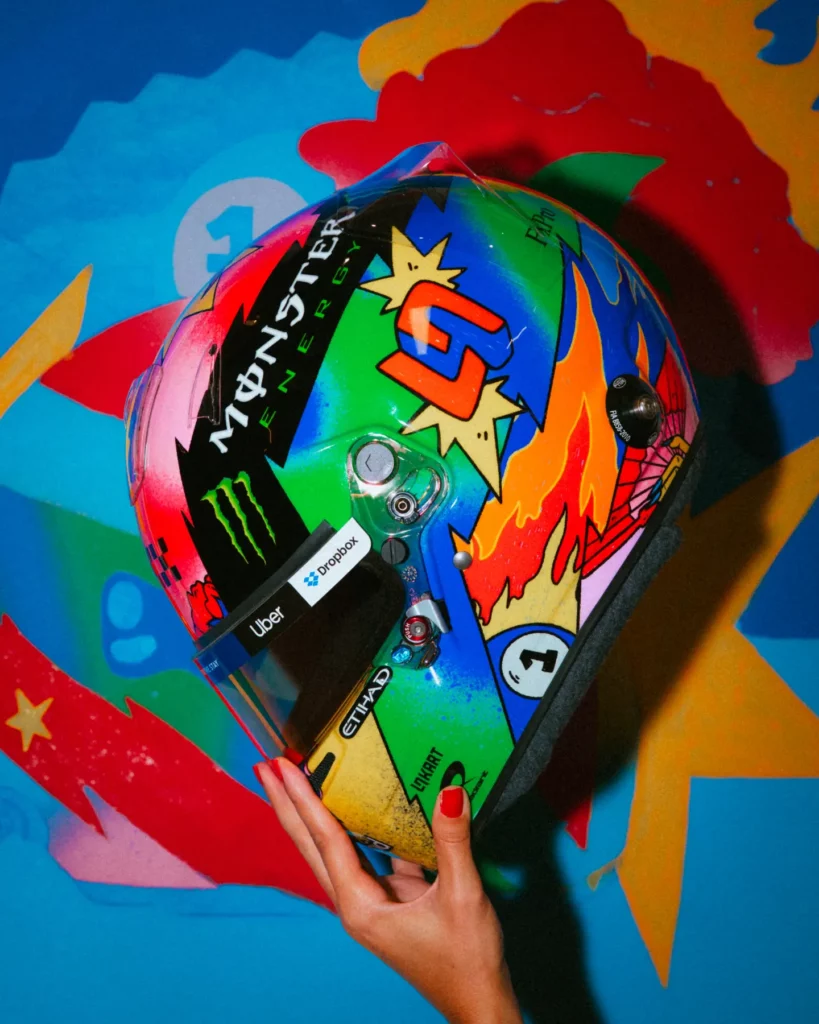
Full-size 1:1 collector replicas of helmets from races like the Spanish Grand Prix serve exactly this purpose. A display piece modelled on a helmet worn during a tyre-strategy epic at Catalunya is not just a piece of branded merchandise — it is a physical reference point for one of the most analytically complex afternoons in a Formula 1 season. The 29 × 25 × 35 cm footprint of a standard display base means a full-size replica helmet sits comfortably on a desk or shelf without dominating the space, while the 1:1 scale ensures every graphic detail — the sponsor placement, the visor angle, the chin strap hardware — is reproduced at the same proportions as the race original.
The liveries arriving in Barcelona for 2026 have been shaped by the new aerodynamic rules, which altered sidepod geometry enough that several teams updated their livery layout between the first race and the European swing. Those mid-season graphic adjustments are exactly the kind of detail that matters to a collector building a chronological record of a championship year.
What Sunday Will Reveal — and What It Means for the Season
The strategic picture heading into the Spanish Grand Prix is unusually open. Teams saved their hard-compound sets through Friday, which means Sunday will be the first real-world test of how the C2 performs over a full stint at race pace in 2026. Pirelli expected the compound to struggle with heat and sliding; the teams apparently think otherwise, or at least think it is worth preserving the option.
The resolution of that disagreement will play out in real time on Sunday. If the C2 delivers the longevity teams are banking on, a two-stop race becomes viable. If degradation accelerates — especially in the hot afternoon temperatures that Barcelona’s June slot typically produces — a third or even fourth stop becomes necessary, and the drivers who committed to the hard early will have the most information to work with.
For Pirelli, the race is also a showcase moment. Marking 500 Formula 1 races at a circuit this technically demanding, with a compound selection specifically designed to force strategic decisions, is a statement about the supplier’s role in shaping how races unfold. The extension of the supply contract to 2028 means there are at least two more seasons of this kind of strategic architecture ahead.
For everyone watching from outside the pit wall — including the collectors and fans who want a display-quality reminder of where the 2026 season found its shape — Barcelona 2026 is setting up as one of the defining strategic afternoons of the year. The helmets that reach the podium on Sunday will carry the story of every compound change, every safety car call, and every split-second decision made by engineers who spent Friday night staring at data from a tyre they have barely tested.
“Personally I was a bit surprised, because the teams decided to use mainly the soft and medium compounds rather than the hard. We expected the hard to suffer a little bit more with sliding, with surface temperature, with overheating, so we didn’t think that the hard was a good race compound. But the teams decided to keep both the sets for the race on Sunday.”
— Simone Berra, Pirelli Chief Engineer
FAQ
Q: Which tyre compounds is Pirelli using for the 2026 Spanish Grand Prix?
Pirelli has nominated the C2 (hard), C3 (medium), and C4 (soft) compounds for Barcelona 2026. This is one step softer across the range compared to the 2025 selection, which used the C1, C2, and C3.
Q: Why did Pirelli go softer with the compound selection for Barcelona 2026?
Pirelli’s goal was to make the hard compound degrade more noticeably and encourage teams to run multiple pit stops. A faster-degrading hard tyre makes long single-stint strategies less viable, which typically produces more strategic variation during the race.
Q: How many pit stops did drivers make at the 2025 Spanish Grand Prix?
Most teams completed two stops in 2025, but a late Safety Car pushed many drivers to three. Both Red Bull drivers made four pit stops during the race, which the team described as a tricky afternoon.
Q: What happened with the hard tyre during Friday practice at Barcelona 2026?
Only three drivers — Max Verstappen, Esteban Ocon, and Ollie Bearman — ran the C2 hard compound during Friday practice. The rest of the field chose to save both hard-tyre sets for Sunday’s race, leaving Pirelli’s chief engineer surprised by the approach.
Q: Are the Barcelona-themed F1 helmet replicas on 123Helmets.com full-size pieces?
Yes. All helmets in the 123Helmets.com collection are full-size 1:1 scale display replicas. They are collector and exhibition pieces only, not certified for protective use of any kind.
The helmets that reach the Barcelona podium carry the full story of one of the season’s most strategically complex afternoons. Browse the full F1 helmet collection at 123Helmets.com and find your display-worthy piece from the 2026 season.
Display and collector replicas only. Not certified for protective use. Full-size 1:1 scale.
This article was written with the help of AI tools. Editorial policy