Blog
James Wharton Wins Barcelona F3 Sprint for PREMA in a Race of Reversals
 123Helmets Editorial Team
James Wharton delivered a composed, hard-fought victory for PREMA Racing in the Formula 3 Sprint Race at the Circuit de Barcelona-Catalunya, overcoming an early squeeze from pole-sitter Gerrard Xie and a charging Freddie Slater to take the top step. The podium — all three drivers in distinct, visually striking liveries — produced some of the most display-worthy moments of the 2024 F3 season so far.
Key Takeaways
Wharton moved from second on the grid to the race lead by Lap 5, passing Xie around the outside of Turn 1 after the DAMS driver’s tyres began to lose pace.
Gerrard Xie started from pole having qualified 12th for the Feature Race — the sprint grid inversion rule at work — but his early pace advantage faded as tyre deg took hold.
Two drivers — Tiato Kato and Mattia Colnaghi — failed to complete a meaningful lap, with Kato stalling on the grid and Colnaghi pitting twice before the race was properly underway.
A Virtual Safety Car period triggered by Ernesto Rivera’s stopped car in the final sector shaped the closing stages, compressing the field just as Wharton was building his advantage.
Grid, Inversions, and the Starting Order
The Formula 3 Sprint Race at the Circuit de Barcelona-Catalunya operates on the inverted-grid principle: the top qualifiers from Saturday’s session line up in reverse order for Sunday morning’s sprint, meaning the fastest qualifier from the Feature Race qualifying session starts near the back. Gerrard Xie, who had clocked a time good enough for 12th on the Feature Race grid, inherited pole position for the Sprint — a reward for mid-pack qualifying pace that is both tactical and slightly counterintuitive to new fans of the series.
Alongside Xie on the front row was James Wharton in the PREMA Racing car, his red-and-white livery immediately distinguishable from Xie’s DAMS Lucas Oil machine. PREMA’s colour language — bold primary red over a white base, with sharp geometric sponsor lettering — has become one of the most recognisable liveries in junior single-seater racing over the past decade, and under the Barcelona sunshine the car looked particularly striking on the grid photographs that now circulate as collector reference material.
Fourth on the grid was ART Grand Prix’s Tiato Kato, whose race would not begin in any meaningful sense. Kato stalled on the grid and was forced to start from the pit lane — a costly mechanical failure that removed one of the championship contenders from the early running before a single racing lap had been completed. Mattia Colnaghi joined him in the pit lane, having filtered off during the formation lap itself. Two drivers absent from the sprint start before the lights went out.
The Opening Laps: Wharton Pushes, Slater Strikes
Xie held the lead off the line with a clean start, his DAMS car getting traction well and covering the inside line into Turn 1. Wharton, however, was committed to the outside, pushing his PREMA machinery into the space on the run towards the first corner complex. It was close — the two cars were side by side for a meaningful stretch — but Xie squeezed the PREMA car and retained the position. A legitimate, hard piece of racing that set the tone for what followed.
While Wharton and Xie were disputing the lead, Freddie Slater in the Trident car was watching the gap. On the approach to Turns 3 and 4, Slater went side by side with Wharton and completed the move, slotting into second place. Three corners into the race and the order had already shuffled: Xie, Slater, Wharton — the sprint race doing exactly what the format promises.
By Lap 3, Xie had broken the DRS detection point cleanly and put 1.5 seconds between himself and Slater. That gap, while not enormous, was enough to deny Slater the DRS activation he needed to mount an immediate challenge. Behind, Wharton was right on the Trident car’s gearbox. He had lost second to Slater around the outside exchange at Turns 3 and 4, but he had not given up the position permanently. On that same third lap he made a dive on Slater, reclaimed second place, and set off after Xie’s DAMS machine.
A yellow flag period interrupted the rhythm briefly — Jose Garfias was moving slowly on track, presumably carrying damage from an earlier contact with Colnaghi (who would return to the pit lane for the second time in the sprint race shortly after). The caution compressed the field momentarily but did not change the race order.
Lap 5: The Move That Decided the Race
By Lap 5 the critical moment arrived. Xie’s tyres had begun to lose their edge — a common pattern in sprint races where a driver who has been defending hard from the opening metre finds the front end starting to wash wide into slow corners. Into the first corner complex, the PREMA car of Wharton appeared on the outside line again, the same arc he had tried and failed on the opening lap.
This time, with Xie struggling for pace and the DAMS car running wide, Wharton completed the pass cleanly and swept into the lead. It was the race-defining moment: not a lunge under braking, not a VSC-assisted gift, but a sustained, patient piece of driving from a driver who had spent three laps waiting for the right conditions. With Xie now falling back into Slater’s front wing, the DAMS driver was fighting on two fronts — attempting to hold second while managing rapidly degrading rubber.
PREMA’s livery in that moment — leading the Circuit de Barcelona-Catalunya, under full racing conditions, the red car pulling away — is the sort of image that ends up framed. The visual contrast between the three lead cars was sharp: PREMA’s red and white ahead, Trident’s distinctive scheme behind, and DAMS Lucas Oil in the mix. For anyone building a display around the 2024 F3 season, this sprint podium represents the kind of moment worth documenting.
Virtual Safety Car and the Closing Stages
With the race order settling into Wharton–Slater–Xie, the circuit threw one more complication into the mix. Ernesto Rivera — running as a Red Bull junior — brought his car to a halt in the final sector, the engine simply not responding. Rivera climbed out and the Virtual Safety Car was deployed. The VSC does not neutralise the race in the same way a full Safety Car does, but it compresses gaps across the field and requires drivers to hit a delta time rather than race freely. For Wharton, holding a gap he had worked to build, the VSC was an unwelcome reset.
When the VSC period ended and racing resumed, Wharton defended with enough composure to bring the PREMA car home in first place. Slater crossed the line in second for Trident — a result that underlined the team’s competitiveness at a circuit where tyre management across a short sprint distance is genuinely difficult to perfect. Xie, despite losing the lead he had held from pole, completed the podium in third — a meaningful points finish for a driver who had arrived at the sprint race with pole position and left with a podium. Third from pole in a reversed-grid sprint is not the maximum result, but it is far from a failure.
The final podium — Wharton, Slater, Xie — was photographed in the Barcelona paddock against a backdrop that any collector of racing ephemera would recognise immediately. Three helmets, three liveries, three teams, on a podium at one of the oldest permanent circuits on the Formula 1 calendar. The Circuit de Barcelona-Catalunya has hosted F1 since 1991 — more than 30 consecutive years of grands prix — and its podium infrastructure is among the most photographed in motorsport.
Helmet and Livery Details: What Made This Podium Display-Worthy
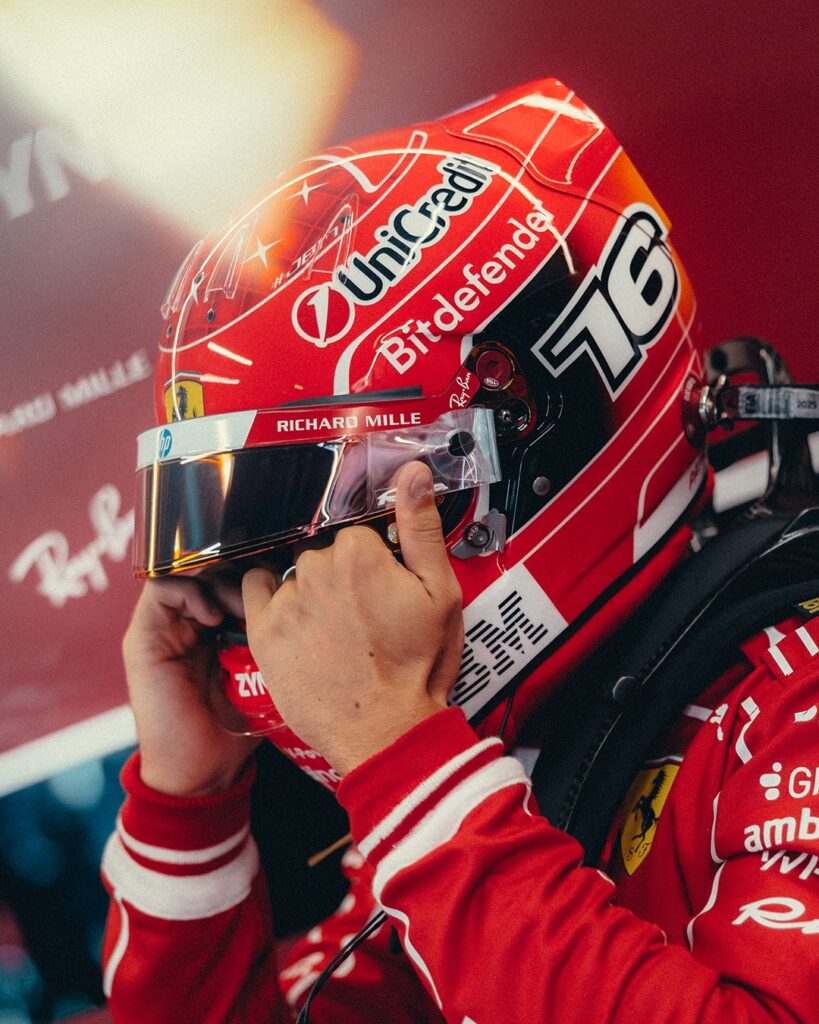
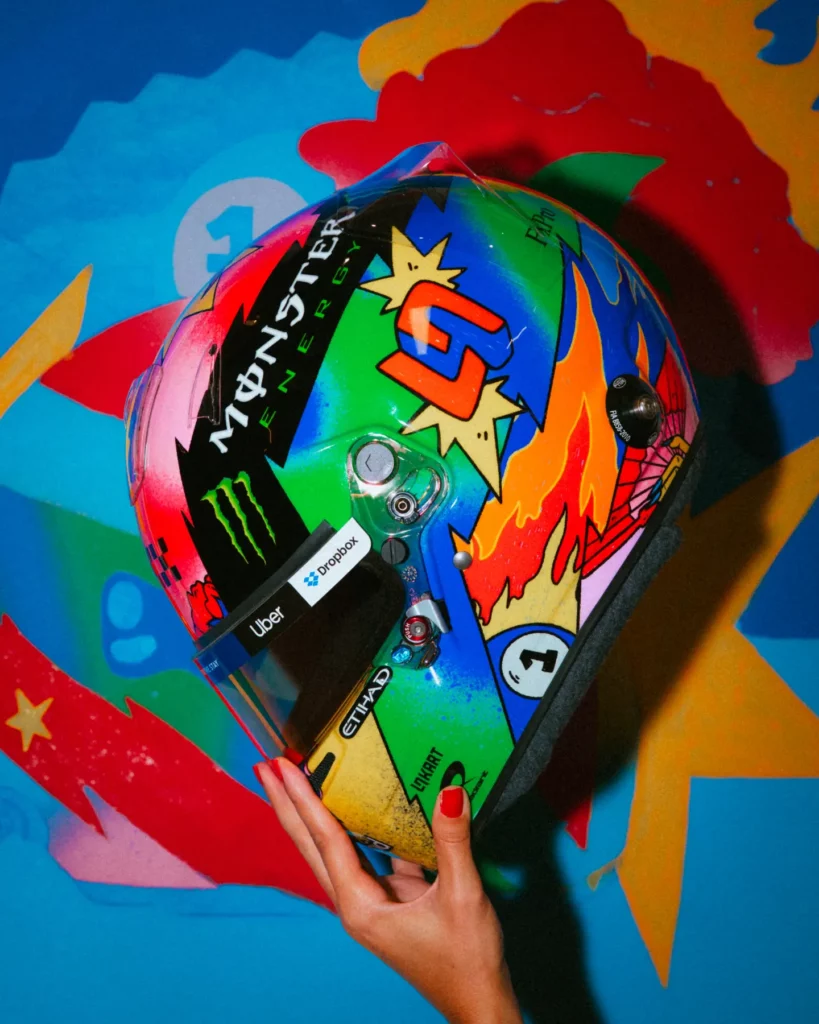
For collectors and display enthusiasts, a podium like Barcelona’s F3 sprint is about more than the result — it is about the visual record. PREMA Racing’s helmet designs for the 2024 season follow the team’s traditional red-dominant palette, with the driver’s personal branding layered over a base that ties the helmet to the car livery. A full-size 1:1 replica of a PREMA-era helmet sits at approximately 29 × 25 × 35 cm in overall dimension depending on the specific shell model used — standard measurements for the adult medium/large sizes common in F3. Display weight for a properly constructed replica shell runs around 1.2–1.5 kg, light enough to mount on a standard display stand without requiring reinforced shelving.
Freddie Slater’s Trident livery carries its own distinct identity — the team’s colour scheme has a darker, more aggressive graphic language compared to PREMA’s clean red-and-white — making a three-helmet podium display from this race immediately readable as a set. Each helmet tells a different story about its team and driver, and the Barcelona sprint podium in particular captured all three at a moment of genuine competition rather than processional racing.
The visor area is one of the most important display details in any collector replica. A properly finished display visor sits at around 3 mm in thickness, with a chrome or dark-tinted finish depending on which specification is being referenced. The Barcelona circuit — with its mix of medium-speed corners and long main straight — sees drivers run a range of visor tints, but the mirror finish associated with bright Catalan sunshine is the one most commonly reproduced in high-quality display replicas. That finish catches light differently depending on the angle of display, giving a full-size replica genuine visual depth that a scaled-down version simply cannot replicate.
For the collector building a documentation of the 2024 F3 season’s key moments, the Barcelona Sprint sits alongside other headline races as a definitive podium to represent. Wharton’s victory — PREMA’s livery leading home a race at a circuit that has produced F1 champions and defining moments across decades — is the kind of result that anchors a display collection around a specific season and team identity.
What Wharton’s Win Means for the Championship Picture
Sprint races in the FIA Formula 3 Championship award points on a condensed scale compared to the Feature Race, but they are not cosmetic. Points from Saturday morning — or Sunday morning, depending on the round schedule — accumulate across a season that spans multiple European circuits, and a victory is a victory regardless of the race duration. Wharton taking the win in Barcelona added to PREMA’s championship momentum and kept the Australian driver in the conversation for the overall title.
PREMA’s record in junior formula racing speaks for itself: the team has produced a consistent pipeline of drivers into Formula 2 and Formula 1 over the past several seasons, and their car preparation — evidenced by Wharton’s ability to manage a tyre-degraded final phase after the VSC restart — reflects the technical depth the Italian outfit brings to every round. A win at Barcelona, on a circuit the entire F1 paddock knows intimately from pre-season testing alone, carries additional weight as a performance benchmark.
For Freddie Slater, second place was a solid consolidation. For Xie, the podium from pole — even if it ended in third — demonstrated that DAMS Lucas Oil had genuine race pace at the Circuit de Barcelona-Catalunya. The race that unfolded across its short sprint distance was, in terms of incident count and lead changes, one of the more eventful of the season to that point: two drivers failing to start properly, a yellow flag, a Virtual Safety Car, a lead change at Lap 5, and a podium decided by tyre degradation patterns rather than strategy calls. That density of action across a compact race distance is precisely what makes sprint format replays — and the helmets that represent them — worth preserving as collector pieces.
“Wharton swept around the outside of the DAMS driver on Lap 5, Xie’s tyres struggling as the PREMA car took the lead it would not relinquish.”
— Race commentary, F3 Barcelona Sprint 2024
“It was a disaster for Tiato Kato — the ART driver stalled on the grid and was forced to start from the pit lane before a racing lap had begun.”
— F3 Barcelona Sprint Race Report
FAQ
Q: Who won the Formula 3 Sprint Race at Barcelona in 2024?
James Wharton won the Formula 3 Sprint Race at the Circuit de Barcelona-Catalunya for PREMA Racing, leading home Freddie Slater in second and Gerrard Xie in third.
Q: How does the F3 Sprint Race grid work?
The Formula 3 Sprint Race grid is based on an inverted order from qualifying — drivers who qualified in the lower half of the field start at the front of the sprint. Gerrard Xie started from pole for the Barcelona Sprint after qualifying 12th for the Feature Race.
Q: What is the typical size and weight of a full-size F3 helmet display replica?
A full-size 1:1 display replica of an F3-era helmet is approximately 29 × 25 × 35 cm in overall dimension and typically weighs around 1.2–1.5 kg — sized for a standard adult helmet shell. These are collector and display pieces only, not certified for any protective use.
Q: Why did Tiato Kato and Mattia Colnaghi fail to start the Barcelona Sprint Race?
Kato stalled on the grid before the race start and was required to begin from the pit lane. Colnaghi filtered into the pit lane during the formation lap and returned there a second time during the early stages of the sprint itself.
Q: What triggered the Virtual Safety Car in the Barcelona F3 Sprint?
Ernesto Rivera, running as a Red Bull junior driver, brought his car to a stop in the final sector of the circuit when his engine stopped responding. The VSC was deployed to allow safe recovery of the stationary car.
The Barcelona Sprint podium — PREMA red, Trident’s livery, DAMS Lucas Oil — is the kind of three-helmet visual that belongs on a shelf, not just a screen. Browse the full F1 helmet collection at 123Helmets and find the full-size 1:1 display replica that marks your moment in the 2024 season.
Display and collector replicas only. Not certified for protective use. Full-size 1:1 scale.
This article was written with the help of AI tools. Editorial policy