
Blog
Mercedes Fixes Spa Deployment Bug Before Hungarian GP 2026
 123Helmets Editorial Team

Mercedes has rewritten deployment code on George Russell’s power unit after a software fault turned his Belgian Grand Prix weekend into a public struggle, and the team says the fix is already in the car ahead of the Hungarian Grand Prix.
Key Takeaways
Mercedes found a code-level fault that front-loaded George Russell’s energy deployment earlier in the lap at Spa-Francorchamps, costing him straightline speed to the final chicane.
Team principal Toto Wolff said the deployment issue accounted for roughly half of Russell’s pace deficit to team-mate Kimi Antonelli, with driving style making up the rest.
A weak exit from Raidillon on lap one left Russell exposed to the chasing pack, a factor in his first-corner-adjacent clash with Lewis Hamilton at Les Combes.
Mercedes has applied deployment software changes ahead of the Hungarian Grand Prix weekend, though the team has not claimed the fix guarantees a result.
What went wrong for Russell at Spa
George Russell lost several tenths of a second per lap in qualifying at Spa-Francorchamps because his car was running out of battery power earlier on the run to the final chicane than team-mate Kimi Antonelli’s. The car’s energy deployment strategy was depleting the battery too early in that final sector, leaving Russell without electric assistance exactly where the long Kemmel-to-chicane run rewards it most. There was no obvious external explanation at the time — no visible damage, no setup discrepancy that jumped out — which is what pushed the team into a deeper software audit after the weekend.
The problem followed Russell into the race. A weak exit out of Raidillon on the opening lap meant he had less straightline punch than expected onto the Kemmel Straight, and the chasing pack closed in immediately. That compression contributed to his coming together with Lewis Hamilton at Les Combes, ending his afternoon early. Sat in the gravel trap, Russell used the word “unacceptable” over team radio to describe what he had faced across the whole weekend — qualifying, race start, and the resulting retirement all traced back to the same underlying fault.
The code fault, explained
The fault was located deep in the deployment algorithm that decides how energy is spent across a lap, and it was biasing extra power toward the run to Les Combes rather than balancing it through the rest of the circuit. In practice this meant Russell’s car was front-loading deployment — using energy sooner than it needed to — which left less in reserve for the final chicane approach where Antonelli’s car was still pulling. Differences in how the two drivers were harvesting and managing battery through the middle sector compounded the effect, but the code-level bias was the root cause the team’s engineers zeroed in on.
Toto Wolff said after the race that this deployment issue accounted for roughly half of Russell’s deficit to Antonelli, with the remaining gap put down to differing driving styles between the two. That split matters for how Mercedes prioritized its fix: rather than asking Russell to simply adapt his inputs, the team went back into the power unit software itself to correct the underlying bias before it could resurface at another circuit with a long final sector.
Livery and helmet story from a difficult weekend
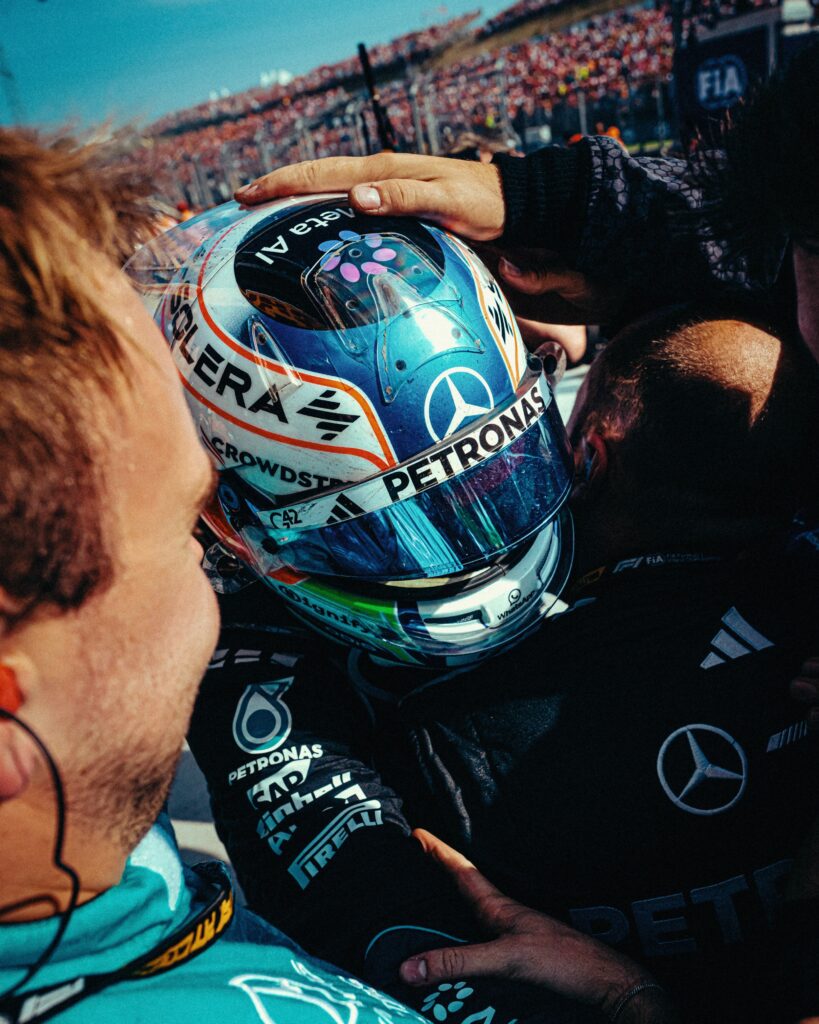
Mercedes ran its established silver-and-black 2026 livery at Spa-Francorchamps, a scheme that photographs cleanly under the circuit’s mixed weather and dense tree line, and it remained the visual backdrop for what was otherwise a frustrating technical weekend for the No. 63 car. Russell’s helmet design, carried through qualifying and into the shortened race, kept its signature color-blocking intact even as his on-track story turned sour — a reminder that livery and helmet artwork exist independently of race results and often become more collectible after a dramatic weekend rather than less.
Antonelli’s helmet, by contrast, was photographed in cleaner running throughout the weekend given his straightline advantage over his team-mate, and images of both drivers side by side at Spa have already become reference points for fans comparing deployment-affected and unaffected pace. For collectors, full-size 1:1 replica helmets from a weekend like this carry extra narrative weight: the shell and visor artwork tell the story of a driver’s fight with the car even when the result sheet does not fully explain it.
Wolff’s response and the team’s reasoning
Toto Wolff confirmed after Spa that internal analysis had uncovered an unspecified engine-related problem contributing to Russell’s lack of deployment on the final run to the chicane. He framed it as a genuine car issue rather than a driver shortfall, which is significant given how publicly frustrated Russell was over the radio mid-race. Wolff’s explanation — that the fault covered around half the pace gap — gave the team a clear technical target rather than leaving the issue as a vague form dip.
That framing also explains why Mercedes moved quickly to apply software changes rather than waiting for a hardware revision. A deployment bias buried in code can, in principle, be corrected between race weekends without a physical part change, which is why the fix reached the car ahead of the very next round rather than being pushed further down the calendar.
What the fix means heading into Hungary
Mercedes has applied deployment software modifications to Russell’s car specifically to prevent the front-loaded energy bias that hurt him at Spa from recurring at the Hungarian Grand Prix. The team has been careful not to frame this as a guaranteed pace gain — Wolff’s own breakdown attributed only part of the Spa deficit to the software fault, with driving style differences making up the rest — so Hungary will be the first real test of whether the correction closes the gap to Antonelli in a straight-line-sensitive sector. The Hungaroring’s own energy demands differ from Spa’s long Kemmel-to-chicane run, which adds another variable to how visible the fix will be in practice.
No results, grid positions or race outcomes from the Hungarian Grand Prix weekend can be reported here since the event has not yet taken place as of July 23, 2026. What can be said is that the technical direction is set: Mercedes engineers have identified a specific code-level cause, applied a targeted correction, and will judge its effectiveness through practice and qualifying data at the new venue rather than assumption.
“Unacceptable.”
— George Russell, over team radio after his Spa retirement
FAQ
Q: What caused George Russell’s straightline speed problem at Spa?
A code-level fault in his power unit’s deployment software front-loaded his energy use earlier in the lap, leaving him with less battery power on the run to the final chicane than team-mate Kimi Antonelli.
Q: How much pace did the deployment fault cost Russell?
Toto Wolff said the software issue accounted for roughly half of Russell’s deficit to Antonelli in qualifying, with differing driving styles making up the remainder of the gap.
Q: Has Mercedes fixed the problem before the Hungarian Grand Prix?
Yes, Mercedes has applied deployment software modifications ahead of the Hungarian Grand Prix weekend specifically targeting the code fault found after Spa, though the team has not predicted the on-track effect at the new circuit.
Q: Did the deployment issue affect Russell’s race at Spa?
Yes, a weak exit out of Raidillon on lap one linked to the same deployment shortfall left him exposed to the chasing pack, a contributing factor in his contact with Lewis Hamilton at Les Combes and his subsequent retirement.
Q: Are 123Helmets Mercedes replicas based on race-used designs?
Our full-size 1:1 collector replicas reproduce the driver helmet artwork and Mercedes livery details seen across the 2026 season, including the designs worn during weekends like the Belgian Grand Prix, built as display and exhibition pieces rather than for on-track use.
Shop Mercedes Helmets
Display and collector replicas only. Not certified for protective use. Full-size 1:1 scale.