Blog
Max Verstappen 2026 Orange Lion Helmet — Austrian GP Collector Replica
 123Helmets Editorial Team
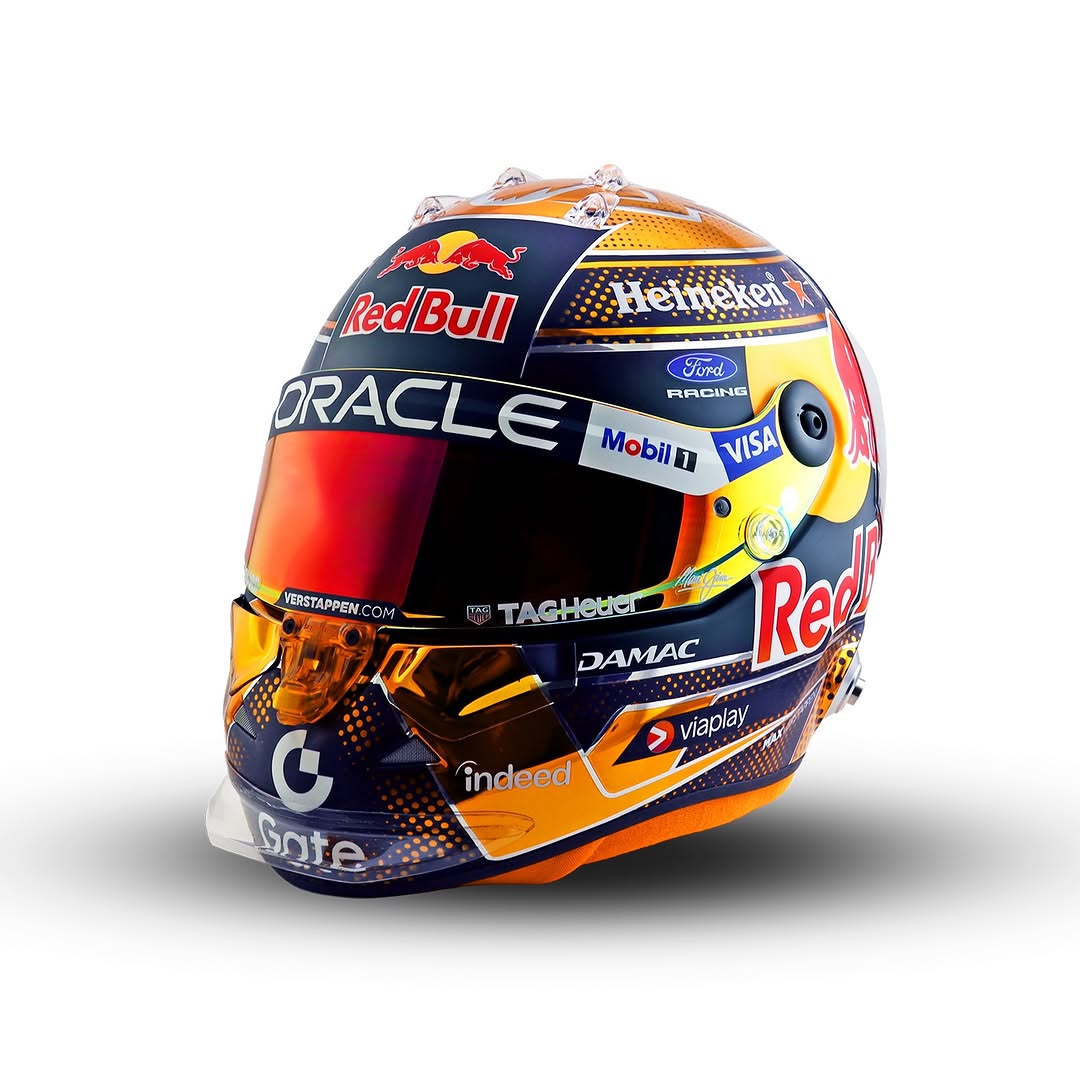
Max Verstappen’s 2026 Orange Lion helmet, worn at the Austrian Grand Prix, is now available as a full-size 1:1 display replica through Verstappen.com. Here is everything a serious collector needs to know about this piece.
Key Takeaways
The 2026 Orange Lion is a full-size 1:1 scale collector replica, not a certified protective helmet.
The design debuted at the 2026 Austrian Grand Prix and is officially tied to Verstappen.com scale model listings.
Orange remains Verstappen’s defining color identity, carrying direct reference to the Dutch national color across every panel.
Six official media images document the helmet’s surface detail, making this one of the most photographed Verstappen display releases of the 2026 season.
What Is the 2026 Orange Lion Helmet Replica?
The 2026 Orange Lion is a full-size 1:1 collector and display replica of the helmet Max Verstappen wore at the 2026 Austrian Grand Prix, listed officially through Verstappen.com as a scale model display piece. It reproduces every painted surface, graphic, and finish detail of the race-worn original at exact 1:1 scale — meaning the shell dimensions, visor aperture, and overall proportions match the genuine article with no reduction in size. This is a display piece produced for collectors and exhibition use, carrying no protective certification of any kind.
The Austrian Grand Prix has long held a special place in Red Bull’s calendar. The race takes place at the Red Bull Ring in Spielberg, a circuit that Red Bull effectively owns, and Verstappen has built a strong personal record there across multiple seasons. A helmet issued specifically for that round carries layered meaning for any collector who follows the championship closely: it marks a specific round, a specific circuit, and a specific phase of the 2026 regulations era.
Display replicas at 1:1 scale are the closest a collector can come to the physical presence of a race helmet without holding the race-worn original. The shell size, the visor cutout, the chin vent detailing — all are reproduced at the dimensions of the genuine helmet. That fidelity is what separates a 1:1 display piece from the 1:2 or 1:5 scale models that occupy a different tier of the collector market.
The Orange Lion Design — Color, Symbol, and Identity
The Orange Lion design takes its name from the combination of the Dutch national color — a deep, saturated orange — and the lion motif that Verstappen has used as a personal symbol throughout his career. Orange is not simply a brand choice; it is the color of the Dutch royal house and the Dutch national football kit, and it carries direct cultural weight for a driver who has become the most prominent Dutch athlete in global sport since the mid-2020s. Every Orange Lion helmet release, regardless of the specific race version, leans into that identity as a primary visual statement.
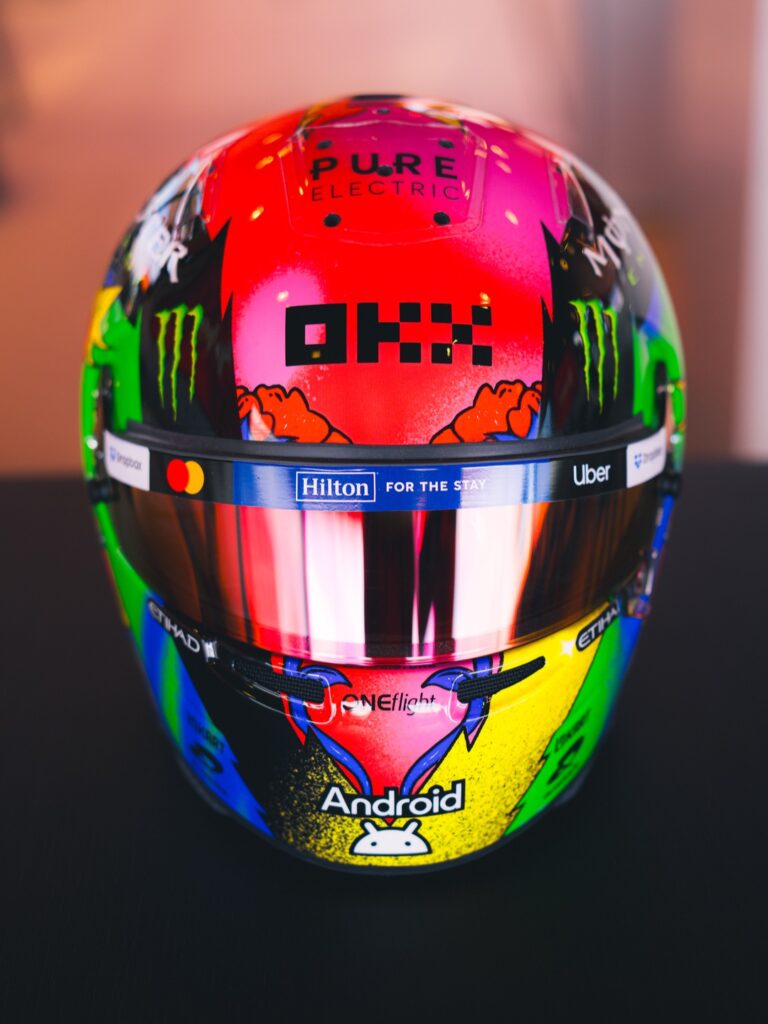
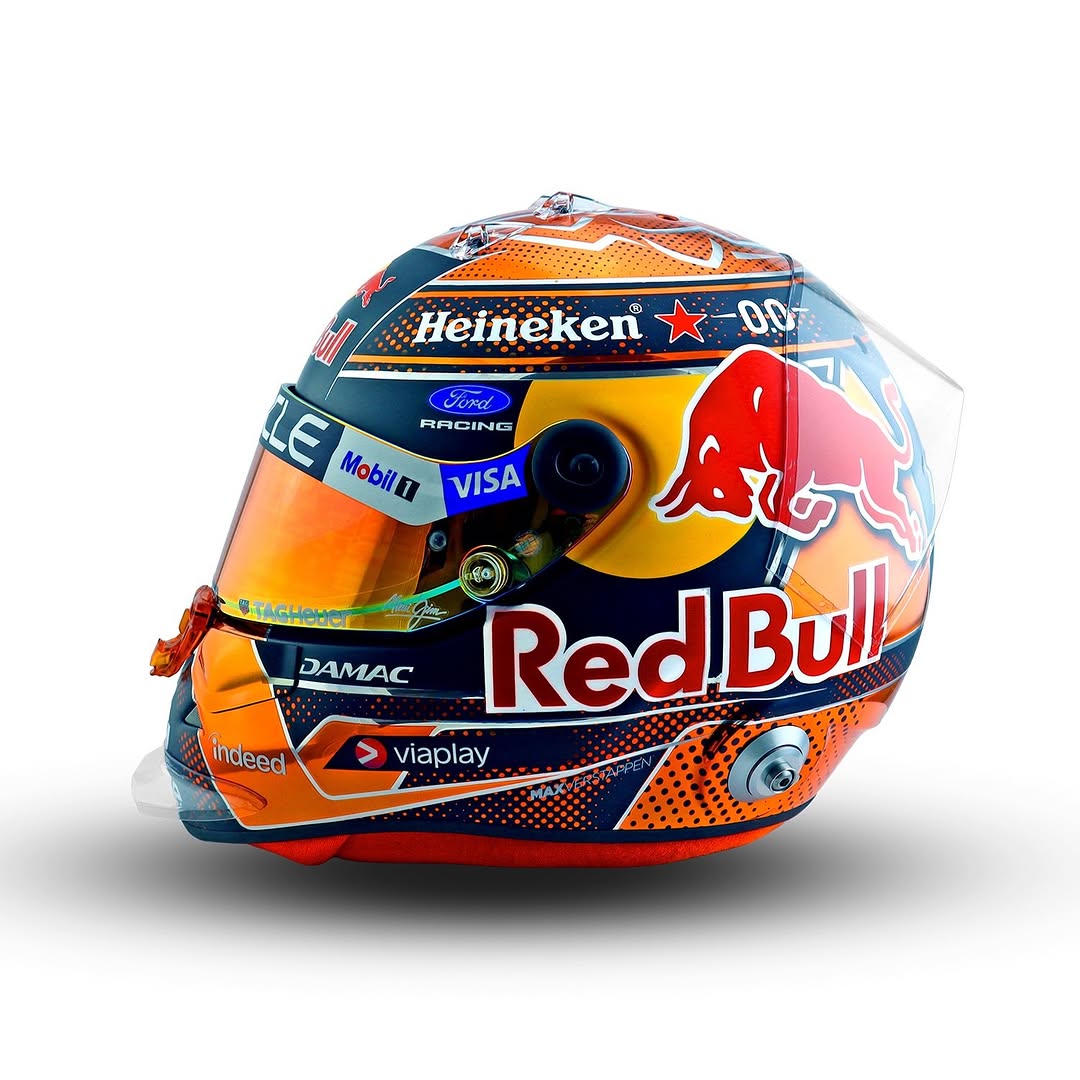
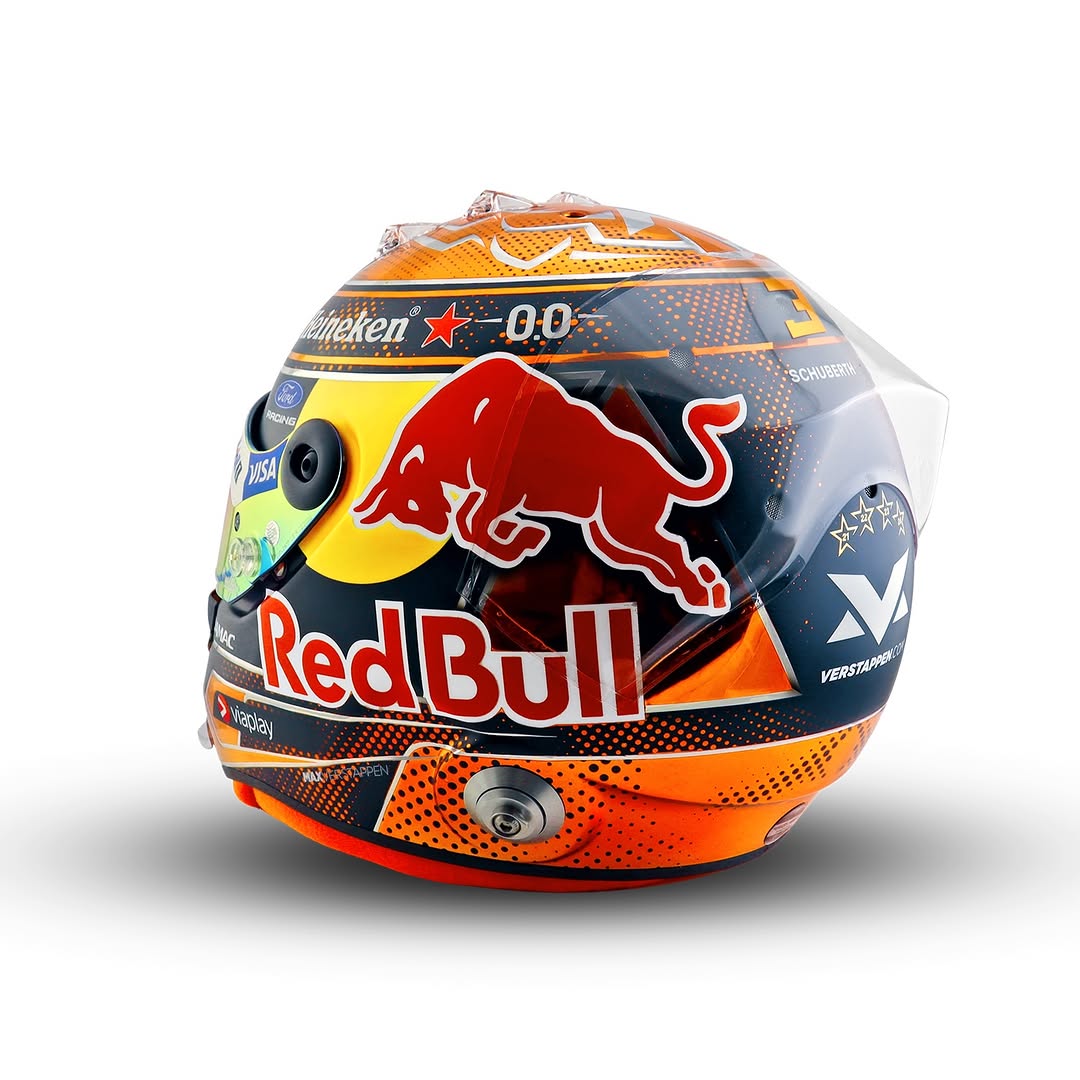
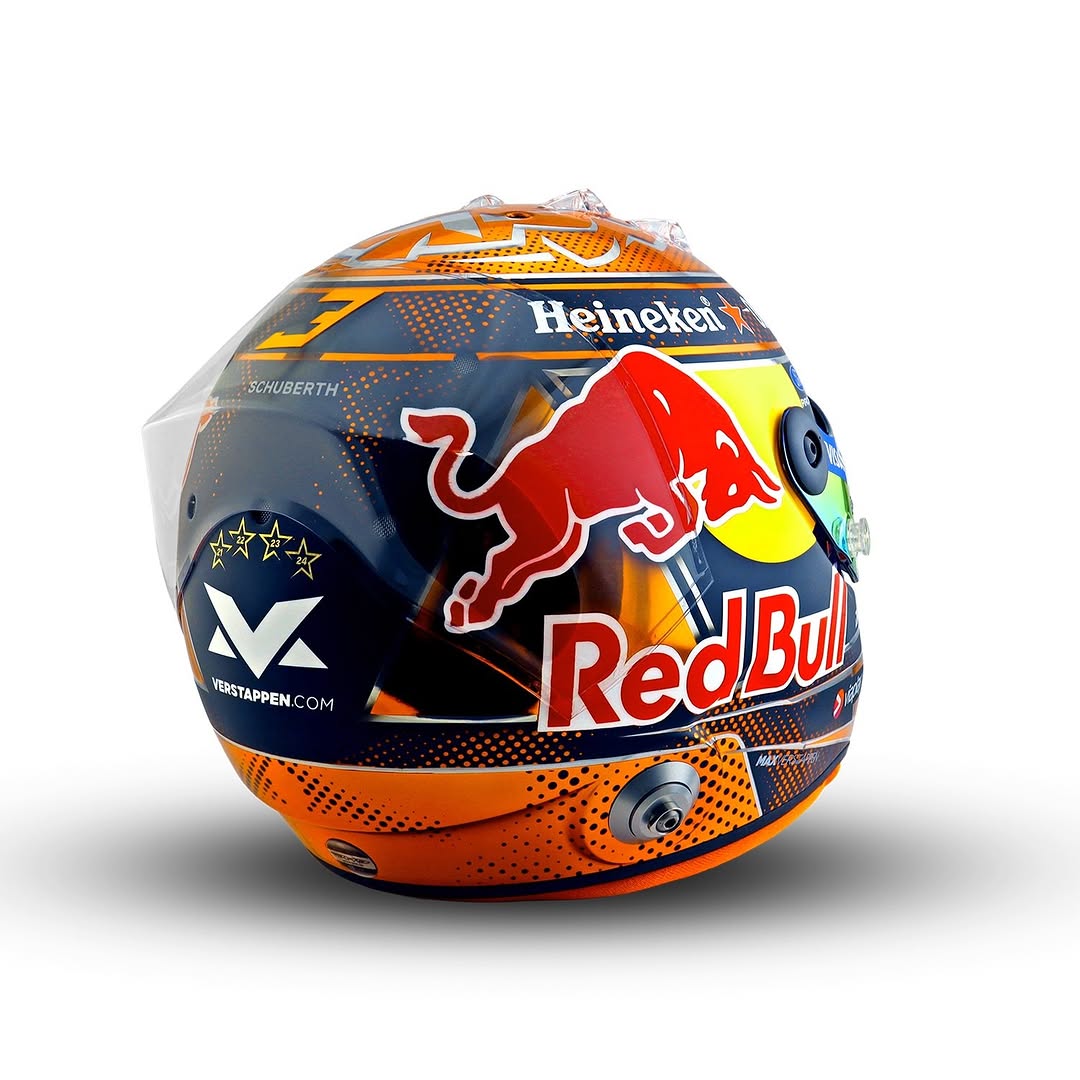
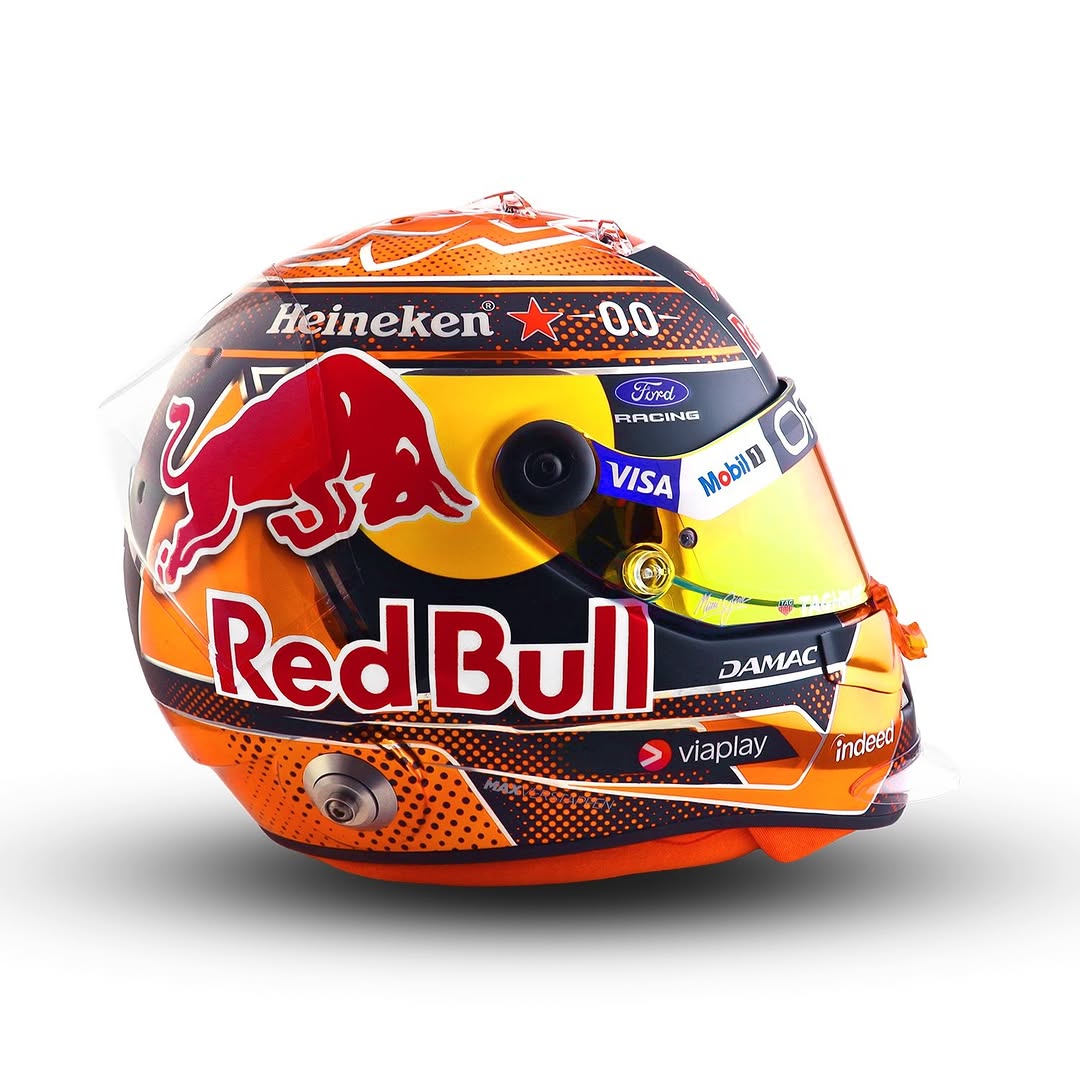
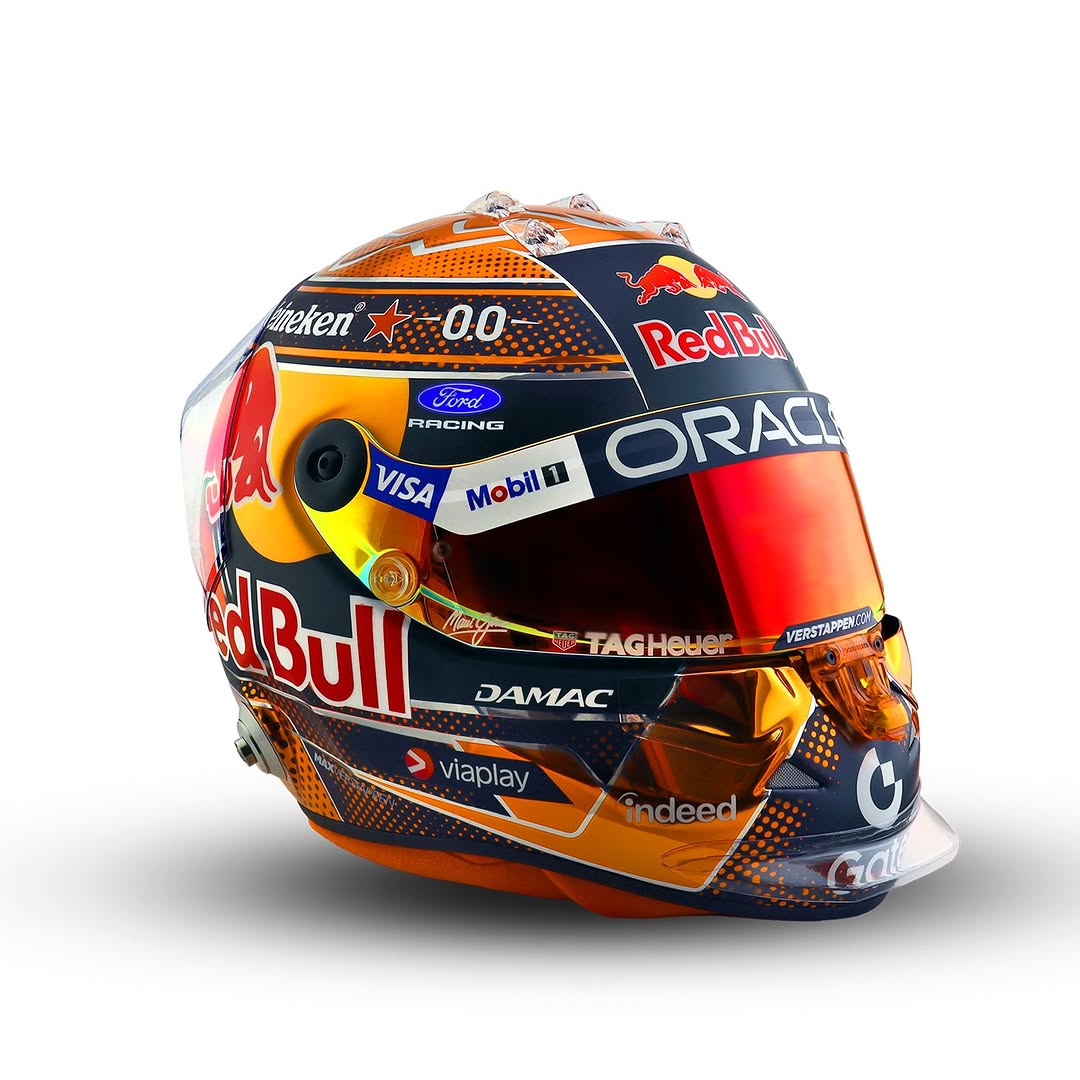
The 2026 iteration updates the graphic language relative to earlier Orange Lion versions. The lion graphic itself appears positioned prominently across the helmet’s crown and lateral panels, rendered with the kind of precision that only becomes fully visible at 1:1 scale. At reduced scales — 1:2 or smaller — fine linework in a complex logo tends to lose resolution. The 1:1 display replica preserves that linework at exactly the size it was painted for the race original.
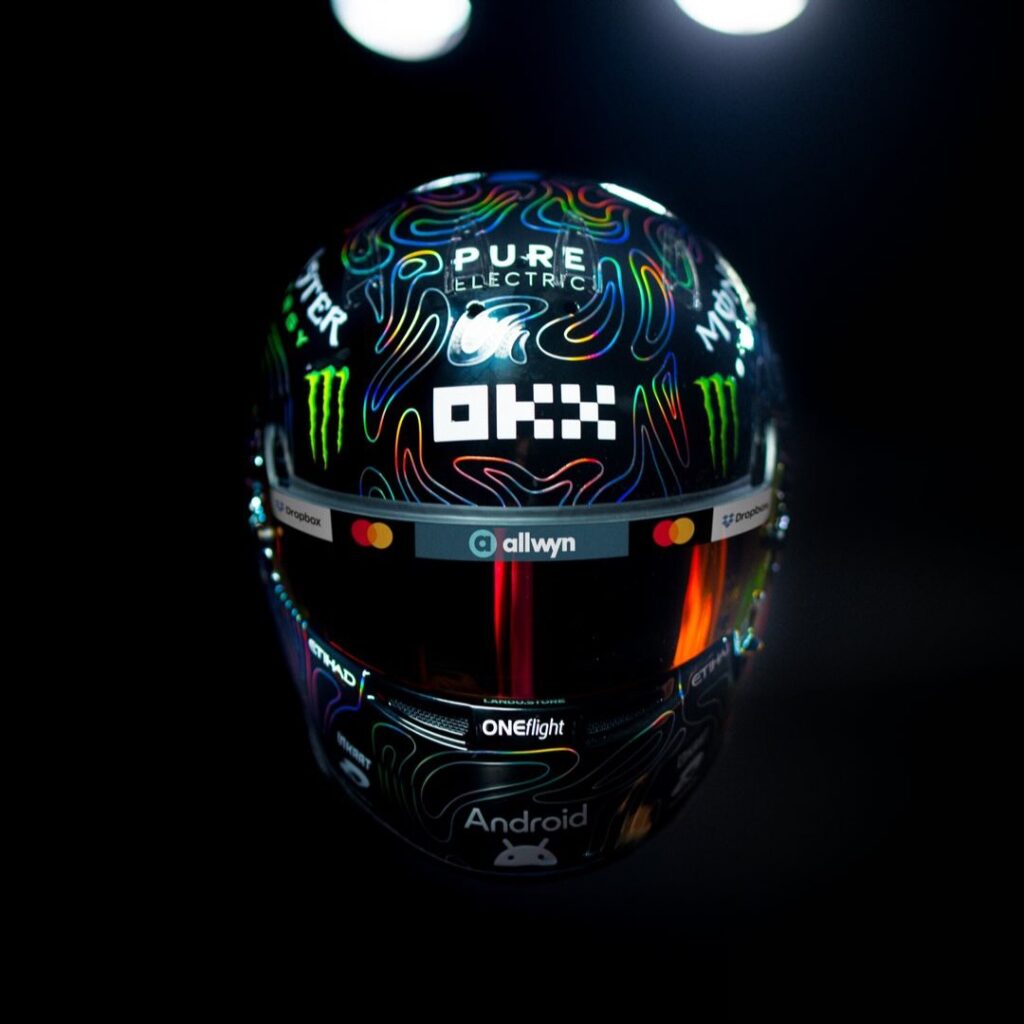
Six official images were released documenting the 2026 Orange Lion, covering multiple angles: front, rear, lateral left, lateral right, three-quarter front, and crown view. That six-image documentation set is notable because it gives prospective collectors a full read of the design before purchase, and it also establishes the visual record that display pieces are typically evaluated against when collectors assess accuracy of finish.
The background tone across the helmet shifts between the signature orange and darker contrasting zones that prevent the design from reading as a single flat color. Those tonal transitions — from the deeper burnt-orange at the chin to the brighter panels at the crown — are the kind of gradient detail that a high-quality display replica must capture accurately to read as exhibition quality rather than a generic licensed product.
2026 F1 Season Context — Why This Austrian GP Helmet Matters
The 2026 season marks the most significant technical regulation change in Formula 1 since 2022, introducing new aerodynamic rules alongside a revised hybrid power unit specification that all manufacturers were required to meet simultaneously. That regulatory reset makes every helmet issued in 2026 a document of a specific historical transition point in the sport. Collectors who focus on championship-era pieces tend to assign higher long-term significance to helmets from regulation-change seasons, because those seasons define new eras rather than continuing existing ones.
The Austrian Grand Prix in the 2026 calendar falls in the mid-season block. The Red Bull Ring circuit runs 4.318 km per lap, and the race distance covers 71 laps — figures that place it among the shorter-lap-count grands prix on the calendar by virtue of the circuit’s compact layout. A helmet worn at a circuit this closely associated with the Red Bull team carries additional collector resonance: Spielberg is effectively Red Bull’s home race, and performances there are watched with particular attention by the team’s global fanbase.
Verstappen’s personal connection to Austria is well established. He has taken pole position and race victories at the Red Bull Ring across multiple seasons, and the Austrian crowd has consistently been among the most vocal in his support. A display piece tied to that specific round communicates not just design identity but geographic and competitive specificity — the difference between a generic season helmet and a race-specific collector piece.
Collector and Display Specifications
The 2026 Orange Lion replica is a full-size 1:1 display piece, meaning it matches the physical scale of the race-worn helmet exactly across all external dimensions. It is listed on Verstappen.com as a scale model display item — the same channel that handles official merchandise and collector products associated with the driver. That official listing matters for collectors because provenance and authorisation are two of the primary criteria by which display replica value is assessed over time.
Display replicas at this scale are typically produced with a rigid outer shell, a fixed visor panel, and painted or printed graphic layers applied to the exterior surface. The visor on a 1:1 display piece is generally manufactured to sit at the correct aperture size and angle relative to the shell, which on a standard open-face F1 helmet profile spans approximately 26 mm in visor thickness at the frame edge — though exact specifications for this particular model are not published in the source material and should be confirmed directly with the retailer.
For display purposes, a 1:1 replica of this type typically requires a dedicated helmet stand or mount. The piece is intended for shelf, case, or pedestal exhibition rather than storage. The orange-dominant colorway means it reads well against both dark and light backgrounds, and the high-contrast lion graphic remains legible at viewing distances of 1 metre or more — a practical consideration for collectors who display pieces in office or gallery settings.
This replica is not certified for any protective use, does not carry FIA, Snell, ECE, or DOT ratings, and is not suitable for road or track use. It exists entirely as a collector and exhibition object, and that classification is what defines its place in a serious F1 display collection.
Why Verstappen Orange Lion Pieces Hold Collector Attention
Max Verstappen has won four consecutive FIA Formula 1 World Championships between 2021 and 2024, a sequence that places him among the most decorated drivers in the sport’s history and gives every piece of helmet memorabilia tied to his name a documented competitive context. Collector interest in a driver’s display pieces tends to correlate with on-track significance, and four consecutive titles across the 2021–2024 period represent a run of dominance that has no modern parallel outside of Michael Schumacher’s five consecutive titles between 2000 and 2004.
The Orange Lion identity specifically has become one of the most recognisable personal liveries in contemporary F1. Unlike some drivers who redesign their helmets frequently and without a consistent throughline, Verstappen has maintained the orange-and-lion combination as a constant across multiple seasons, with individual race versions serving as variations on a recognisable theme rather than completely new designs each time. That consistency means a collector building a Verstappen display series can present multiple helmets that read as a coherent visual set.
The 2026 season version carries the additional weight of being the first Orange Lion design produced under the new regulation framework. Whether that framework ultimately defines a new dominant era for Verstappen — or marks the beginning of a more contested period — the 2026 helmet will be a fixed reference point in the physical archive of his career. Display replicas produced in the same year the helmet was worn occupy a different collector category than retrospective reproductions issued years later.
Verstappen.com as the source channel also matters. Official driver-linked storefronts apply a level of design fidelity and licensing accountability that separates their output from unlicensed third-party reproductions. When a collector acquires a display piece through an official channel, the graphic accuracy — the specific shade of orange, the exact lion geometry, the placement of sponsor elements — reflects the approved design file rather than an approximation of it.
Displaying the 2026 Orange Lion in a Collection
A 1:1 display replica at this scale functions best as a focal point rather than a background item in any F1 collection. The size of a full-scale F1 helmet — approximately 27 cm in height and 35 cm in width at the widest lateral point on a standard profile — means it commands physical space in a way that 1:2 or smaller scale pieces do not. That presence is part of what makes 1:1 display replicas the premium tier of the collector market.
For collectors who already hold Red Bull or Verstappen pieces from earlier seasons, the 2026 Orange Lion fits naturally into a chronological display that traces the evolution of his helmet design from his early Red Bull years through the championship era and into the 2026 regulation cycle. Placed alongside a 2021 title-year helmet or a 2023 season piece, the 2026 version shows both the continuity of the Orange Lion identity and the specific graphic updates that distinguish the current version.
The Austrian GP specificity also opens a race-by-race display approach for the most dedicated collectors — those who seek one helmet per circuit rather than one per season. The Red Bull Ring association, Verstappen’s history at that venue, and the 2026 regulation context together give this piece a precise coordinate in the larger map of his career. That specificity is, for many collectors, exactly what separates a display piece worth acquiring from a generic seasonal release.
“2026 Orange Lion Helmet — Scale models available on Verstappen.com.”
— Verstappen.com official listing, 2026
FAQ
Q: Is the 2026 Orange Lion helmet a full-size replica?
Yes — it is a full-size 1:1 scale collector and display replica, matching the external dimensions of the race-worn original exactly. It is not a reduced-scale model and is not certified for any protective use.
Q: Where is the 2026 Orange Lion helmet officially listed?
It is listed on Verstappen.com as a scale model display item, the official channel for Max Verstappen’s collector and merchandise releases.
Q: Can this helmet be worn or used for track driving?
No — this is a display and collector piece only. It carries no FIA, Snell, ECE, or DOT certification and is not suitable for road use, track use, or any protective application.
Q: What race does the 2026 Orange Lion helmet represent?
The design is associated with the 2026 Austrian Grand Prix, held at the Red Bull Ring in Spielberg, a 4.318 km circuit over a 71-lap race distance.
Q: Why is the 2026 season significant for Verstappen helmet collectors?
2026 marks the first season under a major technical regulation overhaul, making it the opening year of a new F1 era — and the first Orange Lion design produced within that framework, which gives the helmet a specific historical position in any Verstappen display series.
Shop the Max Verstappen Collection — add the 2026 Orange Lion Austrian GP display replica to your exhibition today.
Display and collector replicas only. Not certified for protective use. Full-size 1:1 scale.
This article was written with the help of AI tools. Editorial policy