- Keke Rosberg
- Nigel Mansell
- Jenson Button
- Nico Rosberg
- Gilles Villeneuve
- Mika Hakkinen
- Jackie Stewart
- Charles Leclerc
- Lewis Hamilton
- Max Verstappen
- Lando Norris
- Ayrton Senna
- Michael Schumacher
- Fernando Alonso
- Oscar Piastri
- George Russell
- Kimi Antonelli
- Nico Hülkenberg
- Gabriel Bortoleto
- Pierre Gasly
- Franco Colapinto
- Carlos Sainz
- Oliver Bearman
- Sergio Pérez
- Valtteri Bottas
- Isack Hadjar
- Alain Prost
- James Hunt
Alonso on Aston Martin’s P21–P22 in Barcelona: ‘We Knew We Have the Worst Car and the Worst Engine’
Posted by
 123Helmets Editorial Team
123Helmets Editorial Team
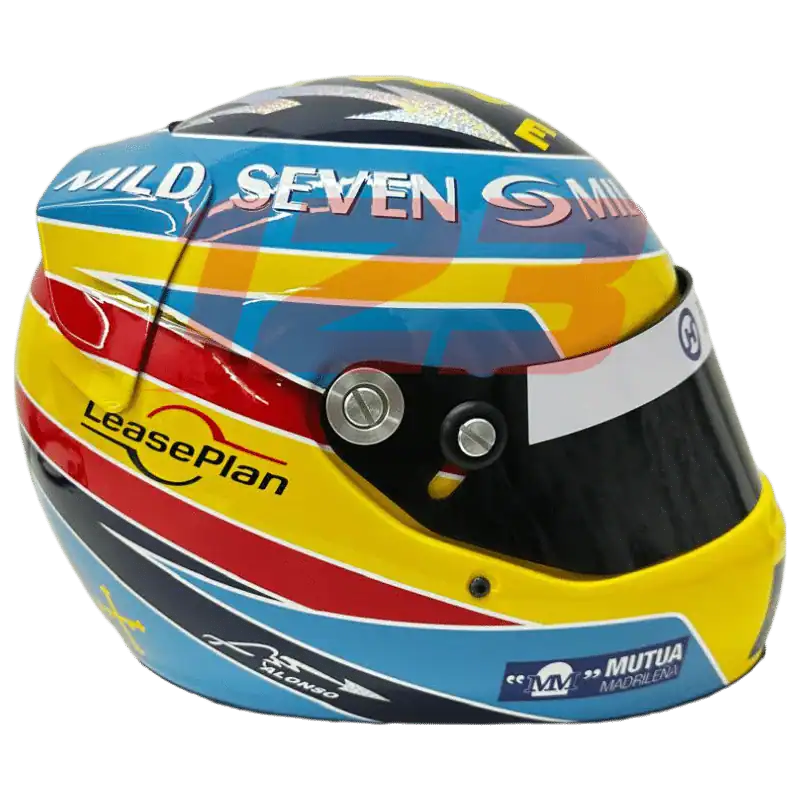
2025 Spanish GP
Fernando Alonso did not flinch when Aston Martin qualified 21st and 22nd at the 2025 Spanish Grand Prix in Barcelona. The two-time world champion was blunt: the team already knew where it stood, it has a plan, and that plan hinges on a major aerodynamic and power-unit overhaul arriving in the second half of the season.
Key Takeaways
Aston Martin qualified P21 and P22 in Barcelona — last and second-to-last on the grid.
Alonso stated the team has ‘the worst car and the worst engine’ and that nothing unexpected was exposed.
A new aerodynamic package and a new engine are both targeted for the second half of the 2025 season.
The Austrian Grand Prix — two weeks after Barcelona — is the next milestone on Aston Martin’s recovery calendar.
The Barcelona Result in Plain Numbers
Aston Martin placed P21 and P22 in qualifying at the 2025 Spanish Grand Prix at Circuit de Barcelona-Catalunya — the two slowest times on the entire grid. For a team that reached the front rows of the grid as recently as 2023, those positions represent a stark reversal of fortune, and they arrived at a circuit where aerodynamic efficiency is punished mercilessly across the long, high-speed corners of Sectors 1 and 2.
Barcelona has hosted the Spanish Grand Prix on its current layout since 1991, and its 4.675 km lap is widely regarded as one of the most technically demanding in the calendar for chassis and downforce balance. A car lacking both aerodynamic grip and raw power has nowhere to hide across the 16-corner circuit, and Aston Martin’s AMR25 was exposed by both deficits at once.
The gap between P21 and P22 and the front of the grid was not a single-tenths story — it was the kind of structural deficit that shows up in every corner type, not just the power-sensitive straights. That context makes Alonso’s measured response all the more telling: he was not surprised because the team had already quantified exactly how far behind it was before a single lap was set in Spain.
Alonso’s Own Words: ‘Nothing Has Been Exposed’
Alonso’s direct statement after qualifying was: “Nothing has been exposed. We knew that we have the worst car and the worst engine, and we’ve been very clear in every race so far that we have to work.” That is not deflection — it is a driver telling the paddock that the team’s internal data matched the public result exactly.
The phrase “nothing has been exposed” carries real weight in Formula 1 engineering language. It means the simulation, windtunnel, and dyno data all pointed to the same conclusion the stopwatch confirmed on track. There was no hidden performance that a different setup or strategy could have unlocked on Saturday. Aston Martin went to Barcelona knowing P21 and P22 were the realistic ceiling, not a bad day at the office.
Alonso, a 32-time Grand Prix winner and two-time world champion (2005, 2006), has been in F1 long enough to know the difference between a bad weekend and a structural problem. His language at Barcelona was the language of a driver who has accepted the structural reality and is focused entirely on the timeline for fixing it, not on managing perception in the short term.
“We knew that we have the worst car and the worst engine, and we’ve been very clear in every race so far that we have to work, and in the second part of the year arrives a new car on the aerodynamic side, arrives a new engine, and we have the hopes there.”
The two-part nature of the upgrade — aero and engine arriving together in the second half of 2025 — is significant. Normally teams stagger development to isolate variables. Bringing both simultaneously suggests Aston Martin believes the deficits are so well-understood that a combined step is the fastest route back to competitiveness.
The Upgrade Plan: Aero Package and New Engine
Aston Martin’s recovery roadmap has two defined pillars: a new aerodynamic package and a new power unit, both targeted for the second half of the 2025 season. Alonso confirmed both elements publicly in Barcelona, giving the team’s timeline an unusual level of transparency for a constructor still deep in its development hole.
The aerodynamic side of the upgrade is expected to address the fundamental downforce deficit the AMR25 has shown all season. In modern F1 cars the floor and diffuser account for the majority of total downforce generated — estimates from aerodynamic engineers across the paddock typically place the underbody’s contribution at around 60–70 percent of total aerodynamic load. A full aerodynamic overhaul therefore is not a wing update; it implies a significant rethink of the car’s ground-effect architecture.
The engine situation is equally serious. Aston Martin runs Honda power, and a new specification unit arriving mid-season would represent a significant step in the supplier’s development programme. Honda has been known for delivering reliable, race-ready upgrades, and a new engine homologated within the 2025 season cycle would give Alonso and teammate Lance Stroll both more raw power on the straights and — in a modern hybrid unit — potentially improved energy deployment through the medium-speed corners where the current car loses most time.
The Austrian Grand Prix at the Red Bull Ring, approximately two weeks after the Spanish GP, is the next race on Aston Martin’s calendar and the circuit Alonso specifically named. The Red Bull Ring’s 4.318 km layout is characterised by long power straights and medium-speed corners, making it another circuit where the current AMR25 deficit will be visible. Whether the upgrades land at Austria or later in the summer will determine how many races Aston Martin sacrifices in the interim.
Where Aston Martin Stood Before Barcelona
Aston Martin entered the 2025 season having already identified that it arrived at every race weekend understanding the car was at the back of the field — Alonso’s Barcelona comments were consistent with messaging the team delivered across every race so far in 2025. That internal consistency is both a strength and a challenge: it shows the team’s engineering analysis is reliable, but it also means there has been no single weekend where unexpected performance gave them a reason for optimism before the planned upgrades arrive.
The 2023 season was Aston Martin’s high-water mark in the hybrid era, with the AMR23 regularly qualifying inside the top four and Alonso taking multiple podiums. The 2024 AMR24 saw a sharp regression as rivals — particularly Red Bull, Ferrari, and McLaren — unlocked further gains from ground-effect floor philosophy that Aston Martin’s car had not matched. By the time the 2025 season opened, the team was no longer competing for points in normal race conditions.
That context makes the Barcelona result a data point in a trend, not an isolated shock. P21 and P22 are the arithmetic conclusion of a development trajectory that began heading in the wrong direction relative to the field in mid-2023. The team has been transparent about that trajectory, and Alonso has consistently refused to pretend the car is closer to the front than it actually is.
Why Helmet Collectors Track Moments Like This
For helmet collectors and F1 display piece enthusiasts, a driver’s candid mid-crisis interview is often the moment that defines an era — and drives long-term collector demand for replica helmets tied to that driver’s image during the period. Alonso’s Barcelona 2025 comments are the kind of honest, unguarded statement that becomes part of the narrative around a career chapter, and collector items from this season carry the weight of that context.
A full-size 1:1 collector replica of Fernando Alonso’s 2025 helmet captures more than paint and livery. It represents a specific moment in the sport: a veteran champion competing at a disadvantage, making no excuses, and committing publicly to a come-back timeline. The 2025 Aston Martin green — defined by the team’s #00594F British Racing Green shade — is among the most recognisable liveries on the 2025 grid, and display replicas produced to exhibition quality carry that livery across a 1:1 scale shell with the same dimensional accuracy a collector expects from a serious display piece.
Collector replicas of Alonso’s helmets have historically tracked his career moments closely. His 2005 and 2006 championship seasons produced high-demand Renault-era display pieces. His McLaren 2007 season, contentious as it was, generated collector interest because of the story attached to it. The 2025 Aston Martin chapter — with its public admission of last-place machinery and a defined upgrade window — is shaping up as another chapter that collectors will want to document in their display collections.
Full-size 1:1 display helmets are produced at real-world helmet dimensions, typically with a shell measuring approximately 27 × 35 cm and a total weight around 1.4–1.5 kg depending on the construction method. A polycarbonate visor on a quality display replica is typically 3–4 mm thick — sufficient to hold its shape under display conditions and resist minor surface abrasion without affecting the collector finish. These are exhibition-quality items produced for display cases, shelving, and private collections — not for track or road use, and not safety-certified under any standard.
What Comes Next: Austria and the Long Game
Aston Martin’s next public test of its trajectory is the Austrian Grand Prix at the Red Bull Ring, scheduled approximately two weeks after the Spanish GP. Alonso named Austria specifically in his Barcelona debrief, indicating it is the next checkpoint on the team’s internal timeline — though not necessarily the race at which the upgrade package lands.
The Red Bull Ring is 4.318 km long and runs at one of the highest average speeds on the calendar, with two extended full-throttle sections in sectors 1 and 2 that will again expose the AMR25’s power deficit. If the new engine specification is not ready by Austria, Alonso and Stroll will likely face a similar starting position to Barcelona. But if the aerodynamic or power-unit development lands in time, Austria could mark the first visible data point of Aston Martin’s second-half recovery.
The team’s decision to be this transparent about its situation — publicly stating it has the worst car and the worst engine, naming the upgrade timeline, flagging Austria as the next milestone — is a calculated communication strategy. It manages the expectations of sponsors, investors, and the media while also holding the engineering side accountable to a publicly-stated delivery window. For a team with Aston Martin’s backing and infrastructure, the credibility of that window matters as much as the result itself.
For collectors tracking the 2025 season, the weeks between Barcelona and Austria represent the final chapter before an anticipated technical inflection point. Display pieces from this precise stretch of the season — helmets, scale models, and associated collector items tied to Alonso’s 2025 campaign — carry the specific narrative of a champion in a difficult car, still racing with precision, waiting for the tools to match the talent. That narrative has historically proven to be among the most enduring in F1 collector culture.
“Nothing has been exposed. We knew that we have the worst car and the worst engine, and we’ve been very clear in every race so far that we have to work, and in the second part of the year arrives a new car on the aerodynamic side, arrives a new engine, and we have the hopes there.”
— Fernando Alonso, post-qualifying interview, 2025 Spanish Grand Prix, Barcelona
“We will arrive in Austria in two weeks.”
— Fernando Alonso, 2025 Spanish Grand Prix, Barcelona — via @adamcooperF1
FAQ
Q: Why did Aston Martin qualify P21 and P22 at the 2025 Spanish Grand Prix?
Aston Martin qualified P21 and P22 in Barcelona because the AMR25 has both the lowest aerodynamic downforce and the weakest power unit on the 2025 grid — a dual deficit Alonso confirmed publicly after qualifying. The 4.675 km Circuit de Barcelona-Catalunya punishes both shortcomings across its high-speed corners and long straights, leaving no area of the lap where the team could compensate.
Q: What upgrades is Aston Martin bringing to fix the AMR25?
Aston Martin is targeting a new aerodynamic package and a new power unit for the second half of the 2025 season. Alonso confirmed both elements publicly in Barcelona. The aerodynamic work is expected to address the car’s ground-effect downforce deficit, while the new engine specification from Honda is intended to close the power gap to the leading teams.
Q: When is the Austrian Grand Prix and why did Alonso mention it?
The Austrian Grand Prix at the Red Bull Ring takes place approximately two weeks after the 2025 Spanish Grand Prix. Alonso named Austria specifically in his Barcelona debrief as the team’s next scheduled race milestone on its road to recovery, making it the next public checkpoint for evaluating whether the upgrade timeline is on track.
Q: What is a full-size 1:1 F1 helmet replica?
A full-size 1:1 F1 helmet replica is a collector and display item produced at the same external dimensions as a real racing helmet — typically a shell measuring approximately 27 × 35 cm — reproducing the exact livery, sponsor graphics, and visor styling of a specific driver’s race helmet. These are exhibition-quality display pieces for private collections and are not safety-certified or intended for any protective or track use.
Q: Does a display replica helmet carry any safety certification?
No. Display and collector replica helmets carry no safety certification of any kind — no FIA, Snell, ECE, or DOT rating. They are produced exclusively as collector items and display pieces, intended for shelves, display cases, and private collections, and have no protective function whatsoever.
Browse F1 Helmet Collection — explore full-size 1:1 display replicas of your favourite drivers’ helmets, including Fernando Alonso’s 2025 Aston Martin livery, at the 123Helmets shop.
Display and collector replicas only. Not certified for protective use. Full-size 1:1 scale.