Blog
Colapinto Qualifies P13 at Barcelona GP, Outpacing Gasly for the Fourth Time in 2026
 123Helmets Editorial Team

Franco Colapinto lines up P13 on the Barcelona GP grid, placing himself one position ahead of Alpine teammate Pierre Gasly in P14 — the fourth time in 2026 that the Argentine has outqualified the Frenchman when Sprint sessions are counted.
Key Takeaways
Colapinto starts the Barcelona GP from P13, one position clear of Gasly in P14 — a genuine midfield split that sets up an intriguing Alpine internal battle on Sunday.
The Argentine has now outqualified his experienced teammate on four separate occasions across the 2026 season, including Sprint qualifying sessions.
Barcelona’s Circuit de Catalunya layout offers multiple overtaking zones, giving Colapinto a realistic path toward the points on race day.
For collectors, Colapinto’s rising 2026 form makes his Alpine livery helmet replica one of the season’s most talked-about display pieces.
A One-Spot Edge on the Barcelona Grid
When the dust settled on Saturday qualifying at the Circuit de Catalunya, Franco Colapinto had carved out a one-position advantage over Alpine teammate Pierre Gasly — P13 versus P14 — in a session that continued to underline the 22-year-old Argentine’s rapid development inside one of Formula 1’s most storied midfield operations.
The gap between the two cars on the grid may look modest at face value, but in the tightly packed midfield of the 2026 Formula 1 season, a single grid slot can mean the difference between clean air on the opening lap and being swallowed by a train of cars through the long Turn 1 run at Barcelona. Starting on the outside of row seven rather than the inside of row eight is a detail that race strategists study closely.
Colapinto’s P13 is his own result to build on. He arrived in Barcelona carrying the kind of momentum that comes from a string of qualifying sessions where the car’s setup has clicked, and Saturday delivered another chapter in that story.
Four Times Over: Colapinto’s Qualifying Pattern Against Gasly
The headline number from this qualifying session is not the grid position alone — it is the running tally. Colapinto has now outqualified Pierre Gasly on four occasions in 2026 when Sprint qualifying sessions are included in the count. That statistic matters for context.
Gasly is no journeyman benchmark. The French driver has been in Formula 1 since 2017, claimed a shock win at Monza in 2020, and has accumulated years of experience reading tyres, traffic, and track evolution across the full calendar. When a driver with significantly fewer grands prix under his belt beats that benchmark four times in a single season, it signals something beyond a one-off upset.
For those who follow qualifying head-to-head data — a favourite metric among serious F1 analysts — a 4-0 or 4-X score in favour of Colapinto at this stage of the season is a result that will be quoted throughout the paddock. It speaks to the Argentine’s ability to extract performance in the single-lap discipline, where there is no teammate slipstream to rely on and nowhere to hide in the data.
Alpine’s internal numbers will record precisely how many thousandths of a second separated the two cars on Saturday, but the public record shows one thing clearly: Colapinto ahead, Gasly behind, for the fourth time.
Barcelona’s Overtaking Opportunities and the Sunday Calculation
The Circuit de Catalunya, which has hosted the Spanish Grand Prix since 1991, is one of the most analysed venues on the calendar precisely because teams know it so well. Wind tunnel programmes, simulator laps, and tyre modelling all converge on a track that rewards preparation. For a driver starting from the lower midfield, that familiarity cuts both ways — it is harder to gain surprise advantages, but the overtaking geography is well understood.
Barcelona’s main overtaking zones sit at Turn 1 after the long pit straight and at Turn 10, where a late-braking move on the inside remains a viable race option for a driver carrying good straight-line speed out of the previous sector. The revised 2026 machinery, with its revised aerodynamic regulations, has altered the following-car performance window compared to prior seasons, and that could play in Colapinto’s favour if Alpine has found a setup that is kinder on the rear tyres over a long stint.
Starting from P13 means Colapinto begins the race outside the top ten points positions. To score, he needs to pass at least three cars during the race distance. That is an achievable target on a circuit where strategy differences, safety car periods, and tyre degradation regularly reshuffle the order by lap 30. The key variable is whether Alpine has the race-pace tools to match the single-lap competitiveness Colapinto showed on Saturday.
The 2026 Alpine Campaign in Context
Alpine entered the 2026 season with a retooled driver lineup and a car philosophy shaped heavily by the regulation changes that redrew performance hierarchies across the grid. Colapinto joined the team after his impressive late-2024 debut with Williams, where he collected points on a circuit that demanded precision and aggression in equal measure.
The 2026 campaign has not been without its turbulent patches — the midfield is extraordinarily compressed this season, and a handful of tenths separates several constructors across a typical Saturday session. Inside that context, Colapinto’s four qualifying beats over Gasly represent a consistent thread rather than isolated bright spots. They suggest the Argentine has adapted to the Alpine car’s characteristics — its particular balance through high-speed corners and its brake bias preferences — faster than many outside the team expected.
For Alpine as a constructor, having both drivers capable of extracting similar or better performance on Saturday gives the team flexibility in strategy. When both cars sit in close proximity on the grid, the pit wall can choose to stack or undercut depending on the race’s development. That option only exists when the qualifying gap is minimal, and on Saturday in Barcelona, it very much is.
Colapinto’s Helmet: A Collector Display Built for This Moment
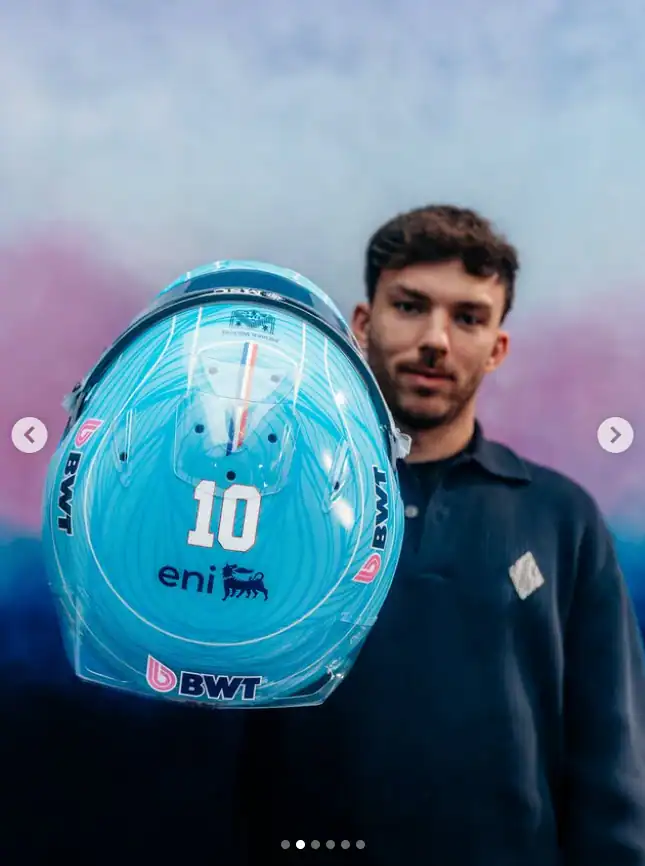
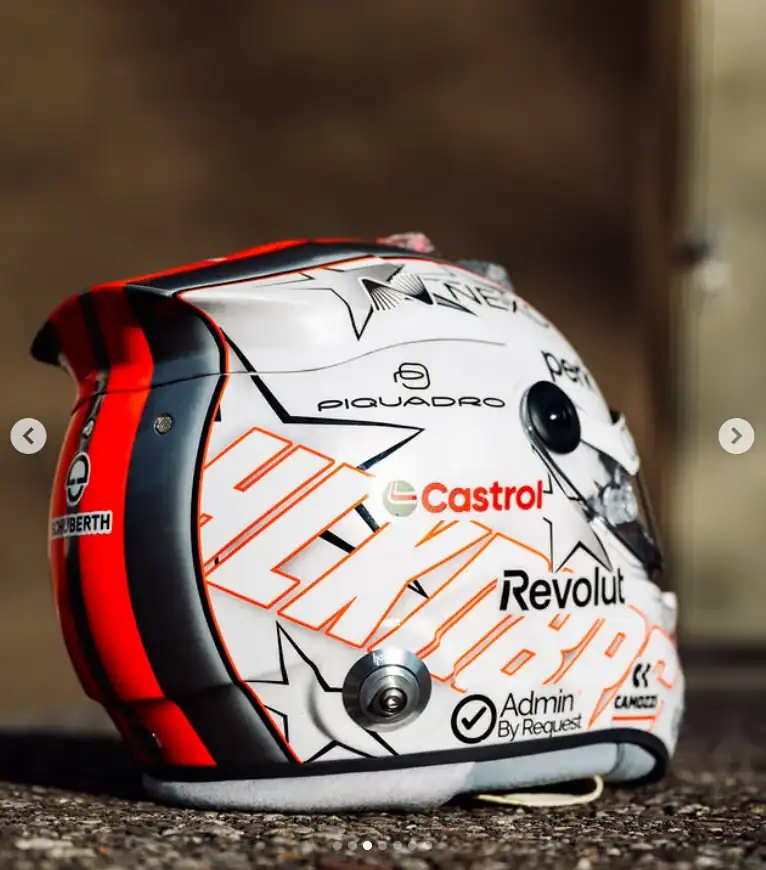
Away from the data, there is a parallel story that runs through every exceptional qualifying Saturday — the story told in paint, carbon, and shell that collectors and display enthusiasts follow just as closely as lap times. Franco Colapinto’s 2026 Alpine helmet design carries the team’s deep blue and pink livery references that have become one of the more recognisable palettes in the paddock since the Renault-to-Alpine rebrand gathered pace.
A full-size 1:1 display replica of Colapinto’s helmet captures the exact proportions of the race item — the shell geometry, the visor cutout, the chin vent structure — at exhibition quality. These are collector pieces and display items only, produced to showcase a driver’s visual identity in a home, office, or dedicated display cabinet rather than for any form of protective use. They are not certified for road, race, or track application and carry no FIA, Snell, ECE, or DOT rating. Their purpose is entirely the display and collector experience.
For a driver accumulating moments like this Barcelona qualifying session — a fourth career outqualification of an established Grand Prix winner in a single season — the helmet that sits on a display stand in 2026 is already carrying a meaningful biography. Collectors who follow Colapinto’s trajectory recognise that the number four in the qualifying tally is not a trivial figure. It is the kind of statistic that, years from now, will be cited as part of the narrative arc of a career that announced itself with real conviction.
Full-size 1:1 replica helmets, produced as exhibition quality collector items at the same scale as the driver wears in the cockpit, give enthusiasts a tangible connection to sessions like Saturday at Barcelona. When Colapinto lines up P13 on Sunday morning, the display piece on a shelf at home carries the weight of that qualifying lap.
What Sunday Holds for P13
The transition from qualifying result to race result is never automatic. Barcelona has a history of rewarding drivers who manage the first stint with discipline — those who resist the temptation to force a move in the opening laps and instead build track position through tyre conservation and opportunistic strategy. For Colapinto, the task on Sunday is to convert the one-position advantage over Gasly into something that grows rather than shrinks as the race develops.
If the Alpine car has the pace to run in the lower top ten on race pace — which the team will have a clear read on from Friday’s long-run data — then a points finish from P13 is a realistic outcome rather than an aspirational one. The constructors’ championship math at this stage of the season means every point counts, and a double-points haul from both Alpine drivers would be a meaningful return from a Barcelona weekend that started with a solid midfield qualifying performance.
Colapinto’s four outqualifications of Gasly in 2026 are a statistical backdrop that gives his Barcelona race attempt added weight. The question Sunday answers is whether Saturday’s single-lap speed translates across a race distance measured not in hundredths of a second but in tyre compounds, pit stops, and the decisions made under pressure at the sharp end of a pitstop window.
The Argentine goes into race day one spot ahead. The task now is to make that spot count.
FAQ
Q: What grid position did Franco Colapinto qualify in at the 2026 Barcelona GP?
Colapinto qualified P13 for the Barcelona GP, placing him one position ahead of Alpine teammate Pierre Gasly who starts P14.
Q: How many times has Colapinto outqualified Gasly in the 2026 F1 season?
Colapinto has outqualified Gasly four times in 2026 when Sprint qualifying sessions are included in the count, as confirmed ahead of the Barcelona race weekend.
Q: Does starting P13 give Colapinto a realistic chance of scoring points at Barcelona?
Starting P13 means Colapinto needs to pass at least three cars to reach the points. Barcelona’s overtaking zones at Turn 1 and Turn 10, combined with strategy variables across the race distance, give him a credible — if not straightforward — path to a top-ten finish.
Q: What is a full-size 1:1 F1 helmet replica?
A full-size 1:1 replica is a collector and display item produced at the exact same scale as a race helmet, capturing the shell geometry, visor cutout, and livery details at exhibition quality. These pieces are display items only — not certified for protective use, and not intended for road, race, or track application.
Q: Why is Colapinto’s 2026 Alpine helmet significant for collectors?
Colapinto’s four outqualifications of Pierre Gasly in 2026 make his season a notable one for collectors tracking emerging talent. A display replica of his Alpine helmet captures the livery and design from a year when the Argentine driver established a consistent qualifying benchmark against an experienced Grand Prix race winner.
Browse F1 Helmet Collection — explore full-size 1:1 display replicas of your favourite drivers at our shop.
Display and collector replicas only. Not certified for protective use. Full-size 1:1 scale.
This article was written with the help of AI tools. Editorial policy