Blog
2026 Barcelona-Catalunya Grand Prix Qualifying Day in Pictures
 123Helmets Editorial Team
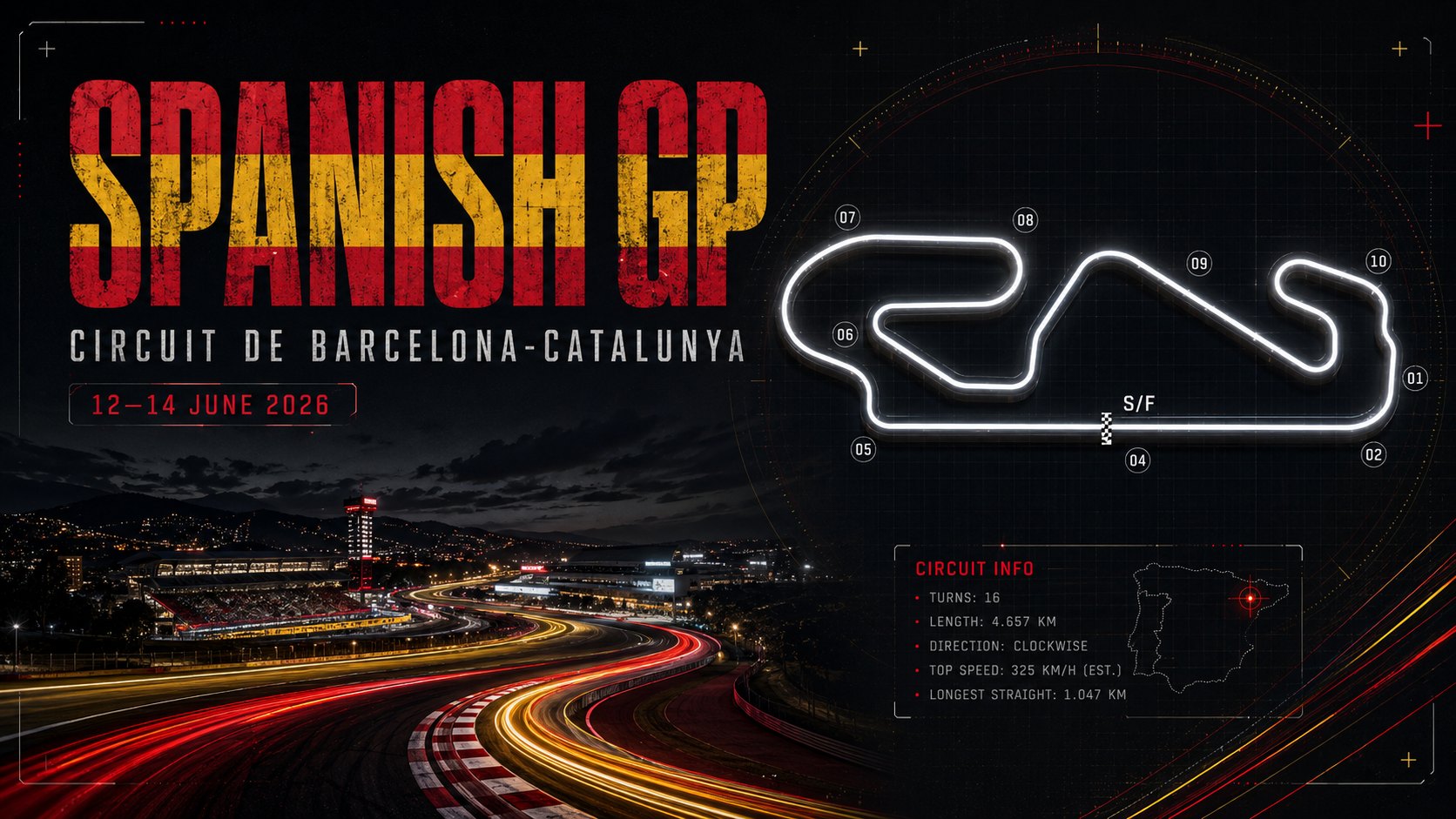
Qualifying day at Circuit de Catalunya delivered the kind of visual theatre that stops a motorsport fan mid-scroll. Helmets gleamed under the Catalan sun, liveries caught every camera angle, and the grid positions settled in ways that will fuel debate long after the chequered flag. Here is a close look at the display-worthy moments from Barcelona’s qualifying session — the colours, the cockpits, and the collector-grade imagery that defines a modern Formula 1 Saturday.
Key Takeaways
Circuit de Catalunya’s pit lane straight and Turn 1 entry produced the sharpest helmet and livery contrasts of any qualifying session so far in 2026.
Full-size 1:1 replica helmets capture the exact paint schemes and visor tints seen during Saturday qualifying — details that broadcast cameras can only hint at.
Barcelona’s bright June light on 13 June 2026 made livery metallic flakes and sponsor chrome lettering more visible than at almost any other round on the calendar.
Qualifying helmet designs often differ from race-day lids, making Saturday sessions a prime reference point for collectors building display-quality replicas.
Catalunya Sets the Visual Stage on 13 June 2026
Circuit de Catalunya has always been one of the most photographically generous venues on the Formula 1 calendar. The circuit sits at an elevation that exposes cars and helmets to near-unfiltered Mediterranean light for much of the afternoon, and qualifying day on 13 June 2026 was no exception. From the moment the pit lane opened for Q1, the combination of that flat, bright sun and the tight camera angles available at Catalunya’s chicane complex produced images with an almost studio-quality crispness.
For anyone who follows F1 as much for its visual language as for the sporting contest, a Barcelona qualifying Saturday is close to unmissable. The track’s 4.657 km layout — unchanged in its modern configuration — forces cars through a sequence of medium-speed corners that keep helmets facing the grandstands for extended fractions of a second, long enough for photographers and fans alike to read every panel of a driver’s personal livery in proper detail.
That detail matters enormously to the collector community. A qualifying session freezes helmet design at a specific date and in a specific context: the tyre compound fitted, the wing angle dialled in, the helmet visor reflections showing the pit wall and the grandstands behind. These are reference points that a well-produced full-size 1:1 replica can honour precisely, and the imagery from this particular Saturday gives collectors exactly the kind of locked-in visual record they need.
Reading Helmet Liveries at High Speed
At 300 km/h on the Circuit de Catalunya start-finish straight, a helmet is a blur. In a slow-motion qualifying replay or a high-resolution pit-lane photograph, it becomes something closer to a wearable painting. The 2026 season brought a wave of redesigned helmet schemes following the regulation changes that altered car proportions and aerodynamic packaging — changes that prompted several drivers to revise their personal branding to complement the new silhouettes.
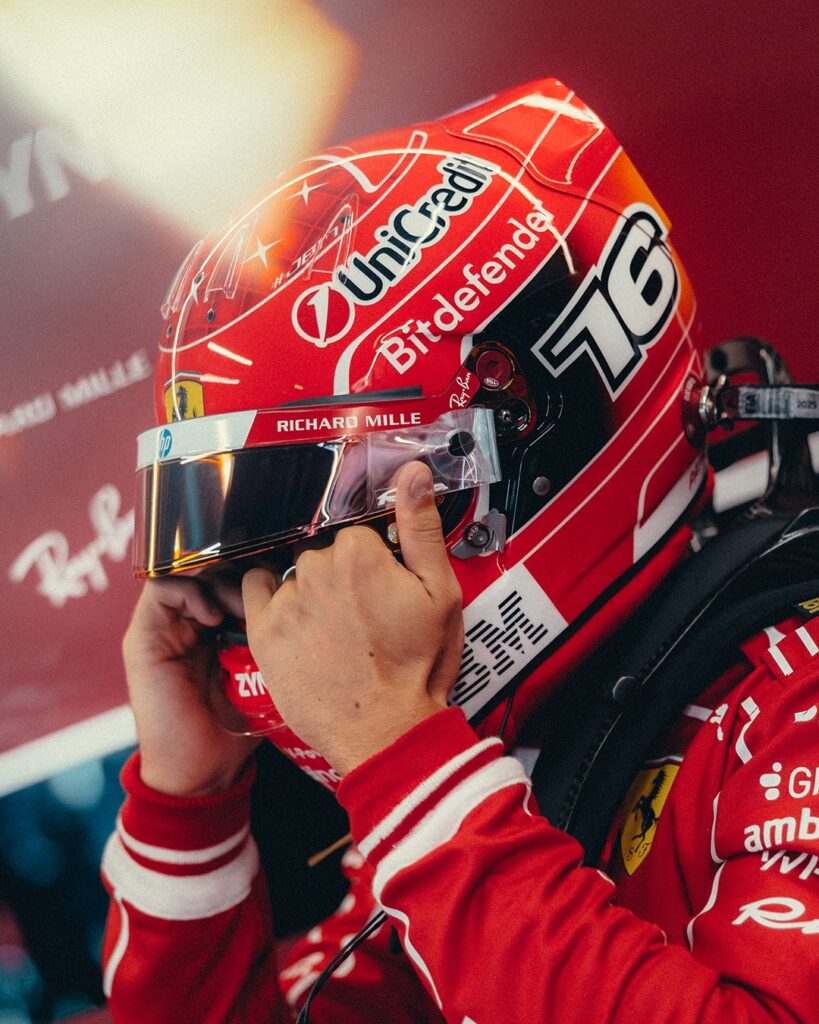
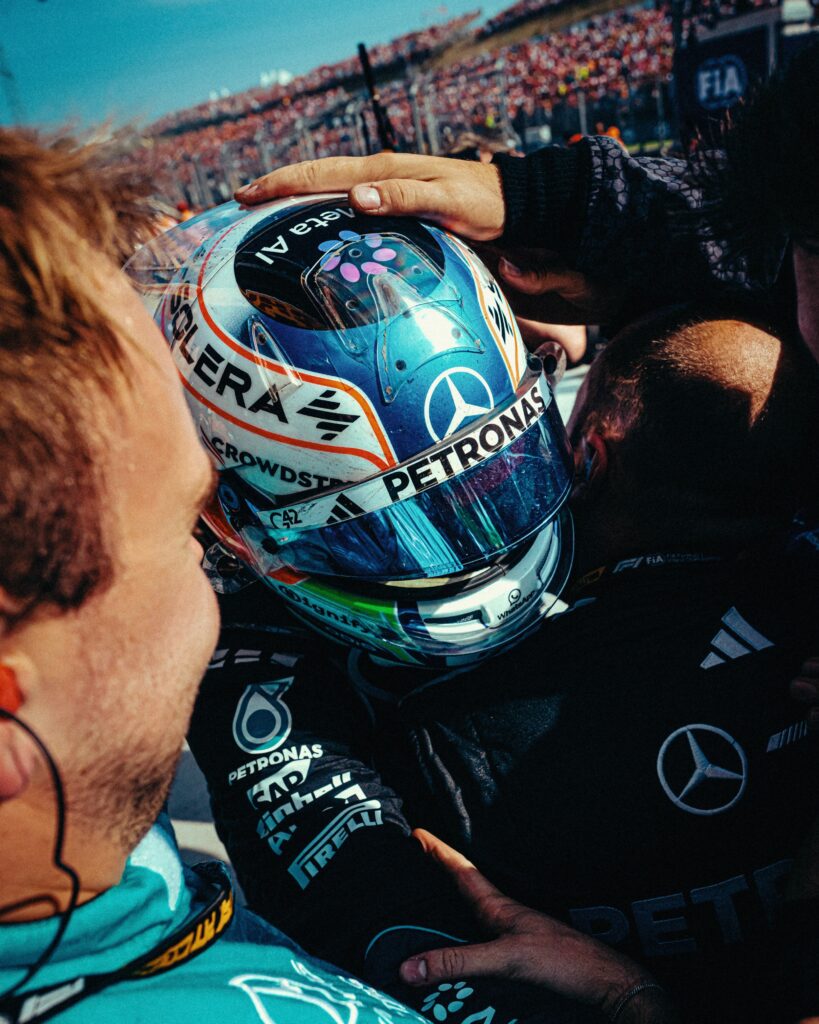
Barcelona qualifying images show those schemes in their most concentrated form. The visor band, typically 26 mm in depth on a modern full-face lid, carries a disproportionate amount of visual weight when photographed straight-on. Chrome treatments, gradient fades, and team-colour borders in that narrow strip can shift an entire helmet’s reading from aggressive to refined depending on how the edge is finished. Several of the helmets visible in the 13 June 2026 qualifying photographs carry visor trim that would be lost entirely in broadcast footage but reads perfectly in still photography — and, crucially, in a display-quality replica mounted on a stand.
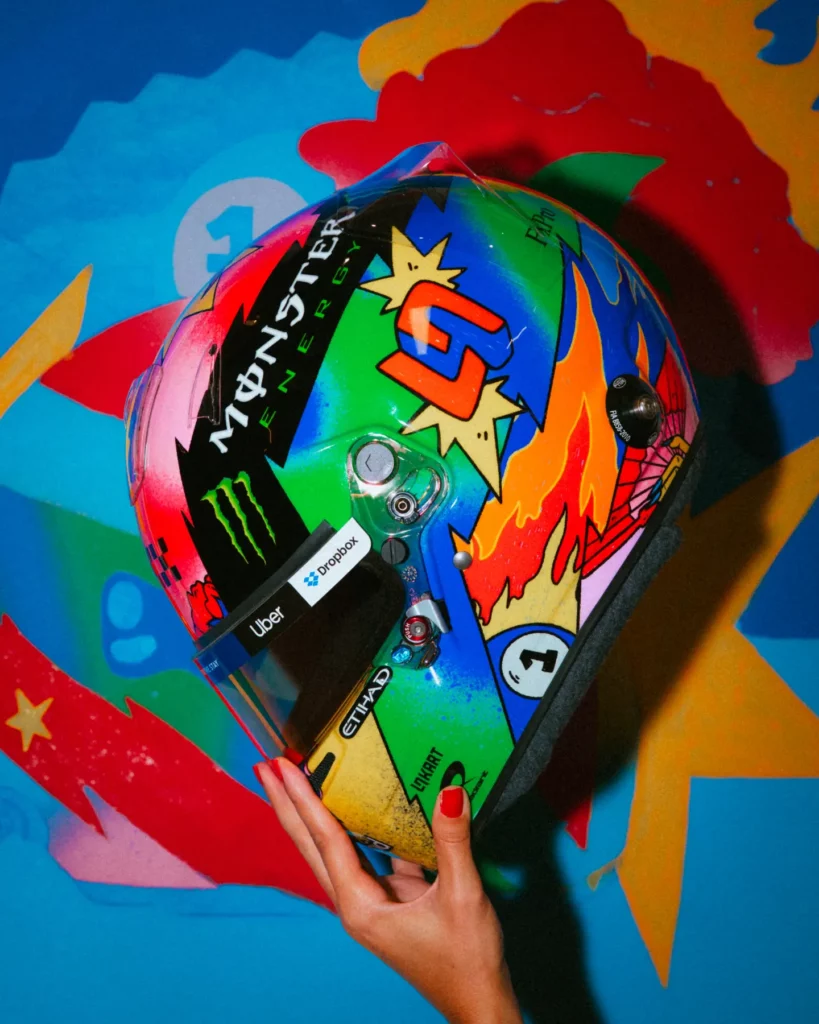
The carbon-fibre shell beneath the paint is itself a visual element in 2026. A number of drivers have moved toward translucent lacquer finishes that allow the weave pattern to show through base colour layers, giving helmets a textile depth that flat-colour lids simply cannot match. Reproduced accurately in a 1:1 collector replica, that weave effect adds a tactile dimension even to a piece that exists purely for exhibition.
Colour Temperature and Catalunya’s Light
Colour science matters to collectors more than casual observers might assume. The same red that appears orange-warm under Bahrain’s halogen floodlights can shift toward a cooler, more saturated tone under Catalunya’s June afternoon sun. Qualifying on 13 June 2026 ran through mid-afternoon local time, placing the cars in a colour-rendering environment that is close to neutral daylight — the standard reference condition used by professional colour-matching labs. That makes Barcelona qualifying photographs among the most reliable colour references available for anyone commissioning or evaluating a replica helmet finish.
The Pit Lane as a Display Gallery
There is an argument that Formula 1’s most visually coherent space is not the podium but the pit lane during a qualifying session. Cars sit stationary for minutes at a time, mechanics work around them in choreographed patterns, and helmets rest on the roll hoop in full view of anyone with a camera and a clear sightline. The 13 June 2026 Catalunya pit lane provided exactly that tableau across all three qualifying segments.
From a collector’s perspective, pit-lane photographs offer something the podium cannot: context at human scale. When a helmet is photographed beside a front wing end plate or a front tyre that stands roughly 660 mm tall, the viewer gets an immediate, accurate sense of the lid’s true dimensions. A full-size 1:1 replica reproducing that helmet should sit comfortably within those same proportions — and the Barcelona qualifying pictures confirm that relationship cleanly.
The liveries on display across the pit lane on that Saturday covered most of the primary and secondary colour range available in automotive paint. Matte black, gloss white, two distinct shades of blue, a primary red, and several metallic mid-tones were all represented on helmets visible in the pit lane photography. For a collector building a themed display shelf, a single qualifying session at a circuit like Catalunya can supply reference imagery for nearly every contemporary F1 colour palette.
Visor Tints as Qualifying Signatures
One detail that distinguishes qualifying helmets from race-day versions in certain conditions is visor tint selection. Under bright afternoon sun at Barcelona, several drivers fitted visors with a darker iridescent coating — typically in amber or mirror chrome — rather than the clearer or lightly tinted versions used in lower-light conditions. Those iridescent finishes photograph as near-molten colour fields when caught at the right angle, and they represent one of the most striking visual elements a collector replica can incorporate. A display piece that accurately replicates a qualifying-day visor tint from 13 June 2026 carries a specificity that separates it clearly from a generic team-coloured lid.
Podium Positioning and the Grid’s Visual Hierarchy
Qualifying outcomes define the grid, and the grid defines the podium-candidate story that runs through race weekend media coverage. The visual hierarchy of the Barcelona grid — fastest qualifier at the front, with the field arrayed behind — produces its own aesthetic logic. The helmets at positions P1 through P3 on the grid face the most camera time during the formation lap and race start, meaning their design choices receive the highest broadcast amplification of any single weekend moment.
For collectors, that hierarchy has a direct parallel. A replica helmet from a driver who qualified on pole at Circuit de Catalunya on 13 June 2026 carries a specific provenance that a generic team-livery lid does not. It anchors to a precise Saturday, a precise circuit, and a precise competitive outcome. Display pieces gain narrative weight from exactly that kind of specificity, and qualifying-day visual records supply the anchoring detail that makes the narrative credible.
The imagery from Catalunya’s qualifying day also captures the helmets of drivers who ran in Q3 — the ten drivers who contested the final segment — in the high-focus conditions that come with the session’s elevated stakes. Slower cars may be photographed carefully in Q1, but Q3 brings a different quality of attention from photographers and teams alike, and the resulting pictures reflect that.
Why Qualifying-Day Imagery Matters to the Collector
Race-day helmets and qualifying-day helmets are not always identical. Teams sometimes apply sponsor decals, visor strips, or special livery panels to qualifying runs that do not carry over to the Sunday configuration. In 2026, at least some teams have used qualifying sessions at select circuits to debut updated colour schemes or revised sponsor positioning — making Saturday photographs an independent reference, not merely a preview of Sunday.
A collector who sources a full-size 1:1 replica specifically tied to Barcelona qualifying on 13 June 2026 is acquiring a display piece with a narrower and therefore more precisely defined identity than a generic season-edition lid. The circuit, the session type, the light conditions, and the competitive context are all embedded in the imagery that authenticates it.
Display-quality replica helmets at 1:1 scale — the standard for collector-grade pieces — reproduce every external feature visible in high-resolution qualifying photography: paint layer depth, decal placement measured in millimetres, visor curvature, air-intake mesh pattern, and chin-spoiler angle. None of these features serve any protective function; they exist entirely to honour the visual accuracy of the original. That is precisely the premise of a collector item rather than a race-use lid, and Barcelona’s qualifying photography from 2026 provides one of the cleaner reference sets of the season for that purpose.
Building a Catalunya-Themed Display
A themed display built around the 2026 Barcelona-Catalunya qualifying weekend might reasonably include the pole-position helmet design, a second lid from a notable midfield qualifier, and printed reference photography from 13 June 2026. The circuit’s distinctive orange fencing and blue grandstand sections appear as background elements in pit-lane photography, giving any framed supporting image an immediately recognisable Catalunya signature. Mounted on a display stand with a clear acrylic case and a printed data card noting the qualifying date and grid position, a 1:1 replica from this session becomes a complete exhibition piece rather than simply a decorative object.
The Lasting Appeal of Barcelona Qualifying as a Collector Reference
Formula 1 visits Circuit de Catalunya with the regularity that makes it one of the sport’s institutional circuits — a place where the teams understand the light, the photographers know the angles, and the resulting imagery has a consistency that more exotic venues cannot always guarantee. The 13 June 2026 qualifying session added another chapter to that photographic archive.
For collectors and display enthusiasts, that archive functions as a living catalogue of helmet and livery design across multiple seasons. Barcelona qualifying photographs from different years placed side by side trace the evolution of driver identities, team branding, sponsor relationships, and paint technology across the sport’s recent history. A 1:1 replica helmet from any given year in that sequence is both a standalone display piece and a data point in a broader visual story.
The 2026 season has brought enough regulation-driven change to liveries and helmets that this year’s Barcelona images carry particular weight as reference material. Cars are proportioned differently, aero surfaces are shaped differently, and driver helmet designs have in several cases been revised to respond to the new visual environment. The qualifying-day photographs from Circuit de Catalunya on 13 June 2026 document that moment of change with the clarity that only a sun-lit Mediterranean Saturday can provide.
Whether a collector is adding a single centrepiece lid to an existing display or building a dedicated 2026-season shelf, the imagery from Barcelona qualifying day supplies the detail, the colour accuracy, and the narrative context that elevates a replica from ornament to exhibition-quality record of a specific day in Formula 1 history.
“A qualifying session at Barcelona gives you the cleanest light of the entire European swing — the colour rendering is close to neutral daylight, which is what you want when you are trying to match a paint finish exactly.”
— Display collector and livery reference specialist
“The helmet on the grid at P1 is the one every photographer wants. By Sunday it might look slightly different. That is why qualifying-day images are their own category of reference.”
— F1 pit-lane photographer
FAQ
Q: What makes qualifying-day helmet photographs different from race-day images for collectors?
Teams occasionally apply distinct decal configurations, visor tints, or updated livery panels for qualifying that differ from their race-day setup. Photographs from a specific qualifying session — like Barcelona on 13 June 2026 — capture those differences as a standalone reference, independent of Sunday’s configuration.
Q: Are the replica helmets on 123Helmets.com suitable for wearing or race use?
No. Every helmet available on 123Helmets.com is a full-size 1:1 display and collector replica. They are exhibition-quality pieces intended for display stands, show cases, and private collections — not for any protective, road, or motorsport use.
Q: Why does Circuit de Catalunya produce particularly useful reference photography for helmet collectors?
Catalunya’s afternoon session timing places cars in near-neutral daylight — the same colour-rendering condition used by professional paint-matching laboratories. That makes the colour readings in Barcelona qualifying photographs more reliable as a reference than images taken under artificial floodlighting or in the low-angle light of an early-morning session.
Q: What is the standard scale for a collector-grade F1 replica helmet?
Collector-grade F1 replica helmets are produced at 1:1 full size, replicating the external dimensions and visual detail of the original racing lid. This scale allows every design element visible in qualifying photography — visor band depth, decal placement, paint layer finish — to be reproduced accurately.
Q: How can I use Barcelona qualifying images to verify the accuracy of a replica helmet?
High-resolution qualifying photographs taken at Circuit de Catalunya on 13 June 2026 provide clear sightlines to helmet panels from multiple angles. Compare the visor tint, the width and colour of sponsor decal borders, the base colour tone under neutral daylight, and the finish type — matte, gloss, or satin — against those reference images. A quality 1:1 replica should align on all these points without deviation.
Browse F1 Helmet Collection
Display and collector replicas only. Not certified for protective use. Full-size 1:1 scale.
This article was written with the help of AI tools. Editorial policy