
Blog
The Art of the F1 Helmet Replica: What Separates a Trophy Piece from a Trinket
 123Helmets Editorial Team
The Art of the F1 Helmet Replica: What Separates a Trophy Piece from a Trinket
Not all F1 helmet replicas are created equal. For the serious collector, the difference between a shelf-worthy trophy piece and a disappointing impulse buy comes down to a handful of craft decisions that most buyers never think to ask about — until it’s too late.
Key Takeaways
Full-size 1:1 scale is non-negotiable for authentic display impact — mini replicas lose all visual drama and proportion.
Livery accuracy, including correct pantone colors, sponsor placement, and visor tint, is the single biggest differentiator between exhibition-quality pieces and tourist-shop imitations.
Shell construction material — ABS, fibreglass composite, or carbon-look — directly affects the visual weight, finish depth, and long-term display durability of the piece.
Provenance and edition documentation (certificates, limited numbering, driver association) dramatically increases both the display prestige and long-term collectible value of a replica helmet.
Why the F1 Helmet Has Become the Ultimate Motorsport Collectible
The Art of the F1 Helmet Replica
What Separates a Trophy Piece from a Trinket
For collectors who take their passion seriously, the helmet stands apart.
In the vast ecosystem of Formula 1 memorabilia — race suits, steering wheels, nose cones, pit boards — the helmet occupies a singular position. It is the most personal object in the sport. Every driver’s lid is a moving canvas, a declaration of identity that fans recognize at 200 miles per hour. It is the first thing children draw when they sketch a racing driver. It is the object that most completely captures a season, a rivalry, a career.
That cultural weight is precisely why the full-size 1:1 replica helmet has emerged as the crown jewel of Formula 1 collecting. A framed photograph tells you what happened. A signed cap tells you someone was there. But a meticulously crafted, exhibition-quality replica helmet puts you in the cockpit. It occupies physical space. It commands a room. It starts conversations.
The market has responded accordingly. Where once a collector had to choose between an overpriced race-used piece or a cheap souvenir-grade mini helmet, a third category has matured: the premium display replica. Full scale. Exacting livery reproduction. Proper construction. The kind of piece that sits in a glass case in a study or a boardroom and looks, to any informed eye, completely authentic.
But — and this is the conversation most retailers avoid — not everything sold as a “replica” belongs in that premium category. Understanding the difference is what this guide is about.
Scale and Proportion: Why 1:1 Is the Only Scale That Matters for Display
The Problem with Miniatures
Walk into any paddock gift shop in the world and you will find shelves of 1:2 and 1:5 scale mini helmets. They are inexpensive, easily shipped, and entirely unsatisfying as display objects for anyone who has ever stood next to an actual F1 car.
The issue is proportion. A Formula 1 helmet is engineered around the dimensions of a human head. Its curvature, its visor geometry, its fin — if the design has one — all interact with those proportions in ways that only register correctly at full scale. Shrink the object and you destroy the visual logic that makes the design work. A 1:2 scale version of a complex, multi-zone livery looks busy and cluttered. At 1:1, the same design breathes. The gradient transitions make sense. The sponsor logos sit in the right visual hierarchy. The visor aperture has the right presence.
What 1:1 Full-Size Means in Practice
A genuine full-size 1:1 replica helmet measures between 58 and 62 centimetres in circumference, matching the dimensions of an actual race helmet shell. The visor aperture is the correct shape and depth. The chin guard has the correct geometry. When you place it on a proper display stand, it looks, from any reasonable viewing distance, indistinguishable from the real article.
This scale fidelity matters for a second reason: it allows the collector to display the piece alongside other full-size memorabilia — gloves, suits, photographs — and have everything cohere visually. A mini helmet surrounded by life-size objects always looks like a prototype or a toy. A full-size 1:1 replica looks like evidence.
At 123Helmets, every piece in the collection is produced at full 1:1 scale, because anything less would be a compromise we are not willing to make for serious collectors.
Livery Reproduction: The Craft That Makes or Breaks a Collector Piece
Color Accuracy Is Not Optional
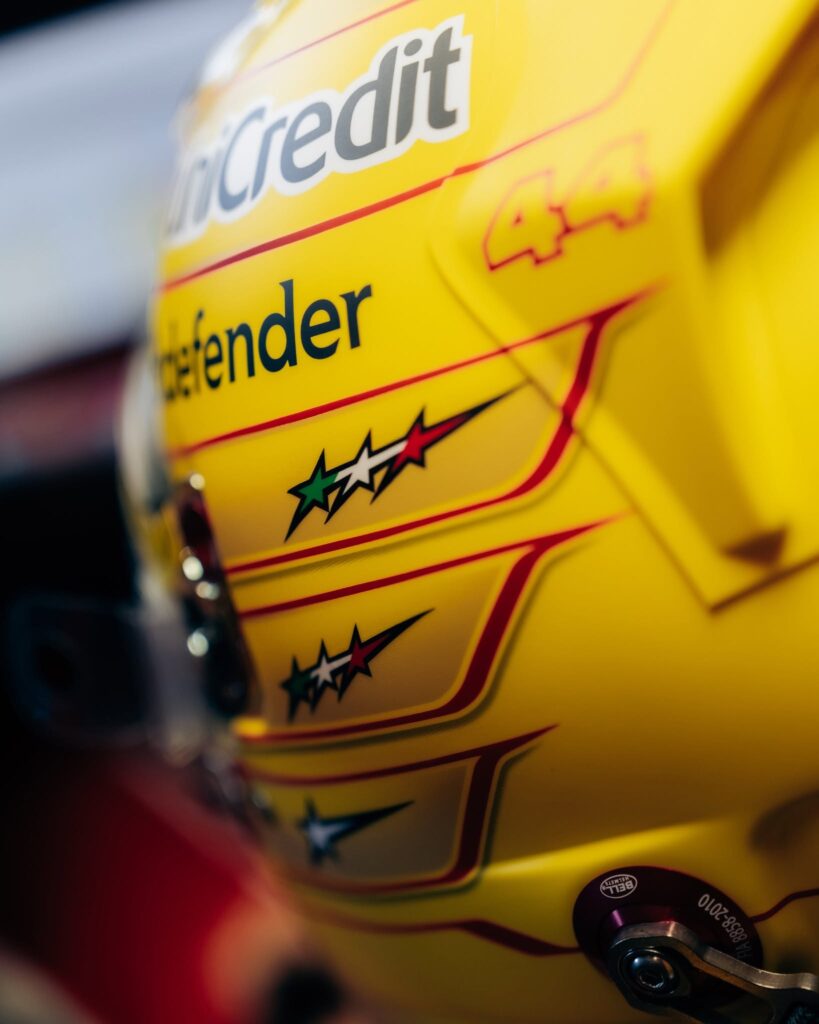
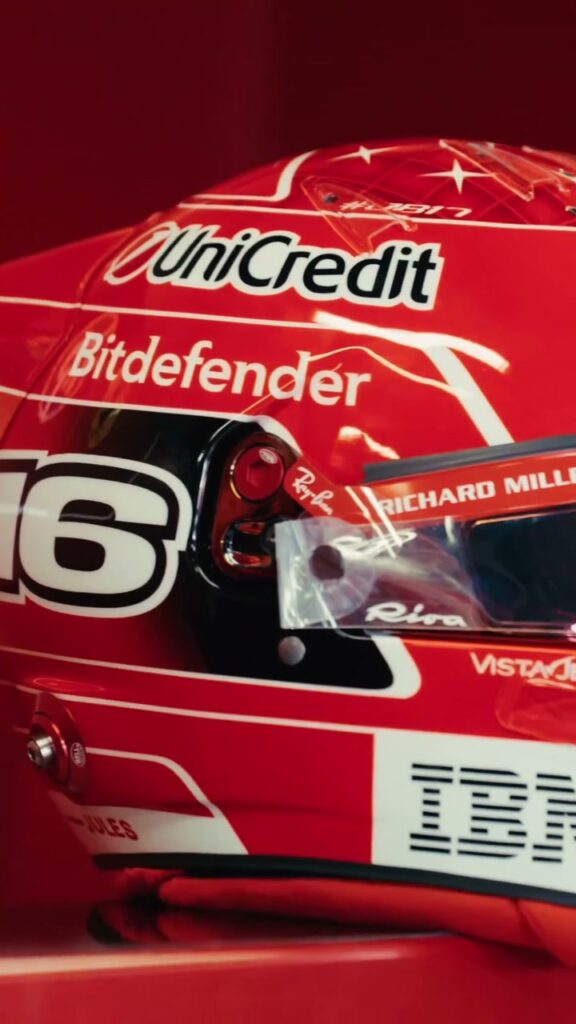
The livery — the complete painted and graphic design applied to the shell — is the soul of any F1 helmet. And it is where the gap between a premium display replica and a budget imitation is most immediately, devastatingly visible.
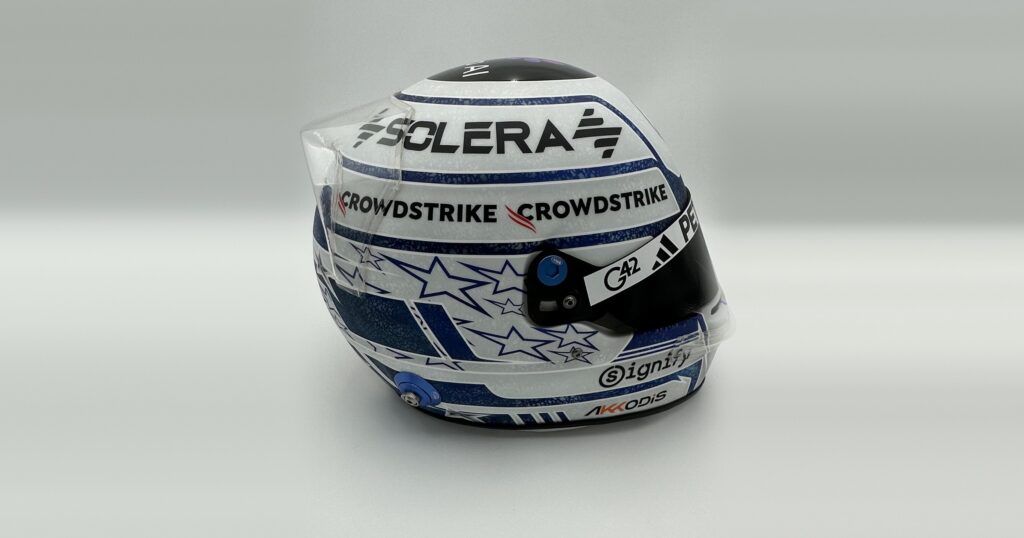
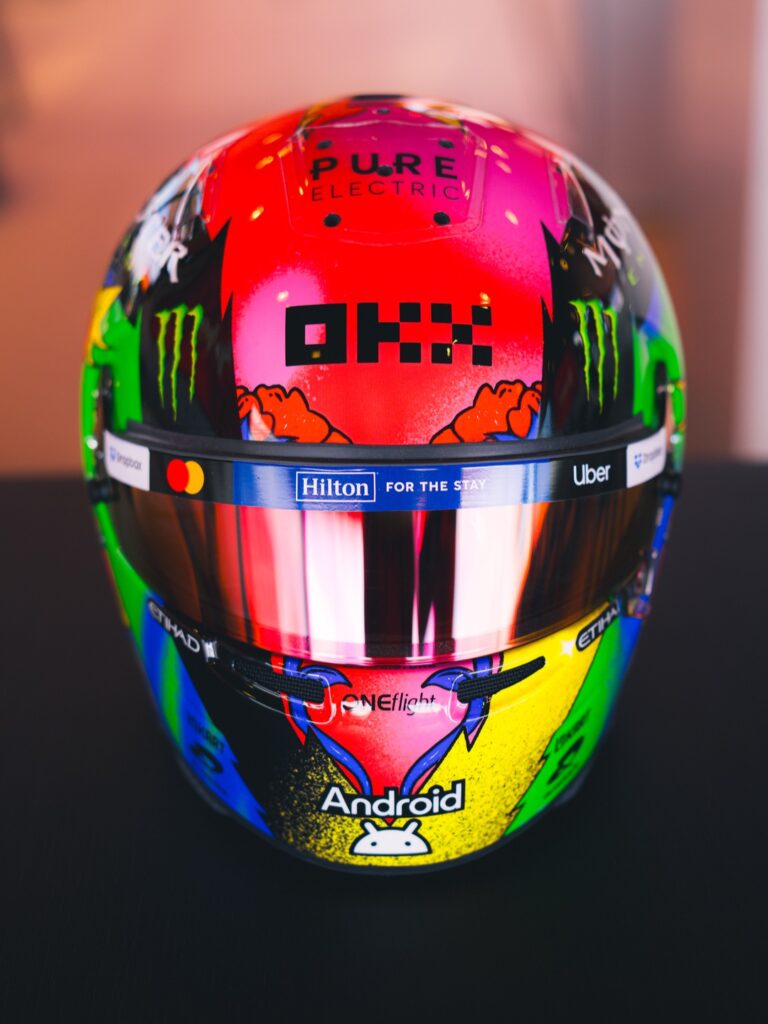
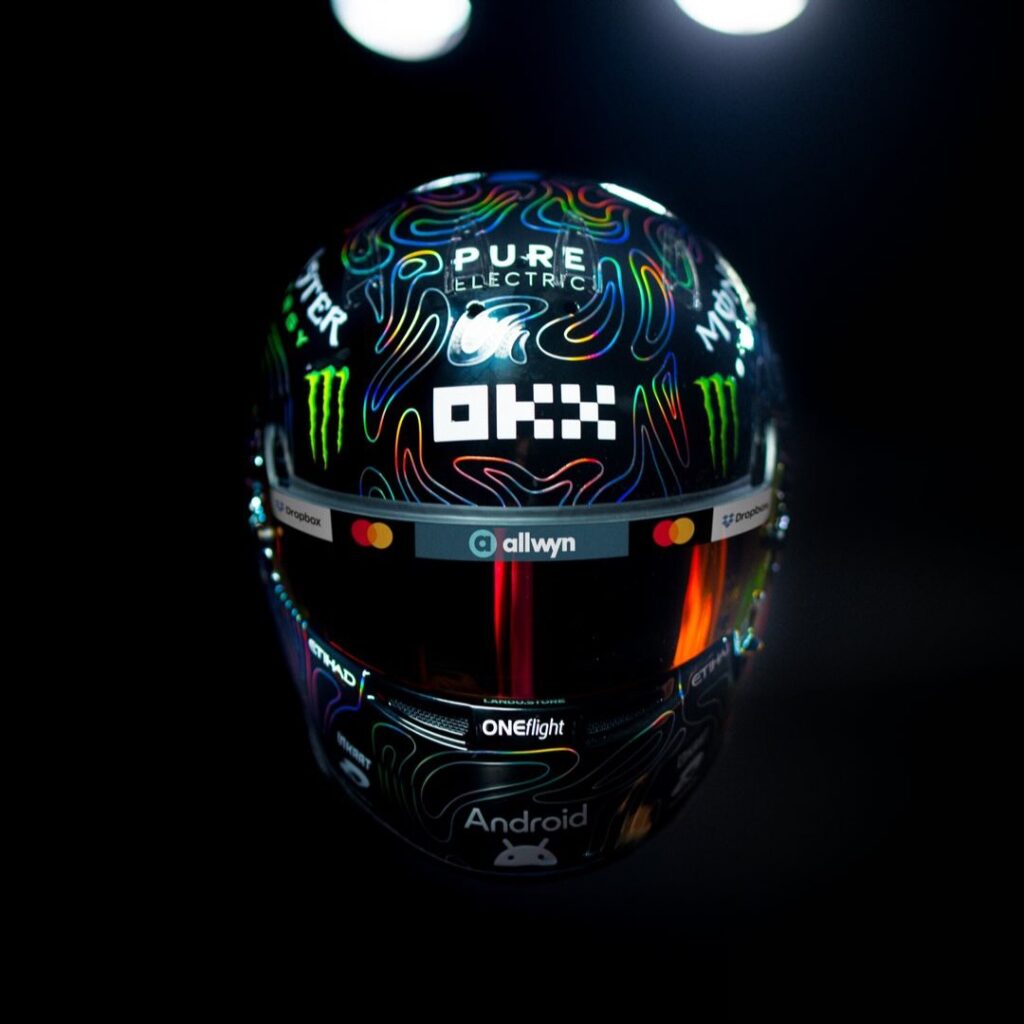
Consider what goes into a single race-used F1 helmet’s visual identity: base color or colors, often applied in multiple layers with specific finish levels (gloss, satin, matte, metallic, pearl, chrome); gradient zones where two or more colors bleed into each other through airbrushing or vinyl overlay; sponsor logos in precise sizes, positions, and color values; nationality flags, personal emblems, and driver numbers rendered at specific weights; and a visor with a specific tint, reflectivity level, and sometimes a branded or patterned tear-off strip.
Reproducing all of that faithfully requires access to the correct Pantone or RAL color references, high-resolution original artwork, skilled application — whether through pad printing, water-slide decal, or direct UV printing — and a quality-control process that actually compares the finished piece against reference photography before it ships.
What Separates Exhibition Quality from Souvenir Grade
On a budget replica, the first things to fail are the gradients and the metallic finishes. Gradients become hard-edged banding. Chrome elements become silver paint. Sponsor logos are slightly wrong in proportion or color. The visor is a flat, uniform grey rather than the correct tinted and reflective material.
On a premium display replica, gradients are soft and natural. Chrome elements have genuine reflective depth. Logos are reproduced from reference artwork at correct proportions. The visor mirrors ambient light the way a real visor does.
These are not small differences. In a well-lit display case, a poorly reproduced livery looks exactly like what it is: a low-cost approximation. An exhibition-quality reproduction looks like the real helmet.
Era and Version Accuracy
One detail that separates the truly committed collector from the casual buyer is attention to version accuracy. A driver’s helmet livery can change significantly across a single season — updated sponsor arrangements, one-off special editions for home grands prix, charity or tribute designs, championship celebration variants. A premium replica should specify which version of the livery it reproduces, and that specification should be verifiable against known photography from that event or period.
Shell Construction: Understanding What Your Display Piece Is Actually Made Of
The Three Material Tiers
The shell of a display replica helmet is what gives the piece its visual weight, its finish depth, and its long-term dimensional stability on the shelf. There are, broadly, three material categories in the collector replica market, and they produce very different results.
ABS thermoplastic is the most common material in the mid-range segment. It is lightweight, takes paint and print finishes reasonably well, and is dimensionally consistent. Well-executed ABS shells can look excellent under display lighting. The limitation is that ABS does not have the visual density of a real helmet shell, which is a composite material, and the surface sheen can look slightly plastic under close inspection.
Fibreglass composite shells sit a tier above. The material has a visual weight and surface texture closer to a real race helmet’s construction. It accepts paint layers with greater depth, and the finished surface has a quality that ABS does not quite achieve. Fibreglass replicas are heavier and feel more substantial on a stand — a tactile detail that matters more than collectors expect when they first handle one.
Carbon-look and genuine carbon fibre shells occupy the premium tier. Carbon-look uses a carbon-weave pattern embedded beneath a clear coat and is visually striking for helmets that used exposed carbon as a design element. Genuine carbon fibre replicas are exceptionally rare in the collector market and command prices that reflect the material cost. For most display purposes, a high-quality carbon-look finish is visually indistinguishable from the real weave at display distances.
The Stand Is Part of the Piece
A point that too many buyers overlook until the helmet arrives: the display stand is not an afterthought. It is the element that elevates a replica from an object that sits awkwardly on a shelf to a genuine exhibition piece. An appropriate stand — whether a simple acrylic pedestal, a branded metal cradle, or a full acrylic case with lighting — frames the helmet correctly, keeps it at the right viewing angle, and protects the finish from ambient dust and contact. Premium collector pieces come with stands designed for the specific shell geometry. Generic stands look generic.
Provenance, Editions, and the Collector Value Conversation
Documentation and Certification Matter
There is a practical reason why premium display replica helmets are produced in limited numbered editions with certificates of authenticity: it protects both the collector and the integrity of the piece over time. A numbered certificate ties a specific helmet to a specific edition run, specifying the driver, the season, the livery version, and the edition size. That documentation is what allows the piece to hold its display prestige over years and decades.
Without documentation, a collector is holding an undifferentiated object. Two identical-looking replicas — one with a certificate, one without — tell very different stories to a guest who picks one up and examines it. The certificate transforms the object into a specific, accountable thing. It is evidence of what the piece is and how many exist.
Driver Association and Official Licensing
Not all replicas carry official licensing from the driver, the team, or Formula 1 itself. Officially licensed pieces — those produced with the cooperation of the rights holders — carry artwork approved by the original parties and can legitimately claim that the design has been verified for accuracy. Unlicensed replicas exist in a grey area where the livery accuracy depends entirely on the producer’s diligence and access to reference materials, with no external verification.
For the serious collector, official licensing is a meaningful distinction. It represents a level of accountability and accuracy assurance that matters when you are building a display collection intended to represent the sport honestly.
Special and Tribute Editions
Some of the most compelling collector display pieces are not standard season livery reproductions but special editions: tribute helmets produced to mark a milestone, anniversary, or championship. These pieces often feature unique design elements — special numbering, commemorative text, distinct colorways — that make them visually distinctive even within a larger collection. They tell a more specific story than a standard replica, and their limited nature by definition makes them more unusual over time.
Building a Collection: How to Think About Your First — and Next — Display Helmet
Start with Meaning, Not Market Value
The best advice for any collector entering the premium display replica space is this: start with the helmet that means something to you, not the one that someone else tells you is the most valuable. Collector value in any memorabilia category is unpredictable. Display value — the pleasure of looking at an object that represents something important to you — is entirely within your control.
That might mean the helmet from the season you first fell in love with the sport. The livery from a driver whose career arc moved you. The design from a race you attended. The piece that, when a guest picks it up, gives you a story to tell that you actually want to tell.
Think About Display Context Before You Buy
Before committing to a piece, think about where it will live. A single helmet in a well-lit case on a study desk tells one story. A row of three helmets on wall-mounted acrylic shelving tells another. A full cabinet with six to eight helmets representing a driver’s career evolution tells something more ambitious — and requires a different acquisition strategy from the start.
Think about the lighting in the space. Think about the viewing distance. Think about whether you want the collection to be thematically coherent — one driver, one era, one team — or deliberately varied. These are the decisions that separate a curated collection from a accumulation of objects.
Quality Over Quantity, Always
In premium display collecting, the calculus is always the same: one exceptional piece creates more visual impact and more lasting satisfaction than three mediocre ones. A single exhibition-quality, full-size 1:1 replica with accurate livery, proper construction, and appropriate documentation commands a room. Three budget replicas with approximate colors and no documentation produce a display that apologizes for itself.
Invest in fewer, better pieces. Your future self, and any guest who walks into your space, will know the difference immediately.
“The helmet is the face of a racing driver. Everything else — the suit, the gloves, the car — can be shared or generic. The helmet is uniquely, personally theirs. That is why it matters as a collectible in a way that nothing else in the sport quite replicates.”
— 123Helmets.com Editorial
“Livery accuracy is where the real collector separates from the casual buyer. You can forgive a slightly heavy stand. You cannot forgive a gradient that looks like it was applied with a house paintbrush.”
— 123Helmets.com Editorial
FAQ
Q: What does ‘1:1 full-size replica’ mean for an F1 helmet display piece?
A 1:1 full-size replica is produced at the exact same external dimensions as a real Formula 1 helmet — typically 58 to 62 centimetres in shell circumference. This is distinct from miniature or scale-down replicas (1:2, 1:5) sold in souvenir contexts. At full 1:1 scale, the livery, proportions, visor geometry, and visual impact of the piece are faithful to the original. These are collector and display pieces only, not certified for any protective, racing, road, or safety use.
Q: Are these display replica helmets wearable or certified for any safety use?
No. Display and collector replica helmets from 123Helmets.com are produced exclusively as exhibition-quality display pieces and collector items. They carry no safety certification and are not intended for wearing, racing, road use, or any protective application. They are full-size 1:1 scale display replicas for collection and exhibition purposes only.
Q: How do I tell if an F1 helmet replica has accurate livery reproduction?
The key markers of high-quality livery reproduction are: correct base color depth and finish (gloss, satin, or matte as per the original); smooth gradient transitions rather than hard-banded color zones; sponsor logos at correct proportions and Pantone-accurate colors; and a visor with appropriate tint and reflectivity. Comparing the piece directly against high-resolution race photography from the specific event or season is the most reliable verification method. Always ask the seller which specific version of the livery is being reproduced.
Q: What is the difference between a licensed and an unlicensed F1 helmet replica?
An officially licensed replica is produced with the approval and cooperation of the rights holders — the driver, the team, or Formula 1 — meaning the artwork has been verified for accuracy by the original parties. An unlicensed replica is produced without that cooperation, relying entirely on the manufacturer’s own reference research. For collectors who prioritize authenticity and provenance, officially licensed pieces offer an additional layer of accountability that unlicensed products cannot provide.
Q: Does the display stand matter for a collector helmet, or is any stand acceptable?
The display stand is an integral part of the presentation and should never be treated as an afterthought. A stand designed for the specific shell geometry holds the helmet at the correct viewing angle and creates a stable, exhibition-appropriate presentation. Generic or poorly fitted stands can scratch the shell finish, create unstable display situations, or simply undermine the visual impact of the piece. Premium collector replicas should ideally be displayed on purpose-built stands or within proper acrylic display cases.
Browse F1 Helmet Collection
Display and collector replicas only. Not certified for protective use. Full-size 1:1 scale.
This article was written with the help of AI tools. Editorial policy