Blog
Russell on Pole: 2026 Race Day Helmet Guide
 123Helmets Editorial Team
George Russell grabbed pole position in the final seconds of qualifying, splitting the Ferraris of Charles Leclerc and Lewis Hamilton on the front two rows. Max Verstappen starts P5 after a barrier impact caused by a confirmed aero failure. Championship leader Kimi Antonelli lines up fourth. Here is everything you need to follow the race — and the collector helmets that mark this moment.
Key Takeaways
George Russell secured pole in the final seconds of qualifying, with his lap surviving a stewards’ review over yellow flag conditions.
Max Verstappen starts P5 after a confirmed aero failure sent his car into the barrier, leaving Red Bull with significant overnight repair work.
Championship leader Kimi Antonelli lines up fourth, meaning he is surrounded by direct title rivals at the front of the grid.
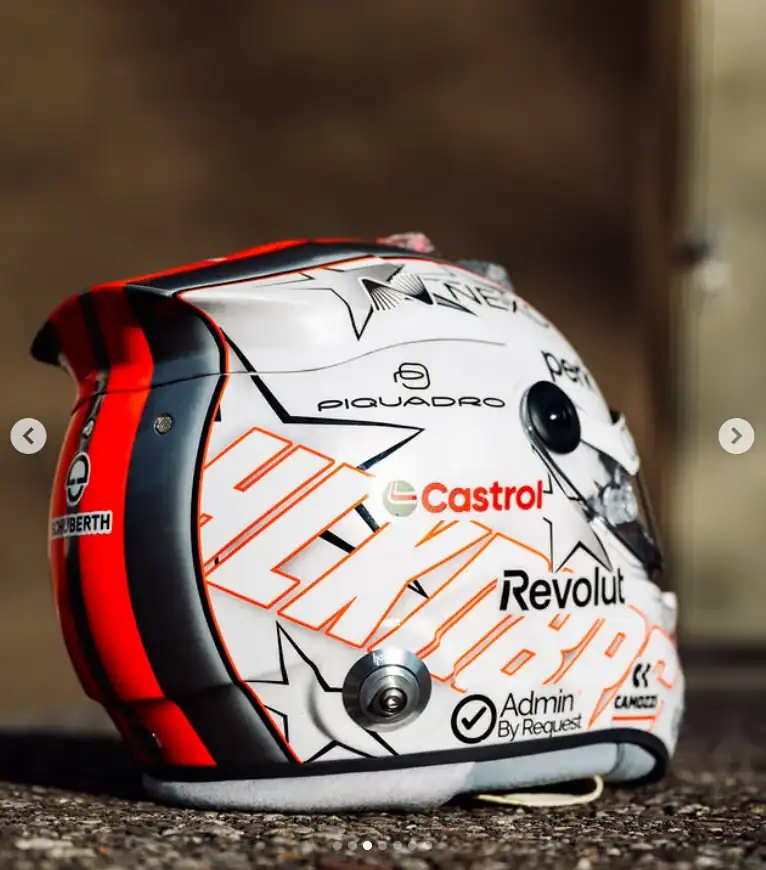
The front-row and second-row helmets worn this weekend are among the most collectible of the 2026 season — full-size 1:1 display replicas capture the exact liveries seen on track.
How Qualifying Unfolded
George Russell took pole position in the closing seconds of qualifying, posting a lap fast enough to head both Ferraris before the chequered flag ended the session. The lap was placed under stewards’ review for a potential yellow-flag infringement but was confirmed legal, keeping Russell at the top of the timing sheet. Charles Leclerc qualified second and Lewis Hamilton third, meaning Ferrari occupies both P2 and P3 on the grid. Kimi Antonelli, who currently leads the 2026 drivers’ championship, qualified fourth. Max Verstappen, who had been quick throughout practice, does not start from the position his pace suggested he deserved.
Verstappen’s session ended against the barrier. Red Bull issued a statement confirming an aero failure gave the Dutchman no opportunity to recover the car — a mechanical cause rather than a driver error. He starts fifth. The gap between pole and fifth is small in raw lap-time terms, but track position at the start of a race rarely follows qualifying gaps exactly, which makes the first corner sequence one of the most important of the 2026 season so far.
Russell’s pole is his first of the 2026 campaign. For George Russell and Mercedes, it represents a signal that the team’s regulation-era package is closer to the front than recent championship standings implied.
The Grid: Five Drivers, Five Stories
Five drivers on the first two and a half rows cover the realistic podium and title-fight picture for today’s race, and each arrives at the grid with a different narrative.
P1 — George Russell, Mercedes
Russell starts on pole having converted a late flying lap under pressure. His Russell helmet livery for 2026 retains the silver-and-black Mercedes palette with teal accents, a design that display replica collectors have tracked closely since the season-opening livery reveal. The stewards’ review added twenty minutes of uncertainty to his evening, but the lap stood.
P2 — Charles Leclerc, Ferrari
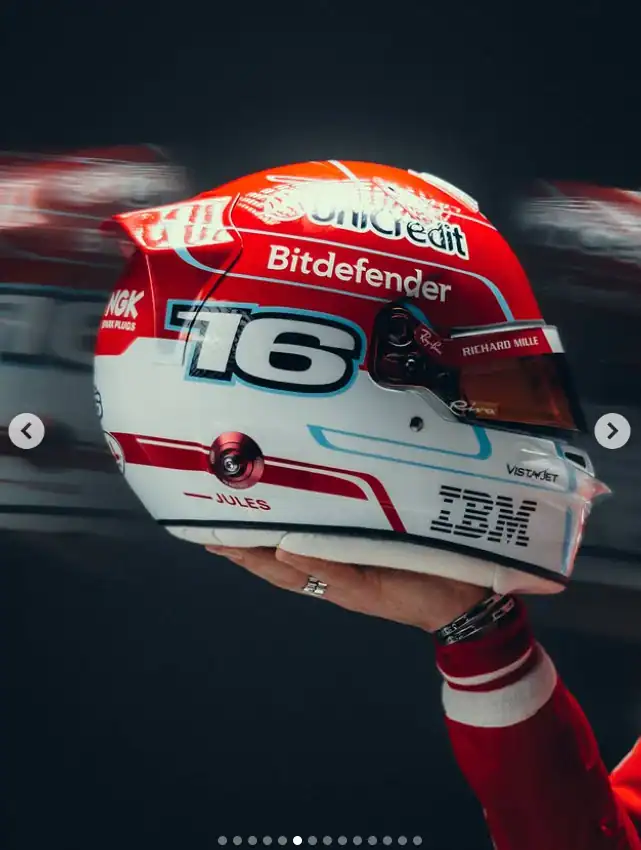
Leclerc lines up second, separated from his Ferrari team-mate Hamilton by just one grid slot. Charles Leclerc has taken two victories in 2026 already and will be aggressive into turn one. His red-and-white helmet, a collector favourite since his first Ferrari season, has an updated graphic treatment for 2026 that collectors have noted features a deeper crimson base coat compared to previous years.
P3 — Lewis Hamilton, Ferrari
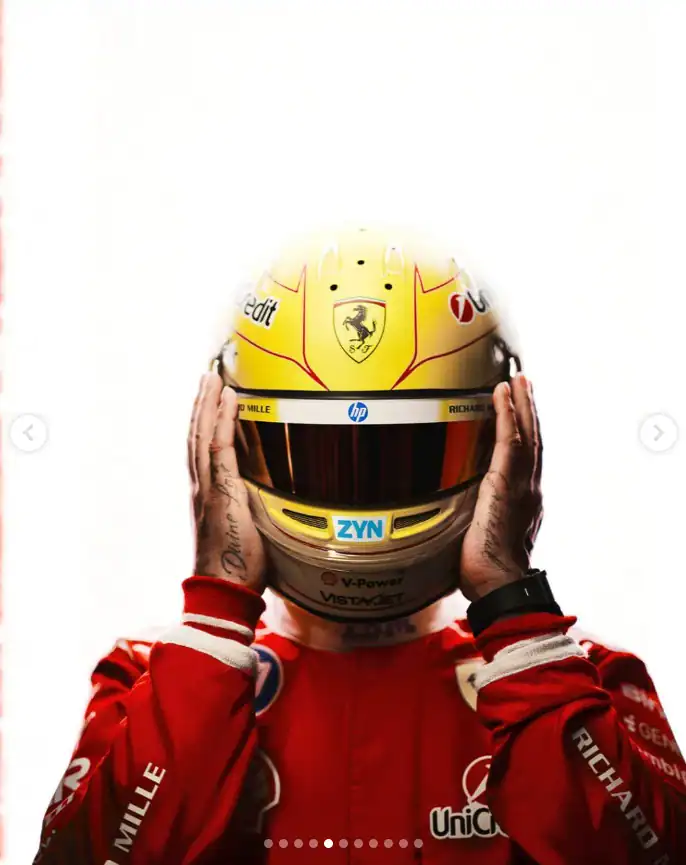
Lewis Hamilton qualified third in only his second season with Ferrari. His helmet design for 2026 blends Ferrari red with his long-standing yellow visor strip — a visual signature he has carried across multiple teams. Starting from P3 with both championship rivals ahead and behind him makes strategy the defining variable of his afternoon.
P4 — Kimi Antonelli, Mercedes
Antonelli leads the 2026 drivers’ championship and starts fourth. The Italian rookie-turned-title-contender has produced one of the more remarkable first full seasons in recent memory, and his helmet designs have been among the most requested in the display replica category this year. A points finish today maintains his lead regardless of what Russell does ahead of him.
P5 — Max Verstappen, Red Bull
Max Verstappen starts fifth after Red Bull’s confirmed aero failure ended his qualifying run in the barrier. The Red Bull mechanics worked through the night to return the car to race-ready condition. Verstappen has overtaken from fifth to podium positions before — the question is whether the repaired package has the same balance it showed in practice.
The Championship Picture Heading Into the Race
Kimi Antonelli leads the 2026 drivers’ championship as the cars line up on the grid today, with the points gap to his nearest rivals determining how aggressively each of the five front-runners needs to race. Antonelli in fourth needs only to finish in the points to maintain pressure, while Russell on pole has the chance to close whatever gap separates them if he converts today.
Hamilton in third and Leclerc in second represent Ferrari’s collective threat. Ferrari’s 2026 constructors’ standing means the Scuderia has strong reason to support whichever of their two drivers is better placed at any given moment in the race, which adds a strategic layer that pure driver competition does not always carry.
Verstappen’s title aspirations depend on recovery drives like the one he now faces. Red Bull confirmed the aero failure was not a recurring design flaw, which means the P5 start is a one-off setback rather than a structural problem — important context for collectors and fans assessing the season arc when choosing which 2026 helmet replicas represent the defining moments of this championship.
Helmet Designs on the 2026 Grid
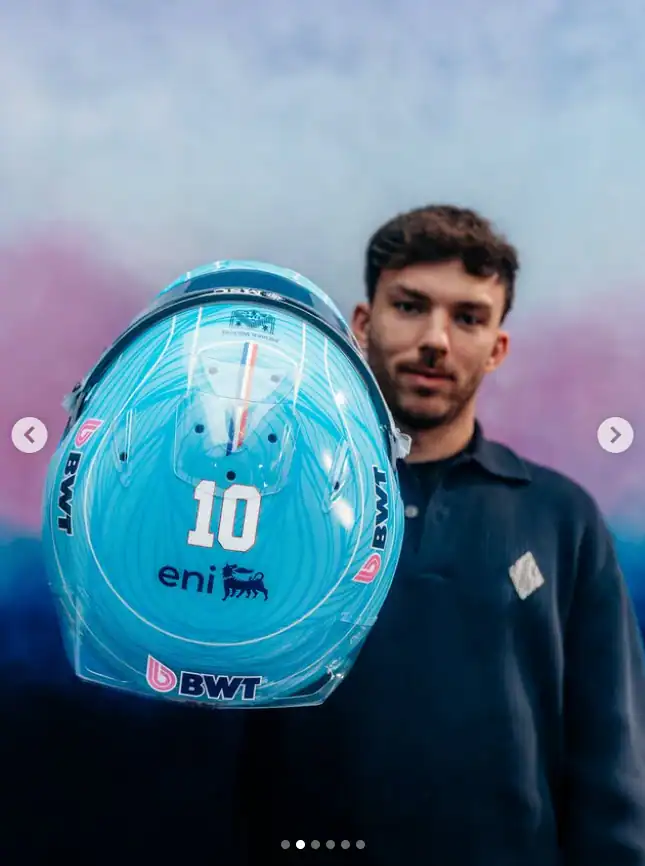
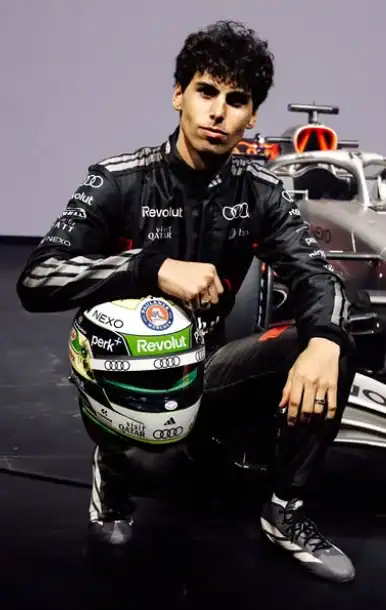
The five helmets worn by the front-five qualifiers this weekend reflect the 2026 season’s visual identity across the paddock — each driver’s lid carrying specific design updates that distinguish this year’s collector replicas from 2025 editions.
Full-size 1:1 display replicas of race-worn helmet designs are produced at exact scale, meaning the shell dimensions match the driver’s actual equipment. A standard full-face F1 display replica measures approximately 29 × 25 × 35 cm in external dimensions and weighs around 1.2–1.5 kg — precise enough to sit on a display stand and reproduce every graphic element visible on broadcast cameras, from the base livery to sponsor logos and visor strip colours.
The visor component on exhibition-quality replicas typically reproduces the 26 mm tinted panel geometry of the race original, including the characteristic slight curvature that gives modern F1 helmets their aerodynamic profile. Paint layers on premium display replicas run to between 8 and 12 individual coats to achieve the depth and gloss finish seen under paddock lighting.
For a race weekend where the front row features a Mercedes, two Ferraris, and the championship leader’s second Mercedes — all in distinct livery treatments — the collector case for adding a 2026-spec replica to a display is straightforward. These are the helmet designs that will appear in the season review footage and the championship statistics, regardless of today’s result.
What to Watch in the Race
The first corner is the single most consequential moment of today’s race, given how tightly the five title-relevant drivers are packed on the grid. Russell on pole has the line advantage, but Leclerc at P2 has a reputation for aggressive starts, and Hamilton at P3 has the experience to gain a position if either car ahead makes a fractional error.
Antonelli at P4 faces a different calculation. As championship leader, he benefits from clean air and risk avoidance, but falling behind Verstappen early would compress his points advantage before strategy can play out. Verstappen, meanwhile, starts on the clean side of the grid at P5 and has historically been quick through the opening sector regardless of grid position.
Tyre choice and pit-stop windows will determine whether the qualifying order survives to the finish. A race that ends with Russell first and Antonelli fourth produces a different championship narrative than one where Verstappen recovers to the podium. Both are plausible from where the cars sit on the grid at the start of Race Day 2026.
The Overnight Repair Story
Red Bull’s confirmation of an aero failure — not a driver mistake — is significant for the team’s internal dynamics heading into the second half of 2026. Verstappen’s radio communications in qualifying were measured; the team took responsibility publicly. The repaired car that rolls to the grid today is, according to Red Bull, aerodynamically identical to the specification that showed strong pace in Friday and Saturday practice. If that is true, fifth place on the grid understates his race-pace potential significantly.
Collecting the 2026 Season in Real Time
Race Day weekends like this one — where qualifying drama, championship tension, and mechanical failure converge in a single session — are exactly the moments that define a season’s collector value. The 2026 grid features five different helmet liveries across the front five positions, each representing a driver at a specific chapter of their career.
Russell’s first 2026 pole, Hamilton’s third year but second Ferrari season, Leclerc defending multiple 2026 wins, Antonelli leading the championship as a second-year driver, and Verstappen recovering from a mechanical failure that was not his fault — these are the storylines that collector display pieces document. A full-size 1:1 replica helmet is not a piece of safety equipment; it is a display item and exhibition piece that captures a driver’s visual identity at a defined moment in the sport’s history.
The 2026 regulation cycle has produced some of the most distinct helmet and car livery combinations in recent seasons. Collectors who acquired 2026-spec display replicas at the season opener on 2026-03-15 have already seen those designs feature in race-winning moments. Today’s result adds another chapter — and potentially another helmet design worth tracking, depending on who takes the chequered flag.
Whether you are documenting Russell’s pole-to-win conversion, Verstappen’s comeback from an aero failure, or Antonelli’s championship-leader performance, the display replica captures the exact lid design worn on the day. That specificity — right driver, right year, right livery — is what separates a 2026 replica from a generic souvenir.
“Red Bull confirmed an aero failure left Verstappen no chance to save the car in qualifying — he starts fifth through no fault of his own.”
— Red Bull Racing, 2026 qualifying debrief
“Russell’s pole lap received a stewards’ review over yellow flags but stood — he takes pole position for Mercedes on Race Day 2026.”
— FIA Stewards’ Decision, 2026 qualifying
FAQ
Q: Who starts on pole position for the 2026 race?
George Russell starts on pole position for Mercedes, having set his lap in the final seconds of qualifying. The lap was reviewed by the stewards for a yellow-flag query but was confirmed legal.
Q: Why does Max Verstappen start fifth instead of higher?
Max Verstappen starts fifth because a confirmed aero failure on his Red Bull sent him into the barrier during qualifying. Red Bull stated the failure gave him no opportunity to save the car — it was a mechanical issue, not a driver error.
Q: Who leads the 2026 F1 drivers’ championship going into this race?
Kimi Antonelli leads the 2026 drivers’ championship and starts fourth on the grid, between the two Ferraris of Hamilton and Verstappen’s Red Bull.
Q: What makes a 2026 F1 display replica helmet different from earlier versions?
A 2026-spec full-size 1:1 display replica reproduces the exact livery graphics, visor geometry, and paint finish of the helmet worn on track in the 2026 season. These are collector and exhibition pieces — not certified for protective use — and differ from 2025 editions in base livery colour treatments, sponsor logo placement, and in some cases visor strip colour.
Q: What are the physical dimensions of a full-size F1 helmet display replica?
A standard full-size 1:1 F1 display replica measures approximately 29 × 25 × 35 cm externally and weighs around 1.2–1.5 kg. These are display pieces produced at exact race-helmet scale for collector and exhibition use only.
Browse F1 Helmet Collection
Display and collector replicas only. Not certified for protective use. Full-size 1:1 scale.
This article was written with the help of AI tools. Editorial policy