
Blog
James Vowles on Toto Wolff’s Decisive Role: A Mercedes Legacy Traced Through Helmet Design
 123Helmets Editorial Team
James Vowles on Toto Wolff’s Decisive Role: A Mercedes Legacy Traced Through Helmet Design
James Vowles’ recent admission about Toto Wolff’s decisive influence on his path to Williams team principal has reopened a fascinating chapter of Mercedes’ modern history — one that collectors can trace visually through the evolution of the Silver Arrows’ helmet design language, from the muted silver of the early hybrid era to the black matte statement of 2020 and the return to silver in recent seasons.
Key Takeaways
James Vowles publicly credited Toto Wolff as the pivotal mentor behind his transition from Mercedes strategy director to Williams team principal.
The Mercedes helmet aesthetic has evolved through three distinct visual eras, each reflecting the team’s internal culture under Wolff’s leadership.
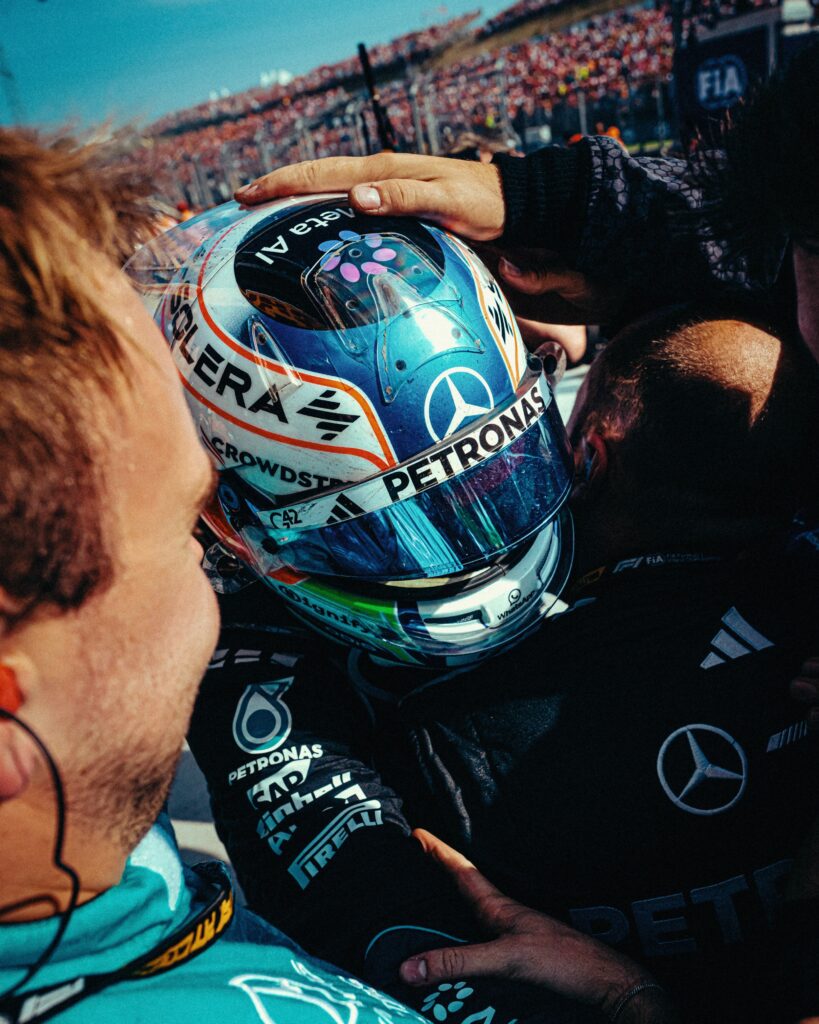
Collector-grade 1:1 replicas capture the matte finishes, star motifs and petronas teal accents that define the Silver Arrows’ display identity.
The Vowles-Wolff narrative adds contextual value to Mercedes display pieces from 2013-2022, turning each helmet into a chapter of team history.
The Vowles Revelation: A Mentorship Forged Inside Brackley
From strategy headset to team principal chair
James Vowles spent more than two decades inside the Brackley operation, rising from Honda through Brawn GP and into the dominant Mercedes era as Motorsport Strategy Director. His voice — calm, measured, often heard on Lewis Hamilton’s radio during pivotal moments — became one of the defining sounds of the hybrid era. Yet until recently, Vowles had rarely discussed the personal dimension of his move to Williams at the start of 2023.
In recent interviews, Vowles has been unusually candid about the role Toto Wolff played. He describes Wolff not simply as a boss who granted permission to leave, but as an active architect of his preparation for leadership. Conversations about management philosophy, long private discussions about organisational culture, and — crucially — the trust to lead strategic decisions on the pit wall all contributed to a grooming process that made the Williams offer viable.
Why this matters for the Mercedes narrative
For collectors and historians of the sport, Vowles’ admission reframes the Mercedes story. The team was not only a winning machine but a deliberate leadership incubator. That cultural DNA is something display pieces can embody — and the helmet, as the most personal artefact in Formula 1, becomes the natural vehicle for telling it.
Designer Analysis: The Three Visual Eras of Mercedes
Era one — the silver restraint (2013-2019)
When Wolff arrived in 2013, Mercedes helmet design — as worn by drivers such as Nico Rosberg and Lewis Hamilton within the team’s visual identity — embraced a restrained silver palette accented by petronas teal and subtle star motifs. The finish was typically a cool metallic silver, occasionally with satin variations, reflecting an engineering-first philosophy. Replica makers reproducing this era focus on achieving the correct cold-silver base coat, a notoriously difficult shade to match because it shifts under different lighting conditions.
Era two — the black statement (2020)
The 2020 season produced one of the most commented visual pivots in modern F1: the all-black Mercedes livery and its corresponding darker helmet treatments. For collectors, this era is unmistakable. The matte black base, stark silver star and minimal typography create a piece of display art that reads as political, cultural and sporting commentary simultaneously. A 1:1 replica from this period is arguably the most visually dramatic Mercedes helmet in any serious collection.
Era three — the return to silver (2022 onward)
The return to bare-carbon silver from 2022 brought a new technical honesty to the design: raw weave patterns visible beneath the clear coat, with accent blocks in teal and black. High-end replicas from this era are judged on how faithfully the carbon-effect finish is reproduced — a detail only top-tier display-grade manufacturing can nail.
Visual Breakdown: Reading a Mercedes Helmet Like a Document
The shell geometry
A full-size 1:1 collector replica begins with shell accuracy. The Mercedes-era helmet silhouettes used by the team’s drivers follow the modern aero-profile template — elongated rear spoiler, mandatory frontal reinforcement strip, and the distinct visor aperture introduced in recent seasons. On a display piece, the edges of this aperture must be razor-clean; any softness betrays a lower-tier casting.
The finish and the lacquer depth
What separates an exhibition-quality replica from a souvenir is lacquer depth. Mercedes livery finishes — whether silver, matte black or carbon-look — require multiple lacquer coats to achieve the correct optical behaviour. Matte pieces in particular are treacherous: too flat and they look plastic, too satin and they lose their identity.
The micro-details
Sponsor logos, three-pointed stars, driver numerals and the small tributes that appeared on specific weekends (charity events, milestone races, farewell liveries) are the collector’s forensic playground. A properly executed display replica reproduces these elements with decal precision, not painted approximation.
The Collector Angle: Why the Vowles Story Adds Value
Narrative provenance beats pure aesthetics
Experienced collectors understand that the best display pieces carry stories. A Mercedes helmet replica from 2017 or 2018 is no longer just a piece of painted composite on a plinth — once you know that the strategy calls behind those seasons came from a team being quietly groomed for leadership roles across the paddock, the object gains narrative weight. Vowles at Williams, Jérôme d’Ambrosio in management, Loïc Serra’s movements: each is a branch of the same Brackley tree.
Building a themed display
We increasingly see private collectors build Mercedes era displays: three 1:1 replicas side by side, representing the silver, black and carbon phases. Paired with a discreet plaque outlining the Wolff-era leadership lineage — now including the Vowles chapter — the arrangement functions as sporting history in physical form.
What to prioritise when buying
For a first Mercedes display piece, the 2020 black helmet offers the strongest visual impact in almost any interior. For purists, the silver hybrid-era replica carries the deepest championship resonance. For those who appreciate engineering aesthetics, the carbon-finish era is the connoisseur’s choice.
Exhibition Quality: What Full-Size 1:1 Really Means
Scale, weight and presence
A true 1:1 replica matches the external dimensions of the real article used by the driver. This matters more than novices expect. Scaled-down helmets — 1:2 or 1:5 — are perfectly valid as shelf pieces, but they cannot create the eye-level confrontation that makes a display helmet so compelling. Place a full-size 1:1 Mercedes replica on a lit plinth at head height and it stops being memorabilia; it becomes presence.
Display environment
Silver-era Mercedes helmets reward warm directional lighting that brings out the metallic shift. Matte black pieces need softer, more diffused lighting to avoid dead spots. Carbon-finish replicas benefit from a slight angle to catch the weave. Professional collectors often commission custom acrylic cases with micro-LED lighting tuned specifically to the livery era.
The disclaimer every serious buyer understands
These are display and collector replicas only. They are not certified for any protective use, are not wearable on road or track, and exist solely as exhibition objects. That clarity is part of why the market for full-size 1:1 collector helmets has matured: buyers know exactly what they are acquiring — a piece of sporting history, crafted to be seen, not used.
“Toto didn’t just let me go. He prepared me to go. That’s a very different thing.”
— James Vowles, reflecting on his path from Mercedes to Williams
FAQ
Q: Does the Vowles-Wolff story affect the collector value of Mercedes helmet replicas?
Narrative context always adds appeal. Mercedes display replicas from the 2013-2022 Wolff-led era now carry an additional leadership-lineage story, making themed collections more compelling.
Q: Which Mercedes helmet era is the most visually striking for display?
The 2020 matte black era is the most dramatic in almost any room. The hybrid-era silver is the most historically resonant, and the recent carbon-finish era is the most technically refined.
Q: What does full-size 1:1 mean exactly?
It means the external dimensions of the replica match those of the real helmet used in competition. The piece is built for exhibition and collector display only, not for protective use.
Q: How should I light a Mercedes display helmet?
Silver replicas respond to warm directional lighting, matte black to soft diffused sources, and carbon-finish pieces to slightly angled light that reveals the weave pattern beneath the lacquer.
Q: Are these replicas certified for any kind of use on track or road?
No. They are display and collector replicas only, not certified for protective use. They are exhibition objects, crafted as faithful 1:1 representations for collectors.
Shop Mercedes Helmets
Display and collector replicas only. Not certified for protective use. Full-size 1:1 scale.
This article was written with the help of AI tools. Editorial policy