
Blog
Canadian GP Recap: Why McLaren Believes It Couldn’t Have Beaten Hamilton and Verstappen in Montreal
 123Helmets Editorial Team
Canadian GP Recap: Why McLaren Believes It Couldn’t Have Beaten Hamilton and Verstappen in Montreal
The Circuit Gilles Villeneuve delivered a Canadian Grand Prix that left McLaren team principal Andrea Stella conceding something rare in a season of papaya dominance: on this particular Sunday, the MCL package simply did not have the pace to challenge Lewis Hamilton’s Mercedes-flavoured charge nor Max Verstappen’s relentless precision. For collectors and display enthusiasts, Montreal is always a feast of distinctive helmet liveries and special-edition tributes — and this race proved no exception.
Key Takeaways
McLaren openly admitted Hamilton and Verstappen had pace the papaya cars could not match in Montreal
The Canadian GP podium showcased three iconic helmet designs ideal for collector display shelves
Lewis Hamilton’s Montreal-specific helmet detailing makes it a standout 1:1 replica piece
Circuit Gilles Villeneuve continues to produce some of the most visually striking helmet moments of the season
A Canadian Sunday That Reshaped the Narrative
For weeks the paddock conversation revolved around McLaren’s apparent supremacy, with Lando Norris and Oscar Piastri trading wins and the MCL chassis looking like the benchmark of the grid. Montreal, however, told a different story. The low-grip, low-downforce demands of the Circuit Gilles Villeneuve, combined with the temperature swings typical of Quebec in June, exposed a window where Mercedes and Red Bull found a sweeter operating zone.
Andrea Stella’s post-race honesty was striking. Rather than spinning the result, the Italian engineer acknowledged that even in a perfect race, McLaren’s cars would have lacked the straight-line efficiency and tyre warm-up profile needed to genuinely fight Hamilton and Verstappen on this layout. It was a refreshingly clear-eyed verdict — and one that immediately turned the spotlight onto the two drivers who did dominate the day.
The Hamilton Resurgence Moment
Lewis Hamilton has long treated Montreal as a spiritual home. His record at the venue is unrivalled in the modern era, and every visit feels like a chapter in an ongoing love letter between driver and circuit. The Mercedes garage saw Hamilton extract everything from a setup window that suited his style, while his helmet — a beautifully detailed Montreal-spec piece — became one of the visual signatures of the weekend.
For collectors building a display wall, a Hamilton Canadian GP helmet replica sits at the intersection of statistical greatness and aesthetic richness. The maple-leaf accents, the deep yellow that has anchored his designs for years, and the personal touches added for this particular round combine into a full-size 1:1 collector item that tells a story before a single word is spoken about it.
Why McLaren’s Pace Deficit Was Real, Not Tactical
It would have been easy for McLaren to point at strategy, traffic, or a poorly-timed safety car. Instead, the engineering room ran the numbers and reached an uncomfortable conclusion: the car was genuinely slower in the configuration required for Montreal. The medium-speed corners onto the back straight, the chicane braking zones, and the long DRS pulls all played into Mercedes’ and Red Bull’s strengths.
Aero Balance and the Wall of Champions
The Wall of Champions exit demands trust in the rear of the car. McLaren’s drivers reported that the MCL package felt nervous on traction phases, costing tenths in every lap. Verstappen, meanwhile, looked utterly planted — a signature of Red Bull’s chassis when its low-drag window is unlocked. Hamilton found his own balance in qualifying trim and translated it into race pace that simply could not be touched.
Tyre warm-up: the silent decider
Restart phases following the safety car periods were where McLaren lost the most ground. The MCL needed an extra sector to bring the front-left into the working window, and on a circuit defined by short bursts of full attack, that delay was decisive. Hamilton and Verstappen had instant grip; the papaya cars had to wait.
Podium Helmet Liveries: A Display Collector’s Dream
If you arranged the three podium helmets from Montreal on a single shelf, you would have one of the most visually compelling F1 helmet displays of the season. Each piece carries its own narrative weight, its own colour story, and its own engineering character — and each works as a full-size 1:1 replica exhibition item.
Hamilton’s Montreal-Spec Helmet
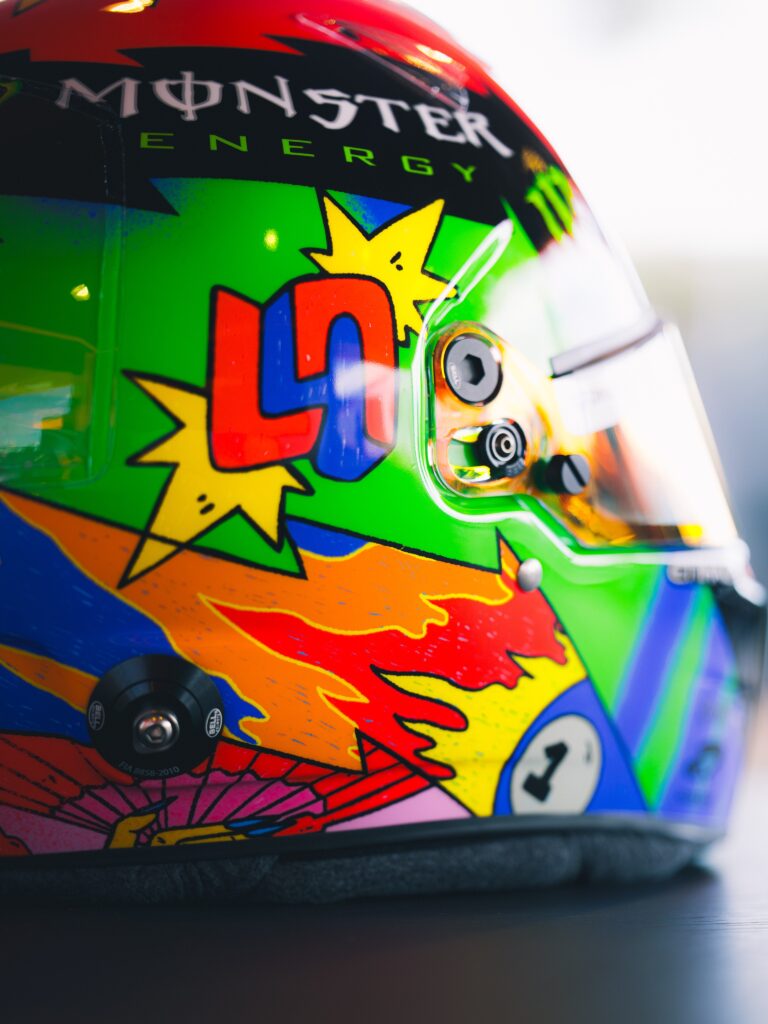
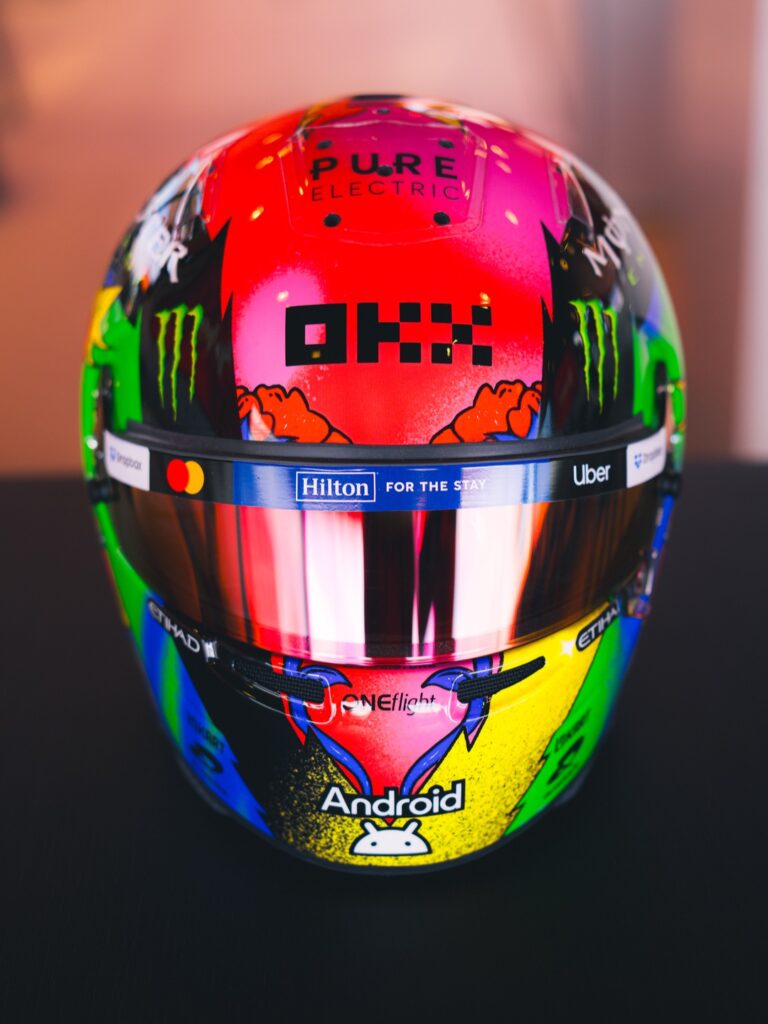
Lewis Hamilton’s helmet for the Canadian round leans into his career-defining palette: yellow, purple, and white, with carefully placed Canadian flourishes. The matte and gloss contrasts catch lighting beautifully, making it an ideal centrepiece for a glass display cabinet. As a collector item, it pairs the gravitas of his Montreal record with the contemporary energy of his current career chapter.
Verstappen’s Precision Aesthetic
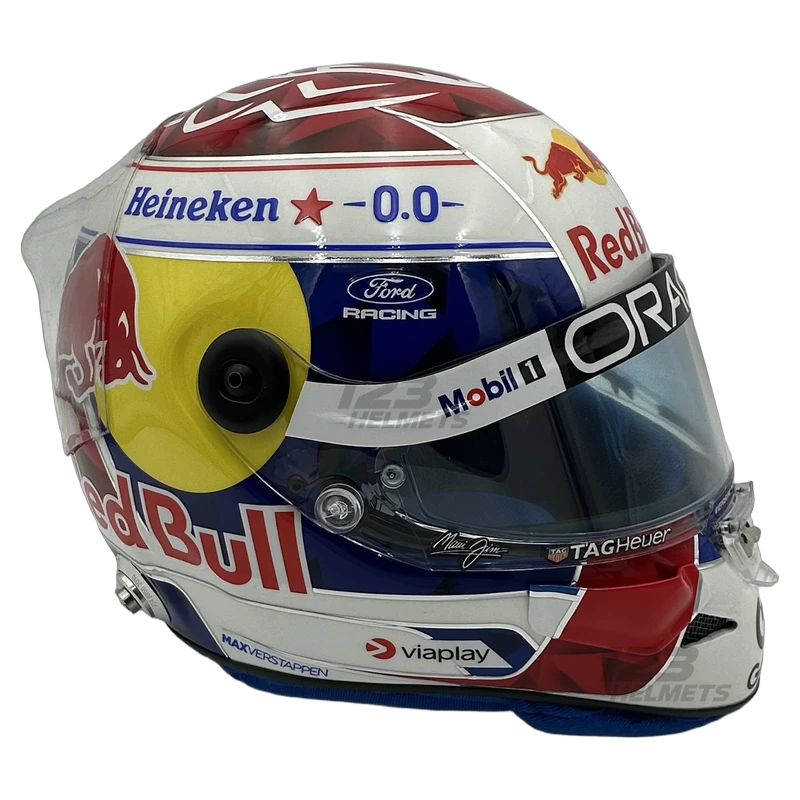
Verstappen’s helmet philosophy is the opposite of Hamilton’s expressive flair — it is sharp, geometric, and tightly disciplined. The Dutch flag bands, the blue-and-red lightning motifs, and the polished crown make for a piece that feels almost architectural on a display plinth. For exhibition setups, it provides perfect visual counterpoint to Hamilton’s warmer tones.
The Third Step Story
The third podium helmet completed a trio that felt almost curated. Together, the three liveries form a study in how modern F1 helmet design has evolved into a personal visual identity — something collectors increasingly recognise when choosing which 1:1 replicas to feature in their displays.
McLaren’s Path Forward — and What It Means for Collectors
Stella’s admission is not a crisis statement. McLaren remains a championship contender, and the Montreal result is more a circuit-specific anomaly than a structural weakness. The team’s response — increased focus on low-drag configuration work and tyre warm-up procedures — suggests we should expect a stronger papaya showing at the next medium-downforce venue.
The Bigger Picture for the Title Fight
What Montreal really did was reopen the championship conversation. Hamilton’s return to victory lane reminds the grid that Mercedes can still produce winning weekends. Verstappen’s relentless points-gathering ensures Red Bull remains in every conversation. And McLaren, despite its candid Canadian GP verdict, holds enough cards to keep the title race a genuine multi-team contest.
Why this matters to the display shelf
For helmet collectors, an unpredictable season is the best season. Each new winner, each new podium configuration, each new special-edition livery becomes another piece worthy of full-size 1:1 replica treatment. Montreal added three such pieces to the conversation — and Hamilton’s helmet in particular feels like a future signature item from this era.
Building a Canadian GP Display Around the Hamilton Helmet
If you are curating a themed shelf around the Canadian Grand Prix, the Hamilton Montreal-spec helmet is the natural anchor. Position it slightly forward, under a warm directional light that catches the yellow gloss, and surround it with complementary pieces — perhaps a Verstappen current-season helmet on one side and a classic Hamilton design on the other to tell a career arc.
Lighting and Presentation Tips
Full-size 1:1 collector helmets reward thoughtful presentation. Warm LED lighting at roughly 3000K brings out the depth of metallic flakes and chrome detailing. A neutral background — dark grey or matte black — lets the colours of the helmet itself do the storytelling. Avoid direct sunlight, which can dull finishes over time on any display piece.
The Story a Display Tells
A well-built F1 helmet display is more than decoration. It is a visual history of the sport, captured in the most personal piece of equipment each driver carries. Hamilton’s Canadian GP helmet, framed by the context of McLaren’s honest admission and Verstappen’s relentless presence, becomes a piece that holds an entire weekend’s drama in its surfaces. That is what elevates an exhibition-quality replica from object to artefact.
“Even with a perfect race, I don’t think we had the pace to fight Hamilton and Verstappen here.”
— Andrea Stella, McLaren Team Principal
“Montreal always feels like coming home — every corner has a memory.”
— Lewis Hamilton
FAQ
Q: Why did McLaren say it couldn’t have beaten Hamilton and Verstappen in Canada?
McLaren acknowledged that the MCL package lacked the low-drag efficiency and tyre warm-up performance needed at the Circuit Gilles Villeneuve, where Mercedes and Red Bull found a stronger operating window than the papaya cars.
Q: What makes Hamilton’s Canadian GP helmet a strong collector item?
The helmet combines Hamilton’s signature yellow-and-purple palette with Montreal-specific detailing, making it visually rich and historically meaningful as a full-size 1:1 display replica.
Q: Are the helmets sold by 123Helmets.com intended for protective use?
No. All helmets are display and collector replicas only, full-size 1:1 scale, designed for exhibition and not certified for any protective application.
Q: How should I display a 1:1 F1 helmet replica at home?
Use a glass cabinet or open shelf with warm LED lighting around 3000K, a neutral matte background, and avoid direct sunlight to preserve the finish of your display piece.
Q: Does Montreal’s result change the championship picture?
It reopens the conversation. McLaren remains a strong contender, but Hamilton’s victory and Verstappen’s consistency confirm the title fight remains a genuine multi-team battle.
Shop Lewis Hamilton Collection
Display and collector replicas only. Not certified for protective use. Full-size 1:1 scale.