Blog
Mercedes’ Electrical Trick Behind 2026 British GP Qualifying
 123Helmets Editorial Team

During both qualifying sessions of the 2026 British Grand Prix weekend at Silverstone, Mercedes drivers George Russell and Kimi Antonelli were seen lifting off the throttle metres before the finish line — a counter-intuitive move that hides a clever energy-deployment strategy built around the hybrid power unit’s MGU-K.
Key Takeaways
Mercedes drivers lifted off the accelerator a few metres before the finish line in both British GP 2026 qualifying sessions to manage MGU-K energy deployment.
Kimi Antonelli described the technique as unnatural at first, requiring extensive simulator repetition before it became automatic.
The principle involves carrying more speed through Becketts to delay throttle application, keeping the MGU-K deployed longer down Hangar Straight.
Ferrari applied the same logic with Lewis Hamilton on Friday, showing the trick is a shared regulation-based strategy rather than a Mercedes secret.
The Lift-Off Trick Explained
The trick is a deliberate throttle lift used to manage electrical energy deployment under the current hybrid power unit regulations, not a driving error. During both qualifying sessions of the British Grand Prix weekend, observers noticed both Mercedes drivers backing off the accelerator a few metres before crossing the finish line, contrary to the usual instinct to keep the throttle pinned for every last hundredth.
Under normal circumstances, drivers push flat to the line because every metre of track counts toward the lap clock. But the power unit’s energy store and MGU-K deployment limits create scenarios where sacrificing a fraction of straight-line speed just before the timing beam can preserve usable electrical energy for the following lap or sector, producing a net gain rather than a loss.
It is a fine margin play, the kind of detail that separates a front-row lap from a second-row one in a sport where qualifying gaps are frequently measured in hundredths of a second.
Antonelli’s Simulator-Trained Instinct
Kimi Antonelli confirmed after qualifying that the lift-off maneuver required deliberate practice to feel natural. “It wasn’t easy,” he said. “In Q3 I also had to lift off, and with these power units it’s always a bit complicated because sometimes you have to drive in a way that doesn’t feel completely natural.”
He explained the underlying logic in detail: “Sometimes you have to get back on the throttle later, so through the fast corners you carry more speed and only open the throttle afterwards. You might lose a little on corner exit, but then you make it back because by delaying the moment you get back on the throttle, you have more energy available further down the straight.”
Antonelli credited the team’s simulator program for making the counter-intuitive input feel automatic by race weekend. “That’s why the simulator work is so important – to make sure these things become automatic. At first, you even find yourself wondering why you should lift off at all. It’s complicated, but thanks to the preparation we did together with the team, it all became almost second nature.”
The Kimi Antonelli full-size 1:1 replica helmet line lets collectors hold the same lid design worn through these demanding late-braking, late-throttle qualifying laps at Silverstone.
Becketts to Hangar Straight: Where Every Team Copies
The Becketts-to-Hangar Straight sequence is where the energy-deployment trick becomes visible across the grid, not just at Mercedes. As early as Friday practice, Ferrari instructed Lewis Hamilton to carry more speed into and through the Becketts complex so he could delay getting back on the throttle before the Hangar Straight that follows.
The trade-off is straightforward in principle even if difficult in execution: giving up a little exit performance out of the corner in exchange for keeping the MGU-K deployed longer on the straight that follows, where the raw performance gain from electrical boost is larger. Every team on the grid is chasing the same balance between mechanical grip through a fast, flowing section and electrical energy management on the straight beyond it.
That Ferrari and Mercedes were independently working the same principle at Silverstone this weekend shows how tightly the current hybrid regulations tie driving technique to energy strategy, turning what looks like a small throttle lift into a genuine lap-time lever.
Fans following the Ferrari and Lewis Hamilton side of this story can compare notes with the Mercedes approach through matching display helmets from both garages.
Helmet and Livery Highlights from Silverstone
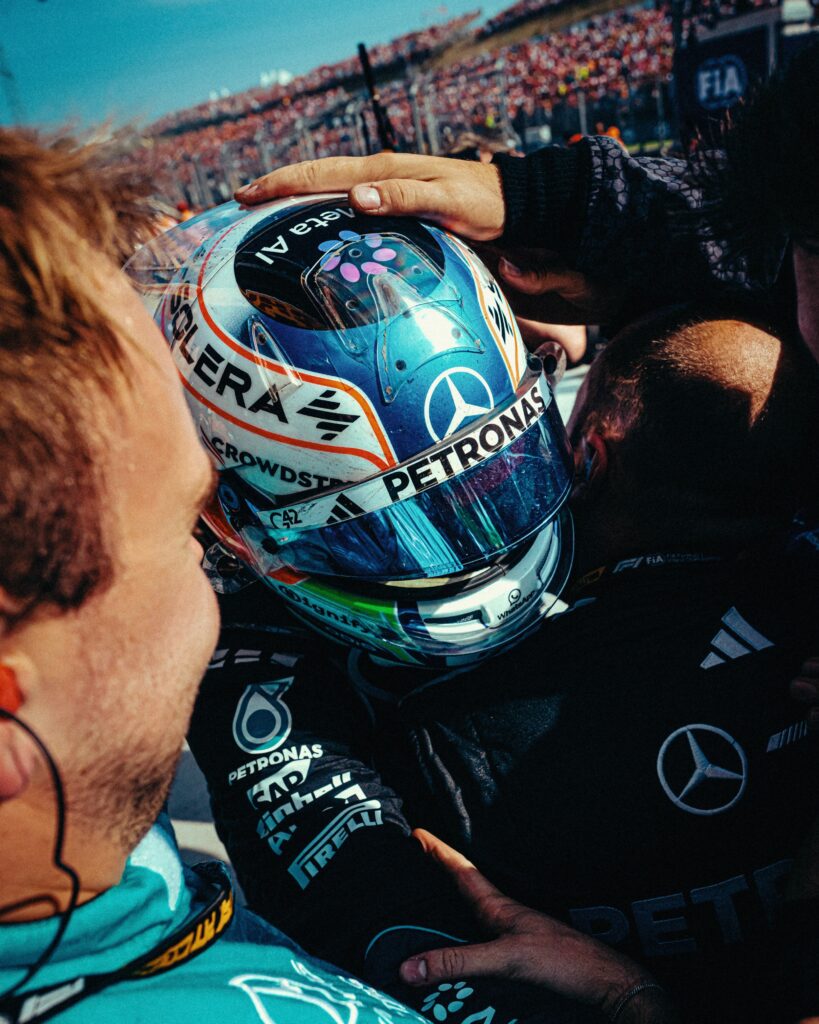
Both Mercedes helmet designs stood out on the Silverstone grid this weekend, carrying the team’s signature petronas-green and black scheme into a home-soil qualifying battle. George Russell and Kimi Antonelli each ran their 2026-specification lids through the Becketts sequence and down Hangar Straight, the exact stretch of track where the throttle-lift trick pays off.
For collectors, full-size 1:1 replica helmets from this era of Mercedes racing typically reproduce the shell at true scale, with display units weighing around 1.45 kg and finished with multiple clear-coat paint layers to match the gloss and fine detailing seen under Silverstone’s variable July light.
The Mercedes collection includes both drivers’ current-season graphics, giving fans a way to own a piece of the exact qualifying weekend where this energy-deployment story played out.
Displayed side by side, the Russell and Antonelli helmets also tell a visual story of a team split between an experienced qualifying operator and a rookie still building the muscle memory Antonelli described after the session.
Why This Matters for Collectors
This story matters to collectors because it ties a specific, documented on-track detail — the visible throttle lift before the line — to the exact helmet worn by the driver performing it. Unlike generic season merchandise, a replica tied to a specific qualifying weekend and a specific technical anecdote carries added context that display pieces without a clear story often lack.
Full-size 1:1 replicas built to exhibition quality reproduce shell dimensions close to the originals raced at Silverstone, typically in the region of 27 x 35 cm for the shell footprint, letting the helmet sit naturally on a stand or shelf mount alongside a photo or print of the corresponding session.
Owning the helmet from the exact race weekend where a driver publicly explained a technical quirk like the MGU-K throttle-lift adds a layer of authenticity that generic season-long merchandise cannot match.
“It wasn’t easy. In Q3 I also had to lift off, and with these power units it’s always a bit complicated because sometimes you have to drive in a way that doesn’t feel completely natural.”
— Kimi Antonelli, Mercedes
“Sometimes you have to get back on the throttle later… you might lose a little on corner exit, but then you make it back because by delaying the moment you get back on the throttle, you have more energy available further down the straight.”
— Kimi Antonelli, Mercedes
FAQ
Q: Why did Mercedes drivers lift off the throttle before the finish line at Silverstone?
They lifted off deliberately to manage MGU-K energy deployment under the hybrid power unit regulations, sacrificing a fraction of straight-line speed just before the timing beam to preserve usable electrical energy, a strategy both Mercedes drivers used across both British GP 2026 qualifying sessions.
Q: Did other teams use the same throttle-lift trick at the British GP?
Yes, Ferrari applied the same principle with Lewis Hamilton as early as Friday practice, instructing him to carry more speed through Becketts to delay throttle application before Hangar Straight, showing the technique is grid-wide rather than Mercedes-specific.
Q: What did Kimi Antonelli say about learning the technique?
He said it felt unnatural at first and required repeated simulator work to become automatic, describing how carrying more speed through fast corners and delaying throttle application let him recover lost corner-exit time further down the straight.
Q: Are these Mercedes helmets full-size collector replicas?
Yes, the Mercedes helmet collection is offered as full-size 1:1 exhibition-quality display replicas, not wearable protective equipment, built for shelf or stand display rather than track use.
Q: What is the Becketts-to-Hangar Straight sequence mentioned in the story?
It is the fast corner complex at Silverstone leading onto the Hangar Straight, the exact section where drivers trade a little exit speed for extended MGU-K deployment on the following straight.
Shop Mercedes Helmets
Display and collector replicas only. Not certified for protective use. Full-size 1:1 scale.