
Blog
2026 British GP: Time to Rethink Safety Car Rules?
 123Helmets Editorial Team
The 2026 British Grand Prix ended under a safety car after Max Verstappen crashed his Red Bull at Stowe with six laps remaining, sparking boos at Silverstone and a fresh debate over whether Formula 1 needs a different finishing procedure.
Key Takeaways
Max Verstappen crashed at Stowe with six laps remaining, triggering the safety car that decided the finish of the 2026 British Grand Prix.
A software glitch briefly displayed the ‘safety car in this lap’ message on the penultimate tour before the FIA overruled it just eight seconds later.
Race control followed current regulations requiring one full lap after lapped cars clear themselves, which meant the race could not restart in time.
Grands prix have ended behind the safety car on 12 occasions since 1999, making Silverstone 2026 a rare but not unprecedented conclusion.
How the 2026 British Grand Prix Ended
The 2026 British Grand Prix finished under safety car conditions after Max Verstappen crashed his Red Bull at Stowe with six laps remaining, removing any chance of a green-flag finish. Once his car had been recovered and the circuit declared clear, race control followed standard procedure by allowing lapped cars to unlap themselves before the checkered flag. The Silverstone crowd, anticipating a grandstand finish, responded with audible boos as the field crossed the line in formation behind the safety car rather than at racing speed.
For a circuit with the history and atmosphere of Silverstone, an anticlimactic ending like this stings more than most. The stands were full, the tension had been building through the closing laps, and then the race simply petered out under yellow-and-safety-car conditions. It is exactly the kind of finish that fuels debate long after the podium ceremony, and this one arrived with an added layer of confusion thanks to a timing glitch in race control’s messaging system.
Verstappen’s Stowe Incident
Max Verstappen’s crash at Stowe with six laps remaining was the trigger event that made a safety car finish unavoidable. Stowe is one of Silverstone’s fastest corners, and a car leaving the track there at speed typically requires barrier checks and a full recovery operation before racing can resume, which eats into the laps left on the clock. Once Verstappen’s Red Bull had been cleared from the gravel and the barriers inspected, the countdown to the checkered flag had already tightened to the point where a standing or rolling restart was no longer realistic.
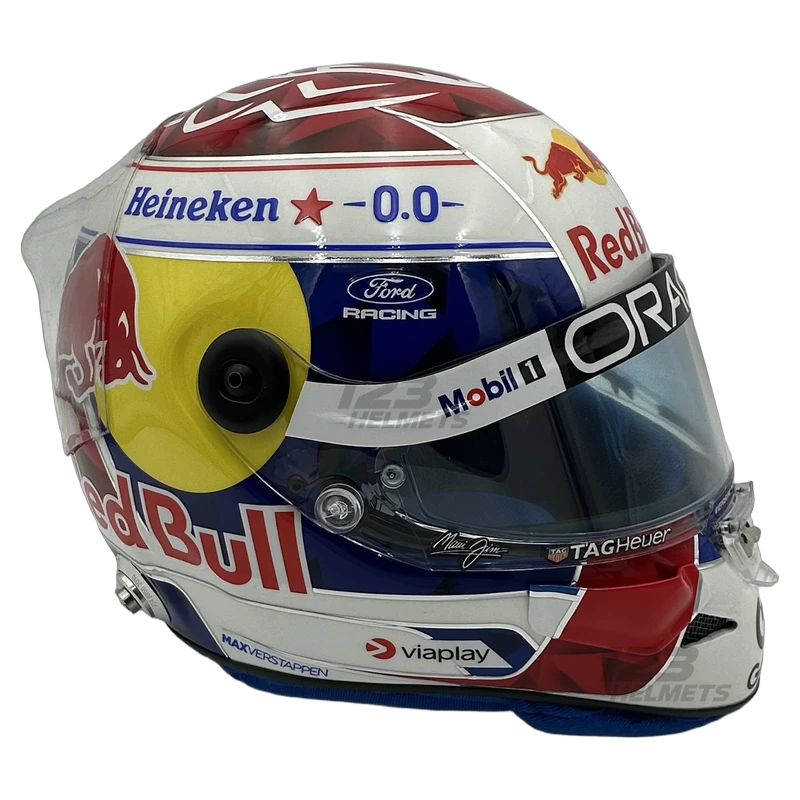
Collectors following Verstappen’s 2026 campaign will want to keep an eye on how Red Bull documents days like this one. A Grand Prix that ends in dramatic circumstances, whether through a driver’s own incident or a rules controversy, often becomes one of the more talked-about weekends of a season, and that context adds to the appeal of a full-size 1:1 display helmet tied to the race. Fans building a Verstappen shelf can browse the Max Verstappen collection and the wider Red Bull lineup for exhibition-quality pieces from his career.
The Safety Car Rule Explained
F1’s current regulation requires that once lapped cars are permitted to unlap themselves behind the safety car, at least one additional full lap must be completed before the race can be declared over or restarted. At Silverstone in 2026, those lapped cars were cleared on the penultimate tour, which meant the mandatory follow-up lap consumed what remained of the race distance, leaving no room for a green-flag restart before the checkered flag fell.
This is not uncharted territory for the sport. Grands prix have finished behind the safety car on 12 occasions since the first instance in 1999, making Silverstone 2026 a genuinely rare occurrence rather than a routine one. The most infamous case remains Abu Dhabi 2021, where the safety car procedure was applied in a way that ultimately did not produce a safety-car finish at all, a decision that still shapes how closely every subsequent application of these rules gets scrutinized.
The Software Glitch Controversy
A software glitch briefly displayed the ‘safety car in this lap’ message during the penultimate tour, only for the FIA to overrule that signal just eight seconds later. That eight-second window was enough to generate confusion in the pit lane and among viewers trying to follow exactly when the race would end, adding a layer of technical embarrassment to an already deflating conclusion for the crowd.
Whatever caused the glitch, the underlying procedure was applied correctly according to today’s rulebook. The confusion was cosmetic rather than substantive, a messaging error rather than a decision error, but it still gave critics of the current system another data point to argue that race control’s tools and communication protocols need tightening even if the regulation itself stays the same.
Podium Visuals and Display-Worthy Moments
Even an anticlimactic finish still produces images worth preserving, and the 2026 British Grand Prix was no exception. Safety car finishes tend to freeze a grid in an unusual formation, with drivers visibly frustrated and marshals still working the recovery at Stowe as the field trundles past under yellow, creating a distinct visual record of the weekend that differs from a typical chequered-flag sprint to the line.
For collectors, races with this kind of narrative weight often become reference points when choosing which full-size replica helmet to add to a display case. A helmet connected to a weekend defined by a dramatic crash and a controversial finish carries its own story, separate from race results alone. Every replica in our range is built as an exhibition-quality, full-size 1:1 piece designed for a display stand or cabinet rather than for wear on track, letting fans mark specific races like Silverstone 2026 with a tangible collector item.
Should F1 Change the Safety Car Rules?
The regulation itself does not need an overhaul, but the messaging systems around it clearly do after Silverstone 2026. With safety-car finishes occurring only 12 times since 1999, the rule is applied rarely enough that consistency matters more than frequency of complaints, and changing it every time a race ends behind the pace car risks creating exactly the kind of inconsistency that damaged the sport after Abu Dhabi 2021.
What Silverstone 2026 exposed is a technical vulnerability rather than a philosophical flaw. An eight-second display error during a live broadcast, on a lap that decided the outcome of a British Grand Prix in front of a full grandstand, is the kind of detail the FIA will want to eliminate from race control software before the next contentious finish arrives. The rule stays; the tooling around it needs to catch up.
“Despite a confusing software glitch, the rules were followed as they were written today, which is exactly what the series needs after some of the traumas we’ve been through.”
— 123Helmets editorial team
FAQ
Q: Why did the 2026 British Grand Prix end under a safety car?
Max Verstappen crashed at Stowe with six laps remaining, and once lapped cars were cleared to unlap themselves on the penultimate tour, the mandatory follow-up lap used up the remaining race distance, leaving no time for a restart before the checkered flag.
Q: What caused the confusion during the finish?
A software glitch briefly displayed the ‘safety car in this lap’ message on the penultimate lap, and the FIA overruled that message just eight seconds later, creating momentary confusion despite the underlying procedure being applied correctly.
Q: How often do F1 races finish behind the safety car?
Grands prix have ended under safety car conditions on 12 occasions since the first instance in 1999, making the Silverstone 2026 finish a rare event rather than a common occurrence in the sport’s history.
Q: Did Max Verstappen finish the 2026 British Grand Prix?
Verstappen crashed his Red Bull at Stowe with six laps remaining, which was the incident that brought out the safety car and shaped the final laps of the race.
Q: Are 123Helmets replicas wearable safety equipment?
No, every helmet in our range is a full-size 1:1 display and collector replica intended for exhibition on a stand or in a cabinet, not for protective or on-track use.
Shop Max Verstappen Collection
Display and collector replicas only. Not certified for protective use. Full-size 1:1 scale.