Blog
Russell: Energy-Starved Silverstone Could Mirror Australia, China
 123Helmets Editorial Team

George Russell says Silverstone’s brutal energy demands will not spoil the 2026 British Grand Prix but sharpen it, pointing to Australia and China as proof that the toughest tracks for battery deployment have produced the best racing of the season so far.
Key Takeaways
Russell says tracks that are hardest on energy deployment, including Melbourne and China, have produced better racing than in previous seasons under the 2026 rules
Silverstone’s low-braking, high-speed layout is expected to be the sternest test yet of the revised energy regulations, concentrating superclipping through several corners
An estimated 600,000 fans are due at Silverstone across the weekend, a crowd Russell says cares more about the spectacle than the technical debate
Display-grade replicas of Russell’s Silverstone helmet and Mercedes livery remain a way for collectors to mark a weekend expected to test the 2026 regulation package like no other circuit
Russell’s case for an energy-starved Silverstone
George Russell believes Silverstone will deliver strong racing precisely because it punishes energy management harder than almost any other circuit on the 2026 calendar. Speaking ahead of the British Grand Prix weekend, Russell acknowledged that the drivers face a genuine challenge managing deployment across a lap with few braking zones, but he pushed back on suggestions that this makes the racing artificial.
“I think Silverstone will be great,” Russell said. “With these regs, we knew there were going to be some tracks that are more difficult than others for 22 drivers to experience.” He pointed out that with roughly 600,000 fans expected at the circuit across the weekend, most spectators are there for the spectacle rather than the energy-deployment arithmetic playing out lap by lap.
Russell’s argument is straightforward: the circuits that stress the 2026 power unit and battery rules the hardest have, so far, produced racing that beats what those same tracks delivered under the previous regulations. He named Melbourne and China specifically as evidence, arguing that difficulty for the drivers has translated into unpredictability and overtaking for the fans.
What changed since Melbourne and China
The 2026 season opened in Melbourne to a genuinely mixed reception, with some fans embracing the chaotic ‘yo-yo’ effect created by uneven energy deployment between cars, while others dismissed it as artificial. That divide has narrowed since, largely because of adjustments made to the allocated deployment and the electrical power available to drivers across subsequent rounds.
In recent races the energy-management storylines have been less pronounced than they were at the season opener, a sign the sport has been tuning the regulations mid-season rather than leaving the package untouched. Silverstone is now shaping up as the toughest examination yet of that revised framework, mainly because of how little braking the layout offers compared to most other stops on the calendar.
Russell’s framing puts Silverstone in the same bracket as Melbourne and China: tracks where the 2026 rules bite hardest on the drivers, but where that difficulty has so far coincided with better racing rather than processions.
Why Silverstone is the sternest test of 2026’s rules
Silverstone punishes energy management more than most circuits because it offers so little braking to recharge the battery across a lap. With fewer heavy braking zones than tracks like Melbourne or China, drivers have fewer opportunities to recover energy, which is expected to push a greater concentration of superclipping into several of the circuit’s high-speed corners.
That concentration could change the character of some of Silverstone’s signature sequences, corners historically defined by minimum-speed commitment rather than energy-saving compromises. A handful of drivers who have already run the 2026 cars in the simulator around Silverstone have been openly unflattering about how the lap feels under the new rules, while others have withheld judgement until they get track time in the car itself.
Russell conceded qualifying could be affected by the expectation of superclipping through the lap, which may blunt some of the raw pace drivers can extract in a single hot lap. But he separated that from the race, arguing that the same energy scarcity that complicates a qualifying lap is what generates unpredictability and overtaking once the field is racing wheel to wheel over a full grand prix distance.
The podium and paddock as a display-piece moment
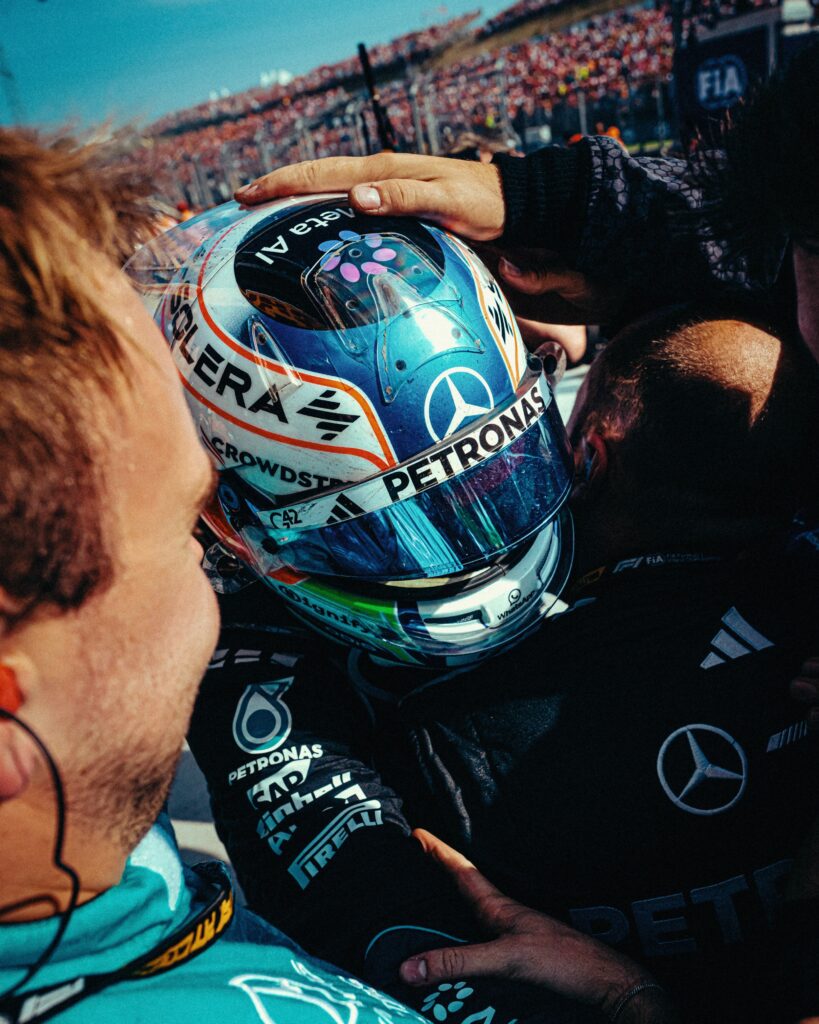
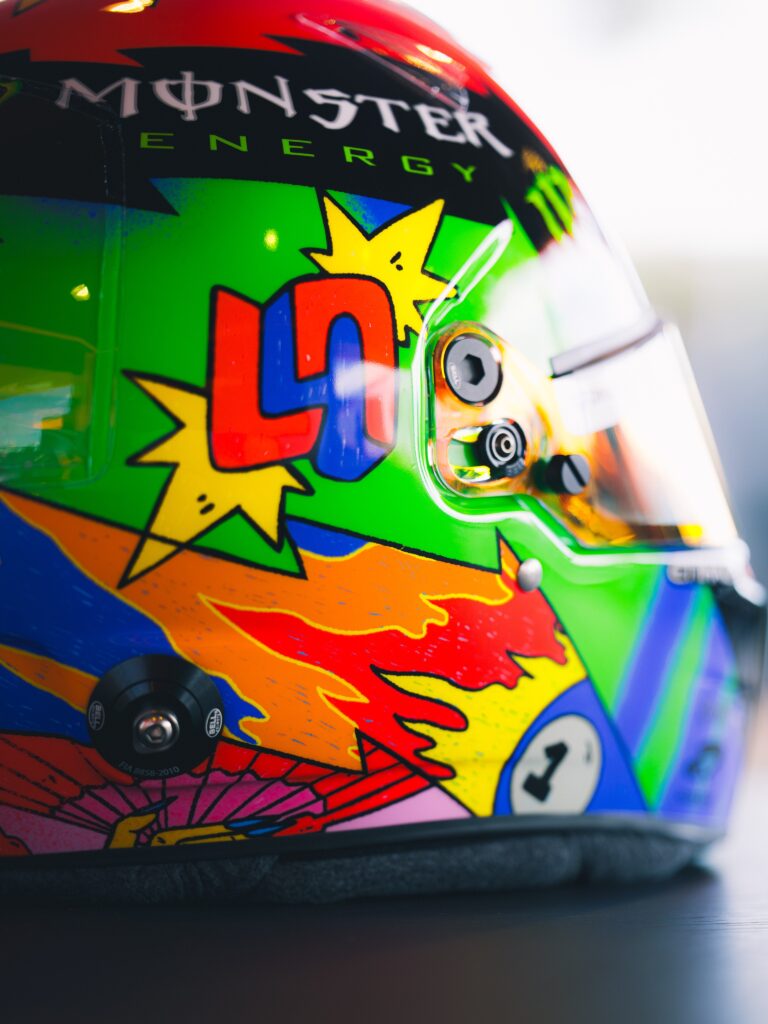
A British Grand Prix weekend at Silverstone is one of the most photographed events on the F1 calendar, and that visual record is exactly what full-size 1:1 replica helmets are built to commemorate. Whatever unfolds under the new energy rules, the images that come out of Silverstone – drivers on the grid, on the podium, in front of a crowd historically near capacity – are the reference points collectors use when choosing a display piece for a shelf or cabinet.
Russell’s own helmet design, along with the wider Mercedes livery worn across the 2026 season, remains a natural focus for anyone assembling an exhibition-quality collection tied to this era of the sport. A full-size 1:1 replica captures the same graphics, colorways and finish drivers wear on track, without requiring the collector to chase a race-worn original.
For fans debating whether Silverstone’s energy-starved character helps or hurts the show, a collector helmet offers a way to mark the weekend regardless of how the on-track storyline plays out. It is a physical artifact of a season defined by exactly the kind of regulation debate Russell is having in the paddock: whether difficulty for the drivers translates into a better product for everyone watching from the grandstands or a screen.
What to watch for across the weekend
The clearest signal to watch for is how superclipping shows up through Silverstone’s high-speed corners, since that is where Russell and others expect the 2026 energy rules to bite hardest. If the pattern from Melbourne and China repeats, drivers with more energy available at key points of the lap should be able to pass or defend in ways that were not possible under the previous power-unit rules.
Qualifying is the session most likely to expose any weaknesses in the current deployment allocation, since a single flying lap leaves no room to recover from a poorly timed energy shortfall. Russell has already flagged that qualifying pace could be blunted by the expectation of superclipping, even if he expects the race itself to benefit from the same scarcity.
With around 600,000 fans expected across the Silverstone weekend, the crowd itself becomes part of the story Russell is telling: a sport where the technical argument over energy management runs alongside, rather than in place of, the spectacle those fans came to see in person.
“I think Silverstone will be great. With these regs, we knew there were going to be some tracks that are more difficult than others for 22 drivers to experience.”
— George Russell
“There’s no doubt the tracks that are energy starved the racing will be better. It probably will be a bit more chaotic.”
— George Russell
FAQ
Q: Why does Russell think Silverstone will produce better racing under the 2026 rules?
Russell argues that tracks which stress the 2026 energy-management rules hardest, including Melbourne and China earlier in the season, have already produced better racing than those same circuits delivered in the past, and he expects Silverstone’s low-braking layout to follow the same pattern.
Q: What makes Silverstone especially hard on 2026-spec energy management?
Silverstone offers relatively little braking across a lap compared to most circuits, giving drivers fewer chances to recover battery energy, which is expected to concentrate superclipping through several of the track’s high-speed corners.
Q: Will qualifying be affected by energy management at Silverstone?
Yes, Russell has said qualifying pace could be somewhat hindered by the expectation of superclipping through the lap, even though he separates that concern from his more positive outlook on the race itself.
Q: How many fans are expected at the British Grand Prix weekend?
Russell referenced a figure of around 600,000 fans expected across the Silverstone weekend, a crowd he says is focused on the spectacle rather than the technical debate over energy deployment.
Q: Are the 2026 energy rules the same as they were in Melbourne at the season opener?
Not exactly – the allocated deployment and electrical power available to drivers have been adjusted in recent races, and the pronounced energy-management storylines seen in Melbourne have been less visible since those changes were introduced.
Browse F1 Helmet Collection
Display and collector replicas only. Not certified for protective use. Full-size 1:1 scale.