Blog
George Russell Still Carries Scars From 2020 Mercedes Call-Up
 123Helmets Editorial Team
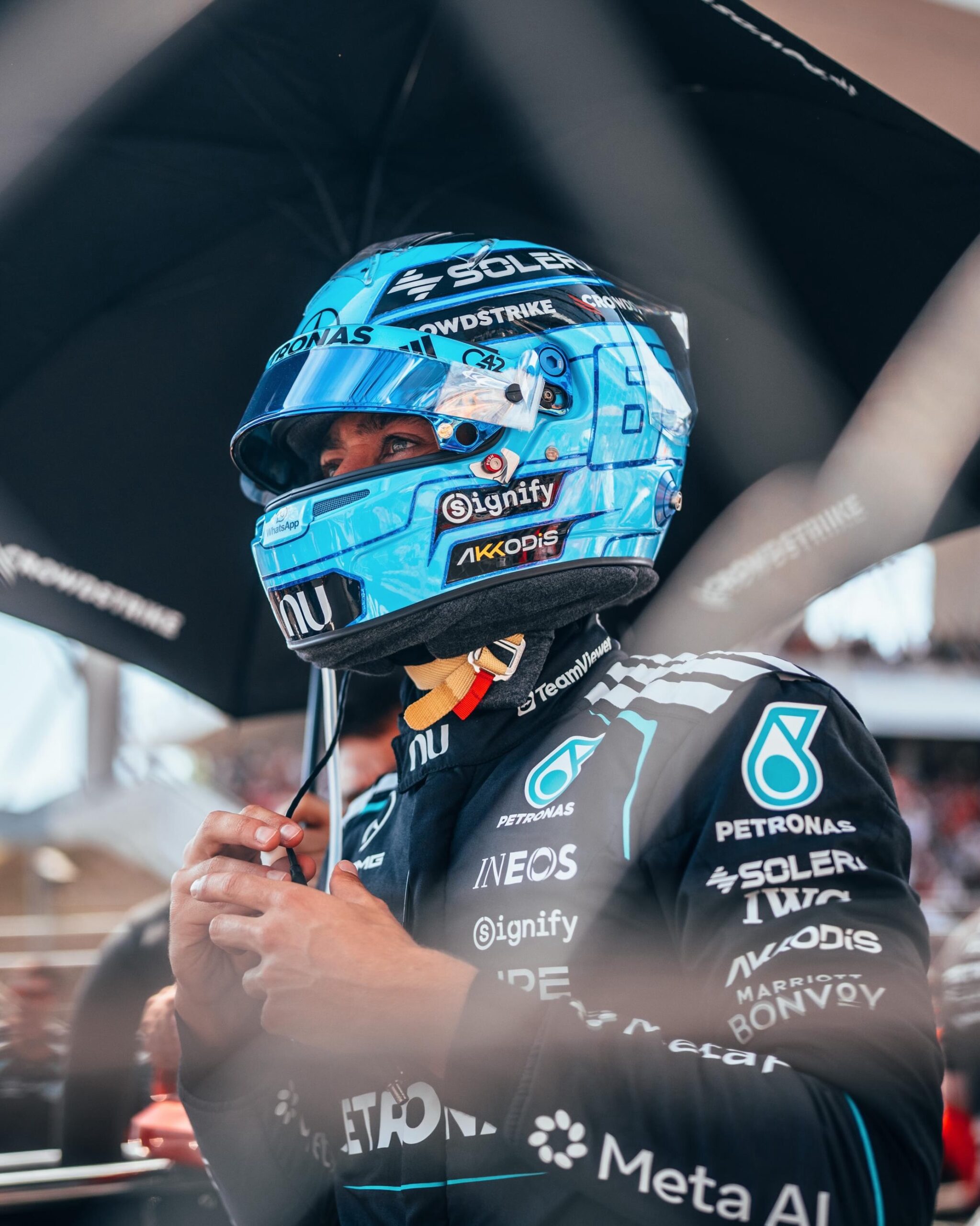
George Russell has revealed that his emergency 2020 stand-in appearance for Mercedes, filling in for Lewis Hamilton at the Sakhir Grand Prix, left him with physical marks he still carries today, alongside a race that very nearly ended in a maiden Formula 1 victory.
Key Takeaways
Russell was called up on a Tuesday and tested the seat fit on Wednesday ahead of the 2020 Sakhir Grand Prix, discovering the car did not fit him at all.
He qualified second, just 0.026 seconds off pole to Valtteri Bottas, and built an eight-second lead after taking control at the start.
A pit-lane mix-up saw Bottas’s tyres mistakenly fitted to Russell’s car, forcing an extra stop before a late puncture ended his run at victory.
Russell says the drive, despite not producing the result, effectively secured his long-term future at Mercedes.
The Phone Call That Changed Everything
George Russell’s route into a Mercedes race seat began with a phone call on a Tuesday, two days before he even sat in the car. Driving for Williams at the time and already in Bahrain after the previous weekend’s Bahrain Grand Prix, Russell was released to Mercedes after Lewis Hamilton returned a positive COVID-19 test ahead of the penultimate round of the 2020 season, the Sakhir Grand Prix. “I got the phone call on the Tuesday. I jumped in the car on Wednesday to see if I fit, and I did not,” Russell explained on the SAP Significant Figures show.
The timeline left almost no room to prepare physically or mentally for a top-team debut. Russell had barely three days between the Tuesday call and first practice on Friday 4 December, a compressed schedule that would have tested any driver stepping into a title-winning car mid-season. The urgency of the situation, combined with the physical mismatch between Russell’s frame and a seat built around Hamilton and Valtteri Bottas, set up one of the more unusual driver swaps in recent Formula 1 history.
Squeezing Into Hamilton’s Seat: The Physical Toll
Russell’s body simply did not match the seat moulded for Hamilton and Bottas, both notably shorter than him. “It was Lewis and Valtteri Bottas, who were the two drivers at the time. They are quite a bit shorter than me. I’ve also got quite big flipper feet as well, which is quite tight in a Formula 1 car. And I was scrunched in, bent over, my shoes didn’t fit,” Russell said. He wears a size 45 shoe, roughly a UK 11 to 11.5, but was forced to squeeze into size 43 footwear just to operate the pedals.
Despite the discomfort, Russell insisted to the Mercedes team that he was fit to compete. “They were asking me, ‘Is it OK?’ I was like, ‘Yeah, totally fine. No issues, no issues. I’m driving, no matter what, I am driving this weekend,'” he recalled. That determination to hide the physical strain from the team is the root of the scarring Russell says he still carries on his hips from that Bahrain weekend.
Qualifying Heroics and an Early Lead
Russell qualified second on his Mercedes debut, missing pole position to teammate Valtteri Bottas by just 0.026 seconds. The margin, one of the tightest front-row splits of that era, underlined how quickly Russell adapted to an unfamiliar car despite the seating problems he had described days earlier.
At the start of the Sakhir Grand Prix, Russell moved into the lead and began pulling away from the field. He built an advantage of eight seconds before the race was neutralized by a safety car, a gap that suggested he had the pace to convert his first Mercedes outing into a maiden Formula 1 win. For a driver who had spent his junior and early F1 career associated with Williams, the sight of him commanding a Mercedes at the front was itself a moment collectors and fans still reference when discussing the black-liveried Silver Arrows of that campaign.
The Pit Stop Error and Late Puncture
A pit-lane mix-up during the safety car period was the first blow to Russell’s shot at victory. Mercedes mistakenly fitted tyres allocated to Bottas’s car onto Russell’s Mercedes, an error against the regulations that forced the team to call him back in for a corrective stop on the following lap, dropping him to fifth.
Russell then worked his way back to second, chasing leader Sergio Perez, before a late rear-left puncture ended his chance of victory; he finished ninth with the fastest lap. “I was on course to win the race and then it all got taken away,” Russell said. “It was really tough, but I also knew what I showed in that race was enough that that would probably seal my future with this team.” The sequence of a strong start, a costly pit error, and a late puncture is remembered as one of the sport’s most dramatic what-if afternoons from the 2020 season.
Helmet and Livery: A Display-Worthy Weekend
Russell’s Sakhir appearance remains a standout visual moment for collectors because it paired his own personal helmet design with Mercedes’ black livery of that season. Seeing a driver normally associated with a rival constructor’s colors run at the front of a factory Mercedes, in Hamilton’s own race seat, created one of the more unusual pairings of driver and machine in recent memory.
For fans who track significant helmet and livery moments, that Sakhir weekend sits alongside other emergency call-ups as a reminder of how quickly a driver’s identity can be placed inside another team’s car without the visual language changing to match. It is the kind of one-off appearance that display pieces and full-size replicas built around that era continue to draw attention for, even years later.
Legacy: How Sakhir 2020 Shaped Russell’s Career
Russell believes the Sakhir weekend effectively secured his long-term path to a Mercedes race seat, even though he did not take the win. “So as I said, if my career had stopped on that Sunday night thereafter, it probably would have affected me until this day,” he said. The performance, built on a near-pole qualifying lap and an eight-second race lead before misfortune intervened, is widely viewed as the moment that convinced Mercedes to commit to Russell’s future.
Russell went on to become a full-time Mercedes driver, and the team he now represents alongside Hamilton’s own legacy continues to be closely followed by fans tracking both drivers’ careers. The Sakhir stand-in remains one of the defining what-if stories of the modern turbo-hybrid era.
“I got the phone call on the Tuesday. I jumped in the car on Wednesday to see if I fit, and I did not.”
— George Russell, on SAP Significant Figures
“I was on course to win the race and then it all got taken away.”
— George Russell, on SAP Significant Figures
FAQ
Q: Why did George Russell drive for Mercedes in 2020?
Russell was called up after Lewis Hamilton tested positive for COVID-19 ahead of the 2020 Sakhir Grand Prix. Russell, then a Williams driver, received the call on a Tuesday and tested the seat fit the following day.
Q: How did George Russell qualify at the 2020 Sakhir Grand Prix?
Russell qualified second, just 0.026 seconds behind polesitter Valtteri Bottas, on his debut appearance in a Mercedes.
Q: What went wrong for Russell during the race?
Mercedes mistakenly fitted tyres allocated to Bottas’s car onto Russell’s Mercedes during a safety car pit stop, forcing an extra stop, and Russell later suffered a puncture while recovering through the field.
Q: Why does Russell say he still carries scars from that weekend?
Russell has said the physical discomfort of squeezing into a seat built for the shorter Hamilton and Bottas, including wearing undersized shoes, left marks on his hips that he still notices today.
Q: Did Russell’s Sakhir performance affect his Mercedes future?
Russell believes it did. He has said the drive was strong enough to secure his path to a long-term Mercedes seat, even though the win slipped away due to the pit-stop error and late puncture.
Relive iconic moments from Lewis Hamilton’s Mercedes career — Shop Lewis Hamilton Collection
Display and collector replicas only. Not certified for protective use. Full-size 1:1 scale.
This article was written with the help of AI tools. Editorial policy