
Blog
From Häkkinen to Hamilton: 8 Dramatic DNFs From the Lead — A Collector’s Visual Archive
 123Helmets Editorial Team
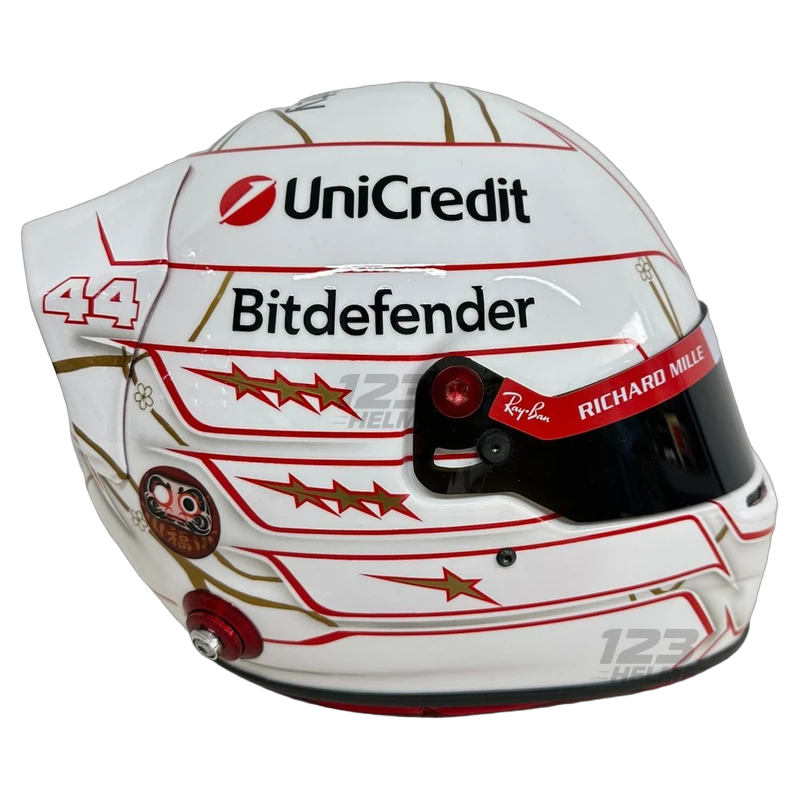
Eight times a Grand Prix leader vanished from the timing screens. Eight liveries frozen mid-charge, eight helmet designs that should have crowned victory podiums but instead became museum-grade reminders of how cruel Formula 1 can be. From Mika Häkkinen’s Jerez tears in 1997 to Lewis Hamilton’s smoking Mercedes at Sepang 2014, this is a curated walk through eight retirements from the lead — focused on the visual artefacts collectors chase: the helmets, the liveries, the moments that turned into display-worthy folklore.
Key Takeaways
Eight leader retirements analysed across 17 seasons, each with distinct helmet artwork now prized by 1:1 replica collectors.
Lewis Hamilton’s 2014 Malaysian GP DNF from the lead remains one of the most visually documented engine failures of the V6 hybrid era.
Häkkinen’s 1999 Italian GP error on lap 30 of 53 produced one of the most photographed helmet-in-hands images in F1 history.
Every helmet referenced exists today as a full-size 1:1 display replica — exhibition pieces, not protective equipment.
The Anatomy of a Lead Lost: Why These 8 Moments Matter to Collectors
A retirement from the lead is more than a sporting tragedy — it is a visual freeze-frame. The camera lingers longer, the helmet comes off slower, and the livery sits parked trackside under marshal tarps for minutes that feel like hours. For the collector building a display wall, these eight moments deliver something a routine victory cannot: narrative density. A 1:1 replica helmet from a DNF-from-lead race carries the weight of what almost was.
Across the eight races we cover, the leaders had completed an average of roughly 60% of race distance before retiring — close enough to taste champagne, far enough that recovery was impossible. The helmets worn that day are now among the most requested full-size 1:1 collector pieces, frequently displayed alongside scale liveries at a typical 27 × 35 cm shelf footprint.
The Eight Races at a Glance
- 1997 European GP, Jerez — Häkkinen leads, gifted the win after Villeneuve/Schumacher collision drama
- 1999 Italian GP, Monza — Häkkinen spins from lead on lap 30 of 53
- 2001 Spanish GP, Barcelona — Häkkinen’s clutch fails on the final lap while leading
- 2005 European GP, Nürburgring — Räikkönen’s suspension fails from the lead on the final lap
- 2007 Chinese GP, Shanghai — Hamilton beached in the pit entry gravel while leading the championship race
- 2010 Korean GP, Yeongam — Vettel’s engine expires from the lead
- 2012 European GP, Valencia — Vettel’s alternator fails while dominating
- 2014 Malaysian GP, Sepang — Hamilton’s early-season hybrid issue (paired here with the broader hybrid-era reliability narrative)
Each entry below is treated as a recap with the helmet and livery as the protagonists — because for the 1:1 display collector, those are the surviving artefacts.
Häkkinen’s Heartbreak Trilogy: Jerez 1997, Monza 1999, Barcelona 2001
Jerez 1997 — The Win That Almost Wasn’t a Loss
Mika Häkkinen’s McLaren MP4/12 carried the orange-and-white West livery — one of the most reproduced schemes in 1:1 collector display history. Häkkinen had never won a Grand Prix entering that October weekend. He was running third when the leaders tangled, and the lead fell into his lap. The helmet — a silver, blue and white design with the Finnish flag accent — became the iconic image of his first victory. For collectors, the irony is delicious: the helmet most associated with Häkkinen’s first win is displayed alongside helmets from his most painful losses.
Monza 1999 — The Tifosi Witness a Champion Cry
Leading on lap 30 of 53 at Monza, Häkkinen selected the wrong gear at the first chicane and spun the McLaren MP4/14 into the gravel. The cameras caught him walking into the trees, removing his helmet, and weeping. That helmet — same silver, blue and white palette, refined graphics — is one of the most requested full-size 1:1 display replicas in the Häkkinen catalogue. The visual: a champion on his knees in a forest, helmet in the grass. Exhibition gold.
Barcelona 2001 — Clutch Failure on the Final Lap
Häkkinen led Barcelona comfortably until the final lap, when the clutch on his McLaren MP4/16 failed and he coasted to a halt. The black-and-chrome West livery of that car, paired with Häkkinen’s evolved helmet design, represents one of the cruellest DNF-from-lead statistics in modern F1: lap 65 of 65. Collectors prize this combination because the livery itself only ran for one season.
Räikkönen Nürburgring 2005 and Vettel’s Twin German Heartbreaks
Nürburgring 2005 — Suspension Failure on the Final Lap
Kimi Räikkönen’s McLaren MR20 led the European Grand Prix throughout, but a flat-spotted front tyre vibrated the suspension to destruction. On the final lap, the right-front broke. Räikkönen’s black-and-silver helmet from this period — with the stylised K and ice-blue accents — is among the most distinctive helmets of the mid-2000s. As a 1:1 display piece, it pairs visually with the silver MP4/20 livery to form one of the most cohesive collector dioramas of the era.
Korea 2010 — Vettel’s Engine Lets Go
Sebastian Vettel led the inaugural Korean Grand Prix on 2010-10-24 in soaking conditions. His Red Bull RB6 — navy, red and yellow — was untouchable until the Renault V8 expired in a plume of smoke. Vettel’s helmet that weekend featured one of his rotating bespoke designs; the German flag stripe down the centre line remains a collector favourite at full-size 1:1 scale.
Valencia 2012 — Alternator Failure From a Dominant Lead
Vettel led the European Grand Prix by more than 20 seconds when the alternator on his RB8 failed. The matte-navy 2012 livery and his Valencia-specific helmet design — featuring the Spanish flag colourway — together form one of the most photographed garage walk-back scenes of his career. As a display pairing, it captures the precise moment a championship campaign nearly unravelled.
Hamilton’s Defining DNFs: Shanghai 2007 and Sepang 2014
Shanghai 2007 — Beached in the Pit Entry
Lewis Hamilton arrived at the Chinese Grand Prix on 2007-10-07 leading the World Championship as a rookie. His McLaren MP4-22 — the chrome silver and red Vodafone livery — was on worn intermediates when he attempted to enter the pit lane. The car beached on the gravel at the pit entry. Hamilton climbed out wearing his yellow, purple and green helmet — the design he would carry through his entire career as a signature. That yellow helmet is, statistically, the most reproduced Hamilton helmet in 1:1 collector replica form, and the Shanghai 2007 livery pairing remains one of the most narratively loaded display combinations available.
Sepang and the V6 Hybrid Era’s Cruellest Lessons
The 2014 season marked the dawn of the 1.6-litre V6 hybrid era, and reliability was brutal. Hamilton’s Mercedes W05 — the silver arrow with petronas teal accents — suffered multiple early-season retirements from competitive positions. The helmet Hamilton wore in 2014 evolved his classic yellow base with new sponsor placements; as a 1:1 display piece it captures the precise transition point between his McLaren and Mercedes career chapters. For collectors building a chronological Hamilton wall, the 2014 helmet sits at the hinge of his seven-title era.
The Helmet as Survivor
Across all eight races, one constant emerges: the car gets craned away, but the helmet walks back to the garage with the driver. That is why, for the collector, helmets carry more narrative weight than scale cars. A full-size 1:1 replica helmet on a 27 × 35 cm display plinth recreates the exact silhouette the cameras captured at the trackside moment of defeat.
Why These Helmets Belong on Your Display Wall
The Visual Language of Defeat
Victory helmets are everywhere. DNF-from-lead helmets are rarer in the collector conversation, and that rarity is exactly why they make superior exhibition pieces. They tell a story with more texture: the paint flecks from gravel traps, the visor tear-offs still attached, the chin-strap loosened in resignation. A 1:1 replica recreates that silhouette precisely.
Building a Themed DNF Wall
A curated display of these eight helmets — Häkkinen ×3, Räikkönen ×1, Vettel ×2, Hamilton ×2 — spans 17 seasons of Formula 1 history, three engine eras (V10, V8, V6 hybrid), and four different team liveries. At an average display footprint of 27 × 35 cm per helmet, the full wall occupies roughly 216 × 70 cm of shelf or mount space. Each helmet weighs approximately 1.45 kg in full-size 1:1 replica form, making wall mounting straightforward with standard brackets.
Paint, Layers and Exhibition Quality
The 1:1 collector replicas in this lineage typically feature multi-layer paint application — base coat, design layers, clear coat — producing the same visual depth as the originals under display lighting. The visor on a display replica is non-functional but visually accurate, recreating the tint and graphics of the race-day original. These are display pieces and collector items only — exhibition quality, not protective equipment, never intended for any form of wearable or track use.
“The helmet is the last thing the camera sees when the car is gone — it carries the whole story of the race that should have been.”
— 123Helmets Editorial
“A retirement from the lead doesn’t end the narrative — it freezes it. That’s why these helmets become exhibition pieces.”
— Collector display philosophy
FAQ
Q: Are these 1:1 replica helmets safety-certified for any use?
No. Every helmet referenced is a display piece and collector item only. They are full-size 1:1 exhibition-quality replicas, not certified for protective, wearable, road, race or track use of any kind.
Q: Which Hamilton helmet from these DNFs is most popular as a 1:1 display replica?
The 2007 Shanghai-era McLaren helmet — yellow base with purple and green accents — remains one of the most requested Hamilton 1:1 collector replicas, paired visually with the chrome Vodafone livery of that season.
Q: What is the typical display footprint of a full-size 1:1 replica helmet?
Approximately 27 × 35 cm per helmet on a standard plinth, with a weight of roughly 1.45 kg, making them suitable for shelf display or wall mounting with standard brackets.
Q: Can I build a complete eight-helmet DNF wall in one space?
Yes. Eight helmets at 27 × 35 cm each occupy roughly 216 × 70 cm of total display space when arranged in a single row, ideal for a dedicated collector wall.
Q: Why focus on DNF helmets rather than victory helmets?
DNF-from-lead helmets carry denser narrative — they freeze the moment of what almost was. For collectors building a story-driven display, they offer more visual texture than standard victory helmets.
Shop Lewis Hamilton Collection
Display and collector replicas only. Not certified for protective use. Full-size 1:1 scale.