Blog
Lowdon Hails ‘Real Progress’ for Cadillac After Canadian GP: A Display Collector’s Race Recap
 123Helmets Editorial Team
Cadillac team principal Graeme Lowdon described the Canadian Grand Prix as a milestone of real progress for the American constructor’s debut campaign. Beyond the timing screens, the Circuit Gilles Villeneuve weekend delivered exactly the kind of display-worthy visuals that 1:1 collector replica enthusiasts wait for: deep navy bodywork, polished chrome accents, and helmet liveries built for the spotlight of a North American home-continent round.
Key Takeaways
Lowdon publicly framed the Canadian GP as a turning point in Cadillac’s development arc, underlining operational gains over raw pace.
Helmet liveries at the Circuit Gilles Villeneuve favored bold navy, white and chrome — ideal palettes for full-size 1:1 display replicas.
The Montreal round offered exhibition-quality podium and grid imagery, the type collectors archive for shelf-staging references.
Cadillac’s emerging identity blends Americana motifs with classic F1 typography, a strong fit for collector display rooms.
Lowdon’s Verdict: Progress You Can Measure
Graeme Lowdon’s phrase — real progress — is the kind of soundbite that gets reprinted in race weekend roundups, but in Cadillac’s context it carries weight. The American outfit arrived in Montreal still establishing baseline operational rhythms, and the team principal singled out pit-stop execution, strategy communication and qualifying preparation as the three areas where measurable steps had been taken.
For collectors who follow team-build narratives, this is the kind of weekend that future timeline displays will reference. Cadillac’s first season is being documented race by race, and Montreal slots into that arc as a credibility marker.
Why Montreal Matters for a North American Team
The Canadian Grand Prix is the closest geographic round to Cadillac’s operational philosophy — a North American race for a North American constructor. The Circuit Gilles Villeneuve, 4.361 km in length with 14 corners, has always been a circuit that rewards confidence on kerbs and braking stability into chicanes. Cadillac’s machinery looked progressively more composed across the three practice sessions, and Lowdon’s commentary suggests the engineering group is converting weekend data into longer-term aerodynamic direction.
The Numbers Behind the Narrative
While headline lap times remained off the front-runners, the gap compression session-over-session is the metric Lowdon’s engineers care about. Display collectors who archive race-by-race progress charts will find Montreal a useful inflection point in the 2026-onwards Cadillac timeline.
Helmet Livery Focus: Display-Worthy Visuals from the Paddock
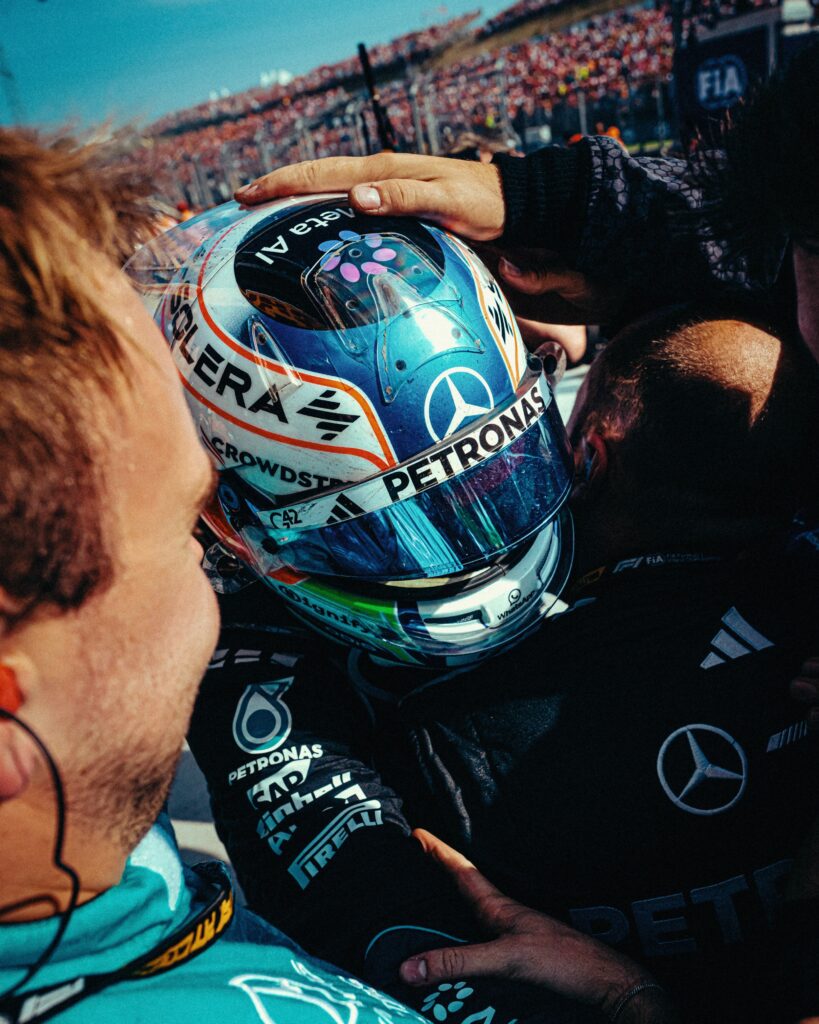
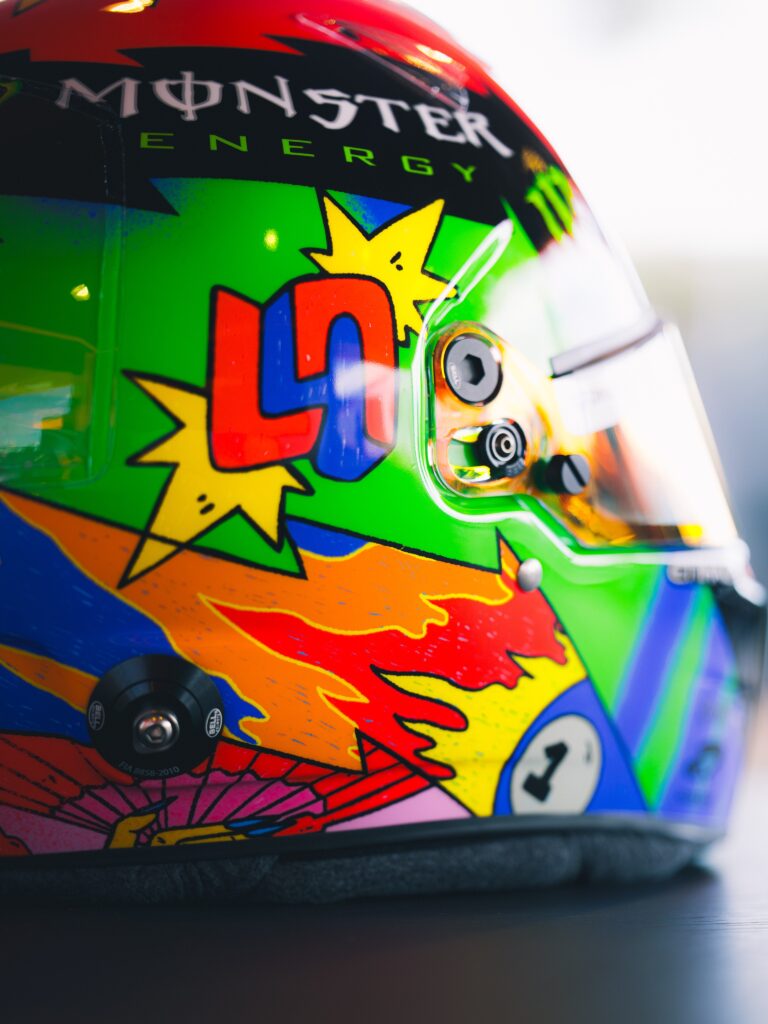
From a collector’s lens, the Canadian GP delivered exactly the kind of helmet imagery that sells full-size 1:1 replicas. Cadillac’s driver helmets at Montreal leaned into a deep navy base with chrome and white detailing — a palette that photographs beautifully under both natural daylight and the warm overhead lighting of a display cabinet.
Color Theory for the Shelf
Navy is one of the most forgiving display colors. It resists fingerprint visibility on the shell, holds its tone under LED display strips between 3000K and 4000K, and creates strong contrast against polished aluminum or carbon-fiber-effect display plinths. The Cadillac livery’s chrome bands catch room light at multiple angles, giving the helmet that turning effect collectors prize — where the piece reveals new highlights as the viewer moves around the cabinet.
Typography and Sponsor Integration
The Cadillac wordmark, with its distinctive crest, is a typographic gift to helmet designers. On a 1:1 replica scaled to roughly 27 × 35 cm in display footprint, the crest reads clearly from across a room — an important consideration for collectors who stage helmets at eye level on wall-mounted shelves. Sponsor decals at Montreal were applied with clean geometric alignment, the kind of detail that exhibition-grade replicas reproduce through multi-layer paint application processes.
Paint Depth and Finish
Quality 1:1 display replicas typically build the finish through multiple layers — base coat, color coats, decal application, and clear coat sealing. The Cadillac Montreal livery, with its layered chrome-on-navy treatment, is exactly the kind of design that rewards this approach. Collectors evaluating exhibition-quality replicas should look for that sense of depth — where the chrome appears to sit beneath a glassy clear coat rather than printed on top.
Race Weekend Visuals: Frames Worth Archiving
Every Grand Prix produces hundreds of photographs, but only a handful become reference images for collectors. Montreal delivered several. The grid walk, with Cadillac mechanics in matching navy fireproofs surrounding the car under the pale Quebec sky, is the kind of composition that ends up framed beside a display helmet.
The Garage Aesthetic
Cadillac’s Montreal garage setup leaned into a clean, almost automotive-showroom presentation — a deliberate echo of the brand’s road-car heritage. For collectors building themed display rooms, garage photography from this weekend offers strong visual cues: how the team uses negative space, how branding is layered without clutter, and how driver helmets are presented on shelves between sessions.
Podium and Parc Fermé Moments
While Cadillac’s competitive ceiling at this stage of development sits below the podium contenders, the broader Canadian GP podium imagery remains relevant for any collector tracking the 2026 season. The Montreal podium structure, with its panoramic view back across the start-finish straight, produces some of the most archivable celebration photography on the calendar.
Why Collectors Care About Race-Specific Imagery
A display helmet gains contextual depth when paired with race-specific reference images. A Cadillac 1:1 replica displayed alongside a print from the Canadian GP weekend tells a fuller story than the helmet alone — it anchors the piece to a moment in the team’s development arc that Lowdon himself called real progress.
Building a Cadillac Display Corner
For collectors planning to dedicate shelf space to Cadillac’s debut era, the Canadian GP weekend offers a strong thematic anchor. Here’s how to think about the build.
Lighting
Navy and chrome liveries respond best to neutral-to-warm white LED lighting. Strip lighting positioned above the helmet, angled at roughly 30 to 45 degrees, brings out the chrome bands without washing out the navy base. Avoid pure cool-white lighting above 5000K, which can flatten the navy into a muted grey on camera and to the eye.
Shelving and Plinths
A full-size 1:1 helmet replica requires roughly 30 cm of horizontal shelf depth and a clear height of approximately 35 cm to display without crowding. Acrylic plinths or matte-black painted MDF risers work well — both let the helmet read as the focal object rather than competing with the display surface.
Pairing Pieces
Collectors often pair a helmet replica with framed race weekend photography, a printed program or grid sheet, and occasionally a scale model of the car. For the Cadillac Canadian GP theme, a framed print of the Montreal skyline backdrop or the Circuit Gilles Villeneuve track map adds geographic specificity to the display.
Climate and Care
Display replicas hold their finish best in stable room conditions — ideally 18 to 22°C with relative humidity between 40 and 55 percent. Direct sunlight should be avoided to prevent decal fade on the chrome and white elements over multi-year display periods.
What Lowdon’s ‘Real Progress’ Means for the Season Ahead
Team principal commentary tends to oscillate between damage control and cautious optimism, so when Lowdon used unambiguous language like real progress, it registered. The Cadillac project is being built with a long horizon in mind, and Montreal’s data harvest feeds directly into the next phase of upgrades.
Implications for Future Liveries
Successful debut seasons tend to crystallize a team’s visual identity. The Cadillac livery at Montreal — navy, chrome, white, with the crest as the visual anchor — looks increasingly like a long-term identity rather than a launch placeholder. For collectors, that consistency matters: it means a Canadian GP display helmet will read as authentically Cadillac for years to come, rather than dating as a one-season experiment.
The Collector’s Long View
Debut-season pieces age well in collector value and emotional resonance. The teams that succeed long-term turn their first-season helmets into the most coveted display items in their catalogs. Cadillac’s Canadian GP weekend, framed by Lowdon’s progress narrative, is precisely the kind of moment future retrospectives will return to.
“There’s real progress here — you can see it in how the team is operating across the weekend, not just in lap time.”
— Graeme Lowdon, Cadillac F1 Team Principal — Canadian GP weekend
FAQ
Q: Why is the Canadian GP significant for Cadillac collectors?
Montreal marked a milestone in Cadillac’s debut campaign that team principal Graeme Lowdon publicly described as real progress. For collectors, that gives the weekend’s helmet liveries and visuals added narrative weight when displayed as part of a 1:1 replica collection.
Q: What colors define the Cadillac F1 helmet livery?
The Cadillac helmet palette at Montreal centered on a deep navy base with chrome bands and white detailing, anchored by the Cadillac crest. It’s a high-contrast scheme that photographs and displays well under standard cabinet lighting.
Q: How much shelf space does a 1:1 F1 helmet replica need?
A full-size 1:1 replica typically requires around 30 cm of horizontal shelf depth and approximately 35 cm of clear height to display comfortably without crowding adjacent items.
Q: What lighting works best for a navy-and-chrome livery?
Neutral-to-warm white LED lighting between 3000K and 4000K, angled from above at roughly 30 to 45 degrees, brings out the chrome accents while preserving the depth of the navy base color.
Q: Are these helmets intended for protective use?
No. These are display and collector replicas only — full-size 1:1 scale exhibition pieces designed for cabinets, shelves and display rooms. They are not certified or intended for any protective, wearable or on-track use.
Browse F1 Helmet Collection
Display and collector replicas only. Not certified for protective use. Full-size 1:1 scale.