
Blog
Why McLaren Will Try the Rejected Front Wing Again in Monaco: A Display Collector’s Recap
 123Helmets Editorial Team
McLaren returns to Monte Carlo with a familiar aerodynamic gamble — and a livery story worth framing. We break down the front-wing saga, the papaya helmet visuals, and the display-worthy moments collectors will want to preserve in full-size 1:1 replica form.
Key Takeaways
McLaren plans to reintroduce a previously rejected front-wing concept specifically for Monaco’s low-speed layout.
Papaya and anthracite liveries dominate the visual narrative — ideal for exhibition-quality 1:1 replica display.
Norris and Piastri helmet designs remain the most requested collector items in the 2025 papaya wave.
Monte Carlo’s 19-corner, 3.337 km layout amplifies helmet close-ups, making display replicas a centerpiece for fans.
The Rejected Front Wing Returns: Why Monaco Changes Everything
McLaren’s technical department made a decision that raised eyebrows across the paddock: the front-wing specification scrutineers had previously rejected earlier in the season is being re-engineered for the Monaco Grand Prix. The reasoning is purely circuit-specific. Monte Carlo’s 3.337 km layout, with its 19 corners and an average speed below 160 km/h, rewards aerodynamic loads that would be wasteful on faster venues like Spa or Monza.
The wing in question was originally flagged for a flex characteristic under high-speed loading. At Monaco, where the longest flat-out stretch barely exceeds 6 seconds, those high-load conditions essentially never appear. McLaren’s engineering group believes the component can legally pass scrutineering when the operational envelope is restricted to the slow-speed, high-downforce demands of the principality.
The technical logic behind a Monaco-only part
Front-wing flex tests in F1 are conducted under static loads designed to simulate the worst-case aerodynamic pressure. McLaren’s argument is straightforward: at Monaco the wing never experiences anything close to those theoretical peaks. The component, repainted in the latest papaya specification, becomes a Monaco-exclusive piece — and for collectors, that exclusivity is exactly what makes the 2025 Monte Carlo weekend a visual event worth commemorating.
Papaya Livery Under Monaco Light: A Display Collector’s Dream
Few circuits flatter a livery the way Monaco does. The harbour reflections, the white Armco, the shadow lines between Casino Square and the tunnel — all of it transforms the papaya orange into something almost luminous. McLaren’s 2025 livery uses a deeper anthracite base with the papaya concentrated around the airbox, nose tip and rear-wing endplates, creating exactly the kind of contrast that a full-size 1:1 replica helmet captures beautifully on a display shelf.
The helmet as the centerpiece
When the cars emerge from the tunnel at roughly 290 km/h and brake hard for the Nouvelle Chicane, television cameras lock onto the driver’s helmet for several uninterrupted seconds. This is the visual moment collectors chase. A full-size 1:1 replica — typically measured at approximately 27 × 35 cm in display configuration — reproduces every paint layer, every sponsor placement and every tonal shift of the helmet exactly as it appeared on track. It is a display piece and a collector item, intended for exhibition only, never for protective use.
The papaya pearl coat on the 2025 McLaren helmets is applied in multiple layers, giving the surface a depth that flat photographs struggle to convey. Under Monaco’s Mediterranean sunlight, that depth becomes the entire story.
Norris and Piastri: The Helmet Designs Defining 2025
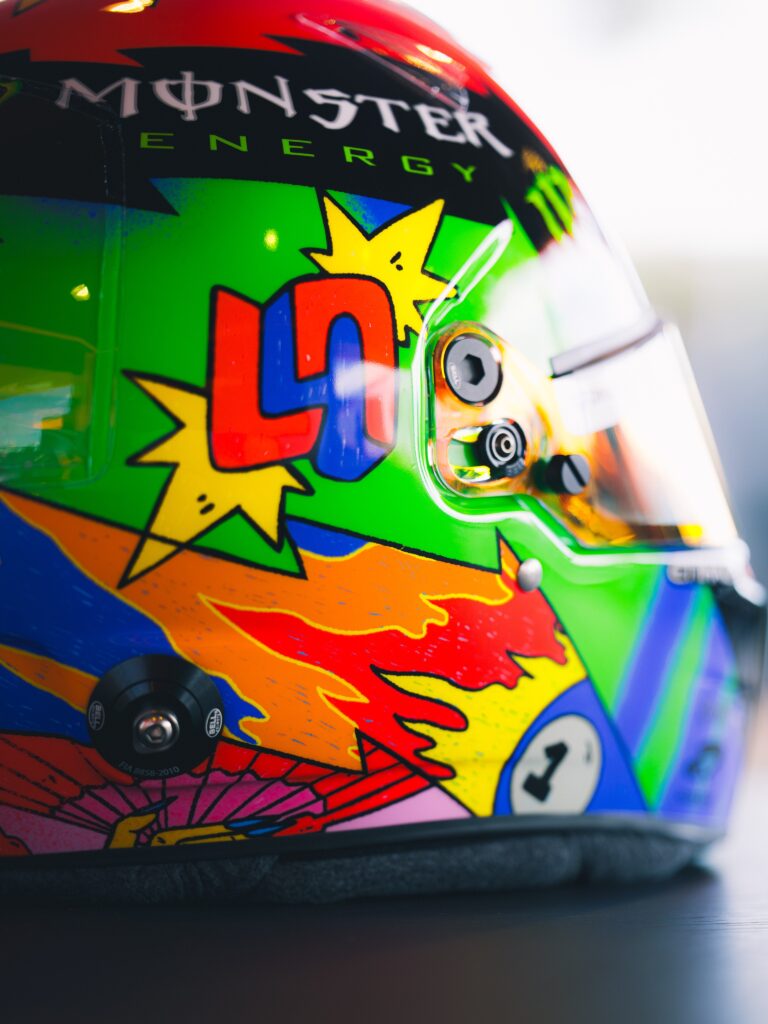
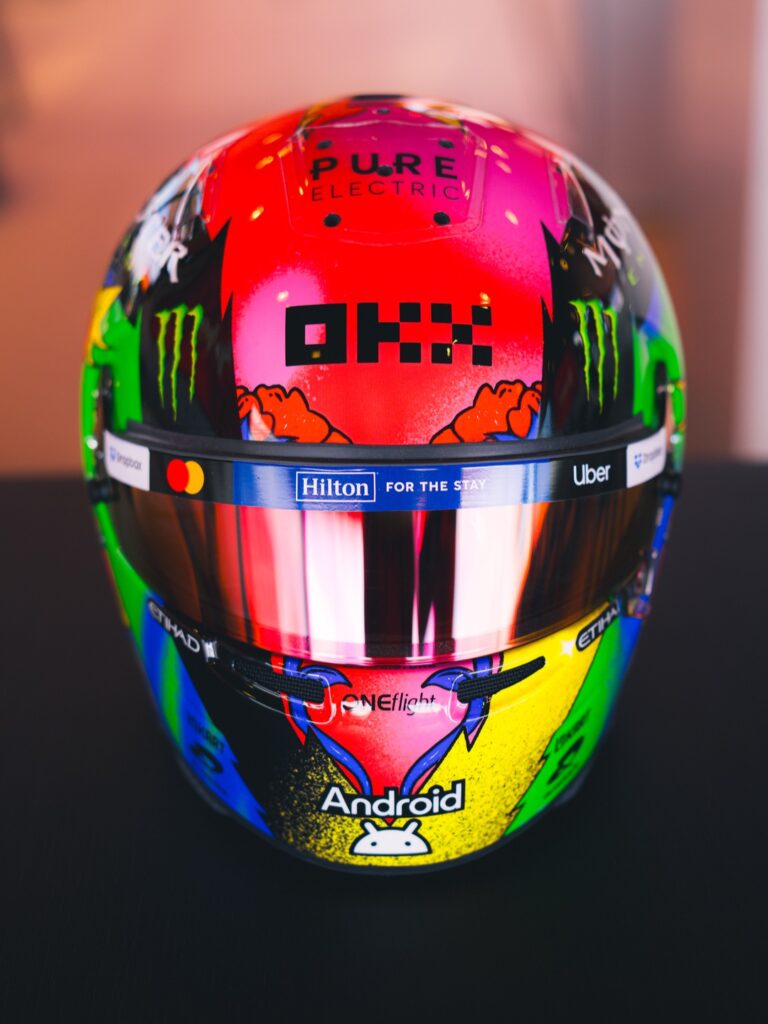
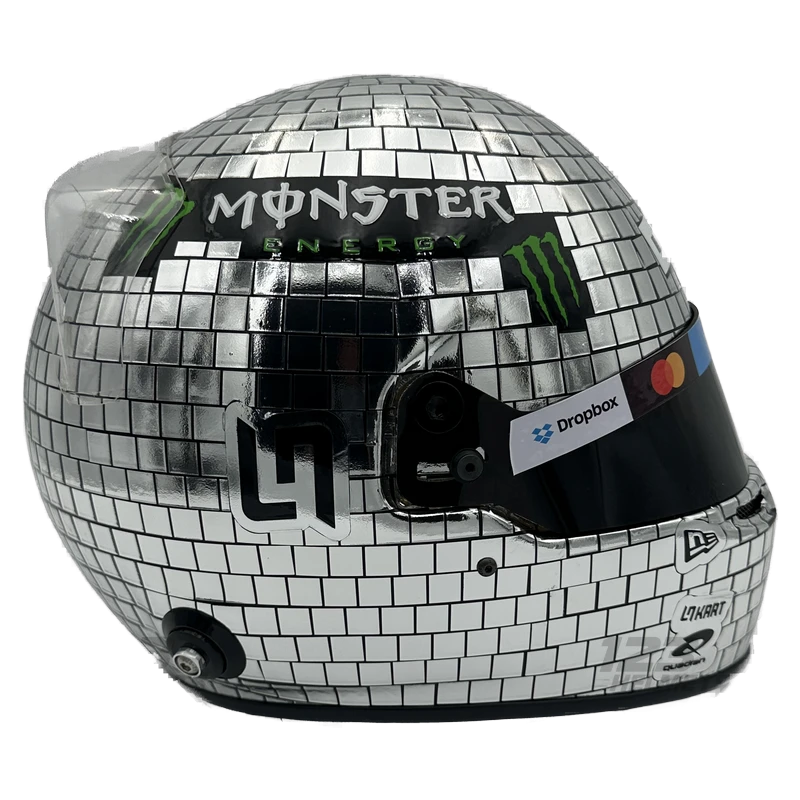
Lando Norris arrives in Monaco carrying a helmet design refined over multiple seasons. The neon yellow crown, the white-and-papaya wave wrapping around the chin bar, and the personalised graphics on the visor surround have become some of the most recognisable visuals in modern Formula 1. As a display replica, the design rewards close inspection — the kind only a full-size 1:1 collector piece allows.
Oscar Piastri’s helmet takes a different visual route: a cleaner, more geometric papaya-and-black layout with the Australian flag motif rendered in subtle tonal blocks rather than bold colour blocks. On a display stand, the contrast between Norris’s expressive design and Piastri’s architectural restraint makes a paired exhibit genuinely compelling.
Why Monaco helmets matter more
Monaco is the one weekend where drivers are most likely to debut special editions. Historically, the principality race has produced some of the most collected one-off helmet designs in the sport’s history. Even when no special edition appears, the standard 2025 livery photographed against Monte Carlo’s backdrop becomes the definitive image of that helmet for the entire season — and the reference photograph collectors use when selecting their next display replica.
Monte Carlo’s Visual Geography: Where the Display-Worthy Moments Happen
Every corner at Monaco offers a different visual signature for the McLaren livery and its papaya helmets. Understanding where the iconic frames come from helps collectors visualise why a 1:1 display replica recreates more than a paint job — it recreates a memory of a specific corner, a specific light, a specific lap.
Sainte-Dévote to Massenet
The opening sequence, climbing toward Casino Square, is where helmets catch the morning sun most cleanly. Photographers position low, and the papaya crown of the McLaren helmet fills the frame against the dark Armco.
The tunnel exit
Emerging from the tunnel into bright daylight at high speed produces the single most dramatic colour shift of the weekend. The papaya appears to ignite as the helmet transitions from artificial yellow tunnel lighting into open sun in under 0.4 seconds of camera time.
The harbour chicane and swimming pool
Slow speeds here mean long camera lock-ons. Every detail of the helmet — every paint layer, every sponsor logo, every visor tear-off tab — becomes visible. This is the section that makes display replicas feel essential: nothing else lets a collector study these details at home, in their own light, on their own shelf.
Why a 1:1 Replica Captures Monaco Better Than Any Photograph
Photographs flatten. Video compresses colour. A full-size 1:1 collector replica helmet, mounted on a quality display stand, preserves the physical reality of the helmet as it appeared in Monte Carlo. The shell dimensions match the original. The visor curvature is reproduced to scale. The paint application uses the same layering principle that gives the on-track helmet its depth under direct sunlight.
For McLaren collectors specifically, the 2025 papaya specification is among the most photogenic helmet finishes the team has produced this decade. Pairing a Norris and a Piastri replica on a shared display creates a visual narrative — two team-mates, one livery, one of the most demanding circuits on the calendar. These are display pieces and exhibition items only, intended purely for collection and visual enjoyment, never for protective use of any kind.
Display recommendations
A pair of full-size replicas typically requires a shelf depth of at least 38 cm and a width of around 80 cm to display comfortably without crowding. Indirect lighting at roughly 45 degrees brings out the pearl finish in the papaya without creating harsh reflections on the visor.
The Collector’s Verdict on McLaren’s Monaco Weekend
Whether the rejected front wing ultimately delivers performance or quietly disappears into McLaren’s archive, the visual story of Monaco 2025 will be told through helmet close-ups, harbour panoramas and tunnel-exit frames. That story is exactly what full-size 1:1 collector replicas are designed to preserve.
For the serious McLaren collector, the question is not whether to add a 2025 Monaco-era papaya helmet to the display — it is whether to add one or two. The Norris and Piastri designs work as individual statement pieces and as a paired exhibit. Either way, the principality weekend is the visual reference point the rest of the season will be measured against.
“Monaco is the only circuit where you can stare at a helmet design for ten consecutive seconds on television. That is why the visuals there define a season.”
— 123Helmets editorial desk
“A 1:1 replica is not a souvenir. It is the physical record of a livery that existed for one weekend, in one specific light, on one specific street circuit.”
— 123Helmets collector guide, 2025
FAQ
Q: Why is McLaren bringing back a previously rejected front wing for Monaco?
Because Monaco’s low average speed of under 160 km/h and 19 tight corners mean the high-speed load conditions that caused the earlier rejection essentially never occur on the circuit, allowing the part to pass scrutineering under Monaco-specific operating conditions.
Q: Are the McLaren helmets featured here usable for protection?
No. Every helmet referenced on 123Helmets.com is a full-size 1:1 collector replica intended strictly as a display piece and exhibition item. They are not certified for any protective use.
Q: What dimensions should I plan for when displaying a 1:1 McLaren replica?
A typical full-size replica occupies approximately 27 × 35 cm on its stand. A paired Norris and Piastri display benefits from a shelf at least 80 cm wide and 38 cm deep with indirect lighting.
Q: Why is Monaco considered the best circuit for helmet photography?
The combination of slow corners, dramatic light transitions through the tunnel, harbour reflections and tight TV framing means helmets stay on-screen longer and in better lighting than at any other Grand Prix on the calendar.
Q: Will McLaren debut a special-edition helmet for Monaco 2025?
Special editions are a long-standing Monaco tradition but cannot be confirmed in advance. Even without a one-off design, the standard 2025 papaya livery photographed in Monte Carlo typically becomes the season’s most iconic helmet image.
Shop McLaren Helmets
Display and collector replicas only. Not certified for protective use. Full-size 1:1 scale.