Blog
Oscar Piastri Reveals LEGO x McLaren Helmet for Monaco 1000th GP Celebration
 123Helmets Editorial Team
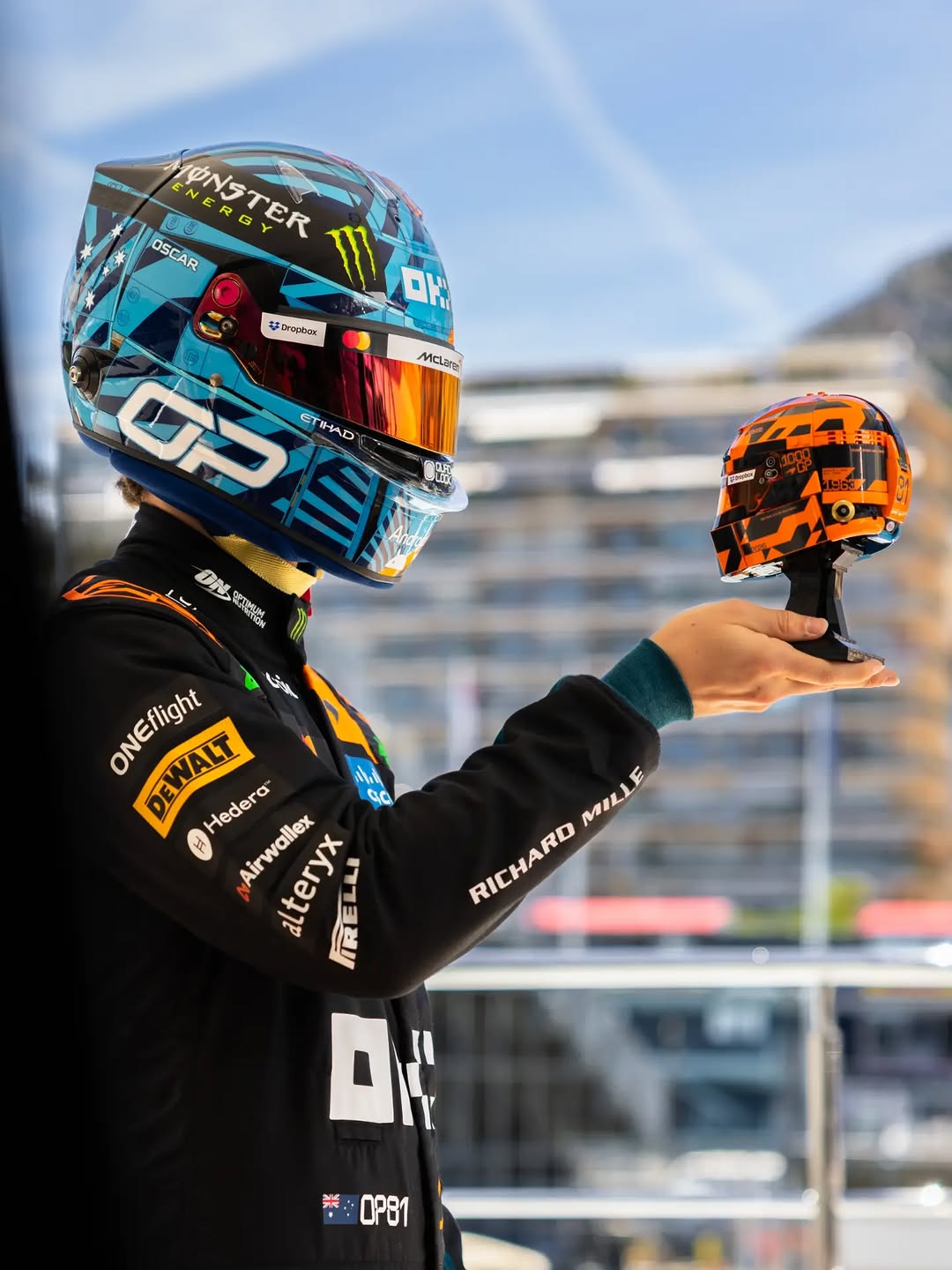
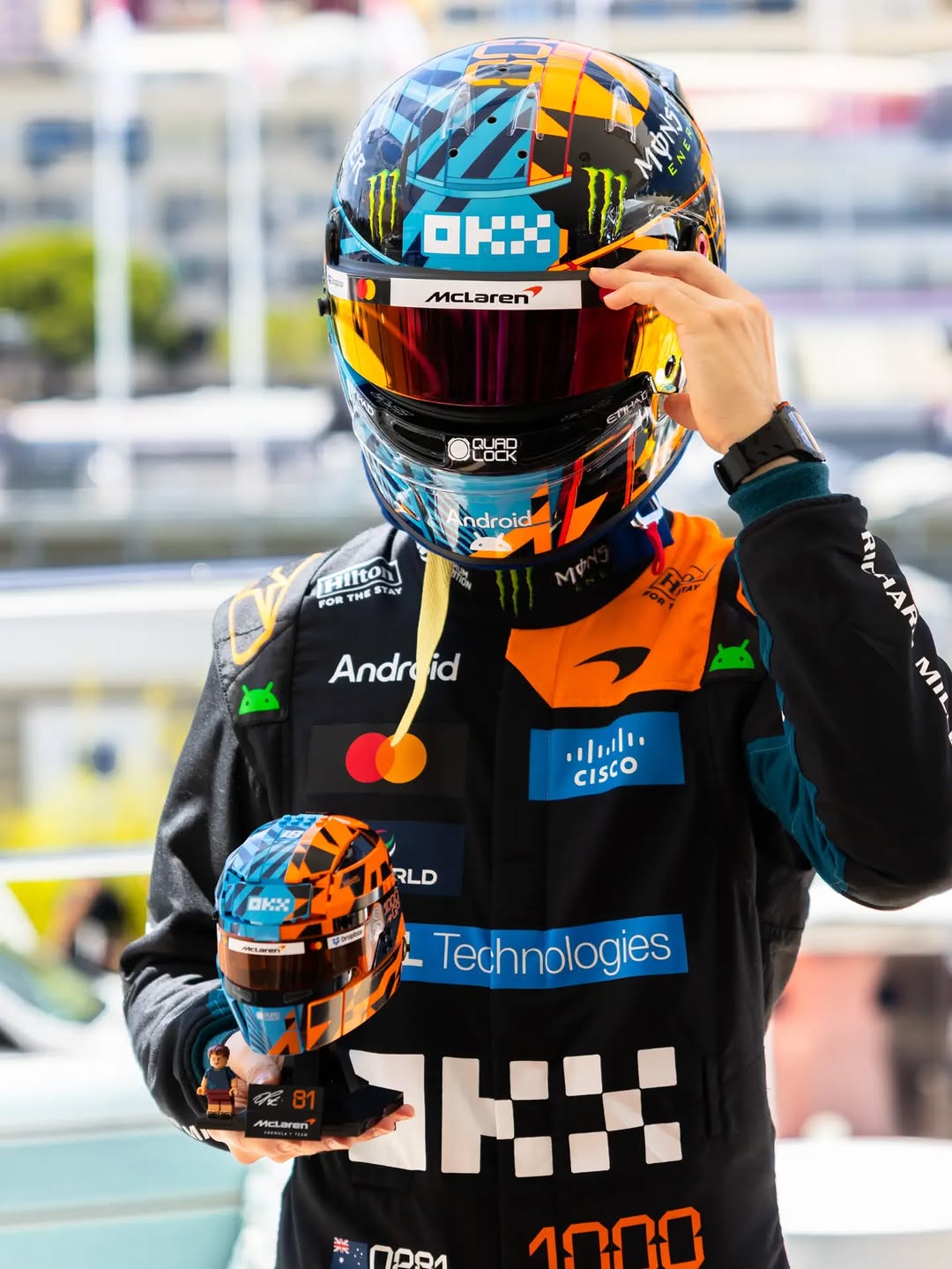
Oscar Piastri has pulled the cover off a one-off LEGO Group collaboration helmet finished in McLaren papaya, set to debut at the Monaco Grand Prix on 7 June 2026 as the opening act of a two-weekend celebration marking McLaren’s 1000th Formula 1 start. Monaco hosts race 999 — the symbolic homecoming where Bruce McLaren entered his first F1 car in May 1966 — before the actual 1000th start lands at the Spanish Grand Prix in Barcelona on 14 June 2026. The lid will sit at the centre of the collector and display story across both rounds.
Key Takeaways
Helmet debut: Monaco Grand Prix, 7 June 2026, McLaren’s symbolic 999th F1 start.
Actual 1000th McLaren F1 start: Spanish Grand Prix, Barcelona, 14 June 2026.
LEGO Group brand collaboration finished in McLaren papaya orange on a full-size 1:1 display replica subject.
References Bruce McLaren’s F1 debut at Monaco in May 1966 — a 60-year arc to 2026.
Strictly a collector and display piece — livery, finish and proportions only.
A papaya lid built for race 999 — the prelude to 1000
The first thing to understand about Oscar Piastri’s new helmet is the calendar. McLaren is celebrating its 1000th Formula 1 Grand Prix across two consecutive weekends in June 2026, and Piastri’s LEGO-collaboration design is engineered to live across both. The Monaco Grand Prix on 7 June 2026 is start number 999. The Spanish Grand Prix at Barcelona on 14 June 2026 is the literal 1000th. Monaco gets the emotional weight — it is where Bruce McLaren lined up for the team’s debut in May 1966 — and Barcelona gets the milestone number.
The papaya orange shell is unmistakable from 20 metres away, the same hue that has anchored McLaren’s identity since the late 1960s. On the replica, the colour reads as a deep, saturated papaya rather than the lighter fluorescent tone used on some 2023-era cars, with a matte-to-gloss transition across the crown that catches Monaco’s harbour light.
Why Monaco gets the reveal, not Barcelona
Monaco is the storytelling weekend. Bruce McLaren, then 28 years old, drove a McLaren M2B in the 1966 Monaco Grand Prix on 22 May 1966 — the team’s first championship entry. Sixty years later, almost to the month, Piastri carries a helmet that openly references that origin. The 1966-to-2026 arc is the design brief; the LEGO collaboration is the medium.
The LEGO Group collaboration explained
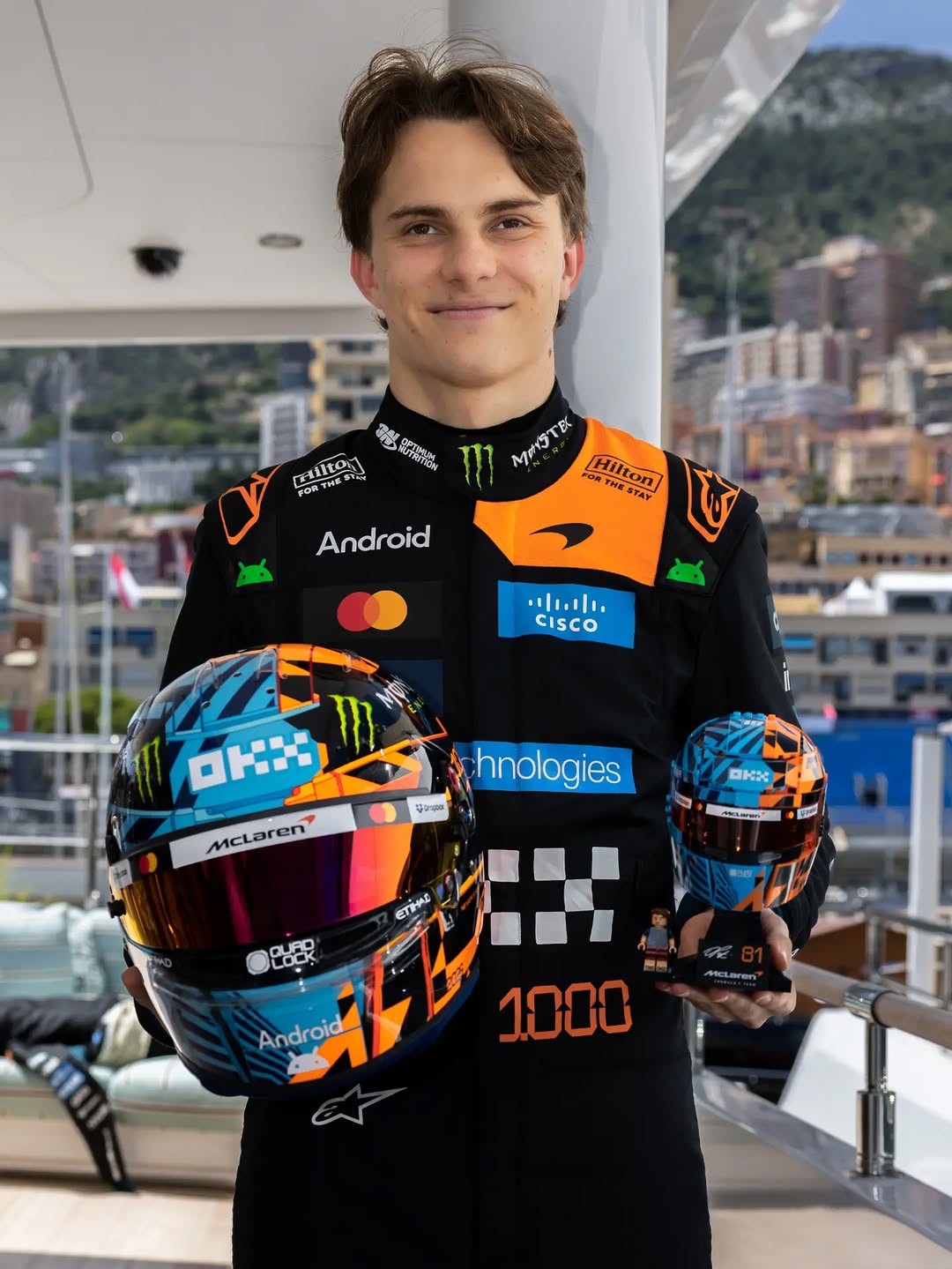
This is a brand collaboration, not a literal brick build. The helmet replica subject is finished in McLaren papaya with LEGO Group co-branding applied as part of the livery — logo placement, supporting graphics and a colour-block treatment that nods to the toy-brick visual language without compromising the silhouette of a modern F1 helmet shape.
Where the LEGO motif appears on the shell
The collector replica carries the LEGO wordmark on the rear lower band, with smaller repeats running along the chin bar area. The crown panel uses a stepped graphic — flat papaya blocks separated by thin black pinstripes roughly 3 mm wide — that reads as an abstract brick pattern when viewed from above. Piastri’s race number 81 sits on the top centre in white, framed by two thin black outlines.
Visor treatment
The visor on the display piece is a dark smoke tint with a thin papaya top strip approximately 25 mm deep. A single LEGO logo sits centred on that strip. The tear-off posts are reproduced in matte black on the 1:1 replica, with the eye port edged in a 4 mm gloss black trim.
Reading the livery: papaya, black and a 60-year nod to 1966
The base coat is McLaren papaya, applied over a white primer to lift the saturation. A black band wraps the lower edge of the shell, approximately 35 mm deep at its widest point above the ear cutouts, narrowing to roughly 18 mm at the rear. That band is the anchor for the LEGO co-branding and the McLaren speedmark.
The 1966 reference
On the rear quarter panels, a small commemorative graphic reads “1966–2026” — the 60-year span from Bruce McLaren’s Monaco debut to this weekend. Beneath it, a stylised silhouette of the McLaren M2B sits in white against the papaya. The graphic is roughly 45 mm wide and intentionally subtle; it is a detail for the collector to find, not a billboard.
Piastri’s personal marks
The Australian flag appears on the left temple in a 30 × 20 mm rectangle. Piastri’s signature, in white script approximately 60 mm long, sits below the flag. The number 81, his career race number since his F1 debut on 5 March 2023, is reproduced three times across the shell: top crown, and both rear quarters.
The replica as a display object
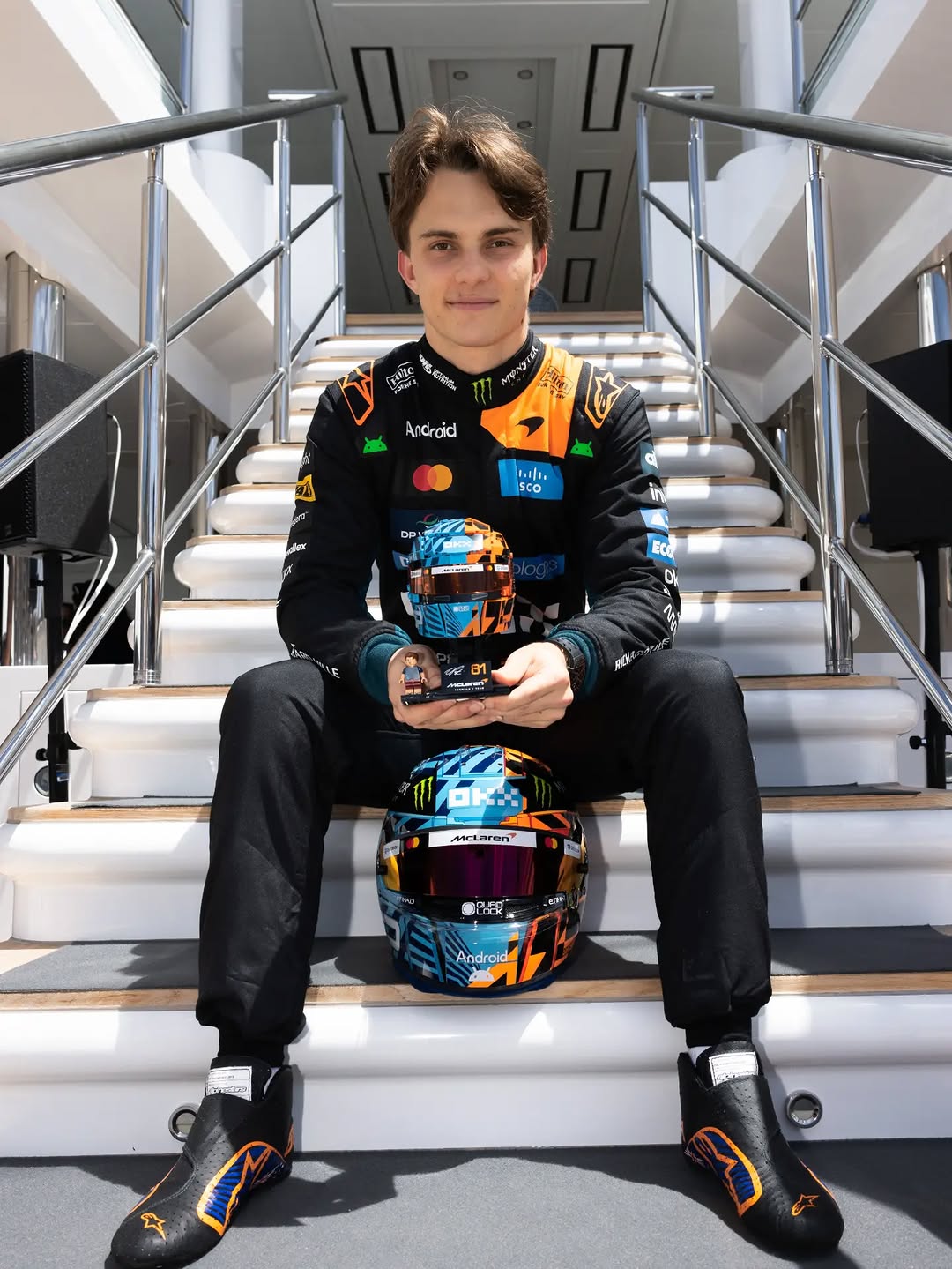
For the collector, the value of this piece is the combination of three rare ingredients: a milestone weekend, a brand collaboration that has not appeared on a McLaren helmet before, and a single-race livery limited to the Monaco round of the celebration. That triangulation is what makes a one-off lid into a long-term display item.
Proportions and presentation
The full-size 1:1 replica subject reproduces the external geometry of a current-generation F1 helmet shell — roughly 27 cm long, 23 cm wide and 24 cm tall at the crown, with a typical display weight in the 1.40–1.55 kg range depending on the inner liner specification. A presentation stand with a low-profile black base lets the papaya finish carry the visual weight on a shelf or in a cabinet.
Finish layers
The paint stack on a high-grade display reproduction typically runs to 6–8 layers: primer, base white, papaya colour coat, black graphics, LEGO co-branding, commemorative 1966–2026 details, and two clear coats. The final clear coat gives the shell its depth and protects the graphics from handling marks during display rotation.
Two weekends, one lid
Piastri is expected to run the same livery at both Monaco (7 June 2026) and Barcelona (14 June 2026). That makes the helmet the visual through-line of the celebration — the single object that bridges race 999 and race 1000.
Where this sits in Piastri’s helmet timeline
Since arriving in F1 in March 2023, Piastri has kept a stable core identity — papaya and dark blue, with the number 81 as the anchor — and reserved livery shifts for specific weekends. The LEGO Monaco 2026 lid is the most graphically aggressive departure of his McLaren run so far, and the only one tied to a team-wide milestone rather than a personal or national one.
What collectors should watch
Single-race liveries from milestone weekends tend to hold display value because the design cannot be re-used. Once the Spanish Grand Prix on 14 June 2026 is in the books, the helmet’s window closes. The Monaco-Barcelona double-header is the only context in which this papaya-and-brick combination makes narrative sense.
“1000th McLaren GP calls for a special LEGO lid.”
— Oscar Piastri, helmet reveal
FAQ
Q: When does Piastri’s LEGO helmet debut?
At the Monaco Grand Prix on 7 June 2026, the opening weekend of McLaren’s 1000th-Grand-Prix celebration.
Q: Is Monaco actually McLaren’s 1000th F1 start?
No. Monaco on 7 June 2026 is race 999. The actual 1000th start is the Spanish Grand Prix at Barcelona on 14 June 2026. Monaco gets the symbolic role because Bruce McLaren made the team’s F1 debut there in May 1966.
Q: What is the LEGO connection?
It is a brand collaboration between McLaren and the LEGO Group. The replica subject carries LEGO co-branding inside a McLaren papaya livery, with a stepped graphic on the crown that nods to the toy-brick visual language.
Q: What colour is the helmet?
McLaren papaya orange as the base, with black accent bands and white detailing for the number 81, signature and 1966–2026 commemorative graphic.
Q: Is the replica for protective use?
No. It is a full-size 1:1 collector and display replica — finish, livery, design and proportions only. It is not certified or intended for any protective application.
Shop Oscar Piastri Collection
Display and collector replicas only. Not certified for protective use. Full-size 1:1 scale.