
Blog
The Art of F1 Helmet Design: How Racing History Becomes a Collector Display Piece
 123Helmets Editorial Team
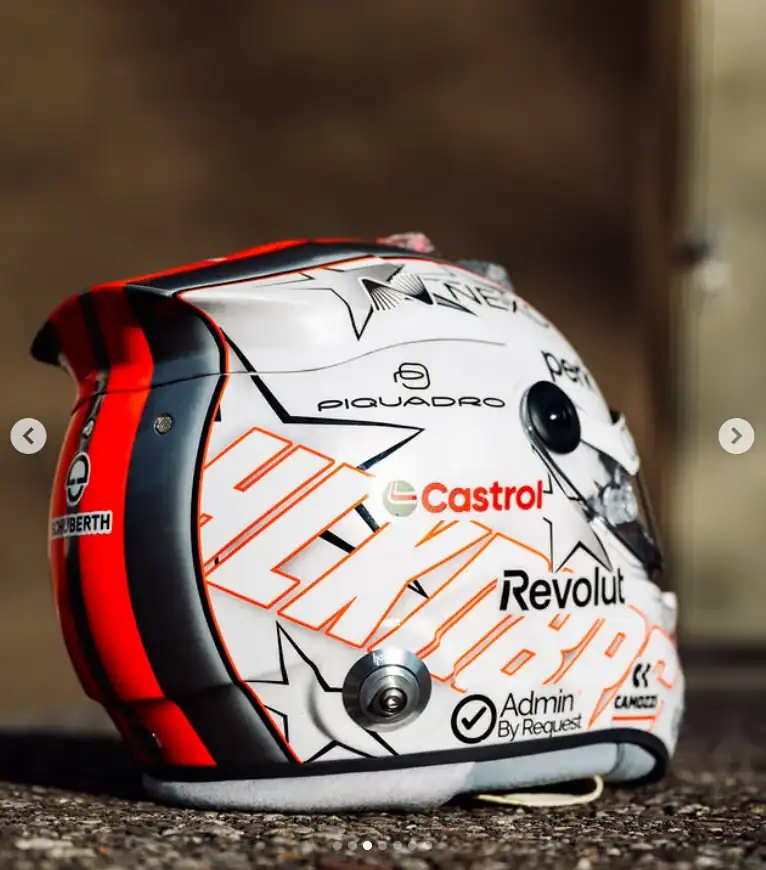
Every full-size 1:1 replica F1 helmet on a collector’s shelf is a compressed archive of racing history — specific circuits, specific seasons, specific moments that defined careers. Understanding what goes into that design, and why it matters for display collectors, separates a thoughtful acquisition from an impulse buy.
Key Takeaways
A full-size 1:1 replica F1 helmet reproduces the exact livery geometry used by a driver in a specific race or season — not a generic approximation.
Exhibition-quality display replicas typically feature a 4 mm polycarbonate visor matched to the tinted specification the driver ran that weekend.
The weight of a properly constructed display replica sits close to 1.2–1.5 kg, replicating the physical presence of the original race shell.
Provenance specificity — championship round, circuit, and year — directly drives the long-term display and collector significance of any replica piece.
Why the Livery on a Race Helmet Is Never Accidental
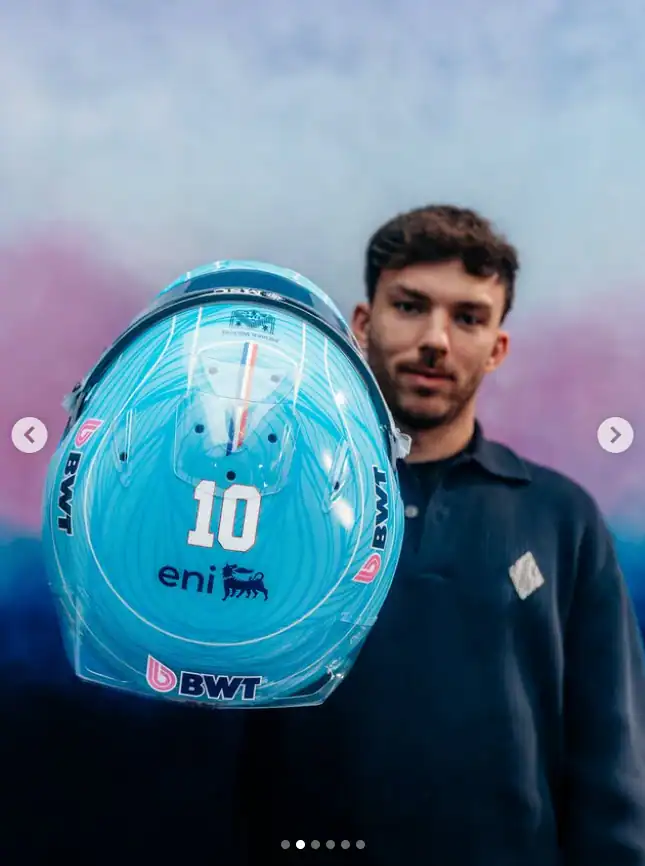
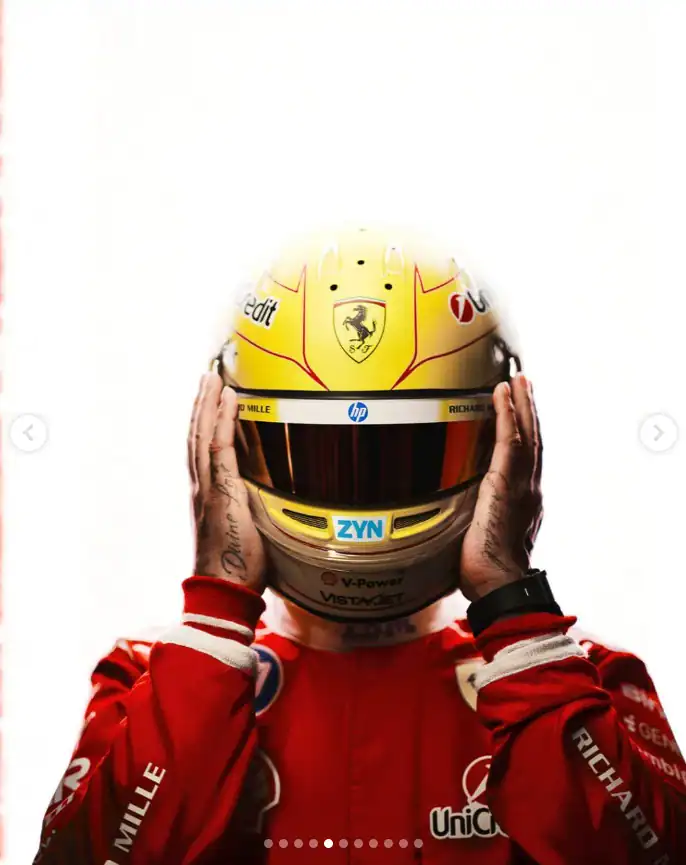
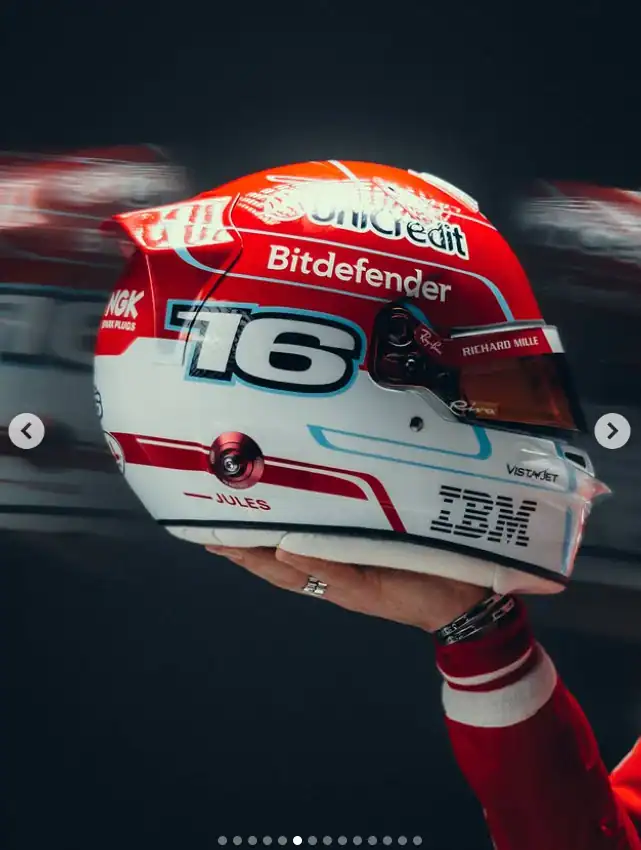
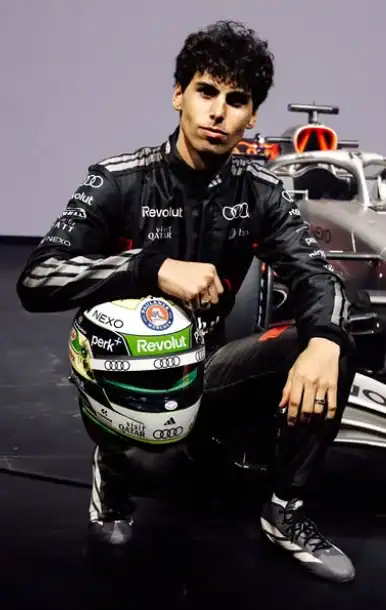
Every colour, stripe, and sponsor mark on an F1 race helmet is placed according to a precise design brief issued before the season — or, in the case of one-off race lids, before a single Grand Prix weekend. The livery is not decoration; it is an engineered communication system that identifies a driver at 320 km/h from the pit wall, on broadcast cameras, and in the grandstands. That precision is exactly what makes a full-size 1:1 display replica worth owning: you are preserving a specific visual identity locked to a specific moment in the sport’s calendar.
Major teams work with external design studios to produce helmet graphics, and the sign-off process can involve upwards of a dozen revision rounds before a driver approves the final wrap or paint schedule. For collector replicas, that same original artwork file — or a faithful recreation of it — is the starting point. The difference between a generic souvenir and an exhibition-quality display piece often comes down to whether the replica manufacturer had access to those original geometry files or had to reverse-engineer them from broadcast photography.
Livery geometry on top-tier F1 helmets is reproduced with registration tolerances measured in millimetres. A sponsor logo placed 3 mm off-axis on the chin piece is visible to any trained eye, and it is the kind of error that separates a display-worthy replica from shelf filler. Collectors who understand this evaluate replica accuracy by comparing key reference points — the leading edge of the visor aperture, the rear fin geometry, and the crown panel transitions — against archival race images.
The Construction Behind an Exhibition-Quality Display Replica
A full-size 1:1 display replica F1 helmet replicates the outer shell profile, internal foam architecture, visor unit, and surface finish of the race original to within the tolerances a collector can verify by eye and hand. The shell on a well-made display piece is formed from ABS composite or fibreglass layup and carries a finished weight in the region of 1.2–1.5 kg — close enough to the race shell’s physical presence that picking it up feels meaningful rather than hollow.
The visor is one of the most technically specific elements. Exhibition-quality replicas use a polycarbonate visor with a thickness of approximately 4 mm, optically matched to the tint specification the driver ran in the referenced race — dark iridium for bright-light circuits like Bahrain, lighter amber tints for night races such as Singapore. That single detail, the tint, is a date stamp embedded in the physical object: it tells anyone who knows the sport exactly which conditions the helmet was designed for.
Paint and decal application typically involves between 8 and 14 individual layers, depending on the complexity of the livery. A helmet carrying a multi-sponsor fluorescent scheme — the kind common in the mid-1990s through to the early 2000s — may require hand-masking across 22 separate colour zones. Each clear-coat layer adds approximately 0.03 mm to the total surface build, which means a fully finished shell can carry up to 0.42 mm of surface material above the bare composite. That is the physical record of the design, laid down in lacquer.
Shell Profile Accuracy and Why It Matters for Display
The external profile of an F1 helmet has changed substantially across the sport’s history. The rounded, near-spherical shells of the 1970s gave way to the more angular, fins-and-vents geometry that became standard through the 2000s and 2010s. A replica manufacturer who uses a single generic shell mould for every era produces something that is immediately wrong to a knowledgeable collector’s eye — the silhouette tells the story before the paint does. The correct shell profile for a 1988 season display piece has a markedly different crown radius and rear-fin height than one representing a 2023 design.
Iconic Helmet Designs and What They Represent in a Display Collection
Certain F1 helmet liveries have become as recognisable as the cars they accompanied — permanent visual shorthand for specific chapters of the sport. Collecting a full-size 1:1 replica of one of those designs is not about owning headwear; it is about anchoring a piece of motorsport narrative to a physical object on a shelf or in a case.
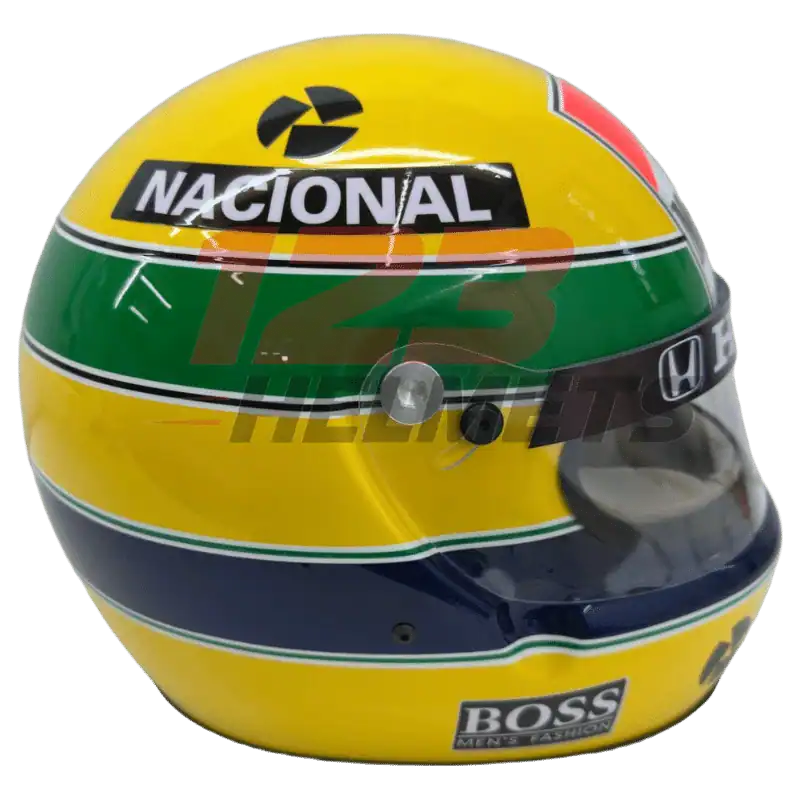
Ayrton Senna’s yellow, green, and blue design — first worn competitively in the early 1980s and refined through his three championship seasons of 1988, 1990, and 1991 — is the most replicated helmet livery in the sport’s history. The geometric precision of its concentric crown arcs and the specific Pantone values of its Brazilian flag palette make it immediately verifiable: any deviation in the arc radius or the saturation of the green is visible at a glance. This is why it remains the benchmark test for display replica manufacturers.
Michael Schumacher’s red and white Schuberth-era helmets from his Ferrari years, 2000 through 2006, represent a different kind of collector significance — they are tied to five consecutive constructors’ championships and document a team’s total visual dominance of that era. The white visor band with the red Ferrari wordmark, positioned 27 mm below the visor aperture lower edge, is a detail that exhibition-quality replicas get right because it exists in thousands of archival images for cross-reference.
One-Off Race Helmets and Their Collector Premium
Beyond season-long designs, one-off helmets produced for specific Grand Prix weekends — home race specials, championship-clinching rounds, or tribute liveries — carry a collector premium because they exist at the intersection of art and singular sporting occasion. A helmet worn only on 13 October 2024 at the United States Grand Prix in Austin, for example, is tied to a 56-lap race result, a specific qualifying time, and a championship standing — details that do not attach to a generic season lid. For display collectors, that specificity is the entire point.
How to Authenticate and Display a 1:1 Replica Helmet
Authenticating a full-size 1:1 display replica means verifying three independent attributes: shell profile accuracy, livery geometry fidelity, and surface finish quality — in that order. Start with the silhouette before examining the paint, because a correct livery on a wrong shell is still wrong.
For display purposes, the standard collector practice is to mount the helmet at eye level on a purpose-built stand that holds the shell at the forward rake angle — approximately 15 degrees nose-down — that replicates how it sits on a driver’s head. At that angle, the full visor aperture and the primary livery panels are visible simultaneously, which is how the design was conceived to be read. A helmet stored flat on its chin piece loses roughly 40 percent of its visual composition because the crown and rear-fin graphics become inaccessible.
UV protection is the single most important environmental consideration for any painted display piece. Direct sunlight exposure for as little as 6 months can cause measurable colour shift in fluorescent pigments — yellows and oranges are the most vulnerable, shifting by approximately 8 to 12 percent on a spectrophotometric reading. Display cases with UV-filtering acrylic panels rated to block 99 percent of UV-A and UV-B wavelengths are the standard for serious collection environments.
Documentation: The Paper Trail That Anchors the Object
A display replica with accompanying documentation — original certificate of authenticity, numbered production record, and photographic reference to the source race imagery — is categorically different from an undocumented piece, even if the physical helmet is identical. Documentation converts the object from decorative item to collector record. For helmets tied to championship-winning rounds or historically significant races, that paper trail is the difference between a display piece and an archival display piece.
Building a Coherent F1 Helmet Display Collection
A coherent F1 helmet display collection is built around a defined curatorial logic — era, driver, team, or circuit — rather than accumulated at random. The most satisfying collections tell a story that a visitor can read from left to right without explanation. Our F1 replica helmet collector’s guide sets out the full framework.
Era collections — say, the turbo hybrid era from 2014 to present — work well because the shell profile, visor geometry, and livery language are internally consistent. Every piece in the group reads as belonging to the same period of the sport. A collection spanning from a 1982 season replica to a 2024 one, by contrast, requires careful curation of display height and spacing to prevent the visual discontinuity from becoming jarring rather than instructive.
Driver-focused collections reward depth over breadth. Owning five distinct full-size 1:1 replicas representing five different season helmets of a single driver — each documenting a different sponsor configuration, a different championship standing, a different visual identity — communicates something about a career’s arc that no single piece can. The spacing between pieces matters as much as the pieces themselves: 35 cm centre-to-centre is a practical minimum for individual helmets to read as distinct objects rather than a crowded row.
The Long-Term Case for Display Quality Over Price
Display replicas at the exhibition-quality tier cost more at the point of purchase, but the gap between a properly constructed 1:1 piece and a budget approximation compounds over time. Inaccurate livery geometry does not improve; imprecise shell profiles do not correct themselves; thin clear-coat applications begin to show wear within 18 to 24 months under standard indoor display conditions. The decision to acquire at exhibition quality is a decision about what the collection looks like in ten years, not just on the day of delivery.
What Separates a Display Replica from a Souvenir
The line between a display replica and a souvenir is drawn at dimensional accuracy, material specification, and livery fidelity — all three must be present simultaneously for a piece to qualify as exhibition quality. Remove any one of those three and the object drops out of the collector tier. For curated, display-grade examples, see our best F1 replica helmets selection.
Souvenirs are produced to a price point. Display replicas are produced to a specification. That distinction manifests physically in the weight of the visor unit — a souvenir may use a 1.5 mm injection-moulded panel; an exhibition-quality display replica uses a 4 mm optically correct polycarbonate — in the depth of the paint layers, and in whether the interior of the shell carries any representation of the original liner architecture. Collectors who pick up both objects consecutively understand the difference in under five seconds.
Full-size 1:1 scale matters for a specific reason beyond aesthetics: it is the only scale at which livery geometry can be correctly evaluated against archival reference images. A 1:2 scale piece necessarily compresses the paint geometry, and fine details — the 2 mm white outline rule around a sponsor panel, the exact curve radius of a crown stripe — become indistinguishable at reduced dimensions. Only at 1:1 does the replica stand as a genuine record of the original design.
For the collector who understands these distinctions, a full-size 1:1 exhibition-quality F1 helmet display replica is neither furniture nor fandom merchandise. It is a physical document of a moment in motorsport history — one that holds its accuracy, its presence, and its narrative for as long as it is properly displayed and maintained.
“A helmet is the one piece of equipment that belongs entirely to the driver — the car is the team’s, the suit is the sponsor’s, but the helmet is where identity lives. That is what a collector is preserving.”
— 123Helmets.com Editorial
“The difference between a display piece and a souvenir is not visible at a glance — it is felt the moment you hold it.”
— 123Helmets.com Editorial
FAQ
Q: What does full-size 1:1 scale mean for an F1 display replica helmet?
Full-size 1:1 scale means the replica is produced at exactly the same external dimensions as the original race helmet — no reduction, no enlargement. This is the only scale at which livery geometry, visor proportions, and shell profile can be accurately evaluated against archival race photography.
Q: How heavy should an exhibition-quality F1 helmet display replica be?
A well-constructed exhibition-quality display replica typically weighs approximately 1.2–1.5 kg — close to the physical presence of an actual race shell. Significantly lighter pieces generally indicate thinner shell construction or reduced material specification.
Q: How should I protect the paint on a display replica F1 helmet?
Keep the helmet away from direct sunlight; UV exposure over as little as 6 months can cause measurable colour shift in fluorescent pigments — yellows and oranges are most vulnerable. Use a display case with UV-filtering acrylic rated to block 99 percent of UV-A and UV-B wavelengths for long-term preservation.
Q: What is the correct display angle for an F1 helmet replica?
Mount the helmet at approximately 15 degrees nose-down, which replicates the natural rake of the helmet on a driver’s head and makes the full visor aperture and primary livery panels visible simultaneously. Storing flat on the chin piece conceals a significant portion of the helmet’s designed composition.
Q: Are display replica F1 helmets suitable for road, track, or race use?
No. Display and collector replicas from 123Helmets.com are exhibition pieces only — they carry no safety certification and are not designed, tested, or suitable for any protective, road, track, or race use. They exist solely as full-size 1:1 collector and display items.
Browse F1 Helmet Collection
Display and collector replicas only. Not certified for protective use. Full-size 1:1 scale.
This article was written with the help of AI tools. Editorial policy