
Blog
Ferrari’s Monza Suits Revealed — But Not the Helmets
 123Helmets Editorial Team
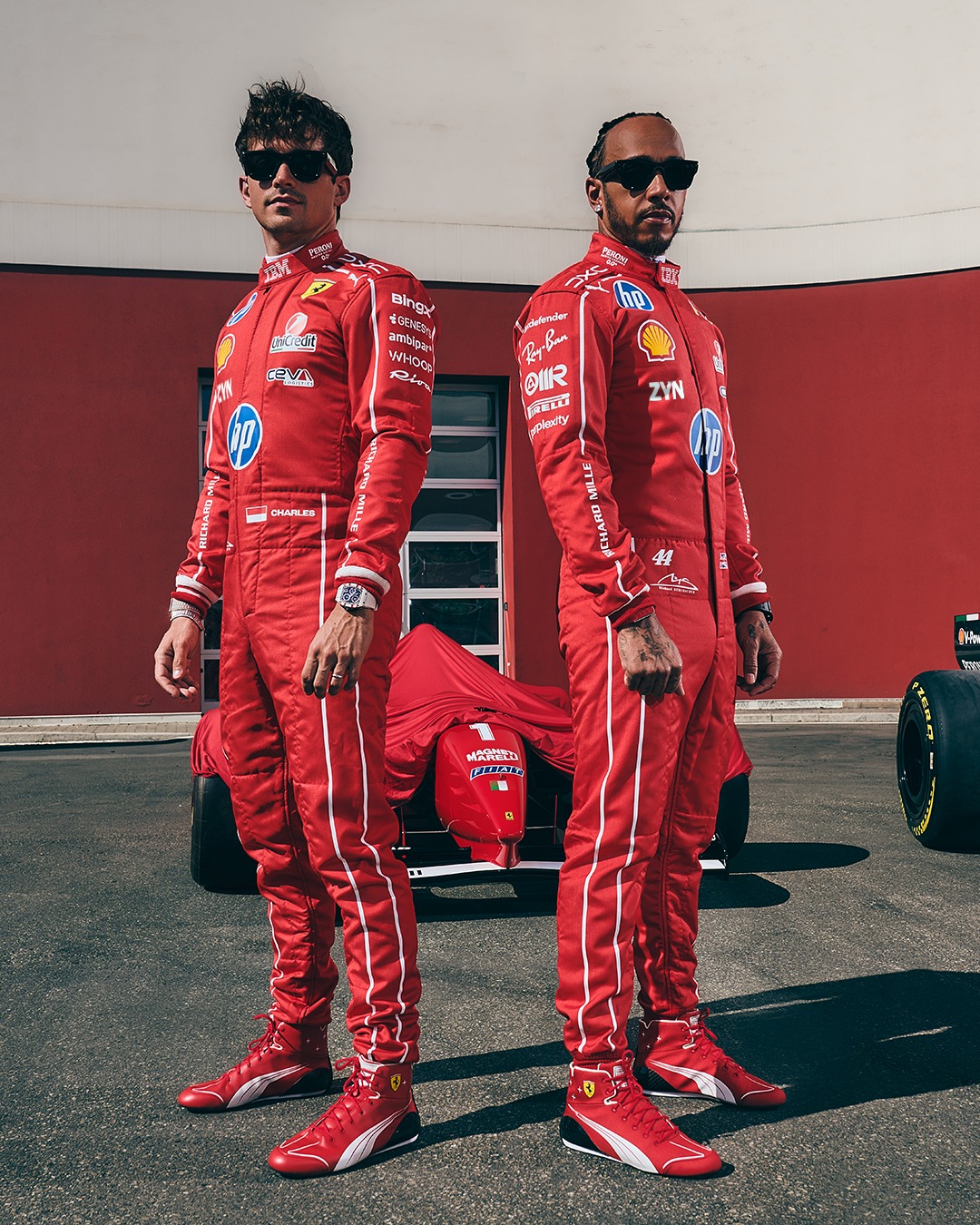
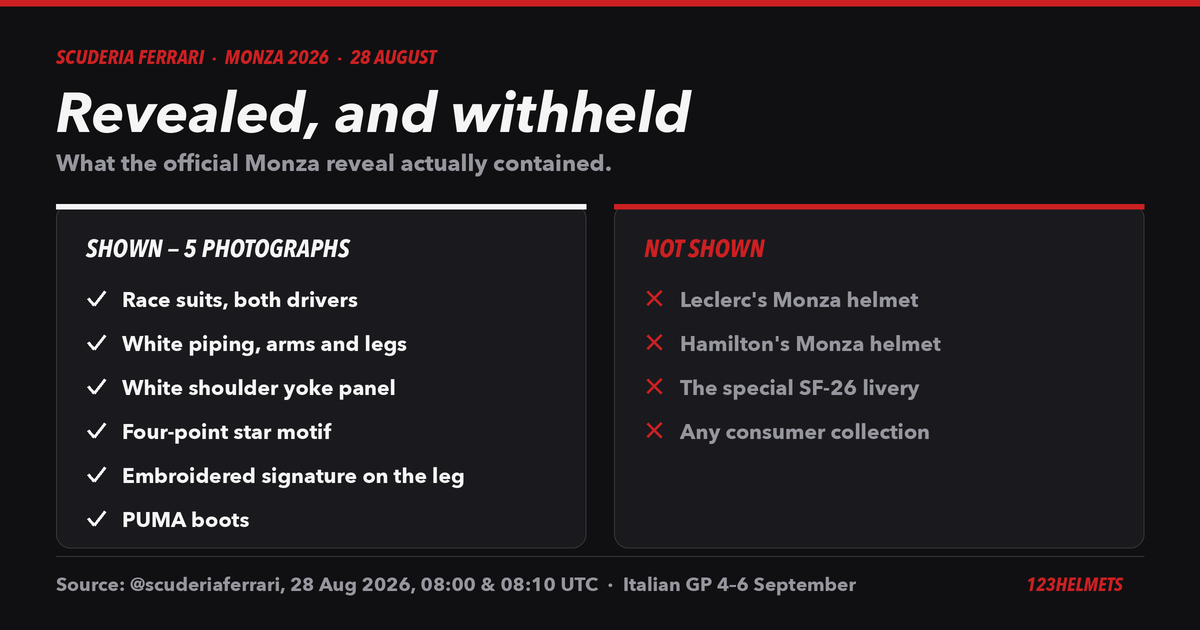
On the morning of 28 August 2026, Scuderia Ferrari showed the world what Charles Leclerc and Lewis Hamilton will wear at Monza. Five photographs, both drivers, head to boots — and not a single helmet among them. For anyone who follows helmet design, that absence is the story. Here is what Ferrari actually put in frame, what the fabric tells you, and what the team is still holding back with the Italian Grand Prix eight days away.
What Ferrari published on 28 August
Two posts, ten minutes apart, both from the team’s own verified account. At 08:00 UTC, a video captioned “A legacy celebrated. Unveiling our special race suits for Monza, inspired by Michael Schumacher’s impact on the racing world 💪”. At 08:10 UTC, a carousel of five photographs captioned “Up close with our Monza race suits 💫”.
Those two posts are, as of this writing, the most recent things Ferrari has published. Nothing has followed them. So the whole of the official reveal is: one video, five stills, and two captions that both use the same noun — suits.
Reading the suit, detail by detail
The five frames are unusually generous. One wide shot of both drivers standing side by side; one from directly behind Hamilton; one close on the boots; one three-quarter of Leclerc; one of Hamilton seated on a covered car. Between them you can read most of the garment.
The white line. A single white pipe runs the full outside length of each arm and each leg, unbroken from shoulder to cuff and from hip to ankle. On the current Ferrari suit that line does not exist. It is the most visible departure from what the team has raced all season, and it is the detail that reads oldest.
The shoulder yoke. Seen from behind, the upper back carries a white panel shaped around the Ferrari shield, outlined in a thin red keyline, with the driver’s surname beneath it in white block capitals. Again: a panel, not a print. It changes the silhouette of the suit from the back, which is the angle a grandstand actually sees.
The stars. Small white four-point stars are scattered across the upper back and repeated on the boots. They are the one motif with no obvious precedent in the 2026 suit, and the one most likely to migrate onto other pieces of the weekend’s kit.
The signature. On both suits, immediately below the race number on the leg — 16 for Leclerc, 44 for Hamilton — sits an embroidered signature. Ferrari has not captioned it. Given the stated inspiration for the whole exercise, the reading is not difficult.
What has not changed. The sponsor set is the standard 2026 arrangement, in the standard positions. Ferrari has not cleared the suit to make room for the tribute; it has threaded the tribute through a suit that still has a full commercial load on it. That is worth noting, because it sets a ceiling on how far any matching helmet design can go.
The car in the background is doing work
In two of the five frames there is a car under a red cover, with its nose left deliberately exposed. That nose carries the race number 1, alongside Magneti Marelli and FIAT decals.
That is a specific pointing gesture, not set dressing. Ferrari’s 1996 car, the F310, ran the number 1 on its nose because Michael Schumacher arrived from Benetton as the reigning champion, partnered that season by Eddie Irvine. Ferrari has covered the whole car and left exactly the panel that dates it. The team is telling you which year it means without saying the year.
The helmets were not in the frame
Across five photographs of two drivers photographed from the front, the back and the ankles, there is no helmet. Both drivers wear sunglasses in every shot. There is no helmet on the ground, none in either driver’s hands, none on the covered car, none on a shelf behind them.
On a shoot this controlled, that is a decision. Every other element of the weekend look was made available in high resolution and pushed to sixty thousand-plus engagements within hours. The helmets were held back.
There is a plain reason why a team would do that, and it has nothing to do with the helmets being unfinished. A special suit is a team announcement. A special helmet is a driver announcement — Leclerc and Hamilton each own their own helmet design, each has their own designer and their own audience for it, and each traditionally gets their own reveal moment. Bundling two driver helmets into a team clothing post would spend three stories to tell one.
What the suit does and does not tell you about the helmets
It is tempting to read the suit as a preview. It is worth being careful about how far that goes.
What transfers reasonably. The palette is now set — red, with white as the only accent. Any Monza-specific helmet arriving in the next week will almost certainly work inside that two-colour limit rather than introduce a third. The four-point star is a live motif with an obvious surface to sit on. And the reference year is now fixed at 1996 by the nose cone, which is far more useful than the vague “retro” that had been circulating.
What does not transfer. A suit is a large, flat, sponsor-dense canvas; a helmet is small, curved and, for these two drivers, personal. Leclerc and Hamilton have not run matching helmet designs at any point this season, and there is no indication either of them is about to start. The most likely outcome is two different helmets that each nod to 1996 in their own way — not one team livery applied twice.
Anyone publishing a rendering of “Leclerc’s Monza helmet” this week is guessing. Ferrari has released nothing on which such an image could be based.
What is still unconfirmed
Three separate things are being run together in this week’s coverage, and only one of them has happened. The suits are official — Ferrari showed them and named them itself on 28 August. The special car livery is only reported — press accounts describe it, but the team has not formally revealed it. A consumer collection does not exist — no Monza 2026 capsule has been announced, and there is no page, price or release date for one anywhere.
We set out the evidence for each of those three positions, source by source, in a separate piece on what is confirmed and what is not. This article does not re-argue it.
When the helmets should appear
The Italian Grand Prix runs from 4 to 6 September 2026 — first practice on the Friday, qualifying on Saturday afternoon, the race on Sunday. Special helmets for a home weekend follow a fairly reliable rhythm:
- Two to four days out — the driver, not the team, posts the design on their own channel. This is where a Monza helmet is most likely to surface.
- Thursday media day — the helmet appears in press photography whether or not it has been formally announced.
- Friday first practice — the last realistic moment. After this it is simply visible, and the reveal has been overtaken by the car.
If nothing has appeared on either driver’s channel by the Wednesday, the sensible conclusion is that there is no special helmet this weekend, and that the tribute lives in the suit and the car alone. That would be a slightly unusual outcome for a home race of this weight, but it would not be unprecedented.
Why this matters for a collection
One-off liveries are the pieces that date a collection precisely. A driver’s standard-season helmet says which year; a Monza one-off says which weekend, which anniversary and which decision the team made about its own history. That specificity is exactly what makes a display piece worth shelf space years later — and it is why the gap between “suit revealed” and “helmet revealed” is worth watching rather than filling in with speculation.
We will cover the helmet designs when Ferrari or the drivers actually publish them, and not before.
123Helmets produces full-size 1:1 replica helmets for display and collection. Display/collector replica. Not certified for protective use.