Blog
Verstappen Crash Forces Red Bull Spare Chassis
 123Helmets Editorial Team
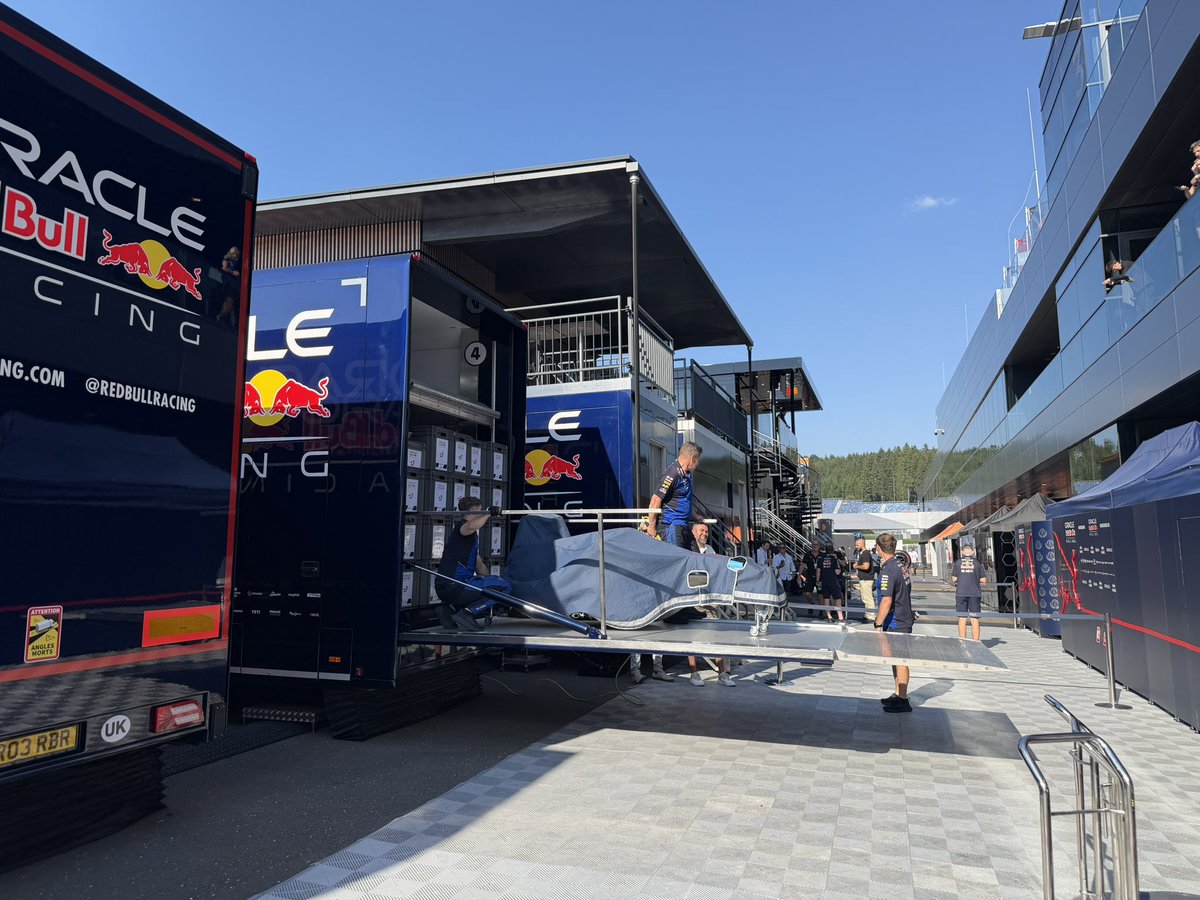
Max Verstappen’s crash at the 2026 Austrian Grand Prix was severe enough to force Red Bull to pull out a spare chassis — one of the most consequential mechanical responses a top team can make during a race weekend. For collectors, moments like this crystallise exactly why a Verstappen replica helmet from a pivotal 2026 race weekend carries lasting significance.
Key Takeaways
Verstappen’s crash at the 2026 Austrian GP was severe enough to require Red Bull to switch to a spare chassis — a rare, high-stakes mechanical decision.
Deploying a spare chassis mid-weekend compresses the engineering timeline dramatically, with mechanics working through the night to rebuild the car to race specification.
The Austrian GP at Red Bull Ring runs on a short 4.318 km circuit, making crash damage particularly consequential given the high kerb-riding demands on the chassis.
For display-helmet collectors, a Verstappen 2026 Austrian GP replica marks a specific, historically documented race weekend — one defined by drama before the lights even went out.
What Happened: Verstappen’s Crash at the 2026 Austrian GP
Max Verstappen’s crash at the 2026 Austrian Grand Prix was damaging enough that Red Bull had no choice but to bring the spare chassis out of its crates — a response that signals the primary tub was unfit for continued use that weekend. The incident was reported live from the paddock by F1 journalist Chris Medland, whose track-side sourcing confirmed the team’s decision as it happened.
A spare chassis is not a quick swap. It is the fundamental structural backbone of the car — the carbon-fibre monocoque to which every mechanical and aerodynamic component attaches. Pulling it out mid-weekend means stripping the damaged car and rebuilding an entirely new tub in the garage, often overnight, under race conditions.
The Red Bull Ring, home of the Austrian Grand Prix since 1970, sits at an altitude of approximately 700 metres above sea level in Spielberg, Styria. Its 4.318 km layout is one of the shortest on the F1 calendar, and its aggressive kerbs — particularly at Turn 9 and Turn 10 — place enormous lateral and vertical loads on the chassis. A car launched over those kerbs at racing speed can generate impact forces far beyond what routine set-up work accommodates.
For Max Verstappen and Red Bull, the 2026 Austrian GP weekend immediately became a race against the clock rather than just a race against rivals.
What a Spare Chassis Actually Means in Modern F1
A spare chassis in modern F1 is a complete, homologated monocoque held in reserve specifically for high-damage events — its deployment is uncommon enough that it signals a genuinely significant impact has occurred. Under current F1 regulations, teams are permitted to bring multiple chassis to each event, but the logistics of building a second car from the tub upward during a race weekend are formidable.
The rebuild process requires the mechanical team to transfer every component — suspension, gearbox, power unit, cooling systems, all aerodynamic bodywork — from the damaged chassis to the new one. A full chassis change of this kind can take upward of eight hours of continuous work by a full team of mechanics. At a circuit like the Red Bull Ring, where Saturday’s sprint or qualifying schedule can follow Friday practice by less than 18 hours, time margins are extremely tight.
Red Bull’s infrastructure at the Austrian GP is also logistically unusual: the circuit is effectively the team’s home race, located within driving distance of the Milton Keynes factory and — more critically — the team’s Austrian heritage via its energy drink roots. That proximity can allow for faster parts procurement, but no factory proximity shortens the actual man-hours required to rebuild a chassis safely.
The Carbon-Fibre Reality
Modern F1 monocoques are manufactured from aerospace-grade carbon fibre, typically built over several weeks in a controlled environment. The tub that arrives at each race weekend has passed rigorous load and impact testing. When damage is severe enough that engineers cannot certify the structural integrity of the primary chassis for further running, the decision to switch is not discretionary — it is mandatory under both FIA safety protocols and the team’s own engineering standards.
The fact that Red Bull made this call at the 2026 Austrian GP means their engineers assessed the primary tub as compromised beyond acceptable tolerance. That is a decisive, high-consequence judgment call made under pressure.
The Austrian GP’s History of High-Intensity Weekends
The Austrian Grand Prix has produced some of F1’s most compressed and dramatic race weekends, and the Red Bull Ring’s aggressive kerb profile has been a recurring factor in chassis damage across multiple seasons. The circuit’s 10-turn layout covers just 4.318 km per lap, meaning drivers complete a high number of laps in each session — more laps mean more cumulative stress on every structural component.
In 2026, the race weekend format allocates three practice sessions, one qualifying session, and the Grand Prix itself — each one a fresh opportunity for the kind of kerb-strike or barrier contact that sends engineers to the spare-chassis crate. The Red Bull Ring’s Turn 3 and Turn 7 are particularly noted for producing large kerb strikes, with lateral g-forces at those corners capable of exceeding 4g under braking and rotation.
For Verstappen specifically, the Austrian GP carries additional weight. The circuit is embedded in his team’s identity and has historically been one of the strongest venues on the calendar for Red Bull. A chassis-damaging crash here, at a race the team treats almost as a home event, adds a layer of significance beyond the purely mechanical.
Rebuilding Under Pressure
The overnight chassis rebuild that follows an incident of this magnitude is one of the genuine tests of a top F1 team’s depth. It is not just the mechanics who work through the night — the composites team must inspect every transferred component, the aerodynamicists must confirm no bodywork tolerances have shifted, and the data engineers must re-zero all the sensors attached to the new tub. A car that leaves the garage on a rebuilt chassis on Saturday morning has effectively been born twice in the same weekend.
Why This Moment Matters to Helmet Collectors
A display helmet tied to the 2026 Austrian Grand Prix — and specifically to Verstappen’s race weekend — now represents one of the most clearly documented flashpoint moments of the 2026 F1 season. Collector interest in replica helmets is consistently strongest when a specific race weekend carries a concrete, verifiable narrative: a championship turn, a dramatic mechanical failure, or a moment of visible team crisis all serve as anchors for long-term provenance.
The spare chassis deployment is exactly that kind of anchor. It is a fact reported live from the paddock on 2026-06-27, attributed to a credentialed journalist with direct access to the Red Bull garage. Future collectors researching this helmet will find the incident documented across multiple contemporaneous sources, which is the foundation of a collectable piece’s historical value.
Full-size 1:1 replica helmets — display pieces manufactured to the same exterior dimensions as race-worn lids, typically weighing approximately 1.2–1.5 kg and measuring around 29 × 25 × 35 cm across the outer shell — allow collectors to place a physical object in their home or office that maps directly to a documented race weekend. The helmet is not the car, but it is the most personal piece of kit associated with the driver: the one surface that carries their livery, their colours, and their number through every moment of that race.
The 2026 Verstappen Helmet Design
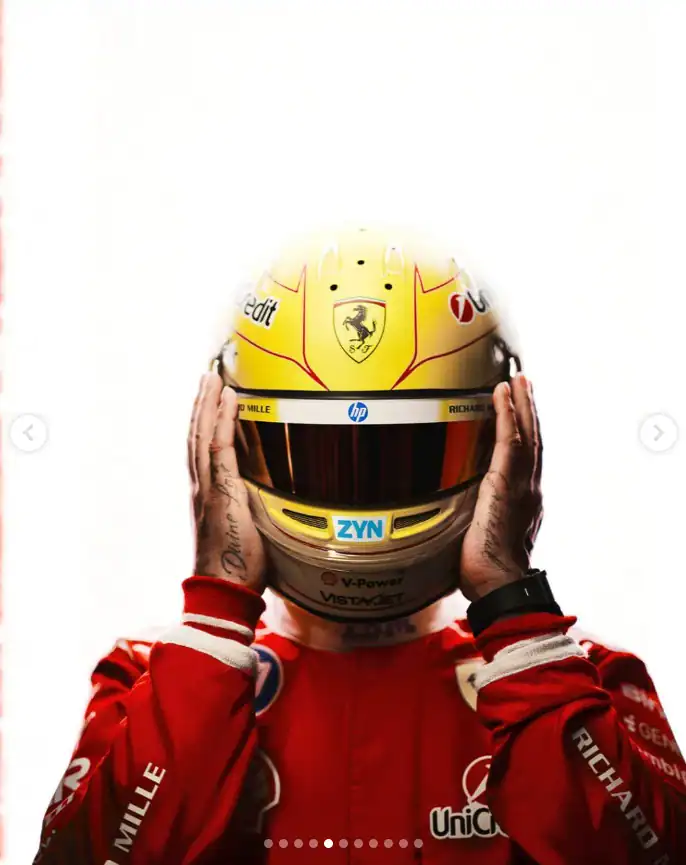
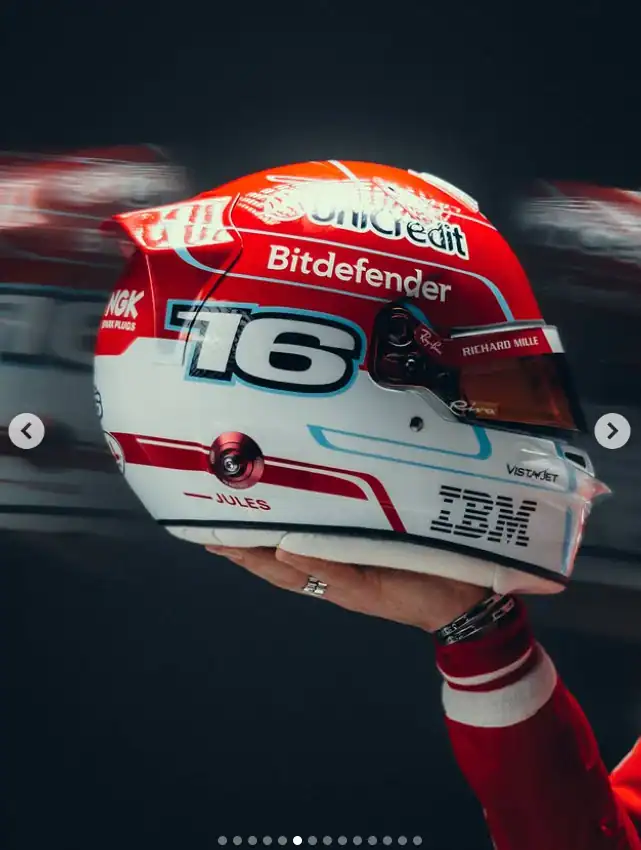
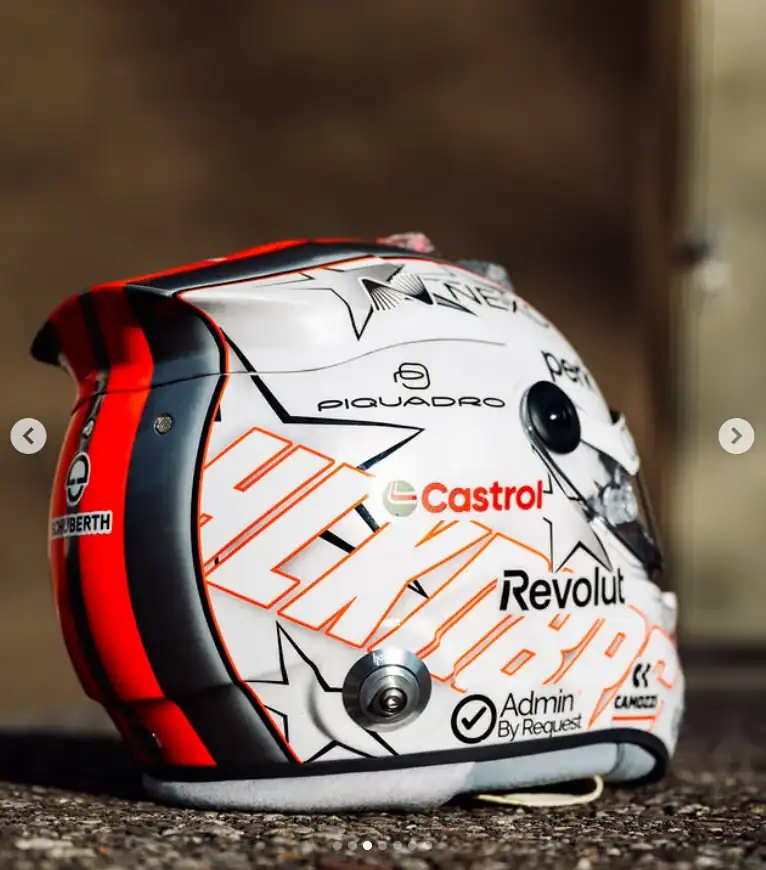
Verstappen’s 2026 helmet livery follows the design language he has refined over recent seasons — a strong Dutch-orange base with geometric graphic blocks and sponsor elements integrated into the upper shell. As a 1:1 display replica at 29 × 25 × 35 cm, it sits at a scale that makes the graphic detail legible and shelf-ready without requiring a dedicated display cabinet. These are collector pieces only, manufactured for exhibition and display use — not certified for any protective or racing application.
Red Bull’s 2026 Season Under the Microscope
Red Bull entered the 2026 season under more scrutiny than any point since their dominant 2022–2023 run, with the new technical regulations reshaping the competitive order across the grid. A chassis-damaging crash at the Austrian GP is another data point in a 2026 narrative that has been more turbulent than the team’s most recent championship campaigns.
The 2026 regulation cycle introduced significant changes to aerodynamic philosophy — active aerodynamics, revised floor dimensions, and a new power unit framework that all teams are still refining mid-season. These regulations mean that chassis loads and suspension geometry are being recalibrated across every race weekend. A crash that might have produced cosmetic damage under a previous car concept can, with new suspension geometry and different load paths, propagate stress into the monocoque in ways that make a chassis swap necessary.
Red Bull’s decision to bring a spare chassis to race weekends — standard practice at the top level — meant they were prepared for exactly this scenario. Preparedness is not the same as preference: no team wants to spend the night between Friday and Saturday rebuilding a car from the tub. But the fact that the infrastructure existed and was deployed immediately demonstrates the operational depth that separates the leading teams from the midfield.
For the 2026 Austrian GP, the question is whether the rebuilt car will perform to the level required once it is back on track. A new chassis, however carefully assembled, introduces minor unknowns: sensor baseline shifts, minor geometry tolerances, the psychological factor of a driver knowing their car is not the same one they drove in FP1. These are marginal effects, but at the front of the 2026 grid, margins are everything.
Collecting the 2026 Austrian GP: What to Look For
The 2026 Austrian GP is already one of the most newsworthy weekends of the F1 season, and Verstappen’s crash and the subsequent spare chassis deployment make a display helmet from this event particularly worth acquiring now. Collector replica helmets tied to specific race weekends — rather than generic season editions — tend to carry stronger long-term interest precisely because the provenance is unambiguous.
When evaluating a 1:1 display replica helmet for a collection anchored to this event, the key attributes are accuracy of the 2026 livery, scale fidelity at the full 29 × 25 × 35 cm outer-shell dimension, and quality of finish on the visor unit — typically a polycarbonate panel at around 3 mm thickness on a well-made display piece. These are exhibition-only items, not certified for any form of protective use, and their value is entirely in their accuracy as display objects representing a documented moment in the 2026 season.
The Austrian GP weekend of 2026 will be referenced in season retrospectives, in Verstappen’s career documentation, and in Red Bull’s engineering history. A display helmet on a shelf in 2030 or 2035 that carries the 2026 Austrian GP livery will have a specific, verifiable story behind it — one that began with a crash, a spare chassis, and a team working through the night in Spielberg.
“Spare chassis coming out at Red Bull after Verstappen’s crash.”
— Chris Medland (@ChrisMedlandF1), paddock report, 2026 Austrian GP
FAQ
Q: Why did Red Bull need a spare chassis after Verstappen’s crash at the 2026 Austrian GP?
Red Bull deployed a spare chassis because the crash was severe enough to compromise the structural integrity of the primary monocoque beyond what the engineering team could certify safe for continued race use. When a carbon-fibre tub sustains impact damage that cannot be fully assessed or cleared, switching to a spare chassis is the standard and necessary response at the top level of F1.
Q: How long does it take to rebuild an F1 car on a spare chassis?
A full chassis swap in F1 typically requires upward of eight hours of continuous work by a full mechanical team. Every component — suspension, power unit, gearbox, aerodynamic bodywork, and all sensors — must be transferred from the damaged tub to the new one and re-checked before the car can run again.
Q: What is a 1:1 display replica F1 helmet and is it safe to wear?
A 1:1 display replica F1 helmet is a full-size collector piece manufactured to the same exterior dimensions as a race-worn lid — typically around 29 × 25 × 35 cm — for exhibition and display purposes only. These items are not certified for any protective use and are not designed or tested to any safety standard; they are collector and display pieces exclusively.
Q: Does a crash at a specific race weekend increase the collector value of a driver’s helmet replica?
Yes — display replica helmets tied to specific, well-documented race weekends tend to carry stronger collector interest than generic season editions because the provenance is clear and verifiable. A moment like the 2026 Austrian GP spare chassis incident, reported live from the paddock on 2026-06-27, provides an unambiguous historical anchor for any replica associated with that event.
Q: How short is the Red Bull Ring circuit used for the Austrian GP?
The Red Bull Ring measures 4.318 km per lap, making it one of the shortest circuits on the F1 calendar. Its compact layout and aggressive kerbs — particularly at Turns 3, 9, and 10 — place high cumulative stress on the car’s chassis over a full race distance.
Browse F1 Helmet Collection — find 1:1 display replicas from the 2026 season, including Verstappen and Red Bull editions, at the 123Helmets shop.
Display and collector replicas only. Not certified for protective use. Full-size 1:1 scale.
This article was written with the help of AI tools. Editorial policy