




Blog
Did Russell Really Lift? The Telemetry Behind Austria 2026’s Yellow-Flag Pole
 123Helmets Editorial Team
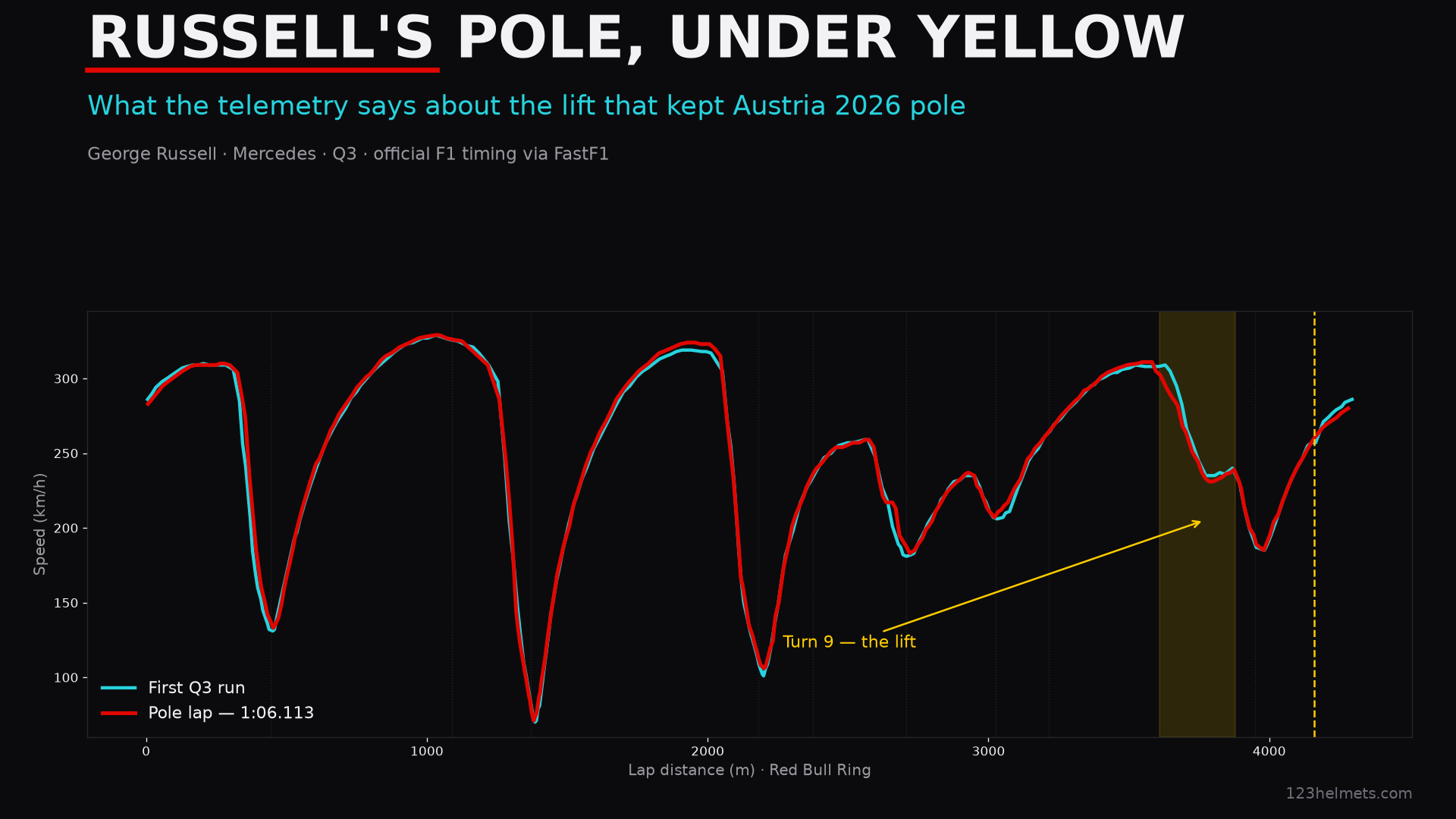
George Russell took pole for the 2026 Austrian Grand Prix with a 1:06.113 — and within minutes the question wasn’t about the lap time, it was about a flag. Max Verstappen had crashed at Turn 9 on the final runs, the yellow lights came on, and Russell was the next car through. He kept the lap. He kept pole. So we did what the stewards did: we pulled the official car telemetry and looked at exactly what his right foot was doing through the marshalling zone.
The short answer: the telemetry is consistent with his account — he lifted, and the lap still stood. Here is the long answer, frame by frame.
What actually happened at Turn 9
It was the closing stage of Q3, with the leading cars on their last flying laps. Verstappen lost the rear of his Red Bull through the fast Turn 9 right-hander and speared into the barriers. Race control showed a single waved yellow first, waiting to see whether Verstappen could rejoin or get back to the pits. Only once it was clear he could not did the zone go to double waved yellow — and the official race-control log shows that upgrade came exactly 22 seconds after the first yellow (single yellow 15:00:23, double yellow 15:00:45).
That gap is the whole story. The telemetry puts Russell through Turn 9 about five seconds before the zone was upgraded — his pass was unambiguously under a single yellow. By the time it went double yellow he was already through Turn 10 and roughly 130 metres from the line (about 4,160 m into the lap, at 260 km/h). His provisional pole lap was therefore set under a single yellow — a meaningful distinction in the regulations, and the reason his time was never in doubt.
The rule the lap had to satisfy
Under the 2026 F1 Sporting Regulations, the two flags carry very different obligations. A single waved yellow (Art. B1.8.4.a) requires a driver to “reduce their speed and be prepared to change direction,” and the driver is “expected to have braked earlier and/or discernibly reduced speed in the relevant marshalling sector.” A double waved yellow (Art. B1.8.4.b) is far stricter: the driver must “reduce speed significantly,” it “must be clear that the driver has not attempted to set a meaningful lap time,” and in qualifying the lap time is deleted automatically.
So the test for Russell’s pole lap was the single-yellow one: did he discernibly reduce speed at Turn 9? Telemetry answers that cleanly.
The telemetry: did he lift?
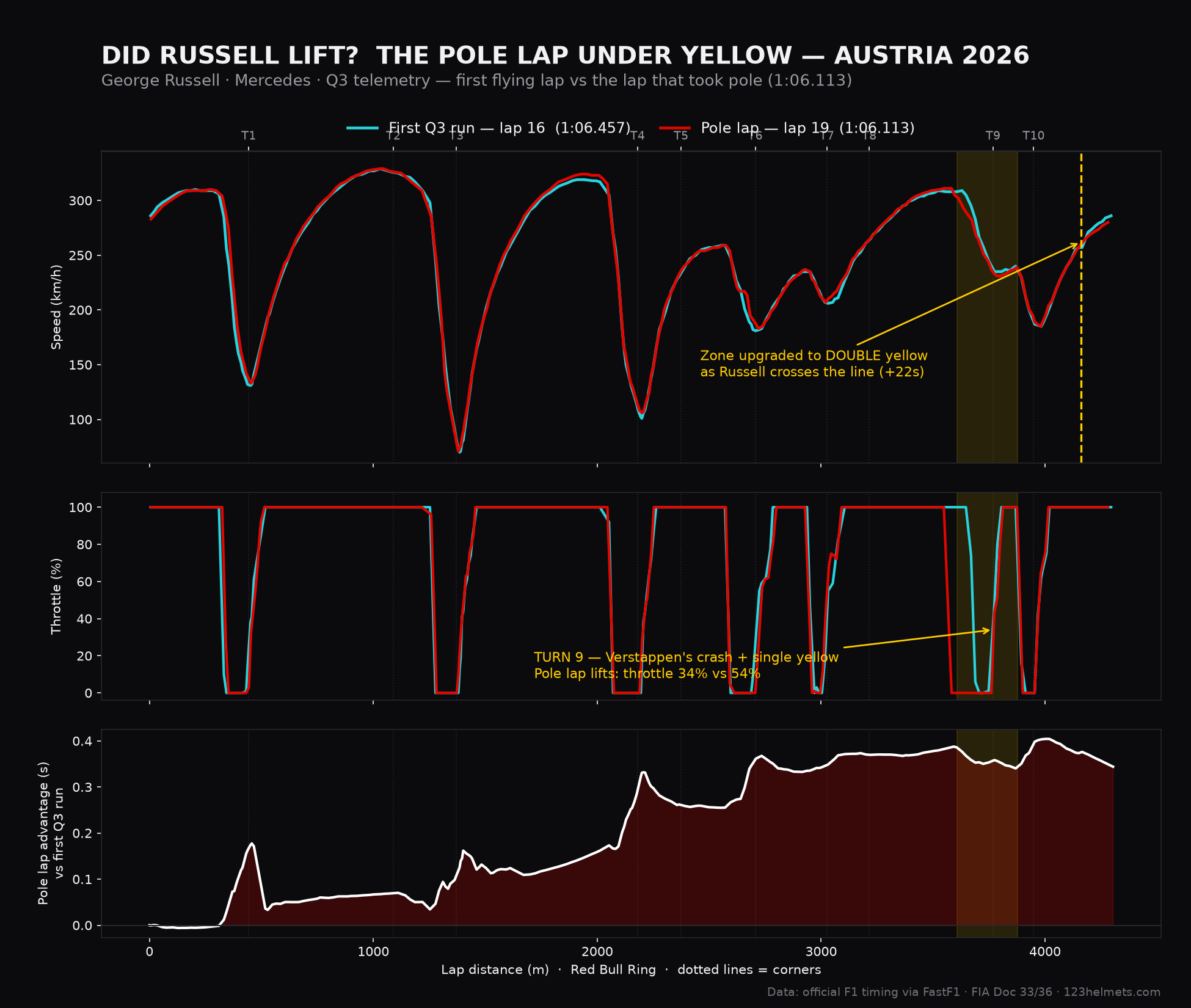
Comparing his pole lap with his first flying lap of Q3 — a 1:06.457 — the throttle trace tells the story. Through the Turn 9 zone, where the single yellow was showing, Russell’s pole lap runs an average throttle of about 34–38%, against 54–55% on his first run. He comes off the power earlier — dropping to no throttle around 3,560 m, before the corner itself at 3,768 m — and holds it longer. That is the “discernible reduction in speed” the single-yellow rule asks for, and it matches what he said he did.
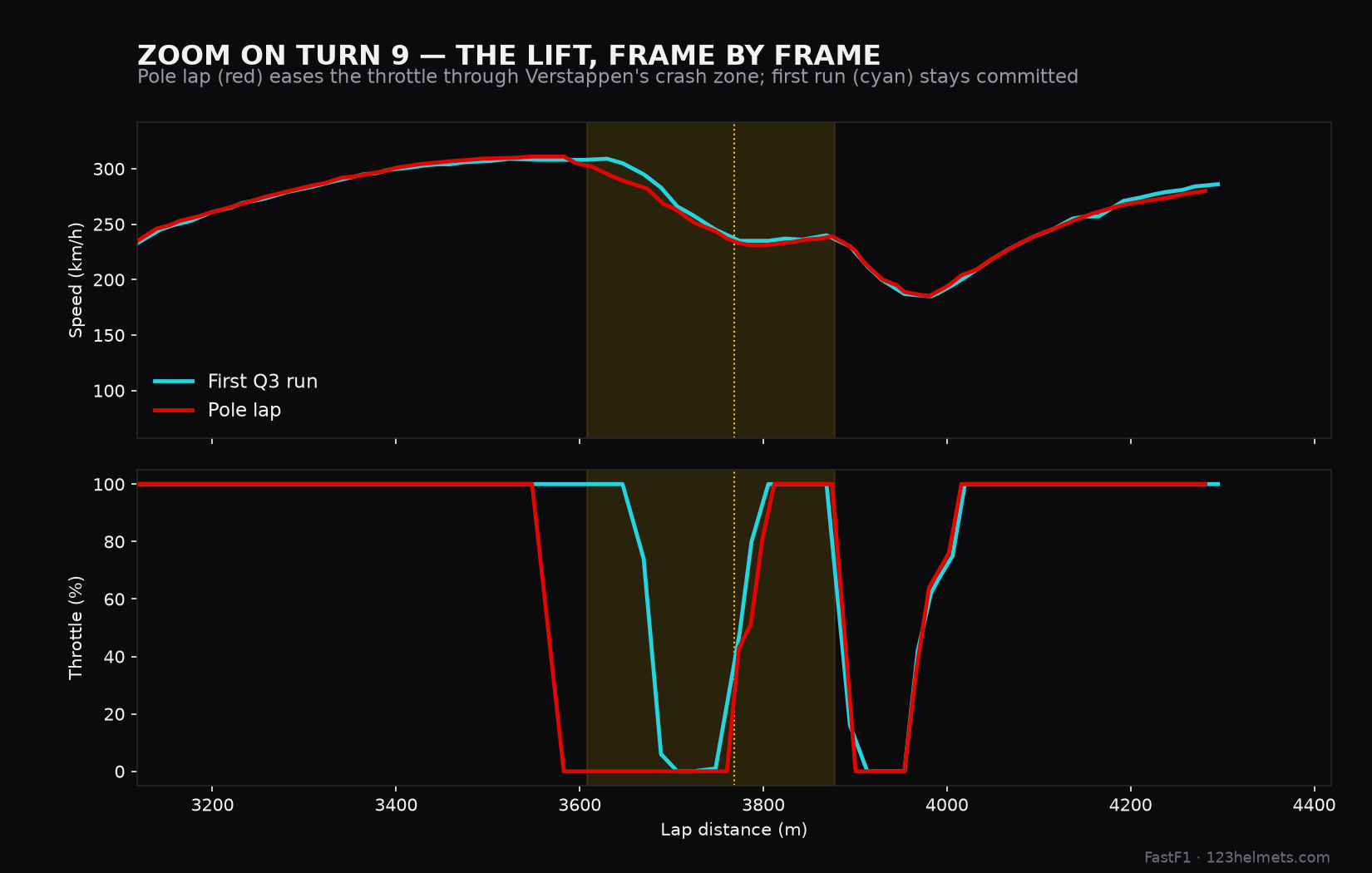
And it cost him almost nothing. The time-gain trace shows Russell ahead of his first run for the whole lap, the advantage peaking near four tenths through the middle-to-late part of the lap. Through Turn 9 itself the gain barely moves — from about 0.368s to 0.351s, an in-corner cost of only around two hundredths despite the lift. He crossed the line 0.344s up on his own first Q3 run (1:06.457 to 1:06.113), and held pole by 0.236s over Charles Leclerc. He did the right thing and still produced the lap of the session.
In the cockpit Russell read it slightly differently — a driver’s dash compares against a rolling ideal lap, not his earlier run — but the conclusion is the same: a clear lift, and a lap good enough to keep pole.
“I saw the yellow, I had a big lift into the corner — it was five tenths up, and I came out the last corner two and a half tenths up. It was a single yellow as well, not a double, so it should be okay.”
George Russell, Mercedes
His team boss reached the same conclusion. “It’s a single yellow and a 100-metre lift-off, George loses a tenth and a half. It’s completely on,” said Toto Wolff. The stewards agreed: Russell’s flying lap was not investigated and not deleted, and no further action was taken.
Why the grid barely moved
The headline “nine lap times deleted” is real — but it did not reshuffle the front of the grid. Per the official timing bulletin (Document 33), nine drivers had a lap deleted for passing the double waved yellow at Turn 9: those were the in-laps (all logged as returning to the pits) set after the flags had been upgraded, not the flying laps that decided the order. A separate document removed two more times for track limits (Hamilton at Turn 3, Colapinto at Turn 1). The one front-row casualty was self-inflicted: Andrea Kimi Antonelli aborted his own final lap believing the zone was already double-yellow, which cost him a likely front-row start and dropped him to fourth.
Final order at the top: Russell on pole (1:06.113), Leclerc second (1:06.349), Hamilton third (1:06.408), Antonelli fourth (1:06.414) and Verstappen — despite the crash — fifth (1:06.475), his earlier Q3 time standing.
How we read the data
Every chart here is built from the same source the stewards and teams use: official Formula 1 timing and car telemetry, accessed through the open-source FastF1 library, cross-checked against the official published decision documents for the weekend (the final classification and the deleted-lap-times bulletins). We compared two of Russell’s own laps so the picture is like-for-like — same car, same tyres, same session — and the only variable that matters is what he did when the flag came out. The numbers, his words and the stewards’ verdict all line up.
For the full grid, the penalties and the running order, see our companion report: Nine lap times deleted in 2026 Austrian GP qualifying — Russell keeps pole.
Weekends like this are why a driver’s helmet is worth displaying — the livery that was on track for a pole lap like Russell’s. 123Helmets builds full-size 1:1 display replica helmets celebrating Formula 1’s drivers and liveries — collector pieces for the shelf, not the cockpit. Explore the driver collection.
This article was written with the help of AI tools. Editorial policy