
Blog
Entertaining Canadian GP Masks Deeper F1 Rules Debate: Drivers Speak Out
 123Helmets Editorial Team
The 2025 Canadian Grand Prix at Circuit Gilles Villeneuve delivered overtakes, strategy gambles and a photo-finish podium — yet several drivers insist the spectacle hides unresolved problems with the current technical and sporting rules. For collectors of full-size 1:1 replica display helmets, Montréal also gave us some of the season’s most striking lid designs, podium visuals and exhibition-worthy moments worth dissecting.
Key Takeaways
The Canadian GP delivered a thrilling race, but several drivers publicly argued the entertainment factor doesn’t validate the current regulatory framework.
Podium helmet liveries from Montréal offer exhibition-grade visual contrast — ideal references for full-size 1:1 display replicas.
Driver comments reignite the debate around the 2026 regulation overhaul and whether show should outweigh sporting purity.
Collector value tends to spike around landmark races; Montréal 2025 visuals are already flagged by display-helmet enthusiasts.
A race that thrilled the grandstands
The Circuit Gilles Villeneuve once again proved why it sits among the most beloved venues on the calendar. The 4.361 km semi-permanent layout, with its 14 corners and the infamous Wall of Champions on the exit of the final chicane, forced teams into compromise setups and turned strategy into a coin toss. From lights-out the race delivered wheel-to-wheel battles through the hairpin at Turn 10, late braking duels into the Turn 13–14 chicane, and a string of DRS-assisted passes along the back straight.
For neutral fans the 70-lap distance flew by. For the drivers in the cockpit, however, the post-race media pen told a different story. Several podium finishers — while celebrating the result — questioned whether the show on track masks deeper issues with tyre management windows, aerodynamic dirty-air thresholds, and the sporting balance heading into 2026.
Why “entertaining” isn’t the same as “healthy”
The argument from the drivers’ side is consistent: a chaotic, weather-influenced or strategy-driven race can produce great television without proving the rulebook is working. Tyre degradation windows that force one-stop conservatism, gaps that only close under Safety Car deployments, and overtakes that rely heavily on a 600+ metre DRS zone are, in their view, symptoms — not cures.
What the drivers actually said
In the cool-down room and the subsequent press conference, the tone was measured but pointed. Drivers acknowledged the entertainment value of the Montréal weekend, then immediately pivoted to structural concerns: the weight of the current generation of cars (around 800 kg minimum including the driver), the difficulty of following closely through medium-speed corners, and the unpredictable thermal behaviour of the current tyre compounds when track temperatures swing.
Concerns flagged for 2026
The 2026 regulation cycle — with its 50/50 split between internal combustion power and electrical deployment, plus active aerodynamics — was a recurring topic. Drivers stressed that a single entertaining race shouldn’t be used as evidence that the current framework is fine, nor as an excuse to rush or delay the 2026 reset. Several emphasised that consistency of competition, not headline-grabbing chaos, should be the metric.
The recurring themes
- Dirty-air sensitivity in medium-speed corners
- Tyre operating windows that punish aggressive racing
- Weight figures that limit agility at street-style circuits
- Uncertainty over the 2026 power unit and chassis package
Podium helmets: exhibition-worthy visuals from Montréal
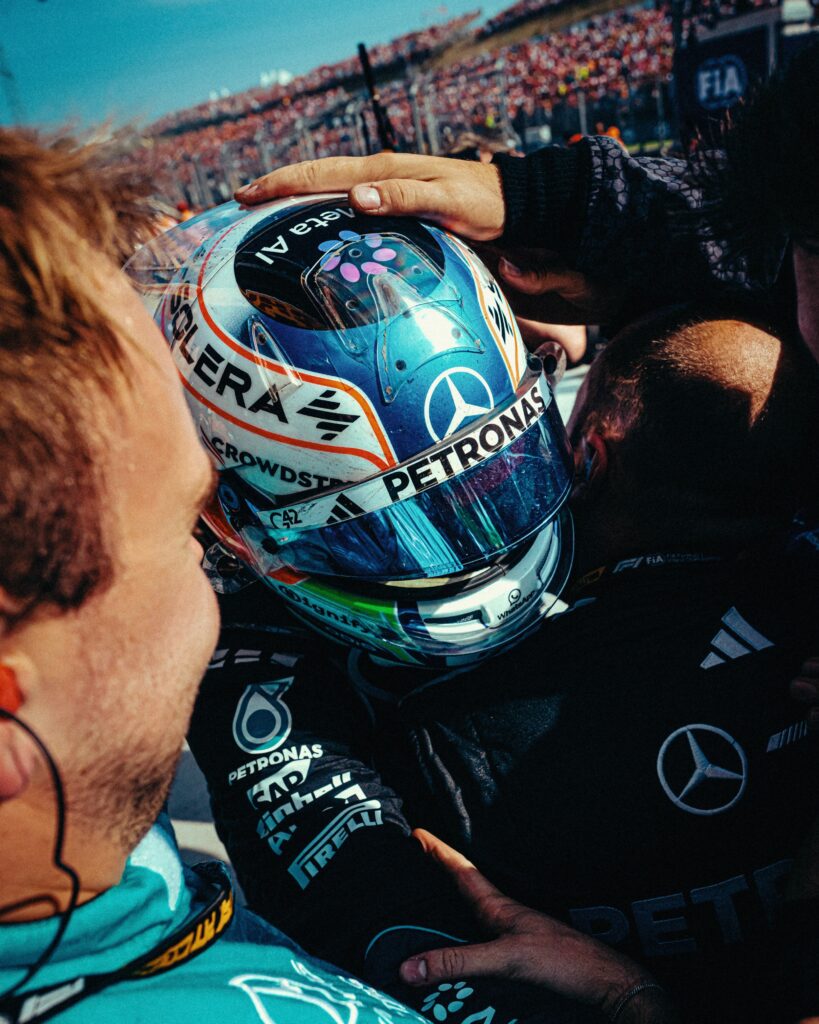
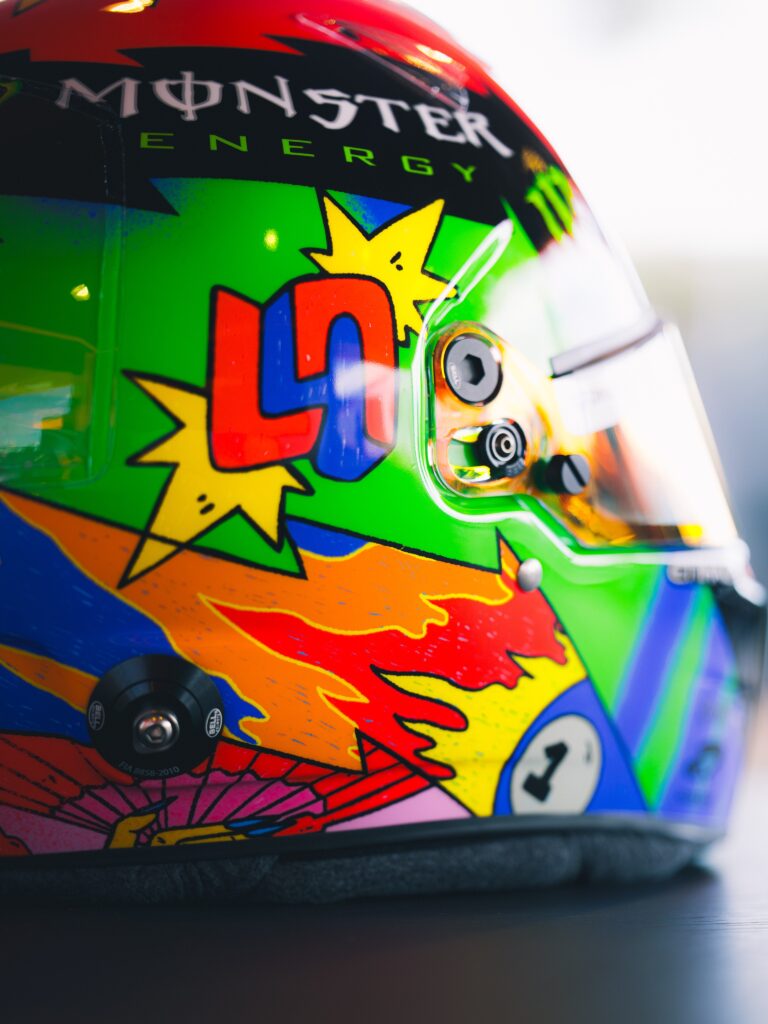
From a collector’s standpoint, Montréal 2025 delivered a podium tableau worth framing. The three lids on the top step combined matte and gloss finishes, fluorescent accents and personalised crown graphics — exactly the kind of design density that makes a full-size 1:1 replica helmet pop on a display shelf or in a glass cabinet.
Design elements worth noting for display
Replica helmet displays typically measure around 27 × 35 cm with the visor mounted, and weigh in the region of 1.4–1.6 kg depending on the shell construction used by the manufacturer. The Montréal designs leaned heavily on:
- High-contrast crown graphics — ideal for top-down shelf lighting
- Maple-leaf nods and Canadian flag accents on at least one special-edition lid, a recurring collector favourite for the Montréal round
- Multi-layer paint finishes (often 6–8 paint layers on the original) that replica makers reproduce with airbrush passes and clear-coat depth
- Sponsor-decal hierarchy that translates cleanly to a 1:1 scale display piece
Why these visuals matter to collectors
Display replicas are about visual storytelling. A podium-finishing helmet from a memorable race — particularly one that triggers debate, as Montréal 2025 has — gains long-term narrative value. Collectors aren’t just buying a shell; they’re buying the moment.
Strategy, Safety Cars and the talking points
The race featured multiple strategic inflection points. A mid-race Safety Car compressed the field and handed fresher-tyre runners a window to attack. The top three were separated by under 5 seconds at the flag — close enough to feel like a true contest, wide enough to suggest the leader still had margin in hand.
The strategic chess match
Pit windows opened around lap 18 for the early one-stoppers and remained viable until roughly lap 42 for those gambling on a long second stint. Teams that committed to the medium-hard combination generally finished ahead of those who tried to extend the soft compound, with degradation reportedly costing around 0.4 seconds per lap once the cliff arrived.
The Wall of Champions held its name
The final chicane once again claimed at least one front wing across the weekend, reinforcing why Circuit Gilles Villeneuve remains a setup nightmare. For helmet collectors, race-used or race-weekend designs from drivers who survived the wall add a layer of authenticity to a display narrative — even when the piece itself is a full-size 1:1 replica intended purely for exhibition.
The bigger picture: rules debate ahead of 2026
What makes the Canadian GP fallout interesting is the disconnect between fan reaction and driver reaction. Social-media engagement around the race spiked, broadcast highlights drew strong viewership, and Montréal’s race-day attendance once again exceeded 100,000 spectators across the Île Notre-Dame venue. By every external metric, the event was a success.
Why drivers keep pushing back
The drivers’ position is that the metrics of “good show” and “good sport” don’t always align. A race decided by a Safety Car timing window or a tyre-temperature anomaly may entertain — but it doesn’t necessarily prove the cars can race wheel-to-wheel cleanly. As F1 moves toward the 2026 regulations, with active aero and a substantially revised power unit, the call from inside the cockpit is for honest assessment rather than highlight-reel justification.
What it means for the rest of 2025
The remaining rounds will be scrutinised through this lens. Expect drivers to keep flagging structural issues even after entertaining races, and expect the FIA and FOM to weigh the 2026 transition carefully against the current product. For collectors, that ongoing tension is a gift: every contested race generates iconic visuals, and iconic visuals make for compelling 1:1 display helmets.
Display recommendations for the Montréal weekend
If you’re building a collection themed around the 2025 season, the Canadian GP is a strong anchor point. Full-size 1:1 replica helmets capture the paint detail, sponsor layout and visor tint in exhibition-grade fidelity — without any pretence of protective function. These are display pieces, collector items, exhibition-quality reproductions.
Suggested presentation
- Lighting: warm 2700–3000 K LED spots emphasise metallic flake; cooler 4000 K lighting suits matte and fluorescent finishes
- Mounting height: eye level (around 150–160 cm shelf height) for solo display pieces
- Backdrop: a printed race-day photograph or circuit map of the 4.361 km Circuit Gilles Villeneuve layout adds narrative depth
- Rotation: rotate the helmet 15–20° off-axis to reveal the side-pod logo and crown graphic simultaneously
Each replica is intended strictly as a collector and display item — not certified for protective use, not suitable for track or road, and not a wearable safety product. The value lies in craftsmanship, visual fidelity and the story behind the design.
“A great race doesn’t mean the regulations are working — it means the drivers and teams found a way to make it work despite them.”
— Paddock consensus, Montréal 2025
“We should judge the rules across a season, not by one entertaining Sunday.”
— Post-race driver press conference
FAQ
Q: Why are drivers criticising the rules after an entertaining race?
Drivers argue that a single thrilling race — often shaped by Safety Cars, tyre anomalies or weather — doesn’t prove the underlying regulations are healthy. They want consistent close racing, not chaos-driven highlights, and they’re pushing for an honest assessment ahead of the 2026 regulation reset.
Q: What makes Circuit Gilles Villeneuve special for helmet collectors?
The Montréal round routinely produces special-edition liveries featuring Canadian motifs, maple-leaf accents and unique chrome or fluorescent finishes. Combined with the circuit’s narrative weight — the Wall of Champions, the 4.361 km layout — these helmets become standout pieces in any 1:1 replica display collection.
Q: Are 123Helmets replicas suitable for wearing or track use?
No. All 123Helmets pieces are full-size 1:1 collector and display replicas, designed exclusively for exhibition. They are not certified for protective use, not wearable for racing or road use, and should be treated as display items only.
Q: How big is a full-size 1:1 replica helmet on display?
A typical full-size 1:1 replica measures around 27 × 35 cm including the visor area and weighs roughly 1.4–1.6 kg depending on shell construction. It’s designed to occupy a standard collector shelf or glass cabinet at eye level.
Q: Will the 2026 regulations change the design of F1 helmets?
The 2026 regulation overhaul primarily affects chassis, power units and active aerodynamics. Helmet designs themselves evolve year on year through livery updates and personal driver branding rather than regulatory shifts, meaning current 2025 designs remain highly collectible regardless of the technical reset.
Browse F1 Helmet Collection
Display and collector replicas only. Not certified for protective use. Full-size 1:1 scale.