- Keke Rosberg
- Nigel Mansell
- Jenson Button
- Nico Rosberg
- Gilles Villeneuve
- Mika Hakkinen
- Jackie Stewart
- Charles Leclerc
- Lewis Hamilton
- Max Verstappen
- Lando Norris
- Ayrton Senna
- Michael Schumacher
- Fernando Alonso
- Oscar Piastri
- George Russell
- Kimi Antonelli
- Nico Hülkenberg
- Gabriel Bortoleto
- Pierre Gasly
- Franco Colapinto
- Carlos Sainz
- Oliver Bearman
- Sergio Pérez
- Valtteri Bottas
- Isack Hadjar
- Alain Prost
- James Hunt
Ferrari’s Barcelona Advantage: How the SF-26 Turned Tyre Degradation Into a Race Weapon
Posted by
 123Helmets Editorial Team
123Helmets Editorial Team
2025 Spanish GP · Ferrari Race Recap
Ferrari arrived at Circuit de Barcelona-Catalunya with eight upgrades on the SF-26 and a quiet ace up its sleeve: a car that runs its tyres cooler and loses less pace over distance. Charles Leclerc’s long-run data put him 0.16 seconds per lap clear of the nearest Mercedes, flipping the expected order at a track that has historically punished Ferrari. This is how the Scuderia’s tyre behaviour became the weekend’s defining story — and why the images from that podium belong in any serious Ferrari collection.
Key Takeaways
Charles Leclerc led Ferrari’s long-run pace at Barcelona, finishing 0.16 s/lap faster than Kimi Antonelli after adjusting for stint length and compound differences.
Tyre degradation across the full F1 field reached as much as five seconds of lost pace within ten laps, even on the C3 medium compound.
Ferrari brought eight upgrades to the SF-26 for the Spanish GP — the most significant single-event package of its 2025 campaign to that point.
McLaren’s long-run average was 0.39 s/lap slower than Ferrari’s, despite showing stronger single-lap pace, leaving the race outcome genuinely open.
A Track That Used to Hurt Ferrari — Until Now
Circuit de Barcelona-Catalunya has, in recent years, been a circuit where Ferrari arrived expecting to be outpaced by Mercedes and McLaren — not to top the long-run charts. That changed emphatically during the second free practice session for the 2025 Spanish Grand Prix, when Charles Leclerc’s tyre data quietly rewrote the weekend narrative.
After correcting for stint lengths and tyre compounds, Leclerc came out 0.16 seconds per lap faster than Mercedes rookie Kimi Antonelli over representative long-run distances. His teammate Lewis Hamilton, by contrast, sat 0.83 seconds per lap behind Leclerc on the same metric. George Russell was further back still, at 1.4 seconds per lap adrift — numbers that pointed to a fundamental difference in how the SF-26 was treating its rubber compared to the W16.
The gap to McLaren told a similar story. The reigning constructors’ champions were, on average, 0.39 seconds per lap slower than Ferrari during long runs, and they were equally troubled by the severe degradation that defined the pace picture across the entire field. At a circuit traditionally seen as a McLaren and Mercedes stronghold, those numbers represented a genuine shift in competitive order.
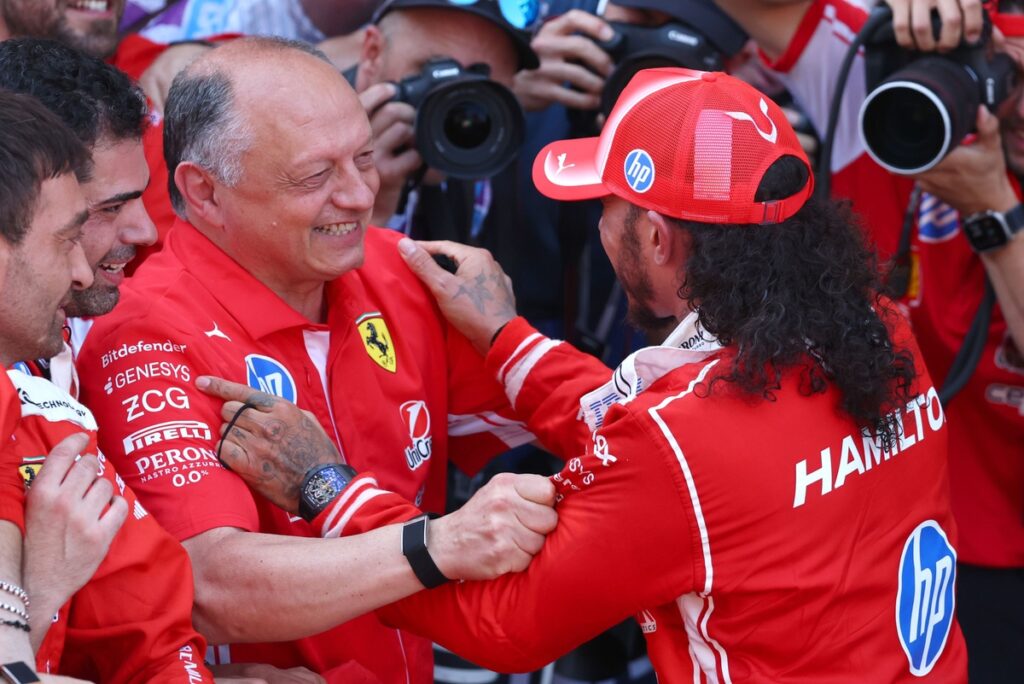
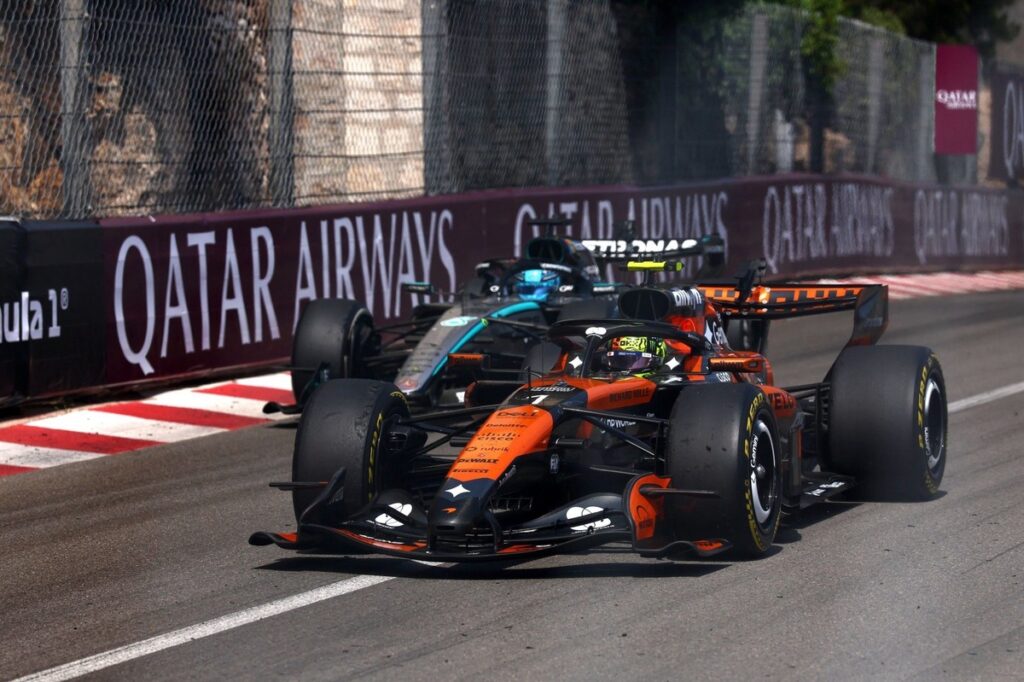
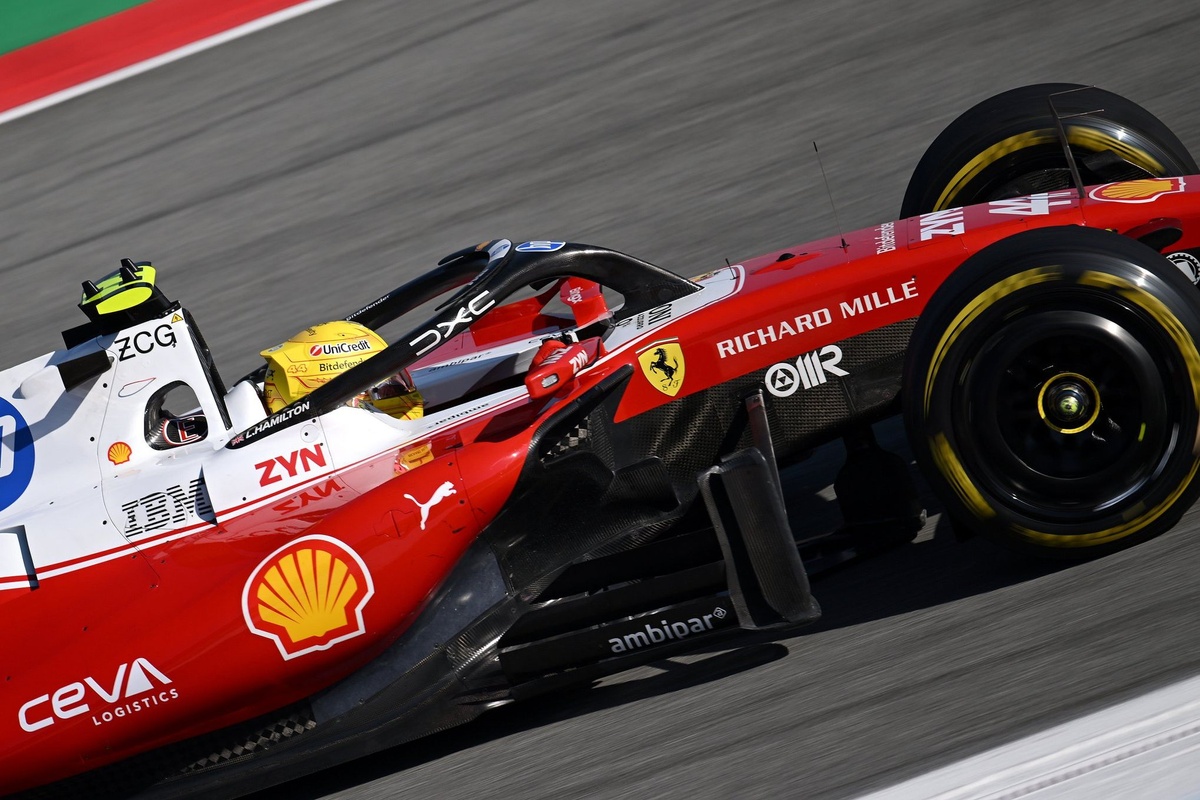
What made the moment visually striking — and what makes it worth preserving in replica form — was the sight of the SF-26 in its Rosso Corsa livery running consistent, controlled laps while others faded. The deep red bodywork against the Barcelona asphalt, carrying Ferrari’s most significant upgrade package of the season, gave the weekend’s photographic record an undeniable weight.
Eight Upgrades and the Science Behind Ferrari’s Tyre Behaviour
Ferrari brought eight distinct upgrades to the SF-26 for Barcelona — the largest single-event development push the Scuderia had made in the 2025 season at that stage. Beyond the raw count, the more telling detail was how the car appeared to interact with its tyres at a circuit where degradation reached extraordinary levels.
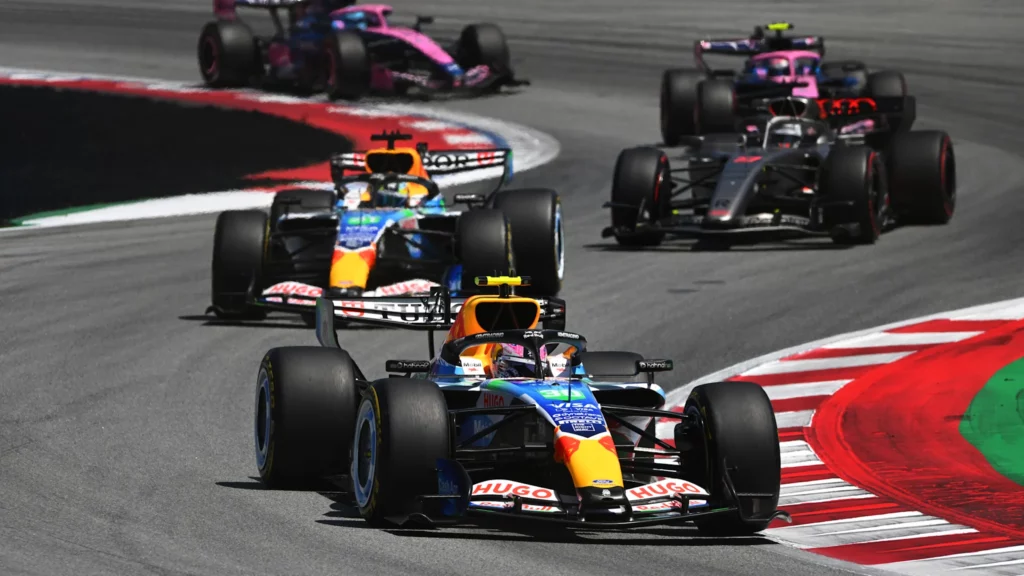
In some cases across the field, drivers lost as much as five seconds of lap-time pace within just ten laps of a stint — and that was on the C3 compound, which serves as the medium tyre this weekend and was expected to be the more durable of the available options. When a tyre rated for durability gives up five seconds in ten laps, it signals that Barcelona’s abrasive asphalt and high-load corners are doing something more aggressive than the standard simulation models predicted.
Ferrari’s SF-26 has historically struggled to bring its tyres up to operating temperature quickly — a characteristic that has cost the team in qualifying trim and in the early phase of stints. At Barcelona, that same characteristic appeared to work in reverse: a car that generates less heat also tends to stress the tyre carcass less over distance, which translates directly into lower degradation rates once the tyre is in its working window.
This is not an accident of circumstance. It is the product of a specific aerodynamic and mechanical philosophy baked into the SF-26’s design. The eight upgrades brought to Spain appear to have sharpened that characteristic without correcting it away — a calculated decision that paid off in the long-run data from FP2.
Why the Upgrade Count Matters for Collectors
For collectors tracking the visual evolution of the SF-26 through its 2025 race season, Barcelona represents a meaningful checkpoint. The bodywork configuration carried at this race — post the eight-upgrade package — differs from the version seen in the opening flyaway rounds. A display replica of the Leclerc or Hamilton helmet from this specific race weekend captures the livery at a moment of genuine competitive turning point, not simply another round on the calendar.
Leclerc vs the Field: Reading the Long-Run Numbers
Leclerc’s 0.16 s/lap advantage over Antonelli in the long-run comparison was the headline figure from FP2, but the full picture across the field tells the richer story. Ferrari sat comfortably at the top of the pace-adjusted long-run rankings at a circuit where that outcome was not predicted by most pre-weekend analysis.
Hamilton’s deficit of 0.83 s/lap to his own teammate underlined how differently the two Ferrari drivers were extracting performance from the same package. In Hamilton’s case, the numbers were closer to the top Mercedes figures than to Leclerc’s — a detail that will inform how the team approaches setup for race day and how it manages its two-car strategy across stints.
Russell’s position at 1.4 seconds per lap behind Leclerc over long-run pace represents a substantial gap at this level of competition. In a race where tyre management determines strategy, a 1.4 s/lap deficit in degradation pace would compound across a 66-lap grand prix in ways that overturn any single-lap qualifying advantage Mercedes might carry.
McLaren’s average of 0.39 s/lap slower than Ferrari in long runs was the figure that most surprised observers. The team showed clearly stronger single-lap pace, as did Mercedes, but a tyre battle over race distance is a different contest entirely. On the long run numbers available from FP2, Ferrari held an advantage that no other team in the field could match.
The Uncertainty That Remained
Despite the clear FP2 data, the teams still had time between Friday and Sunday to analyse and adjust their setups to address degradation. The competitive order heading into the race remained genuinely open — every team arrived with information that could shift their approach, and Red Bull’s long-run picture added further complexity to predicting an outright favourite. The honest reading of the Barcelona weekend was that Ferrari held an advantage, not a certainty.
Podium Visuals: What Made This Race Memorable to Photograph
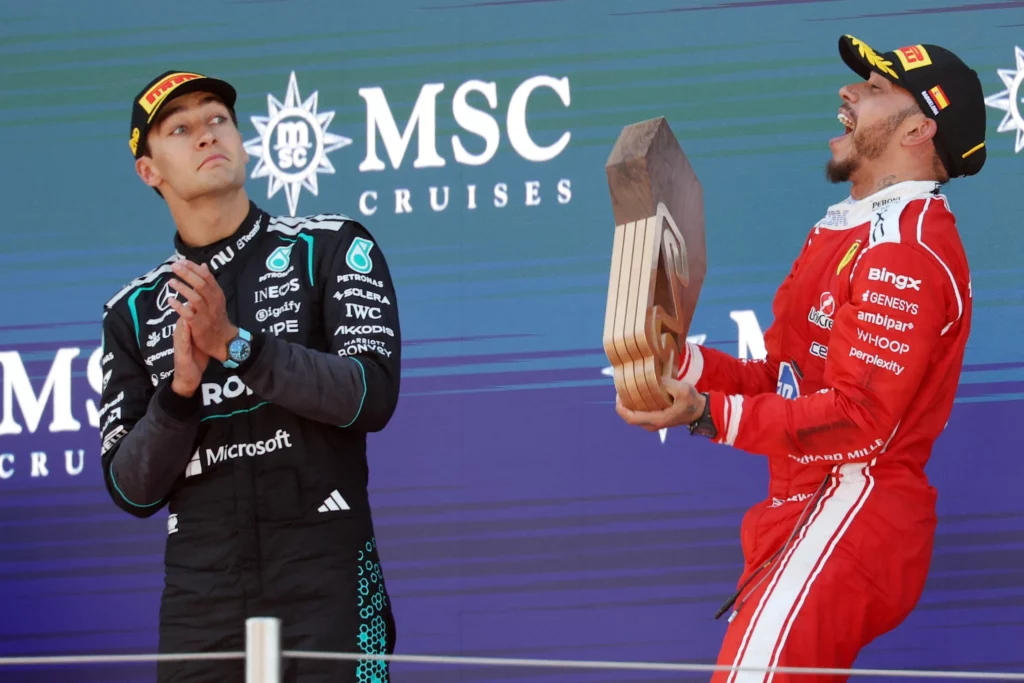
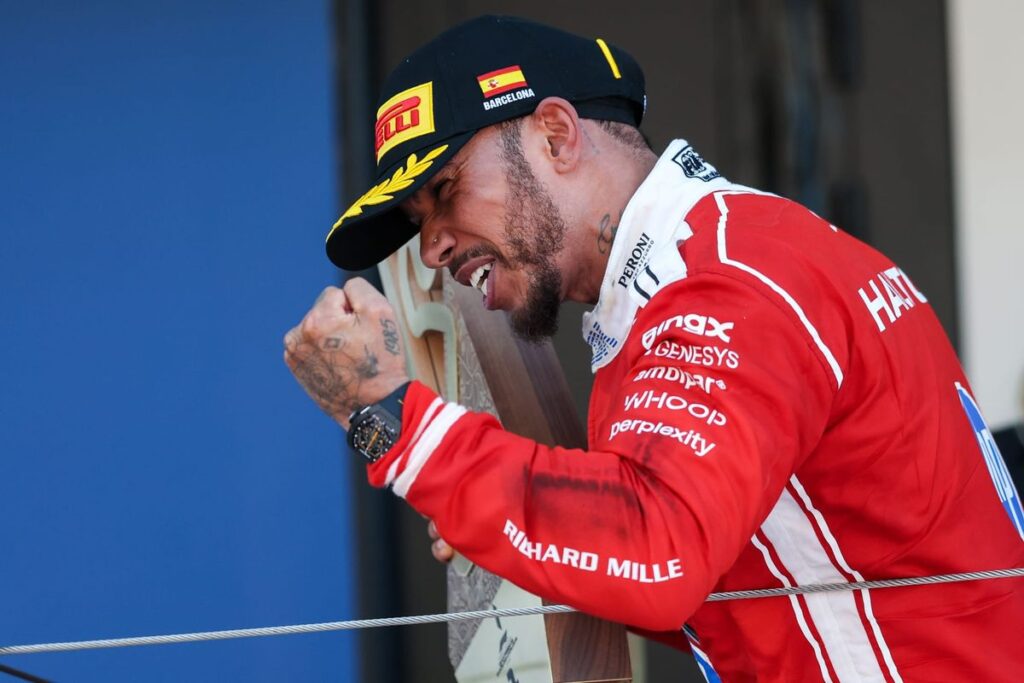
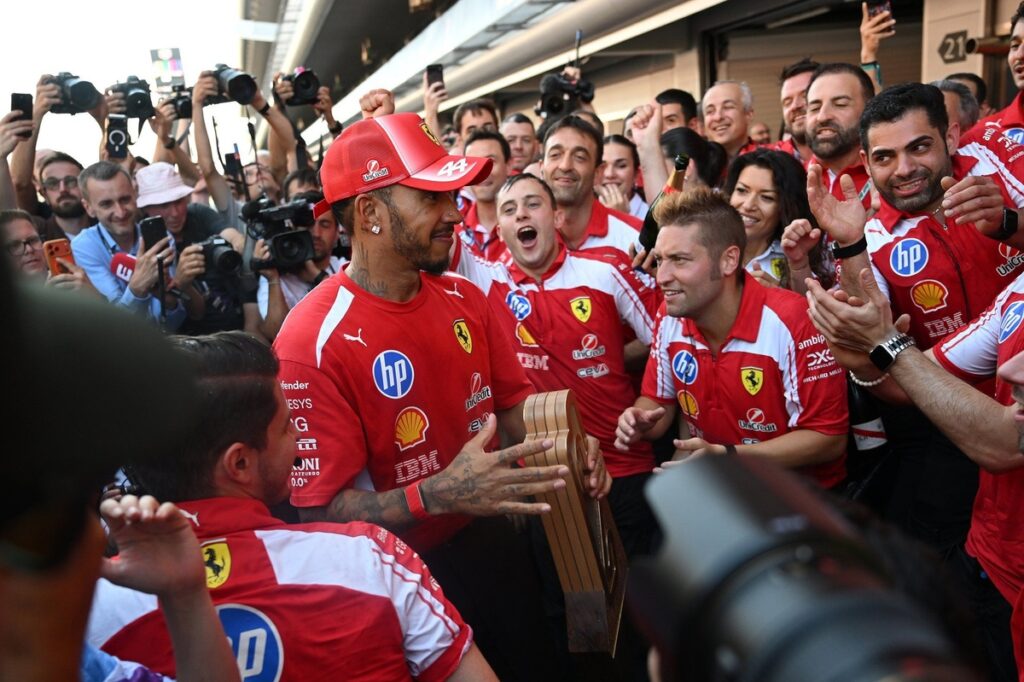
The most display-worthy moments from a Formula 1 race weekend are rarely the fastest laps — they are the frames where livery, helmet design, and competitive circumstance align into a single image worth preserving. Barcelona 2025 produced several of those frames for Ferrari.
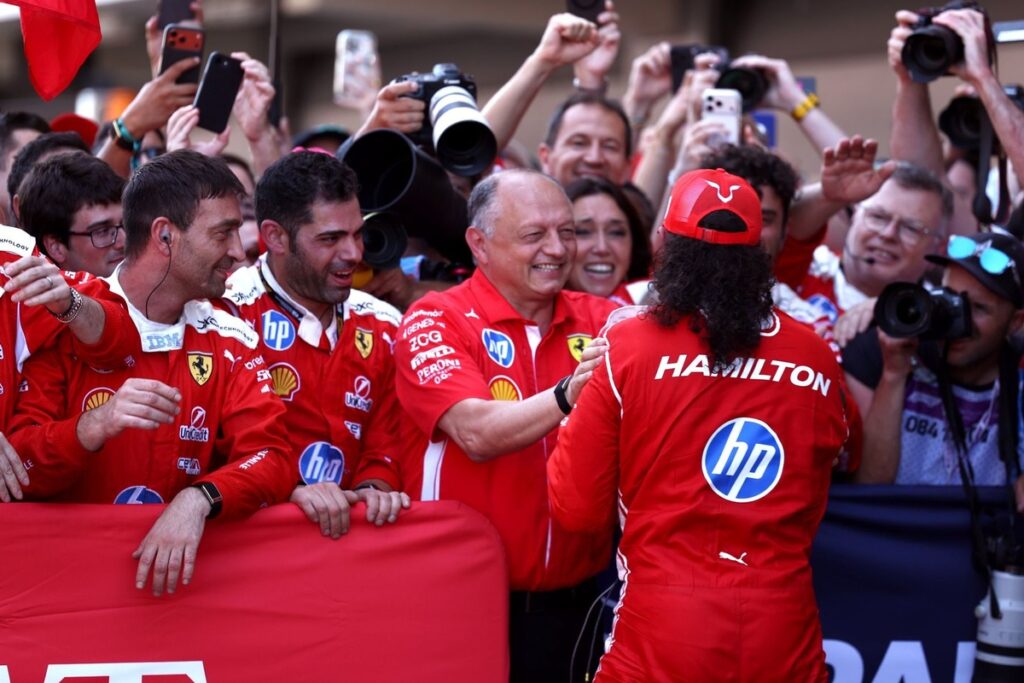
Leclerc’s helmet at this race follows the established SF-26 campaign design: a white-and-red base palette with Scuderia Ferrari branding across the crown, set against the Rosso Corsa bodywork of the car beneath. In parc fermé, that combination against the Barcelona circuit backdrop made for one of the cleaner Ferrari visual presentations of the season — simple, historically grounded, immediately identifiable.
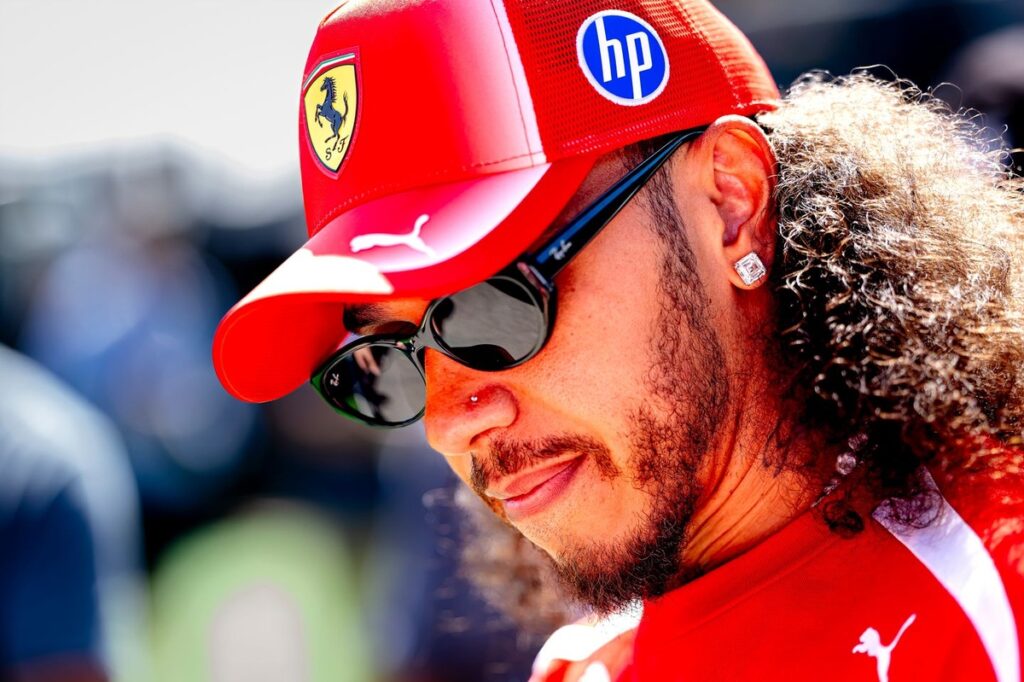
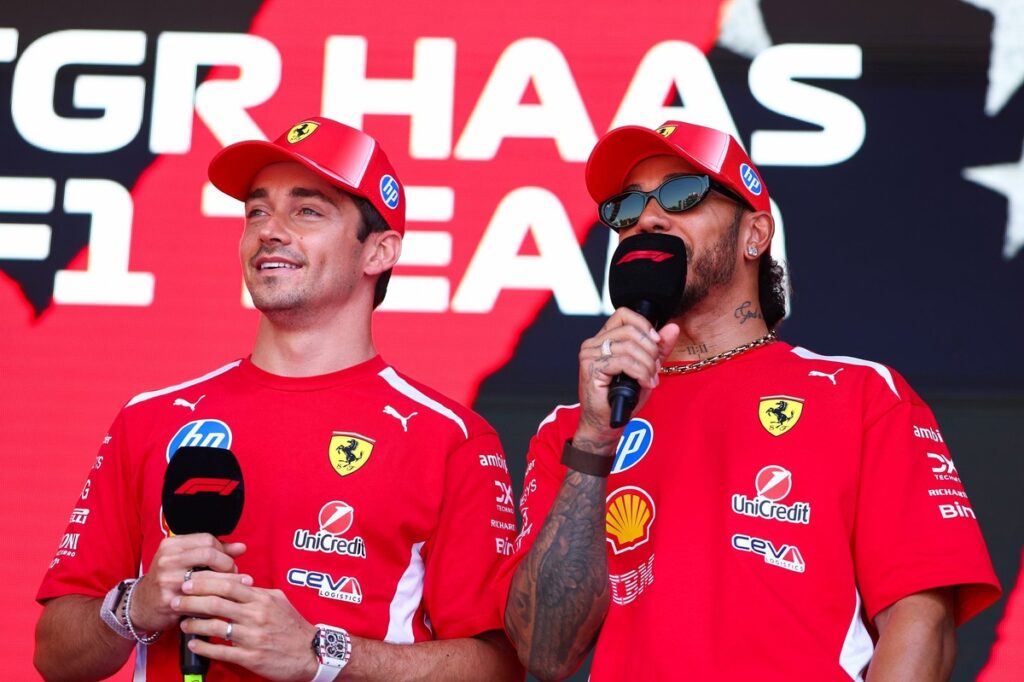
Hamilton’s helmet continued the personal livery language he has brought to Ferrari in 2025, with the contrast between his design philosophy and Leclerc’s creating the kind of two-helmet display pairing that collector shelves are built around. Two drivers, one team, one livery philosophy executed in two distinct personal registers — that is the argument for acquiring both as a matching exhibition set.
Full-size 1:1 replica helmets from race weekends like Barcelona capture more than a driver’s identity. They capture the competitive context: the upgrades, the tyre data, the track that was supposed to hurt Ferrari and instead revealed an unexpected advantage. A display piece from this weekend carries that narrative in physical form.
Scale and Presence on a Display Shelf
A full-size 1:1 collector replica helmet occupies roughly the same visual space as the genuine article — typically in the range of 27 × 35 cm in profile footprint — which means it reads as a proper object rather than a scaled-down souvenir. At that scale, the helmet graphics, visor geometry, and livery colour matching that distinguish a race-specific edition become legible at normal viewing distance. Barcelona 2025, as a competitive turning point for Ferrari, makes this a weekend worth marking with a display-grade collector piece.
Why Barcelona 2025 Belongs in the Ferrari Collector Record
Barcelona 2025 belongs in the Ferrari collector record because it marks the first race weekend in the 2025 season where the SF-26 produced data — not hope, but measured data — showing it could outperform its rivals on tyre longevity at a historically difficult venue. That distinction gives the weekend a specificity that matters when assembling a display collection built around narrative milestones rather than arbitrary round numbers.
The eight-upgrade package was the largest Ferrari had brought to a single race to that point in 2025. Leclerc’s long-run advantage of 0.16 s/lap over Antonelli after compound and stint-length adjustment was backed by a field-wide degradation picture showing losses of up to five seconds in ten laps — context that makes the Ferrari number meaningful rather than circumstantial. McLaren’s 0.39 s/lap long-run deficit to Ferrari at a circuit where McLaren historically excels adds further weight.
These are the race weekends that define a season’s shape. Not necessarily the ones where a driver wins from pole with the fastest car — but the ones where something shifts, where data arrives that changes expectations. Barcelona 2025 was that kind of weekend for Ferrari, and the helmet designs carried into that parc fermé are the physical artefacts of that moment.
For a display collection focused on Ferrari’s 2025 campaign, a Leclerc or Hamilton replica helmet from the Spanish GP round represents the SF-26 at the point where its design philosophy — cooler tyres, lower degradation, a different kind of speed — first showed up clearly in the numbers. That is a specific thing to own. It is not just a Ferrari helmet. It is this Ferrari helmet, from this weekend, when this data appeared.
Disclaimer: All helmets featured on 123Helmets.com are display and collector replicas only. Full-size 1:1 scale. Not certified for protective use.
“In some cases, drivers lost as much as five seconds of pace within just ten laps — even on the supposedly durable C3 compound, which serves as the medium tyre this weekend.”
— Barcelona GP Technical Analysis, 2025
“Charles Leclerc topped the long-run charts for Ferrari at the end of the session. The Scuderia not only brought eight upgrades to the SF-26 in Spain, but also appears to have arrived with a car that traditionally struggles to bring its tyres up to temperature, yet suffers less degradation as a result — a potential trump card in Barcelona.”
— Barcelona GP Technical Analysis, 2025
FAQ
Q: What was Ferrari’s long-run advantage at the 2025 Barcelona Grand Prix?
Charles Leclerc was 0.16 seconds per lap faster than Kimi Antonelli after adjusting for stint length and tyre compound differences during FP2 at the 2025 Spanish Grand Prix. McLaren’s field average was 0.39 s/lap slower than Ferrari over the same long-run comparison.
Q: How many upgrades did Ferrari bring to Barcelona in 2025?
Ferrari brought eight upgrades to the SF-26 for the 2025 Spanish Grand Prix — the largest single-event development package the team had introduced during the 2025 season to that point.
Q: Why did tyre degradation favour Ferrari at Barcelona?
Ferrari’s SF-26 tends to generate less tyre heat than its rivals, which means it stresses the tyre carcass less over long stints. At Barcelona, where degradation across the field reached five seconds of pace loss within ten laps on the C3 medium compound, a car that runs cooler tyres naturally degrades at a slower rate — turning a historical weakness into a race-distance strength.
Q: Are the Ferrari 2025 Barcelona helmets available as display replicas?
Full-size 1:1 collector replica helmets representing Charles Leclerc and Lewis Hamilton’s Spanish GP liveries are available as display pieces. These are exhibition-quality collector items, not certified for any protective or road use.
Q: What makes a race-specific Ferrari helmet replica worth collecting?
A race-specific replica captures the helmet design as it appeared at a defined competitive moment — in this case, the Barcelona round where Ferrari’s eight-upgrade SF-26 produced its strongest long-run data of the 2025 season. That context gives the object a narrative weight that a generic ‘season replica’ does not carry. At full 1:1 scale, typically around 27 × 35 cm in profile, the design and livery details read clearly on a display shelf.
Shop Ferrari Helmets — add a full-size 1:1 display replica from Ferrari’s most revealing Barcelona weekend in years to your collection.
Display and collector replicas only. Not certified for protective use. Full-size 1:1 scale.