
Blog
McLaren’s Customer Engine Problem: Why 2026 Could Change Everything
 123Helmets Editorial Team

McLaren heads into F1 2026 carrying a structural concern that double podiums in Miami cannot paper over. Two retirements in Monaco and Montreal — each traced to a different root cause — have forced team principal Andrea Stella to say publicly what few customer teams will admit: running a Mercedes power unit places McLaren at an integration disadvantage that no amount of upgrades can fully close.
Key Takeaways
McLaren’s retirements in Monaco and Montreal had different root causes — a power unit issue and a gearbox failure — but Stella says both expose the same reliability gap.
Stella was explicit that Mercedes HPP does not deprioritise McLaren; the disadvantage is purely one of integration time, shared facilities and timeline alignment.
McLaren’s Miami double podium showed the car’s pace potential, making the reliability losses in subsequent rounds more costly from a championship perspective.
The 2026 season, with its wholesale regulation reset, is the clearest opportunity for McLaren to close the structural gap that customer engine status creates.
Two Retirements, One Underlying Problem
McLaren has suffered two retirements in consecutive race weekends, and team principal Andrea Stella believes they point to a single structural weakness despite having different mechanical origins. In Canada, Lando Norris retired with a gearbox failure; the decision to start on intermediate tyres had already compromised the team’s strategy before that. In Monaco, the reigning world champion was sidelined by a power unit problem — a harder retirement to absorb given the circuit’s near-zero overtaking statistics and the precision required to score there.
Those two rounds followed a McLaren double podium in Miami, a result that had suggested the car’s first significant upgrade package of 2025 had landed properly. Losing points in both Canada and Monaco after that performance makes the reliability problem not just a technical concern but a championship-points one. Stella has been careful to note that each failure has had a distinct root cause, but his honesty about what that pattern reveals is notable: reliability is not yet where it needs to be.
For a team that finished 2024 as constructors’ champion, two DNFs in three rounds is a regression that demands an explanation beyond individual component failures. Stella’s answer points not inward alone, but at a structural condition the team has lived with for years without previously naming it as a liability.
What Stella Actually Said About Customer Team Status
McLaren’s integration gap with Mercedes HPP is not a priority issue — it is a timeline and access issue, according to Stella’s own words in Monaco. Speaking to Autosport, Stella was direct: “Never before we felt that being a customer team has put us on the back foot.” He was equally direct about what he was not saying — this is not an accusation that Mercedes treats McLaren as a lower-priority recipient of its power units.
Instead, the disadvantage Stella describes is operational. A customer team has fewer opportunities to integrate with the engine supplier, less ability to stay on the same development timeline when reliability problems emerge, reduced access to shared facilities, and limited scope to run chassis-side experiments that depend on power unit cooperation. When you are not the works team, there is a gap between identifying a problem and being able to work on it in the same room, at the same time, with the same engineers.
This is a structurally different complaint from anything McLaren has said publicly before. The team has run Mercedes power units since 2021 and, by Stella’s own account, had never previously felt the customer relationship was costing them performance or reliability. The fact that 2025 is the first season where this disadvantage is being named openly suggests something about the current competitive environment: when you are fighting for a world title, the margins that customer status creates are no longer acceptable.
“[It is] because you have less opportunities to integrate, to stay on the same timeline when it comes to addressing reliability problems or exploitation of the power unit from a performance point of view, combining the efforts when you use the facilities.”
— Andrea Stella, McLaren Team Principal
The Miami Podium That Made the Losses Hurt More
McLaren’s Miami double podium in 2025 set a baseline of pace that makes the subsequent retirements more painful to score on paper. A double podium represents a minimum of 27 combined points — 18 for second and 15 for third — and those are points that the constructors’ championship math does not forget.
The Miami result was also the first meaningful signal that McLaren’s upgrade philosophy for 2025 was working. The team brought its primary development package to that round, and both drivers converted qualifying pace into race pace without the reliability problems that would follow in Canada. That makes Miami the high-water mark of McLaren’s 2025 campaign so far — and a reference point against which every subsequent result is measured.
From a display perspective, Miami 2025 produced some of the season’s clearest papaya livery moments at the sharp end of the grid. The MCL39’s low-line design and McLaren’s signature orange-and-black colour palette photograph cleanly under the Miami circuit’s flat Florida light, making podium images from that weekend particularly strong reference material for anyone tracking the team’s visual identity across the hybrid era.
Helmet and Livery Identity at the Podium: A Collector’s Perspective
McLaren’s 2025 podium appearances carry a specific visual signature that makes them reference points for display replica collectors. The team’s papaya-and-black livery, unchanged at its core since the 2021 rebrand, reads consistently across circuits, cameras and lighting conditions — a stability that few teams on the current grid match.
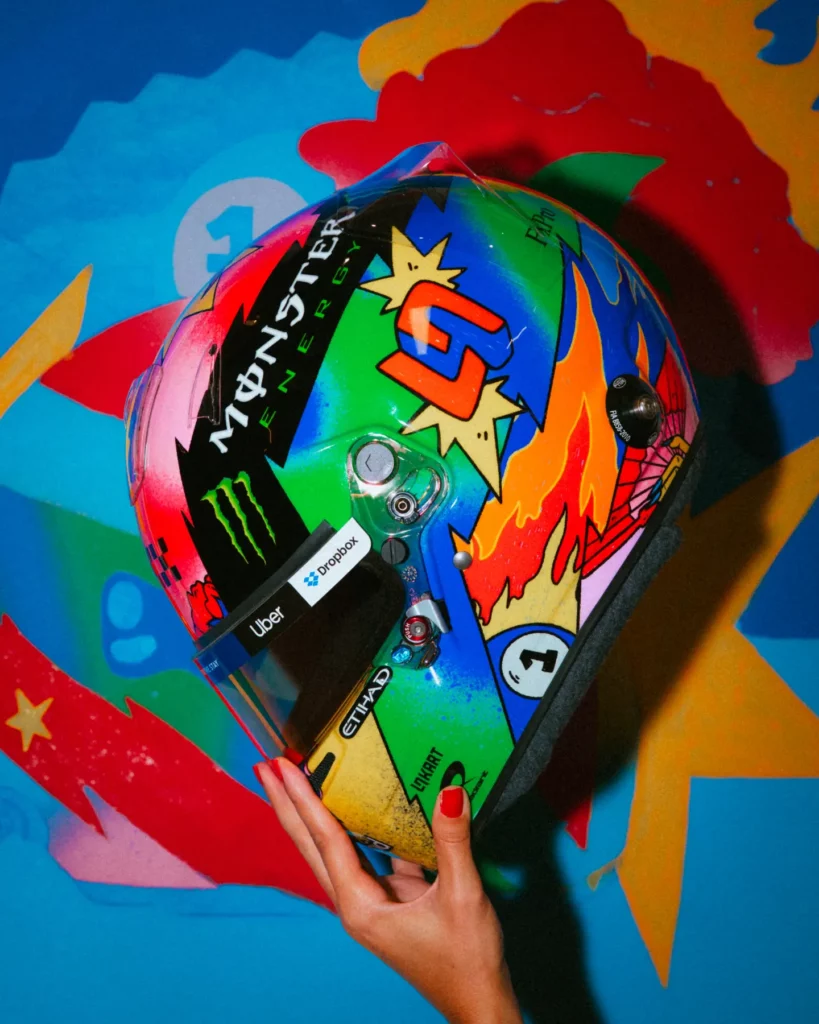
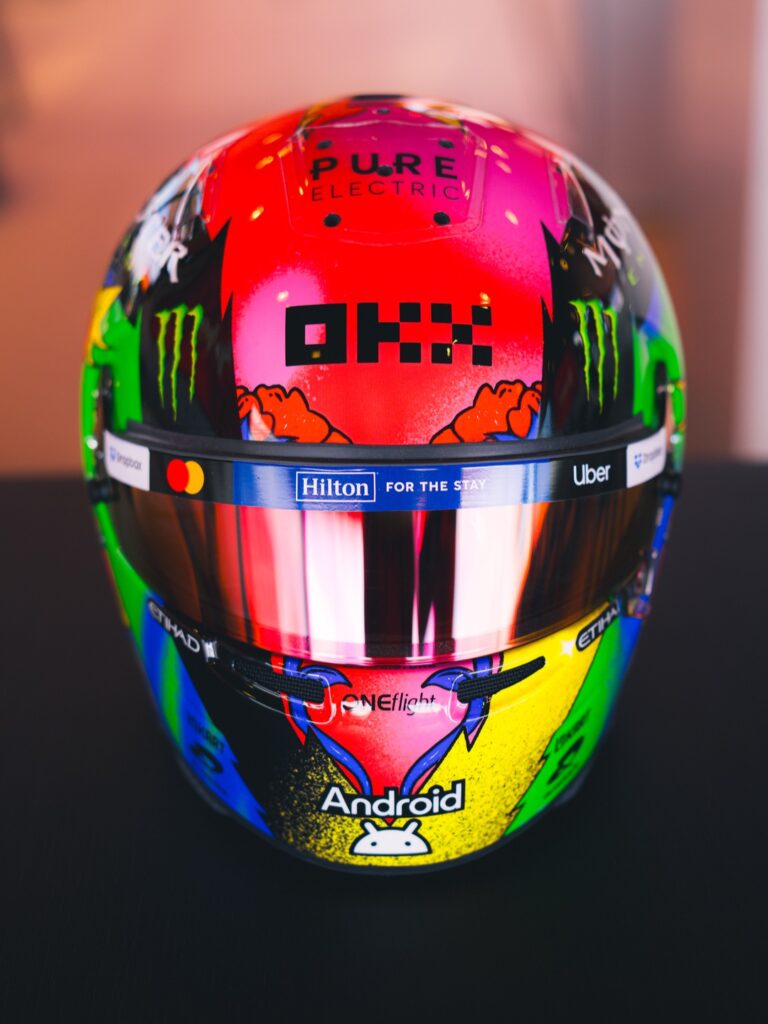
Norris’s helmet design for the 2025 season continues the geometric style he has run since his first full campaign, with a primary palette that complements rather than competes with the MCL39’s bodywork. On a podium, when three drivers from different teams stand together, the McLaren representative consistently produces the clearest brand identity read — papaya helmet, papaya suit, papaya car — which is why Miami 2025’s podium imagery will likely remain a collector reference point for this era of the team.
Full-size 1:1 display replica helmets from McLaren’s 2025 season capture this specific visual identity at a scale that photographs and digital renders cannot replicate. A properly manufactured display piece replicates the helmet shell geometry, visor curvature and graphic registration at 1:1 scale — meaning the proportional relationship between the visor aperture and the crown graphic matches what you see on track, not a compressed or enlarged version of it. For exhibition quality display, that fidelity to the original dimensions is what separates a collector item from a souvenir.
What Makes a McLaren Podium Helmet Display-Worthy in 2025
The strongest display pieces from McLaren’s 2025 season are those tied to specific race moments — Miami’s double podium, or any win that closes the gap on Ferrari and Red Bull in the constructors’ standings. A helmet replica associated with a named race weekend carries a provenance narrative that a generic season design does not. For collectors building a display around McLaren’s championship years, the gap between a Miami 2025 piece and a generic MCL39 replica is the difference between a display item and a display story.
What 2026’s Regulation Reset Means for McLaren’s Engine Problem
The 2026 Formula 1 regulations represent the most significant technical reset since 2014, and for McLaren specifically, they arrive at the moment the team has publicly named customer engine status as a competitive disadvantage. That timing matters. The 2026 power unit regulations introduce a new hybrid architecture with a substantially increased electrical deployment component — changes significant enough that every team, works and customer alike, begins the development cycle from a similar starting point.
McLaren will continue as a Mercedes customer team into 2026, but the integration challenges Stella described in Monaco — timeline alignment, shared facilities, combined reliability work — become more acute, not less, when both parties are simultaneously developing a new power unit concept. The works team will always have first access to its own engineers’ time and its own dynos. That structural condition does not change with a regulation reset; it may intensify during the first 18 months of a new power unit era.
What 2026 does offer McLaren is a reset on the chassis side, where the team’s own engineering is fully under its control. The new aerodynamic regulations — with active aerodynamics and revised downforce philosophy — give McLaren’s Woking operation a clean slate on a part of the car it designs, builds and develops entirely independently. If the chassis proves as competitive as it did in 2024, the engine integration question becomes a smaller fraction of the total performance equation.
From a collector’s standpoint, the 2025 and 2026 seasons sit either side of a clear era boundary. Display helmets from 2025 represent the final year of the hybrid V6 era — a 12-year technical period that ends definitively when the 2026 cars turn their first competitive lap. That makes any podium-associated McLaren helmet from 2025 a period piece in the most literal sense: the last season of a regulation era that began in 2014.
Championship Context: Where McLaren Stands Going Into the European Rounds
McLaren enters the European leg of the 2025 calendar having banked a Miami double podium but surrendered points at both Monaco and Montreal through reliability failures. The constructors’ championship arithmetic after those rounds is less favourable than the team’s raw pace would suggest it should be.
Ferrari’s win in Barcelona — Hamilton’s first for the team — adds pressure from a different direction. Ferrari is now demonstrating that it can win races in Europe, on circuits where tyre management and power unit deployment interact differently than in Miami’s high-speed corners. Barcelona’s Circuit de Catalunya, at 4.657 km in its current configuration, tests power unit reliability across a full race distance of 66 laps — precisely the kind of sustained running where McLaren’s integration gap with Mercedes HPP becomes most visible.
The remaining European rounds through July give McLaren the opportunity to recover points on circuits the MCL39’s characteristics suit well. But Stella’s public admission in Monaco signals that the team is not waiting for the season to resolve itself. Naming the customer engine disadvantage as a real factor — clearly, without blame toward Mercedes HPP — is the first step in building a case for whatever structural change addresses it. Whether that means deeper integration agreements with Mercedes for 2026 or longer-term engine supply discussions, the Monaco press conference marks the moment McLaren stopped treating this as an internal matter.
“Never before we felt that being a customer team has put us on the back foot. And when I say this, and I want to be clear here, to avoid any misunderstanding: it’s not because you are a lower priority for [Mercedes] HPP.”
— Andrea Stella, McLaren Team Principal, Monaco 2025
“[It is] because you have less opportunities to integrate, to stay on the same timeline when it comes to addressing reliability problems or exploitation of the power unit from a performance point of view, combining the efforts when you use the facilities.”
— Andrea Stella, McLaren Team Principal, Monaco 2025
FAQ
Q: Why does McLaren say customer team status is a disadvantage in 2025?
McLaren team principal Andrea Stella said the disadvantage is one of integration access, not engine supply priority. A customer team has fewer opportunities to work alongside the engine manufacturer on shared timelines for reliability fixes and performance development, and less access to combined facility time — limitations a works team does not face.
Q: What reliability problems has McLaren had in 2025?
McLaren suffered two retirements in consecutive rounds: a gearbox failure for Lando Norris in Canada and a power unit failure for the reigning world champion in Monaco. Stella confirmed each had a different root cause but said both point to a reliability level that is not yet where the team needs it to be.
Q: Will McLaren change its engine supply for 2026?
McLaren is confirmed as a Mercedes customer team for 2026. Stella’s public comments in Monaco did not announce a change to that arrangement; they named the structural limitation the team now wants to address through deeper integration, not by ending the customer relationship.
Q: What makes a McLaren 2025 helmet replica a display-worthy collector item?
A full-size 1:1 replica at exhibition quality replicates the original helmet shell geometry, visor curvature and graphic placement at true scale — the proportional relationship between visor aperture and crown graphic matches the race-used original. Replicas associated with specific podium weekends, such as Miami 2025, carry a race-moment narrative that adds collector context beyond the visual design.
Q: How significant is the 2026 regulation reset for McLaren’s chassis competitiveness?
The 2026 regulations introduce a new aerodynamic philosophy including active aerodynamics and a revised downforce structure, giving McLaren’s Woking chassis operation a clean development slate on the parts of the car it controls entirely. If the chassis proves as competitive as the 2024 title-winning MCL38, the power unit integration gap becomes a smaller share of the total performance picture.
Shop McLaren Helmets — add a full-size 1:1 display replica from the papaya era to your collection. Each piece is an exhibition-quality collector item, not certified for protective use.
Display and collector replicas only. Not certified for protective use. Full-size 1:1 scale.
This article was written with the help of AI tools. Editorial policy