Blog
Hamilton’s First Ferrari Win: Everything That Made Barcelona 2026 Possible
 123Helmets Editorial Team
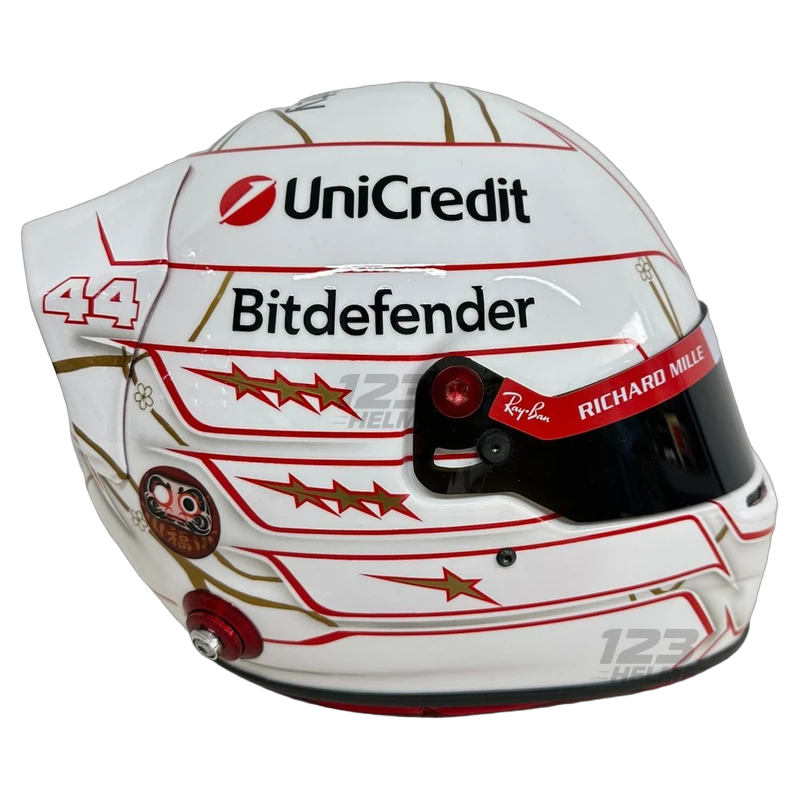
Lewis Hamilton crossed the line in Barcelona in 2026 to take his first Formula 1 victory for Ferrari — ending an 18-month wait that, at its lowest point, had him questioning whether he had lost the ability to win at all. This is how it happened, what it means, and why the visuals of that red helmet on the top step belong in any serious F1 collection.
Key Takeaways
Hamilton’s first Ferrari win came at Barcelona in 2026, ending a victory drought stretching back to July 2024 — a gap of roughly 18 months.
F1’s 2026 regulation overhaul changed car behaviour at corner entry in ways that directly matched Hamilton’s driving style, turning a hypothesis into a race result.
The 2025 season produced zero grand prix podiums for Hamilton — the first podium-less campaign of his entire F1 career — making the Barcelona 2026 win a genuine reversal.
The Ferrari livery on Hamilton’s full-size 1:1 replica helmet from the Barcelona weekend represents one of the most display-worthy collector moments in recent F1 history.
Eighteen Months That Almost Broke the Dream
Hamilton’s first Ferrari win arrived at Barcelona in 2026, closing an 18-month gap since his last Formula 1 victory in July 2024. The weight of that gap is not a simple number — it accumulated through a 2025 season that, by Hamilton’s own admission, made him wonder “maybe it is true that when you get to a certain point, you lose it.” That sentence, spoken by a seven-time world champion, tells the full story of how difficult that year was.
The 2025 campaign was the first season in Hamilton’s career in which he failed to score a single grand prix podium. A sprint race pole and win in China offered early promise, but that turned out to be a false start rather than a foundation. After that Chinese weekend, the Ferrari project never looked like it was on a trajectory toward victory, and the questions around Hamilton’s place in the sport grew louder with every race that passed.
“I’m only human,” Hamilton said when reflecting on that period. “There’s moments where I see the stuff and for sure there’s moments where I allowed it to get to me and penetrate deeply.” For a driver accustomed to operating from a position of near-total dominance, the psychological load of 2025 was real. Understanding that context is the only way to understand the magnitude of what Barcelona 2026 actually meant.
How the 2026 Rules Changed Everything
The 2026 F1 regulation overhaul is the single largest factor behind Hamilton’s Ferrari win, because it changed the physical behaviour of the cars in ways that suited him directly. The new-era cars move around differently and handle braking loads at corner entry in a manner that matches how Hamilton wants to attack a lap. That is not coincidence — it is a structural alignment between driver and machine that the ground-effect era had denied him.
Hamilton had acknowledged before the season that the prospect of new rules freeing him from limitations specific to the previous era was a hypothesis rooted in hope rather than expectation. What Barcelona proved is that the hypothesis was correct. The cars allow him to perform more consistently at his best, and the specifics of the Barcelona weekend confirmed that the improvement was not a one-off circuit match but something deeper in how the 2026 machinery behaves.
F1 regulation changes of this scale happen rarely. When they do, they redistribute performance across drivers as well as teams. The 2026 rules did not simply give Ferrari a faster car — they gave Hamilton a car he could actually drive the way he has always driven. That distinction matters enormously when judging the result.
What Changed Inside Ferrari Between 2025 and 2026
Internal changes at Ferrari were a second pillar of Hamilton’s first win, sitting alongside the regulation reset as a reason the outcome at Barcelona was possible. The team’s direction shifted across the 18-month period in ways that made the car a better tool for Hamilton specifically, not simply a faster one in general terms.
The combination of those internal adjustments and the behaviour of the 2026 chassis gave Hamilton something he did not have through most of 2025: a car he trusted at corner entry. Braking confidence, the point at which a driver commits to a corner knowing the front end will respond, is not a minor preference. It is the foundation of a lap time and the difference between a driver at his limit and one managing uncertainty.
World champion Lando Norris noted after the Barcelona race that Hamilton had taken “a lot of crap” and that “it’s nice he can stick the middle finger up to all of them.” That observation from a rival driver carries weight. It confirms that the scrutiny Hamilton faced was widely recognised inside the paddock, and that the Barcelona result was understood by everyone present as a statement answer to it.
The Barcelona Weekend: Race Visuals Worth Collecting
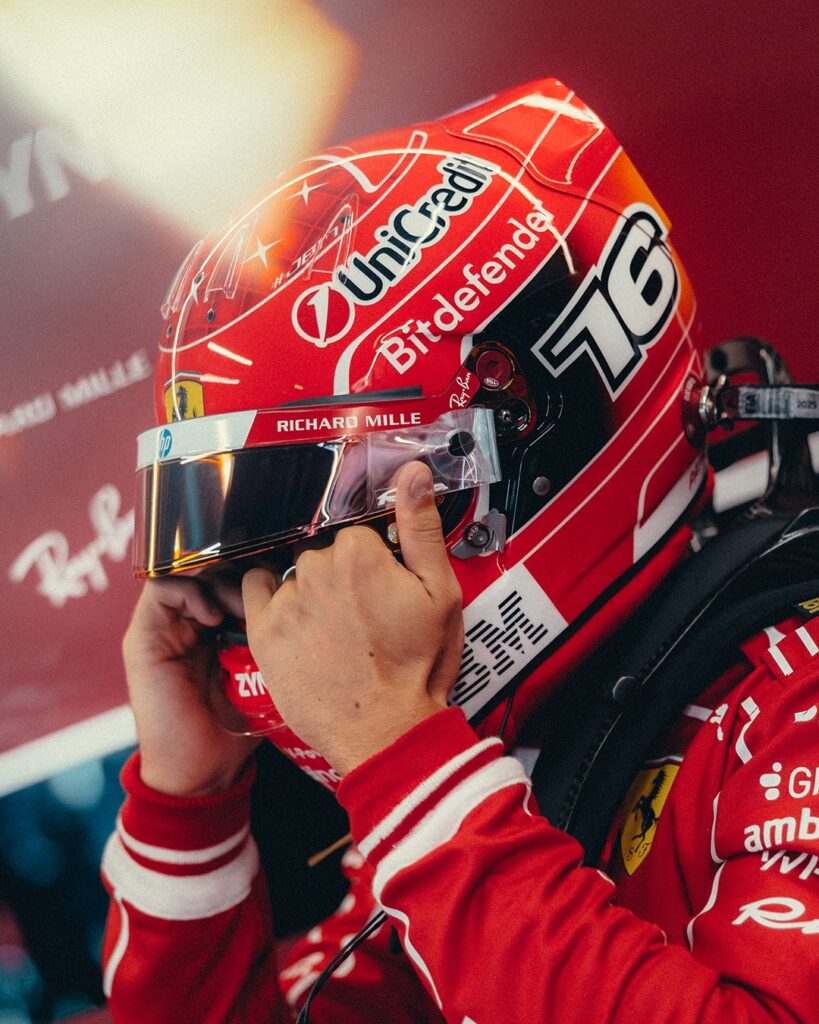
The Barcelona 2026 podium produced some of the most visually striking images in recent F1 history — a red Ferrari helmet on the top step, worn by the driver the sport spent 18 months writing off. For collectors and display enthusiasts, moments like this define why full-size 1:1 replica helmets exist as a category.
A display-quality replica of Hamilton’s Ferrari helmet from the Barcelona 2026 weekend captures the exact livery configuration worn at the race — the Scuderia red, the Ferrari shield, and the helmet graphic identity Hamilton developed for his debut season with the team. At full 1:1 scale, the replica matches the proportions of the race-used item exactly, making it suitable for podium-style display stands or dedicated collector shelving.
The collector value of a helmet tied to a driver’s first win with a new team is historically significant. When the driver in question is Hamilton, the team is Ferrari, and the win ends an 18-month drought that included the worst season of his career, the display context becomes one of the strongest in modern F1. These are the race weekends that define eras, and the helmet worn during them is the most direct physical connection a collector can hold.
Display Specifications
Full-size 1:1 replica helmets in this category are exhibition quality collector pieces. They are display items only — not certified for any protective use, not intended for road or track wear, and not rated to any safety standard. They exist to document and display a moment in racing history at the correct scale and with the correct livery detail.
What the Win Means in the Wider Hamilton Story
Hamilton’s Barcelona 2026 victory is the first Ferrari win of his career, placing it in the same category of firsts as his maiden grand prix win at Montreal in 2007 — landmark results that mark permanent entries in the record books. No previous result with Ferrari existed before this one. That fact alone gives the win a weight that a race in a long sequence of victories would never carry.
The recovery arc from a podium-free 2025 to a race win in 2026 is not simply a feel-good narrative. It reflects a real set of changes — in the regulations, in the car, and in the internal direction of one of F1’s most historic teams — that had to align correctly before the result was possible. Hamilton’s own admission that winning for Ferrari seemed “impossible” during 2025 makes the word he used meaningful: impossible, not unlikely.
The 18-month gap between wins, the first podium-less season of a career that began in 2007, and a championship pairing with one of the sport’s most dominant current drivers in Norris — these are the conditions against which the Barcelona win must be measured. Measured that way, it stands as one of the more significant individual results Hamilton has produced in the second half of his career.
For anyone tracking F1 helmet history, 2026 at Barcelona is the date that marks Hamilton’s Ferrari era turning from a difficult beginning into something entirely different. The helmet he wore to cross that finish line is the physical record of that turning point.
Why This Helmet Belongs in a Serious F1 Display
A full-size 1:1 Hamilton Ferrari replica helmet from the 2026 season represents the intersection of two of F1’s most storied identities — the sport’s most decorated driver and its most iconic team — at the exact moment their collaboration produced its first win. That is the definition of a display-worthy collector item.
The visual language of Ferrari red combined with Hamilton’s personal helmet design creates a livery configuration that had never existed before 2025. By the time Barcelona 2026 confirmed the union could win, that livery had acquired a specific historical meaning that no earlier version of it carried. A collector acquiring a replica from this era is acquiring the document of a transformation, not simply a replica of a popular driver’s headwear.
Exhibition-quality 1:1 display replicas allow collectors to represent this moment at the correct scale — the same dimensions as the helmet worn on track — without requiring access to the race-used item itself. The result is a display piece that holds its context permanently: driver, team, season, and the result that gave all three their meaning in combination.
This is a collector piece only. Not certified for any safety standard. Not suitable for use on road or track. Designed and produced exclusively as a full-size 1:1 display and exhibition replica.
“Maybe it is true that when you get to a certain point, you lose it.”
— Lewis Hamilton, reflecting on his 2025 season with Ferrari
“He’s taken a lot of crap and it’s nice he can stick the middle finger up to all of them.”
— Lando Norris, after the Barcelona 2026 Grand Prix
“I’m only human. There’s moments where I see the stuff and for sure there’s moments where I allowed it to get to me and penetrate deeply.”
— Lewis Hamilton, on the scrutiny he faced during 2025
FAQ
Q: When did Lewis Hamilton win his first race for Ferrari?
Hamilton won his first Formula 1 race for Ferrari at Barcelona in 2026. The win ended a drought that stretched back to July 2024 — a gap of approximately 18 months between victories.
Q: Why did Hamilton struggle so much in his first Ferrari season?
The 2025 season produced no grand prix podiums for Hamilton — the first podium-free campaign of his entire F1 career. The car’s behaviour at corner entry did not match his driving style under the ground-effect regulations, and he admitted the dream of winning for Ferrari seemed impossible during that period.
Q: How did the 2026 F1 rules help Hamilton win?
The 2026 regulation overhaul changed how cars behave at corner entry and under braking, creating a closer match with how Hamilton attacks corners. Hamilton himself had framed this as a hypothesis before the season; the Barcelona result confirmed it was correct.
Q: What makes a Hamilton Ferrari Barcelona 2026 helmet replica worth displaying?
The Barcelona 2026 helmet marks Hamilton’s first ever Ferrari win, making it a historically unique livery configuration. Full-size 1:1 collector replicas reproduce the exact Scuderia red and Hamilton design identity at race-correct scale, giving the display piece permanent historical context as a collector item — not a safety product.
Q: Are these Hamilton Ferrari helmet replicas safe to wear or use on track?
No. These are display and collector replicas only, produced exclusively at full 1:1 scale for exhibition and collection purposes. They carry no safety certification — no FIA, Snell, ECE, or DOT rating — and are not intended for any protective, road, or track use.
Shop Lewis Hamilton Collection — own a full-size 1:1 display replica of the helmet worn during Hamilton’s Ferrari era, including the Barcelona 2026 season. Exhibition quality. Collector piece only. Not for protective use.
Display and collector replicas only. Not certified for protective use. Full-size 1:1 scale.
This article was written with the help of AI tools. Editorial policy