Blog
Hamilton’s ‘Huge’ Warning for 2026 British GP
 123Helmets Editorial Team

Lewis Hamilton has issued a stark warning about power deployment limits at Silverstone, saying the 2026 British Grand Prix will feel like ‘a completely different track’ through its most iconic corners.
Key Takeaways
Hamilton called the 2026 power deployment impact at Silverstone ‘huge’, warning of engine coasting through Copse and forced downshifts at full throttle.
Maggots and Becketts — widely considered the best section of any F1 circuit — will require lift-and-coast phases, fundamentally changing the feel of those corners.
Teams face a long straight between turns 9 and 10 with virtually zero deployment, forcing entirely new energy management strategies.
Hamilton is the most successful driver in British GP history and is already hoping the power unit situation can be fixed for 2027.
Hamilton’s Silverstone Warning in His Own Words
Lewis Hamilton has called the energy deployment challenge at the 2026 British Grand Prix ‘huge’, telling media including Motorsport Week that power unit coasting will fundamentally alter Silverstone’s fastest and most celebrated corners. That is not hyperbole for the cameras — Hamilton laid out a precise, technical picture of what drivers should expect across the circuit’s high-speed layout when the 2026 season’s strict energy recovery rules bite hardest.
Speaking ahead of the opening practice sessions on the Silverstone weekend, the seven-time World Champion described a scenario in which the engine begins to coast on the approach to Copse, a corner that has defined F1 bravery for generations. Instead of arriving flat-out, he expects to be ‘downshifting from 7th to 8th whilst full throttle, trying to keep the engine revs higher’ — a workaround that illustrates just how different the power delivery picture looks in 2026 compared to any prior regulation set.
‘Honestly, I think it’s going to be huge,’ Hamilton said. ‘It’s going to be — if you look at the speed tracers, we started losing deployment going into Copse, then we ended up screaming as you go into Copse and you’re holding on for dear life as you go through there, but this year the engine will be coasting down.’
That single quote encapsulates the scale of the shift. The Copse that fans have watched drivers attack at speeds exceeding 290 km/h in recent seasons will, under 2026 energy rules, be approached in a controlled, partially unpowered state. For those who follow the sport closely — and for collectors who document its technical eras — this marks a genuine inflection point in Silverstone’s modern history.
Maggots, Becketts and the Cost of Coasting
Maggots and Becketts is the section of Silverstone that Hamilton himself has called the best part of the track, and it is precisely there that the 2026 deployment limits will cut deepest. Hamilton warned that drivers will need to ‘lift and coast or something through there for a period of time’, removing the sustained flat-out commitment that makes the sequence one of the most spectacular in motor racing.
The Maggots-Becketts complex — a fast, multi-apex left-right-left-right set of sweepers taken in excess of 200 km/h in qualifying trim — has historically been where lap times are shaped and where the best drivers separate themselves from the field. Under 2026 rules, that calculus changes. Energy recovery constraints mean the power unit cannot sustain full electrical deployment through a sustained high-load, high-speed arc, and the result is a mid-corner coasting phase that disrupts the balance and rhythm that define those corners.
‘Maggots and Becketts, it’s not going to feel the same,’ Hamilton said plainly. ‘I think you have to lift and coast or something through there for a period of time, so it’s just a completely different track.’
For a driver who has won the British Grand Prix more times than anyone else in the event’s history, that assessment carries real weight. Hamilton is not a driver prone to dramatic complaints about circuit character. When he describes his home race as feeling like a different track, teams and fans should take note of the technical reality behind the words.
The Long Straight with No Deployment
Between turns 9 and 10 at Silverstone, Hamilton expects virtually zero electrical deployment — a long straight covered with the power unit essentially in harvest-only mode, unable to deliver the full-throttle electrical boost that modern F1 cars rely on for top speed. This is one of the clearest numerical consequences of the 2026 energy management rules at a power-sensitive circuit.
Hamilton described it as ‘a long, long straight from 9th to 10th with no deployment basically.’ The practical effect is that cars will reach turn 10 — the Vale complex — with less speed than in prior seasons, changing the braking reference points, the overtaking window, and the risk-reward calculation for drivers trying to gain positions under braking.
Teams arriving at Silverstone’s paddock on the opening practice day face a compressed timeline. With drivers getting their first taste of these deployment challenges across Friday’s sessions, engineers have roughly 24 hours before qualifying to optimise energy recovery strategies. That means mapping harvest zones, coasting windows, and deployment triggers across a 5.891 km lap — a circuit that, in any prior season, demanded flat-out commitment for the majority of its length.
The irony is not lost on those who follow the sport: Silverstone was designed and evolved to reward full-throttle bravery. The 2026 technical framework, for all its efficiency gains, asks something different of both driver and machine on British soil.
Hamilton’s Home Race Record and Why This Moment Matters
Lewis Hamilton is the most successful driver in British Grand Prix history, a record built across a career that spans more than 300 Formula 1 starts and 7 World Championships. Silverstone is where his fanbase is largest and loudest, and where his results have repeatedly defined the narrative of entire seasons.
In 2026, Hamilton races in red — now with Ferrari after his headline-making move from Mercedes. The 2026 British Grand Prix is therefore not simply another round of his home event; it is one of the first times the British public will see him carry the Prancing Horse at Silverstone, under a regulation set that he himself describes as transformative for the circuit’s character.
Hamilton acknowledged that the situation will not be uniformly negative. ‘We’ll enjoy it through certain elements of the track where you’re not power limited,’ he said — a realistic concession that the 2026 cars will still produce spectacle where the energy rules allow it. But his hope that the power unit situation ‘can be rectified for next year’ makes clear this is seen as a temporary compromise rather than a permanent feature of the modern Silverstone experience.
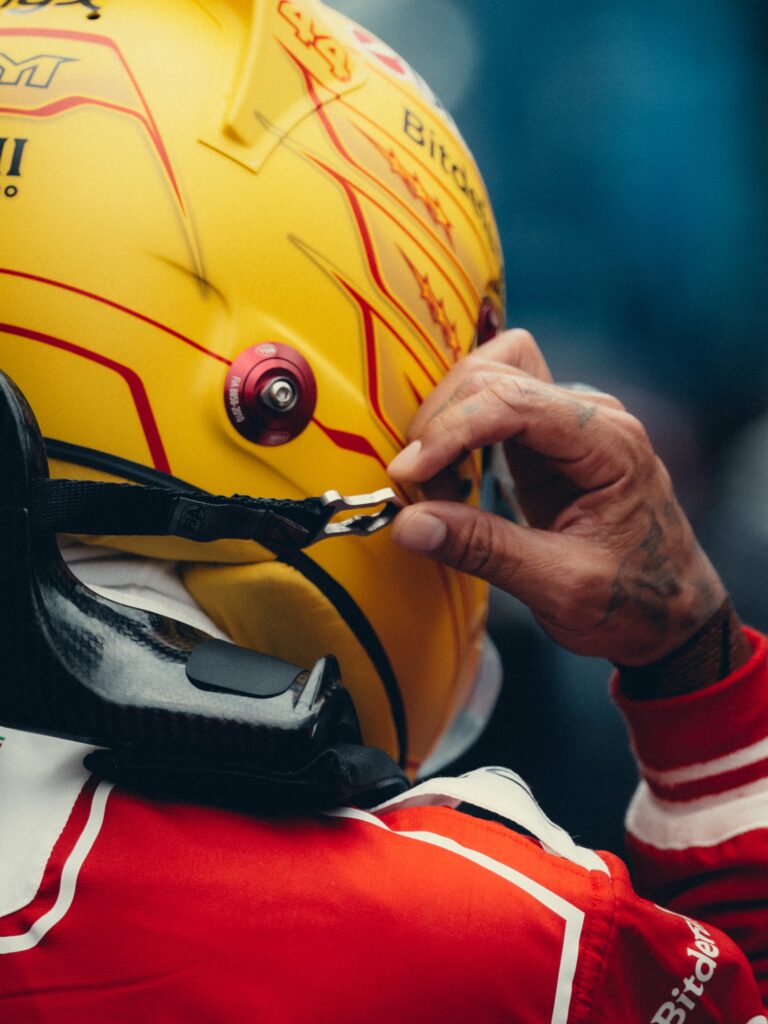
For collectors of F1 history, that tension between a legendary circuit and a rule set that constrains it is precisely what makes 2026 worth documenting. The helmet Hamilton wears at the 2026 British GP represents a specific, unrepeatable convergence: a record-holding home hero, a new team, and a technical era that he has already warned will change the race fundamentally.
Collecting the 2026 Silverstone Era as a Display Piece
A full-size 1:1 collector replica of Lewis Hamilton’s 2026 Ferrari helmet is a display piece that captures the exact technical and narrative context described above — not a piece of safety equipment, but an exhibition-quality item that freezes a specific chapter of F1 history. At 123Helmets.com, every Hamilton replica is produced at true 1:1 scale, matching the dimensions of the race item worn in the 2026 season.
Display replicas of this type typically measure 29 × 25 × 35 cm in their base dimensions and weigh approximately 1.2–1.5 kg, making them suitable for desk, shelf, or dedicated display stand presentation. The visor on a full-size replica is produced at the correct 3 mm curved thickness to mirror the visual proportion of the genuine article, and the paint layers replicate the livery Hamilton debuted in the 2026 season — the Ferrari red with his personal helmet design language integrated into the team colour scheme.
The 2026 British GP represents one of the most historically layered weekends in recent memory: Hamilton’s home race, his first Silverstone in Ferrari colours, and a regulation change he has publicly flagged as transformative. Collector replicas tied to specific seasons and specific circuits hold their narrative value precisely because the context is so defined. A replica marked to the 2026 Silverstone round sits at the intersection of a seven-time champion’s home heritage and a technical watershed that he himself has described as making ‘a completely different track.’
These are display items only — not certified for protective use, not FIA-rated, not intended for road or track. They are exhibition-quality collector pieces produced to full 1:1 scale for fans who want to own a permanent, tangible record of one of F1’s most storied drivers at one of its most storied venues.
What to Watch For When Practice Begins
Friday practice at Silverstone will give the first real data on how the 2026 energy deployment limits play out lap by lap, and Hamilton’s pre-weekend warning gives viewers a specific framework for what to watch. The speed tracers he referenced — the telemetry graphs that show velocity across the lap — will tell the story clearly: look for the velocity dip on the approach to Copse, the sustained low-deployment arc through Maggots and Becketts, and the flat but boost-free run between turns 9 and 10.
Teams will use both Friday sessions to calibrate their harvest maps, trading raw lap time for the energy state they need to execute a full qualifying lap on Saturday. The driver who finds the best balance between deploying enough electrical power to attack the corners Hamilton loves and conserving enough to complete the lap without a deficit will likely dictate the front-row conversation.
Hamilton himself struck a tone of cautious optimism despite his ‘huge’ warning. ‘We’ll see tomorrow — no doubt we’ll still get to it,’ he said. That suggests he expects adaptation, even if the character of the circuit changes. But his explicit hope that the situation can be fixed for 2027 frames this entire weekend as a transitional moment — one that makes the 2026 British GP a landmark edition regardless of its result.
For fans following from home and collectors marking the season, the 2026 Silverstone round already has its defining narrative: the most successful British GP driver in history, racing on his home circuit in new colours, under a rule set he has warned will make it feel like somewhere else entirely. That story starts in practice on Friday, 2026-07-04, and the opening sector times will confirm — or complicate — everything Hamilton has predicted.
“Honestly, I think it’s going to be huge. It’s going to be — if you look at the speed tracers, we started losing deployment going into Copse, and this year the engine will be coasting down. Maggots and Becketts, it’s not going to feel the same. It’s just a completely different track.”
— Lewis Hamilton, media session ahead of the 2026 British Grand Prix
“I hope it’s something that can be rectified for next year.”
— Lewis Hamilton, on 2026 power deployment limits at Silverstone
FAQ
Q: What did Lewis Hamilton warn about the 2026 British Grand Prix?
Hamilton warned that power unit energy deployment limits will make Silverstone feel like ‘a completely different track’ in 2026, with coasting phases through Copse, Maggots and Becketts, and virtually no deployment on the straight between turns 9 and 10.
Q: Why will Maggots and Becketts feel different at the 2026 British GP?
Hamilton said drivers will need to lift and coast through Maggots and Becketts for at least part of the sequence because the power unit cannot sustain full electrical deployment through the prolonged high-speed arc, removing the flat-out commitment that defines those corners.
Q: Is Lewis Hamilton the most successful driver at the British Grand Prix?
Yes. Hamilton is the most successful driver in British Grand Prix history, a record built across his career spanning more than 300 Formula 1 starts and 7 World Championships.
Q: What does a 1:1 Lewis Hamilton display replica helmet look like?
A full-size 1:1 collector replica matches the exact proportions of Hamilton’s race helmet — typically 29 × 25 × 35 cm at the base, approximately 1.2–1.5 kg, with a 3 mm curved visor and paint layers replicating his current season livery. These are display and exhibition items only, not certified for protective use.
Q: When does practice begin for the 2026 British Grand Prix?
The opening practice sessions at the 2026 British Grand Prix are scheduled for Friday, 2026-07-04, giving teams their first data on how the energy deployment limits play out across Silverstone’s 5.891 km circuit layout.
Shop Lewis Hamilton Collection
Display and collector replicas only. Not certified for protective use. Full-size 1:1 scale.
This article was written with the help of AI tools. Editorial policy