Blog
Max Verstappen on Barcelona 2016: ‘Every Race, Every Year Is Different’
 123Helmets Editorial Team
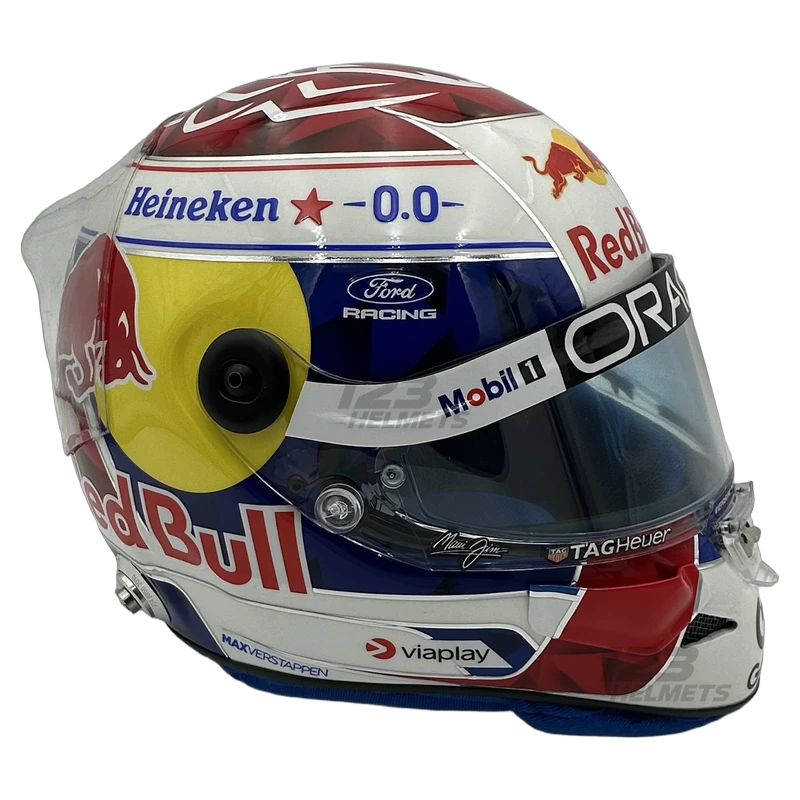
Ahead of the 2026 Spanish Grand Prix, journalist Adam Cooper put a pointed question to Max Verstappen about the ghost of Barcelona 2016 — the race that launched his legend. Verstappen’s answer was measured, forward-looking, and worth reading carefully if you follow the championship battle. For collectors, that same 2016 breakthrough remains one of the most requested eras in full-size 1:1 replica helmet history.
Key Takeaways
Verstappen dismissed any Barcelona 2016 nostalgia, saying ‘it feels a long time ago now’ and that he no longer thinks about past results when preparing for a race weekend.
Adam Cooper’s post-qualifying exchange shows how the 2016 Spanish GP — Verstappen’s maiden F1 win at just 18 years old — still defines the public perception of his early career.
The question of ‘history repeating itself’ hinges on whether Verstappen can fight from his grid position; he stated plainly he wants to ‘see if we can actually be in that fight or not with the cars around us.’
The Barcelona 2016 helmet design remains one of the most historically significant liveries in recent F1 history, making full-size 1:1 display replicas from that race a centrepiece for serious collectors.
The Question Cooper Couldn’t Resist Asking
After qualifying for the 2026 Spanish Grand Prix, veteran F1 journalist Adam Cooper — posting on X as @adamcooperF1 — sought out Max Verstappen for a specific conversation. The subject was not tyre strategy, not Red Bull’s current pace window, and not the championship standings. It was a date: 15 May 2016.
On that Sunday at the Circuit de Barcelona-Catalunya, an 18-year-old Verstappen started fourth and converted a two-stop strategy into his first Formula 1 victory, becoming the youngest race winner in the sport’s history. Nearly a decade on, Cooper floated the idea that history might repeat itself at the same circuit. The prompt was simple and deliberate, designed to see whether any of that old emotion remained.
It was a reasonable journalistic instinct. Barcelona has a habit of producing pivotal moments, and the parallels — Verstappen again in title contention, again needing to extract maximum performance from his machinery — were visible enough to be worth raising.
Verstappen’s Answer: Deliberate Distance from the Past
Verstappen’s reply, quoted directly by Cooper, left no room for romantic interpretation:
“I don’t think like that. Good memories, but it feels a long time ago now, and for me, I don’t think about that anymore. Every race, every year is different, whatever happens. So I just want to try and focus on my race more, and see if we can actually be in that fight or not with the cars around us.”
Three things stand out in that short passage. First, the acknowledgement: good memories. Verstappen does not pretend the 2016 win never happened or that it holds no personal weight. He is not dismissive for the sake of being cool. Second, the temporal separation: it feels a long time ago now. From a psychological standpoint, this is consistent with how elite athletes manage the mental load of a long career — compartmentalising past results so they do not create either complacency or pressure. Third, the operational focus: see if we can actually be in that fight or not with the cars around us. That phrase is the most telling. It acknowledges uncertainty about Red Bull’s current competitive position relative to the cars immediately around him on the grid, rather than making any sweeping claims about race pace.
It is the answer of a driver who has won 4 consecutive Drivers’ World Championships and no longer needs a single historic race to define him.
What Barcelona 2016 Actually Was — and Why It Still Resonates
For those who arrived in F1 fandom after 2020, it is worth reconstructing just how unlikely the 2016 Spanish GP result appeared in real time. Verstappen had been promoted from Toro Rosso to Red Bull Racing only days before the race weekend — a decision announced on 5 May 2016, ten days before lights out. He had never driven the RB12 in a competitive session before climbing in for Friday practice at Barcelona.
The race itself was chaotic from lap 1. Lewis Hamilton and Nico Rosberg, then the dominant Mercedes drivers, collided at Turn 4 on the opening lap, both retiring. That elevated the field, but it did not hand Verstappen the win — he still had to manage a two-stop strategy correctly, deal with Kimi Räikkönen’s Ferrari on fresher tyres in the closing laps, and hold his nerve for the final 66 laps of the race. He crossed the line 0.616 seconds ahead of Räikkönen.
At 18 years and 227 days old, he set the record for youngest F1 race winner that still stands today. The helmet he wore that weekend — Red Bull livery with Dutch orange accents — immediately entered the short list of iconic F1 race-worn designs. It was the visual signature of a changing of the guard, and it is the reason that era generates consistent demand among display collectors.
The Collector Dimension: Why 2016-Era Verstappen Helmets Matter
For the display helmet community, Barcelona 2016 occupies a very specific position: it is the race that confirmed a generational talent in a single afternoon. Replica helmets tied to breakthrough moments carry a different weight in a collection than those from mid-season races or routine podiums. The 2016 Spanish GP is, by any honest assessment, one of the 5 most historically significant individual race results of the past decade in F1.
Full-size 1:1 display replicas of Verstappen’s 2016-era helmets are produced at 1:1 scale, matching the dimensions of the race-used originals. A standard full-face F1 replica shell sits at approximately 29 × 25 × 35 cm and weighs around 1.2–1.5 kg in ABS construction — substantial enough to display on an open stand without a base mount, while remaining light enough for wall-mounted bracketing. The visor panels on exhibition-quality replicas are typically 3 mm polycarbonate, tinted or clear, providing the visual authenticity that distinguishes a serious display piece from a novelty item.
These are collector and display items only — not certified for any protective use, not suitable for road or track use, and carrying no FIA, Snell, ECE, or DOT ratings. Their purpose is exhibition: to represent a specific moment in motorsport history on a shelf, cabinet, or wall mount, in accurate 1:1 proportion.
The paint layers on high-grade replicas replicate the base coat, graphic layer, clear coat, and any metallic or pearlescent finish used on the original design — typically 4 to 6 separate paint stages for a complex livery like the Red Bull 2016 scheme. That level of production detail is what separates an exhibition-quality piece from a mass-market model.
History Repeating? What It Would Actually Take
Cooper’s framing of ‘history repeating itself’ was never purely nostalgic. It carried a competitive subtext: could Verstappen, from wherever he qualified, manage strategy and traffic to win the Spanish Grand Prix again in 2026 — this time against a field in which McLaren, Ferrari, and Mercedes have all demonstrated race-winning pace at various points of the season?
Verstappen’s own answer addressed this directly. The phrase see if we can actually be in that fight or not with the cars around us is an honest admission that Red Bull’s 2026 machinery has not been the dominant force of 2022 or 2023. The RB21 has shown flashes of competitiveness, but the midfield has compressed significantly, and a Barcelona podium — let alone a win — would require near-perfect execution.
The Circuit de Barcelona-Catalunya is 4.675 km in its current configuration, a circuit that places specific demands on rear tyre management through the long, fast corners of Sectors 1 and 2. Historically, Red Bull’s cars have suited Barcelona’s sustained-load corners. Whether that technical alignment remains in 2026 is precisely what Verstappen said he wants to discover on race day.
If the race does produce a Verstappen victory, the 2026 Spanish GP helmet will become a document of its own — another layer in a career that is already one of the most decorated in the sport’s history. And the 2016 original will still be there in the background, the starting point of everything that followed.
From Race Day to Display Case: How a Moment Becomes an Object
There is a straightforward logic to why moments like Barcelona 2016 translate so directly into collector demand. The helmet is the single most personal piece of equipment an F1 driver uses — more so than a steering wheel, more so than a race suit. It sits at the intersection of protection, identity, and visual communication. The livery on a driver’s helmet in a breakthrough race is the image that gets frozen in photographs, printed in newspapers, and remembered decades later.
When Verstappen crossed the line on 15 May 2016, every photographer on the exit of the final corner was shooting the same image: a Red Bull-liveried car with a helmet that had become, in the space of 66 laps, a piece of sporting history. Full-size 1:1 display replicas of that helmet give collectors a tangible, accurately proportioned object that connects directly to that specific Sunday afternoon.
Cooper’s post-qualifying exchange with Verstappen serves as a useful reminder that even as the sport moves forward — new regulations from 2026 onwards, new challengers on the grid — the defining races of the past remain reference points. For Verstappen, Barcelona 2016 is history. For collectors, it is a centrepiece.
“I don’t think like that. Good memories, but it feels a long time ago now, and for me, I don’t think about that anymore. Every race, every year is different, whatever happens. So I just want to try and focus on my race more, and see if we can actually be in that fight or not with the cars around us.”
— Max Verstappen, post-qualifying — via @adamcooperF1 on X
FAQ
Q: When did Max Verstappen win his first Formula 1 race at Barcelona?
Verstappen won the 2016 Spanish Grand Prix on 15 May 2016, finishing 0.616 seconds ahead of Kimi Räikkönen after 66 laps. He was 18 years and 227 days old, making him the youngest race winner in F1 history at the time — a record that still stands.
Q: What did Verstappen say about the possibility of history repeating at Barcelona 2026?
Journalist Adam Cooper raised the 2016 parallel after qualifying. Verstappen acknowledged the good memories but stated clearly: ‘Every race, every year is different.’ He said his focus was on understanding whether Red Bull could compete with the cars immediately around him on race day, not on repeating past results.
Q: Are Verstappen 2016-era display helmet replicas made to full size?
Yes. Exhibition-quality replicas are produced at 1:1 scale, matching the dimensions of the race-used originals — approximately 29 × 25 × 35 cm. They are display and collector pieces only, with no protective certification of any kind.
Q: What makes a full-size F1 replica helmet ‘exhibition quality’?
Key markers include accurate 1:1 proportions, multi-stage paint application (typically 4 to 6 layers for complex liveries), a correctly weighted ABS shell around 1.2–1.5 kg, and a polycarbonate visor panel of approximately 3 mm. These details separate a genuine display piece from a lightweight novelty model.
Q: Can a display replica helmet be used for racing or road riding?
No. Full-size 1:1 replica helmets sold as collector and display pieces carry no FIA, Snell, ECE, or DOT certification. They are not suitable for any form of road use, track use, or protective application. Their sole purpose is exhibition and collection.
Browse F1 Helmet Collection — find full-size 1:1 display replicas spanning the most significant races and drivers in Formula 1 history, including the Verstappen era.
Display and collector replicas only. Not certified for protective use. Full-size 1:1 scale.
This article was written with the help of AI tools. Editorial policy