Blog
‘I Feel Like My Old Self Again’ – Russell Takes Barcelona Pole for Mercedes
 123Helmets Editorial Team
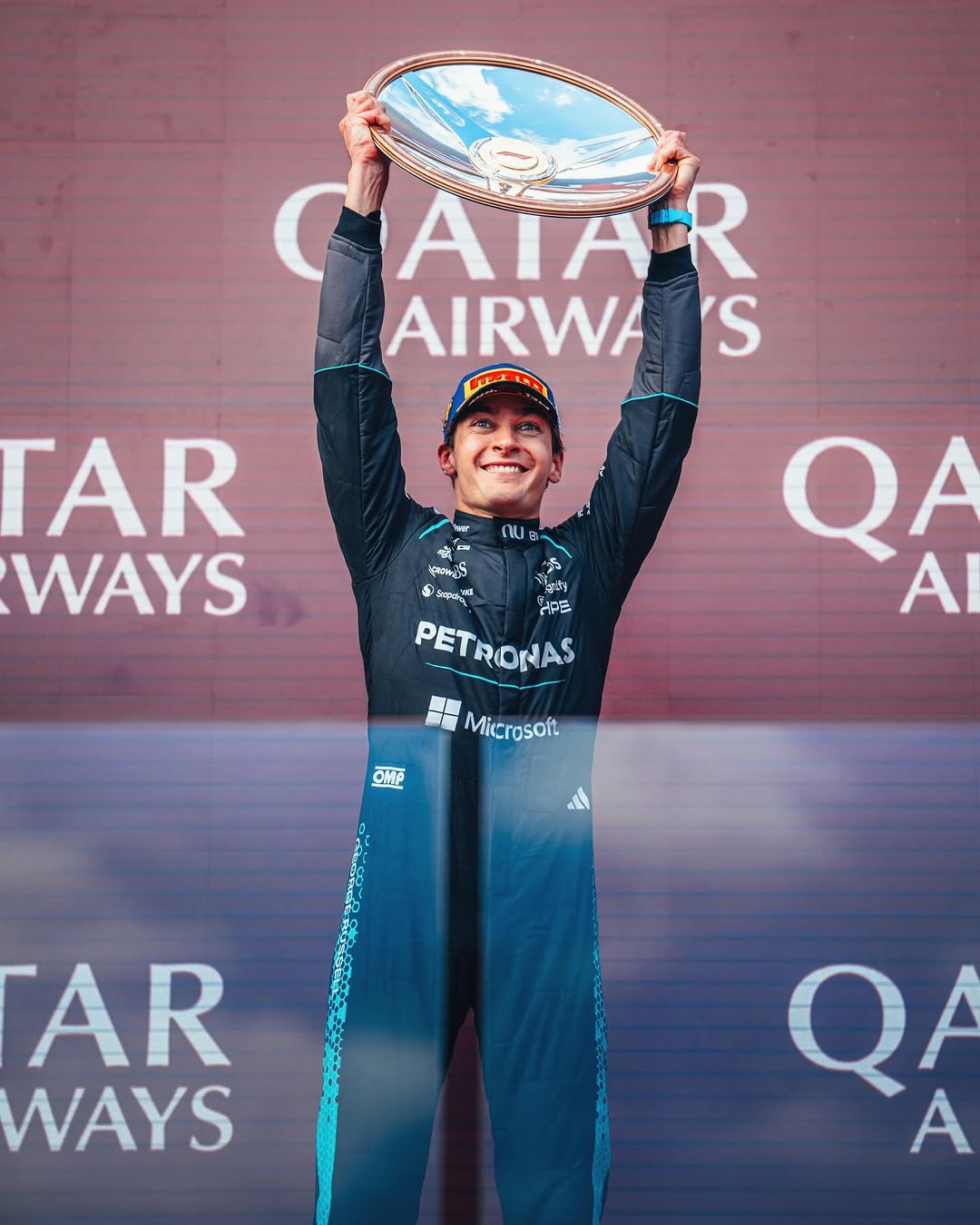
George Russell put Mercedes back on top in Barcelona, setting a 1:14.679 lap to claim pole position at Circuit de Barcelona-Catalunya and silencing weeks of frustration with one of his cleanest qualifying performances of the 2026 season.
Key Takeaways
Russell’s pole lap of 1:14.679 was set on his final qualifying run and held off late challenges from Kimi Antonelli and Lewis Hamilton.
The result arrives after Monaco, where a drive-through penalty for a pit-lane speeding infringement wiped out Russell’s entire weekend.
Antonelli sits 68 points clear of Russell in the Drivers’ Championship after winning five consecutive Grands Prix.
Ferrari and McLaren showed competitive pace in qualifying, signalling a multi-team contest for Sunday’s race at Barcelona-Catalunya.
One Lap That Changed the Narrative
There are qualifying sessions that simply disappear into the data, and there are sessions that define a driver’s weekend — and sometimes redefine a driver’s season. George Russell’s final run at Circuit de Barcelona-Catalunya on Saturday belonged firmly to the second category. His 1:14.679 was not only the benchmark that claimed pole position for the 2026 Spanish Grand Prix; it was a statement delivered at exactly the moment the paddock had started writing uncomfortable stories about a Mercedes number-one driver struggling to keep pace with his own team.
Russell had led Free Practice 1 and Free Practice 3 across the Barcelona weekend, a consistency that suggested the circuit suited both him and the current Mercedes package. Yet nothing in a Grand Prix weekend is guaranteed until the final qualifying lap is logged, and with team-mate Kimi Antonelli and Ferrari’s Lewis Hamilton both mounting late efforts to topple him, the 1:14.679 had to be good enough under real pressure. It was.
“It’s been a great weekend so far – I kind of feel like my old self again, where every lap I’m doing my job and always fighting in those top positions,” Russell said immediately after the chequered flag ended Q3. The relief was audible. This was not the measured language of a driver managing expectations — it was genuine release after a sequence of weekends that had gone wrong in ways he could not always control.
Monaco’s Shadow and the Weight of 68 Points
To appreciate what Barcelona meant for Russell, it helps to trace the weeks that preceded it. Monaco had been a catastrophe in slow motion. A drive-through penalty for speeding in the pit lane — compounded by a failure to serve an earlier penalty correctly — reduced what might have been a points-scoring weekend, perhaps a podium challenge, to nothing. Russell left the Principality pointless and publicly frustrated.
The fallout was numerical as much as emotional. Kimi Antonelli, the 18-year-old Italian who joined Mercedes for 2026, had by that point won five Grands Prix in a row — a run of form that has been one of the genuine stories of the early season. With Russell’s Monaco blank factored in, the gap between the two Mercedes drivers in the Drivers’ Championship stood at 68 points. That is a significant deficit, and Russell acknowledged as much, saying he “came into this weekend with just a clean slate” and was “dying for a smooth weekend” after the preceding chaos.
Barcelona delivered exactly that clean slate through three practice sessions and into qualifying. The pole lap did not close 68 points in a single afternoon, but it re-established something harder to quantify: the image of Russell as a driver who belongs at the front of a Formula 1 grid, not one managing penalties and mechanical misfortune from the midfield.
The Lap in Context: Hamilton, Antonelli and What Came Close
Pole position is only truly meaningful when it is contested. Russell’s 1:14.679 was not a gift. Lewis Hamilton, in his first season with Ferrari after the high-profile switch from Mercedes, produced what Russell himself described as “an amazing job” to get up the order in Q3. Hamilton’s presence at the sharp end of the Barcelona grid is a reminder of exactly how competitive the 2026 field has become, and of how much the Scuderia has developed since the winter.
Antonelli, meanwhile, settled for third on the grid — a result that carries its own complexity. For a driver who has won five races in succession, third place in qualifying is a rare step back from the standard he has set, yet it still positions him well for a race start on a circuit where overtaking into Turn 1 remains possible. The championship leader will be watching Russell’s mirrors on Sunday.
McLaren also showed pace across the qualifying hour, reinforcing Russell’s own read that Sunday would be “an interesting race.” The pole position is the best possible starting point, but it is only a starting point. Circuit de Barcelona-Catalunya rewards tyre management across its 66 laps, and strategy calls from the wall will matter as much as raw grid position once the lights go out.
Silver, Teal and a Helmet Worth Framing: The Visual Story of Pole
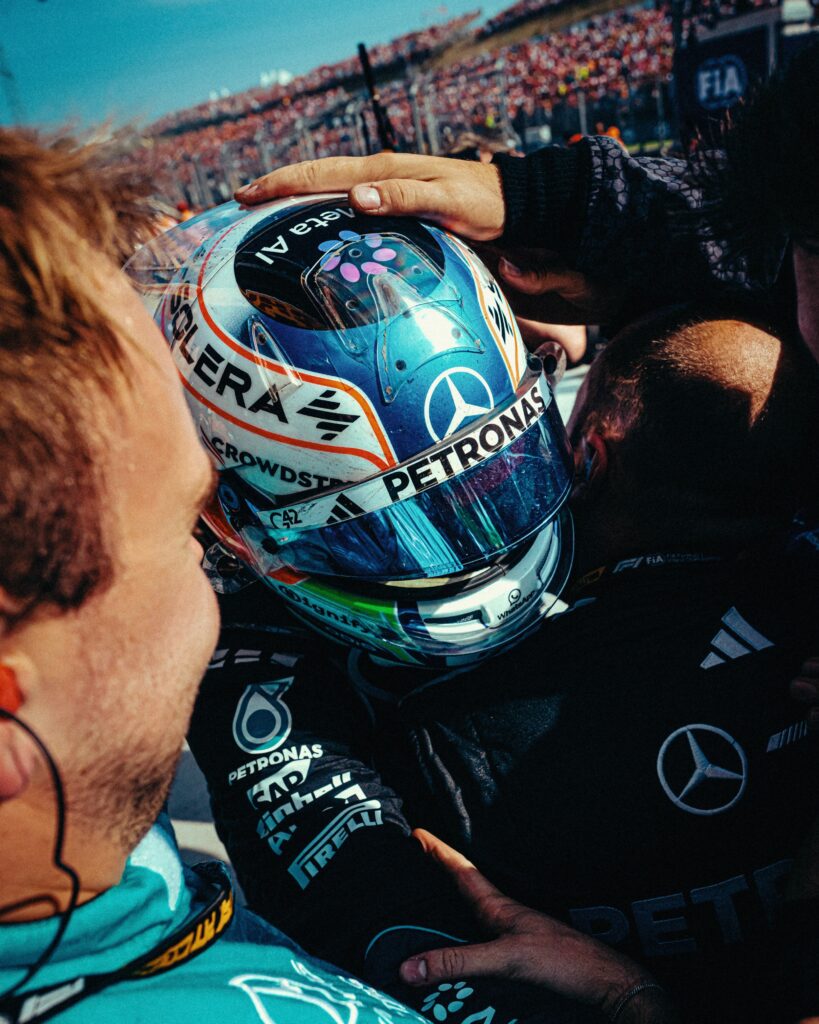
Beyond the times and the championship mathematics, a qualifying session for pole position generates images that have a particular weight — and the parc fermé moment at Barcelona is among the most photographed in the Formula 1 calendar year. Russell climbed from the cockpit in the full Mercedes 2026 livery: the deep silver flanks running into teal at the nose, the team’s characteristic colour language holding its own under the bright Catalan afternoon light.
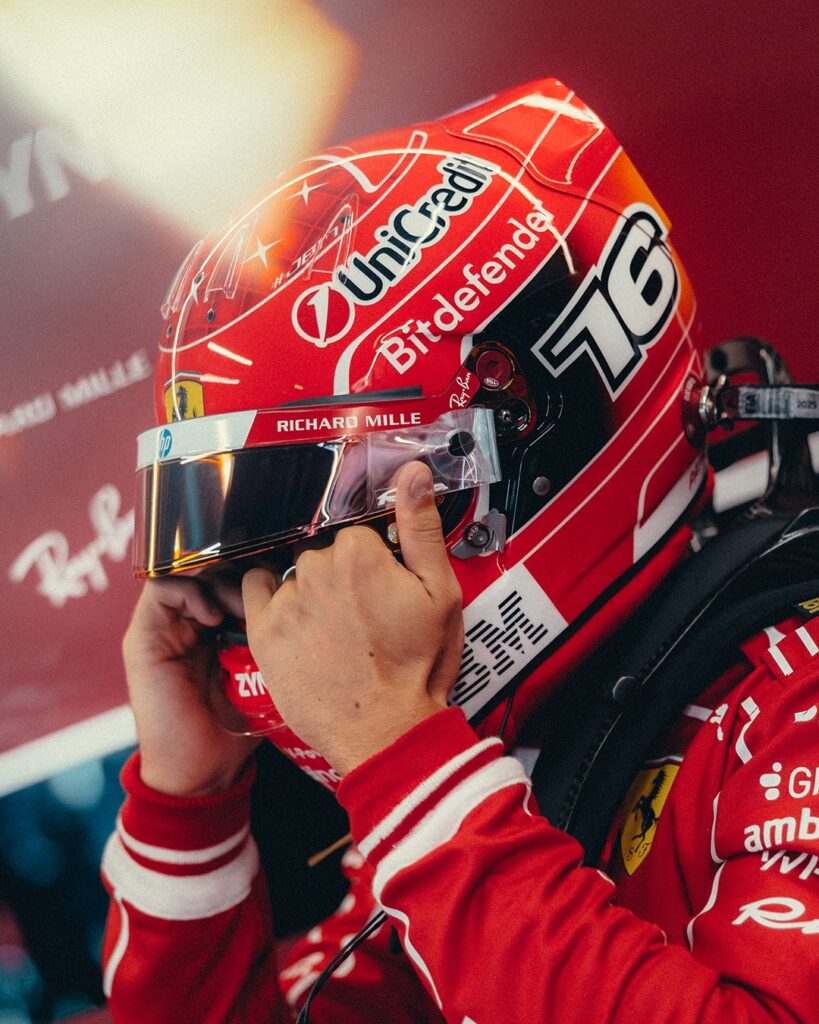
Russell’s own helmet design for the 2026 season carries that same silver-teal foundation, accented with personal graphic elements that have characterised his lids since his Williams and early Mercedes years. Against the backdrop of Circuit de Barcelona-Catalunya’s pit lane and the pole position board, the combination of driver, helmet and car formed the kind of image that collectors and display enthusiasts recognise immediately as belonging to a specific, documented moment in the sport’s history.
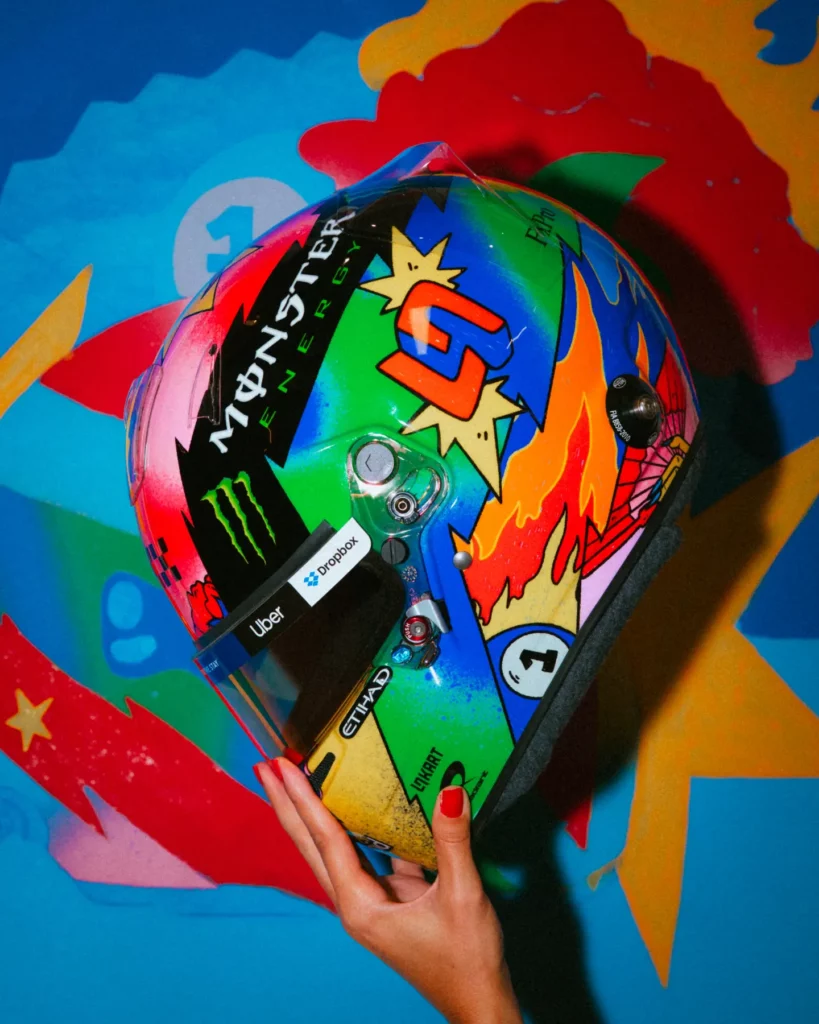
Full-size 1:1 display replicas of race-worn helmet designs exist precisely to capture these moments as three-dimensional objects. A replica of a championship-contending driver’s helmet from the session in which he claimed pole — at a circuit as storied as Barcelona — carries an inherent narrative. It is not decoration in any generic sense; it is a fixed point in a season that is still unfolding, rendered at real scale in real materials. The standard for exhibition-quality replicas of this type runs to construction details such as visor thickness measured in millimetres, shell geometries matched to the original manufacturer’s dimensions, and graphic reproduction that preserves the exact colour references used by the driver’s helmet painter.
For anyone who watched Russell’s lap on Saturday afternoon and wanted something more permanent than a screenshot, the full-size 1:1 collector replica is the answer the hobby has developed over decades of Formula 1 heritage collecting.
What Sunday Means for the Season
A pole position at the Spanish Grand Prix is not a guaranteed race win, but it is the optimal position from which to challenge one. For Russell, converting pole to victory on Sunday would do several things simultaneously. It would trim the 68-point gap to Antonelli in a single afternoon. It would represent Mercedes’ clearest proof yet that the 2026 car is capable of dominating in the hands of both its drivers rather than one. And it would extend the kind of momentum that, in a long season, tends to become self-reinforcing.
Russell’s own assessment was measured rather than triumphant. He acknowledged Ferrari’s Hamilton as a genuine threat, noted McLaren’s pace, and stopped well short of predicting a comfortable Sunday. That reading is accurate. The 2026 Formula 1 grid is genuinely competitive across four or five teams in a way the sport has not consistently seen in recent seasons, and Barcelona’s layout — with its mix of high-speed corners in the first sector, the slow chicane complex, and the long run to Turn 1 — gives multiple strategic paths through a race distance.
What Saturday confirmed, though, is that George Russell is back at the front of the grid where his talent has always suggested he belongs. Whether Sunday delivers the points to match the qualifying performance, the pole lap itself stands as the kind of defining moment that marks a season: a driver, a fast circuit, a 1:14.679, and a silver helmet catching the late Spanish light.
Barcelona’s Place in Formula 1 Heritage Collecting
Circuit de Barcelona-Catalunya has hosted the Spanish Grand Prix since 1991, and over more than three decades it has accumulated a catalogue of defining Formula 1 moments. It has been the site of pre-season testing that shaped whole championship narratives, and its familiarity to drivers and engineers alike means that a strong performance at this circuit carries genuine technical credibility — it is not a result explained away by track characteristics that suit one car unusually well.
That history makes Barcelona sessions particularly valued by collectors of Formula 1 display pieces. A helmet associated with a Barcelona pole position or podium comes with a backdrop that any informed collector recognises. The circuit’s layout is one of the most widely known in the sport — the first-sector sweeps, the stadium section, the long main straight — and that recognition transfers directly to the display value of pieces linked to notable sessions here.
Full-size 1:1 display replicas produced to exhibition quality are the format best suited to representing this kind of moment. At real scale, with accurate shell geometry and faithfully reproduced graphics, they hold the visual memory of a qualifying hour in physical form. They are collector items, display pieces built to sit on a shelf or in a cabinet and communicate a specific event to anyone who looks at them — not wearable equipment, not safety-rated hardware, but objects whose value is entirely in what they represent and how well they represent it.
“It’s been a great weekend so far – I kind of feel like my old self again, where every lap I’m doing my job and always fighting in those top positions.”
— George Russell, after qualifying for the 2026 Spanish Grand Prix
“I came into this weekend with just a clean slate, felt good and, yeah, just good to be on pole.”
— George Russell, Circuit de Barcelona-Catalunya, 2026
FAQ
Q: What was George Russell’s pole position lap time at the 2026 Spanish Grand Prix?
Russell set a time of 1:14.679 on his final Q3 run at Circuit de Barcelona-Catalunya to claim pole position for the 2026 Spanish Grand Prix.
Q: How far behind Kimi Antonelli is Russell in the 2026 Drivers’ Championship?
After Monaco, Russell’s deficit to Mercedes team-mate Kimi Antonelli stood at 68 points. Antonelli had won five consecutive Grands Prix at that stage of the season.
Q: Why did Russell have a difficult Monaco Grand Prix?
Russell received a drive-through penalty at Monaco for speeding in the pit lane, which was compounded by a failure to serve an earlier penalty correctly, effectively ending his race and leaving him without points.
Q: Are full-size 1:1 replica F1 helmets suitable for racing or road use?
No. Full-size 1:1 replica helmets sold as collector and display pieces are not certified for any protective use. They are exhibition-quality display items only, not wearable safety equipment.
Q: What makes a Barcelona Grand Prix pole position helmet particularly collectible?
Circuit de Barcelona-Catalunya has hosted the Spanish Grand Prix since 1991, giving the circuit a deep heritage in the sport. A display replica linked to a notable qualifying session here benefits from that recognised history and the technical credibility the circuit carries among collectors.
Browse F1 Helmet Collection — find full-size 1:1 display replicas built to exhibition quality, each one a permanent record of the moments that define a Formula 1 season.
Display and collector replicas only. Not certified for protective use. Full-size 1:1 scale.
This article was written with the help of AI tools. Editorial policy