
Blog
Hamilton’s “Huge Leap” to Ferrari’s Front Row: A Display-Worthy Qualifying Story
 123Helmets Editorial Team
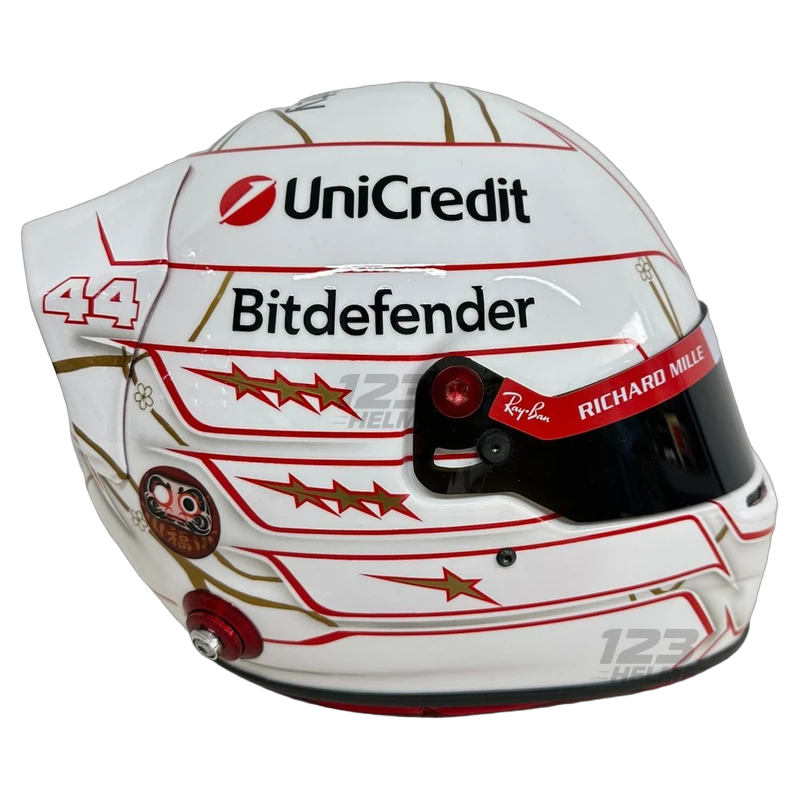
Lewis Hamilton arrived at qualifying facing a deficit of up to one second to the front row. What followed was one of the most visually striking Ferrari moments of his debut season — and a qualifying lap that belongs on any collector’s display shelf.
Key Takeaways
Hamilton was as much as one full second off the front-row pace in one practice session before qualifying, making his front-row result a genuine turnaround.
Ferrari’s upgrade package, developed at Maranello and delivered specifically for this race weekend, was central to closing the gap — Hamilton credited the factory team directly.
Leclerc crashed in Q3 at turn four, leaving Hamilton to carry Ferrari’s qualifying result; Hamilton attributed the crash to carrying too much entry speed into that corner.
This front-row start is Hamilton’s best grid position for a grand prix at Ferrari, marking a collector-worthy milestone in his time with the Scuderia.
A Weekend That Started in the Wrong Direction
Lewis Hamilton’s path to the front row at Ferrari did not begin with confidence. It began with absence. Ferrari deployed junior driver Dino Beganovic in Hamilton’s car for the opening practice session, a decision that left Hamilton without meaningful early data in what proved to be a technically demanding weekend.
The consequence was immediate and visible in the timing sheets. After final practice, Hamilton was seven-tenths of a second off the overall pace — and nearly half a second behind his own team mate, Charles Leclerc. At one point across the session runs, the gap to the front row reached a full second.
“I’ve never been so down before in a sense of the gap between Charles and I and to everybody else,” Hamilton said. “It was half a second to eight tenths. I think it was one second in one session to the front row.”
That kind of deficit, measured across qualifying simulations rather than race runs, is the sort of number that makes engineers reach for the data and drivers reach for composure. For anyone following Hamilton’s transition to Ferrari, the 0.5–1.0 second gap in practice told a story that looked difficult to reverse before Sunday’s lights went out.
For collectors and fans who track Hamilton’s helmet through every chapter of his career, this weekend in Ferrari red already had the texture of a turning point — not yet confirmed, but building. The flat-red shell of his SF-24 lid, carried across a difficult Friday and Saturday morning, was about to become part of a different story by Saturday afternoon.
Finding the “Huge Leap” Before Qualifying
Between the end of final practice and the start of Q1, Hamilton and his engineers went to work. The adjustments were set-up focused — specifically around rear confidence, the area Hamilton identified as the root cause of his practice pace deficit.
“I really struggled to get on pace after missing [first practice],” Hamilton said. “I knew where the time was, it was just having the confidence in the car, especially in the rear of the car. So I needed to make a huge leap going into qualifying.”
That phrase — a huge leap — carries weight when you measure it against the numbers. Closing a gap of between 0.5 and 1.0 seconds in qualifying trim, in a car that had been unfamiliar all weekend, is not a minor adjustment. It required Hamilton to extract pace from a car he had only partially learned across two sessions rather than the standard three.
The set-up changes moved Hamilton and Leclerc onto what Hamilton described as “exactly the same set-up” for Q3. That alignment — two drivers on identical hardware — is significant from a data perspective. It meant whatever lap Hamilton produced in Q3 was a clean reflection of his own pace, not an artefact of divergent set-ups.
By the time the Q3 runs began, Hamilton was braking very late into turn four. His words on this are precise: “I was braking very late into turn four, which had been visible.” That commitment under braking, visible enough to be noted in the post-session review, tells you where the lap time was being generated — deep into the braking zone, trusting the rear that had felt so uncertain in practice.
The Factory’s Role in Saturday’s Result
Hamilton was direct about where credit belonged. Ferrari had brought a significant upgrade package to the circuit specifically for this event, and Hamilton tied his qualifying improvement directly to that hardware.
“This is really down to everyone back at the factory. They’ve been working so hard. We kind of know where our North Star is and for them to bring this upgrade here this weekend, I can’t thank them enough for the hard work that they’ve put in to bring it.”
For display collectors who document Ferrari’s technical evolution through replica helmets, this upgrade moment marks an identifiable point in the SF-24’s development arc. The helmet Hamilton wore in Q3 was, in effect, the first Ferrari lid he carried from a genuinely upgraded platform — a detail that adds context to any full-size 1:1 replica from this period.
Leclerc’s Q3 Crash and What It Revealed
Charles Leclerc had looked quick all weekend. Faster than Hamilton through practice, aligned on the same set-up by Q3, Leclerc was the expected lead Ferrari representative in the final qualifying runs. Then came turn four.
Leclerc crashed in Q3, ending his qualifying session before he could post a representative lap time. Hamilton, watching the data from his own experience at the same corner, offered a clear-eyed assessment of what likely happened.
“I think Charles probably tried to carry a lot of speed into that corner and unfortunately, it didn’t work out for him,” Hamilton said. “But he’s still going to be really quick in the race.”
The contrast here is worth examining. Hamilton had also been braking late into turn four — his own words confirm that. The difference, apparently, was in the precise calibration of how much entry speed the car could sustain. Hamilton found the limit and stayed within it. Leclerc found the same limit and crossed it.
That kind of marginal difference between a front-row start and a barrier is the razor’s edge of Grand Prix qualifying. It is also the kind of moment that freezes in time — visually, historically — in ways that make collector replicas meaningful. The Ferrari helmet Hamilton wore through that Q3 run, in the session where the gap between success and accident was measured in fractions of a second, is the helmet of a driver who got the calculation right when it mattered.
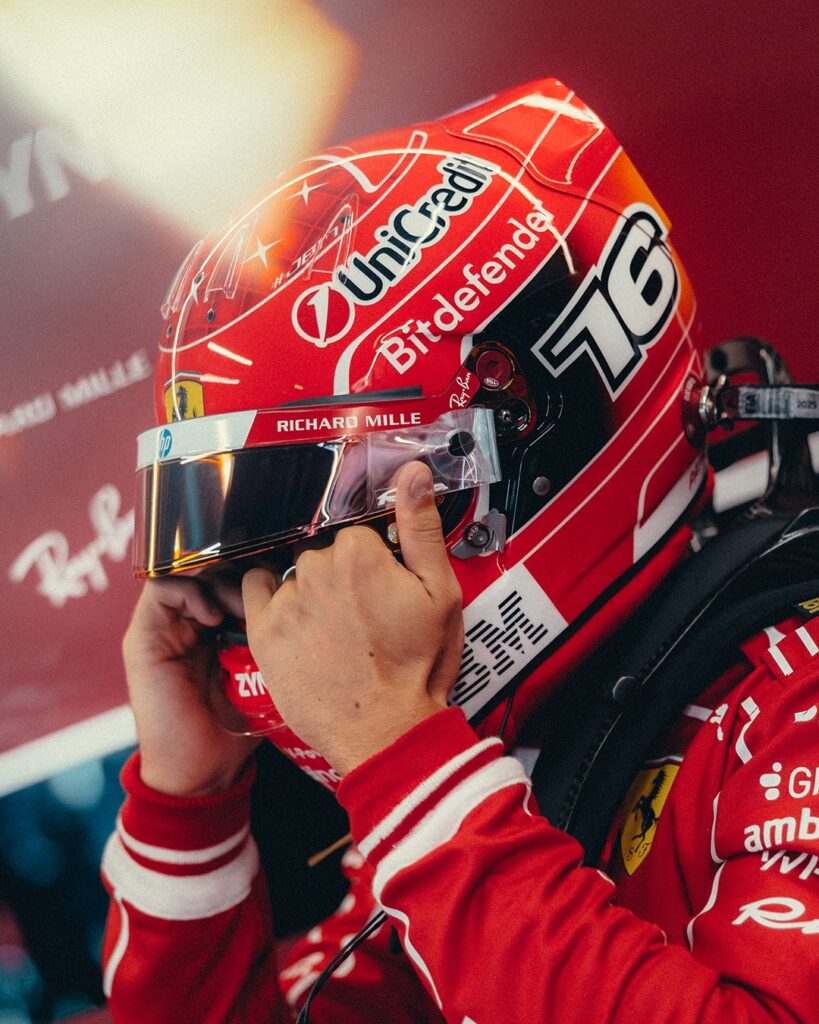
Leclerc’s crash left Ferrari’s qualifying result resting entirely on Hamilton’s shoulders. The 7-number Ferrari lid, in its characteristically bold Scuderia red livery, would represent the team’s full Saturday story going into race day.
Hamilton’s Best Ferrari Grid Position: The Numbers Behind the Milestone
The front-row result stands as Hamilton’s best qualifying position for a Grand Prix at Ferrari since joining the Scuderia. That fact alone positions this weekend as a collector milestone — the kind of identifiable first that gives a replica helmet its specific gravity.
The scale of the qualifying turnaround deserves repeating in cold numbers. In practice: a gap of 0.5 to 1.0 seconds to the front row. In qualifying: front row. The delta between those two data points, achieved across a single preparation window between sessions, was the “huge leap” Hamilton described — and the numbers confirm it as exactly that.
Ferrari’s upgrade package, arriving at this circuit as a targeted development step, provided the hardware foundation. Hamilton’s set-up adjustments, focused on rear stability, provided the confidence layer. The combination produced a lap that, across a difficult weekend, stood as the team’s best qualifying result.
For context on how display replicas capture such moments: a full-size 1:1 Ferrari replica helmet at collector grade typically replicates the exact livery configuration Hamilton runs in any given season — including sponsor placement, visor configuration, and the specific shade of Scuderia red that has distinguished Ferrari’s racing livery for decades. The helmet that sat on Hamilton’s head in Q3, in the session that produced this result, is the reference point for every replica made from this period of his career.
What “North Star” Means in the Ferrari Context
Hamilton’s use of the phrase “we kind of know where our North Star is” is not throwaway language. It signals that Ferrari and Hamilton have an agreed development direction — a shared understanding of where the car needs to go to be consistently competitive. The upgrade delivered at this race was not a surprise intervention; it was a step along a planned path.
That continuity matters for collectors who document a driver’s career chronologically. The helmet Hamilton wore at this event is not just a front-row artifact — it is an early data point in a Ferrari development arc that, by his own description, has a destination in mind. Display pieces from this period sit at the beginning of that trajectory.
The Visual Language of a Ferrari Front Row: Why This Helmet Belongs in a Collection
There is a specific kind of moment in a driver’s career that produces a display-worthy helmet: not necessarily a championship win, but a genuine turning point — a session where adversity produced something unexpected, and the visual record of that session carries the story forward.
Hamilton’s Q3 lap at this circuit is one of those moments. The context — missing first practice, a near-one-second gap in practice, rear instability, a team mate’s crash — makes the front-row result something more than a qualifying statistic. It is evidence of a driver recalibrating at speed, in a new environment, on upgraded hardware that had barely been integrated.
The Ferrari helmet Hamilton ran in this qualifying session carries all of that context in its livery. The Scuderia’s signature red, the number 44 that Hamilton brought with him from Mercedes, the specific sponsor configuration of the 2024 Ferrari — these visual elements, reproduced in a full-size 1:1 exhibition-quality replica, are the physical record of a career chapter still being written.
For display collectors, the distinction between a generic replica and a milestone replica comes down to what the helmet was present for. A helmet from a pole lap, a race win, or — as in this case — a qualifying turnaround that produced a driver’s best Ferrari grid position is a display piece with a fixed address in the historical record. It does not move. The result is permanent.
That permanence is what exhibition-quality collector replicas are made for. Full-size, 1:1 scale, finished to the exact livery standard of the race weekend in question — these are the objects that make the statistical record tangible. When the story of Hamilton’s first Ferrari front row is told, the helmet is the artifact that makes it concrete.
Race Outlook: Carrying the Front-Row into Sunday
Hamilton’s own assessment of Sunday’s race prospects was measured but not quiet. Ferrari’s car, having shown genuine qualifying pace with the upgraded package, would face the longer test of race-distance management, tyre behaviour, and the challenge of a Leclerc starting from a compromised grid position.
“He’s still going to be really quick in the race,” Hamilton said of Leclerc — an assessment that acknowledged his team mate’s pace without dismissing his own qualifying result. The tone was that of a driver who had earned his grid position through a difficult weekend and understood what the race would require.
The upgrade that enabled the front row would face its second examination across race distance. Hamilton’s “North Star” language suggested confidence in the direction, even if the single-lap pace only confirmed one piece of the picture.
For the collector record: the helmet Hamilton carries from Saturday qualifying into Sunday’s race is the same full-size display reference point — the livery unchanged, the result locked in, the grid position confirmed. Whatever the race produced, the qualifying story was already complete. A front row, from a near-one-second deficit, in a car that felt unfamiliar until the engineers found the adjustment that made it work.
That story, told in red and finished in a Q3 lap that held where his team mate’s did not, is the kind of narrative that collector replicas are made to preserve. Display-only, full-size, 1:1 scale — the physical form of a moment that the timing sheets alone cannot fully hold.
“I’ve never been so down before in a sense of the gap between Charles and I and to everybody else. It was half a second to eight tenths. I think it was one second in one session to the front row. So I needed to make a huge leap going into qualifying.”
— Lewis Hamilton, Ferrari driver
“This is really down to everyone back at the factory. They’ve been working so hard. We kind of know where our North Star is and for them to bring this upgrade here this weekend, I can’t thank them enough.”
— Lewis Hamilton, Ferrari driver
FAQ
Q: What was Hamilton’s practice deficit before qualifying?
Hamilton was approximately seven-tenths of a second off the overall pace after final practice, and nearly half a second behind team mate Charles Leclerc. He noted that in one session the gap to the front row reached a full one second.
Q: Why did Hamilton miss first practice?
Ferrari ran junior driver Dino Beganovic in Hamilton’s car for the first practice session, a mandatory requirement for teams to give young drivers track time. Hamilton only rejoined the programme from second practice onward.
Q: What caused Leclerc’s Q3 crash?
Hamilton indicated that Leclerc likely tried to carry too much entry speed into turn four, the same corner where Hamilton had been braking very late but within the limit. Leclerc’s attempt to extract maximum speed from that corner did not hold, resulting in the crash.
Q: What does a full-size 1:1 Hamilton Ferrari replica helmet represent as a display piece?
A full-size 1:1 exhibition-quality replica helmet reproduces the exact livery, sponsor placement, and colour specification of Hamilton’s Ferrari race helmet. As a display and collector item — not certified for protective use — it preserves the visual record of a specific season and milestone, such as Hamilton’s best qualifying position at Ferrari.
Q: What upgrade did Ferrari bring to this race weekend?
Ferrari delivered a significant upgrade package specifically for this race weekend. Hamilton credited the factory team directly for the development work, stating that the upgrade was central to closing his practice deficit and achieving the front-row qualifying result.
Shop Lewis Hamilton Collection — full-size 1:1 display replica helmets from Hamilton’s Ferrari era, finished to exhibition quality. Collector pieces only, not certified for protective use.
Display and collector replicas only. Not certified for protective use. Full-size 1:1 scale.
This article was written with the help of AI tools. Editorial policy