
Blog
Wolff’s Slapback at Russell: British GP’s Spiciest Radio
 123Helmets Editorial Team
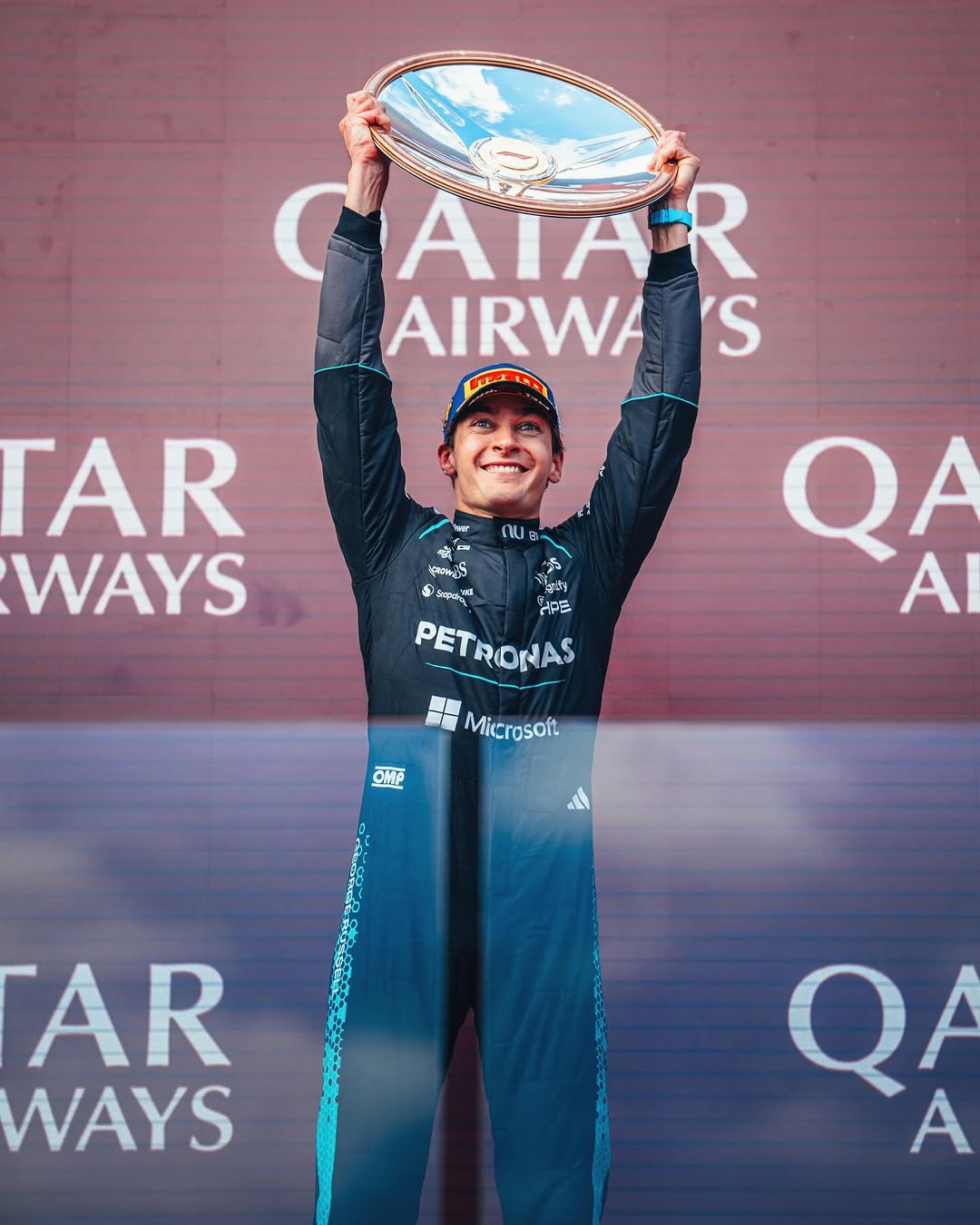
Toto Wolff’s blunt in-race radio shutdown of George Russell at the 2026 British Grand Prix has been compared to Mark Webber’s famous 2010 line, and it arrives just as Russell’s home-race helmet becomes one of the season’s most talked-about collector pieces.
Key Takeaways
Wolff’s “No, the straightline speed’s fine” radio reply to Russell at the 2026 British Grand Prix was described by commentator Alex Jacques as the sharpest team radio comeback since Mark Webber’s 2010 “number two driver” remark
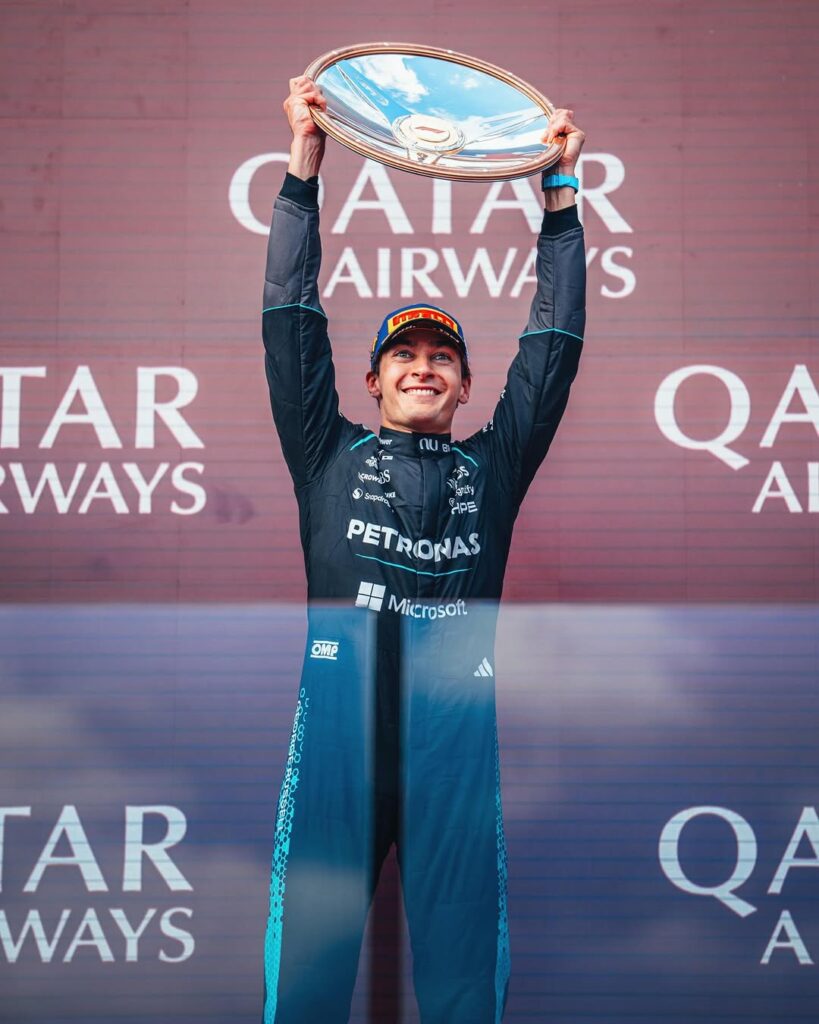
Russell finished second at his home race after Kimi Antonelli dropped to 15th following a dislodged wheel shield and a track limits penalty, then passed Lewis Hamilton as the Ferrari driver pitted under the safety car
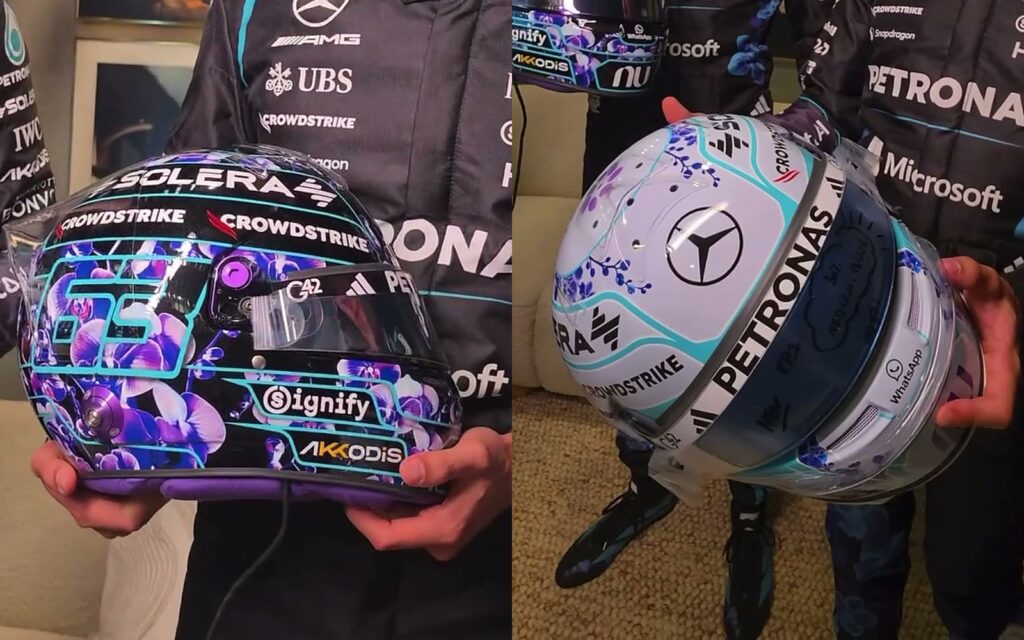
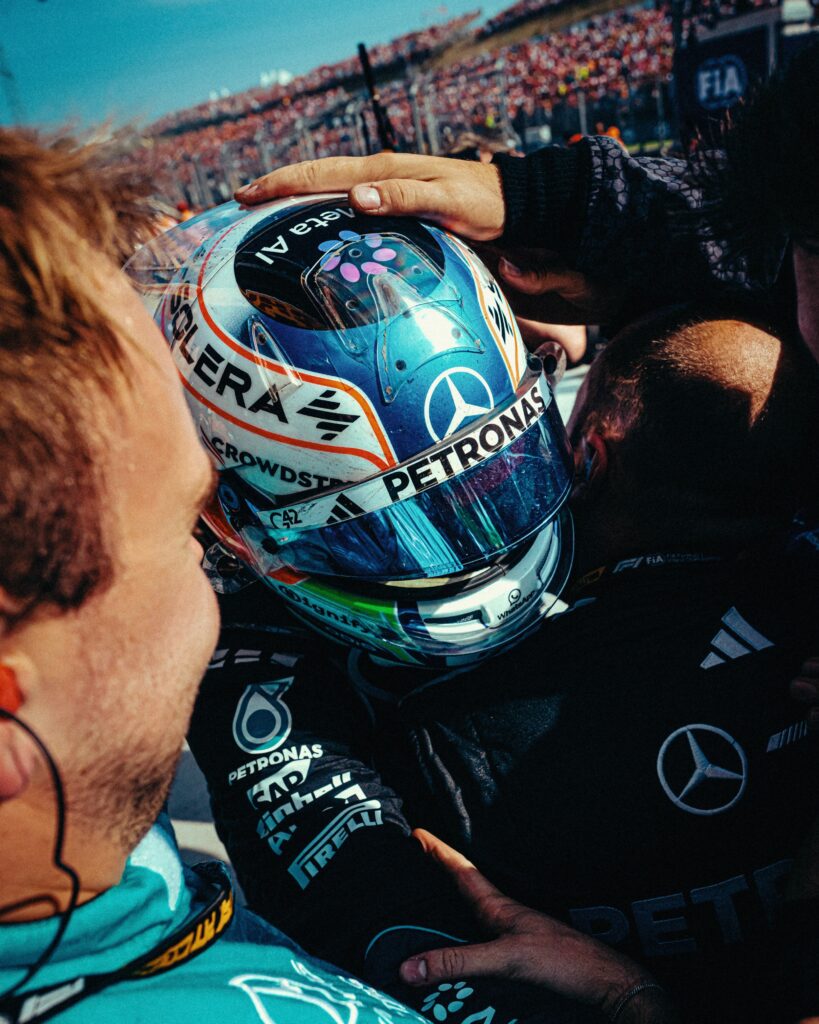
Russell’s British Grand Prix helmet carries home-race detailing that collectors are now chasing as a full-size 1:1 display piece
Jolyon Palmer read Wolff’s comment as a pointed redirection, arguing Russell already knows the rule book well enough to argue his own case in the moment
What Did Toto Wolff Say To George Russell?
Toto Wolff told George Russell over team radio, “No, the straightline speed’s fine,” cutting off his driver’s in-lap complaint about a lack of top-speed pace across the 2026 British Grand Prix weekend. Russell had just secured second place at his home race and used the slowing-down lap to flag straightline speed as a weakness. Wolff’s response landed instantly and without hesitation, closing down the conversation before Russell could elaborate further on the team channel.
The exchange was picked up by Formula 1 commentator Alex Jacques on the F1 Nation podcast, who framed it as a masterclass in short, clinical team-radio management. Jacques said the tone read less like a technical correction and more like a pointed redirection back at the driver. It is the kind of radio moment that spreads fast among fans precisely because it says more in seven words than most post-race interviews manage in five minutes.
For Mercedes, the timing matters. Russell had just converted a second-place finish at Silverstone into one of his stronger results of the 2026 campaign, and the podium came with a story attached — his team-mate’s misfortune and a late pass on a rival former team-mate. Wolff’s radio line, delivered in real time, became the soundbite that framed how the result was remembered.
How Does It Compare To Mark Webber’s 2010 Line?
Alex Jacques directly compared Wolff’s line to Mark Webber’s 2010 remark, calling it “the spiciest slapback on a victory lap radio since Mark Webber said, ‘Not bad for a number two driver.'” Webber’s 2010 comment, delivered after a win while driving for Red Bull, became one of the sport’s most quoted radio moments because it captured internal team tension in a single sentence, live, without filtering.
Jacques’ comparison works because both quotes share the same mechanism: a driver saying something loaded in the immediate adrenaline of a race result, broadcast unedited to millions of listeners. Webber’s line exposed friction over team status. Wolff’s line, by contrast, exposed friction over performance ownership — a boss telling his driver, in effect, to stop blaming the car and start reviewing his own weekend.
Jolyon Palmer, appearing alongside Jacques, agreed with the read and pushed it further. He argued Wolff’s reply was less about the timing sheets and more about redirecting Russell’s attention toward his own driving rather than the data. Palmer noted Russell is unusually sharp with the rule book — pointing to how quickly Russell explained his handling of single yellow flags in Austria — and suggested that same quick reasoning was on display again in how fast he tried to frame the straightline speed narrative before Wolff shut it down.
How Did Russell’s Podium Actually Happen?
Russell finished second at the 2026 British Grand Prix largely through other cars’ misfortune combined with a well-timed pass under the safety car. His team-mate Kimi Antonelli fell to 15th after picking up a dislodged wheel shield and a track limits penalty, removing a direct rival from the podium picture. Russell then moved ahead of Lewis Hamilton when the Ferrari driver pitted during a safety car period, completing the swing from midfield threat to podium finisher.
The result puts extra weight behind Wolff’s radio comment. A driver who inherits second position through a rival’s technical issue and a rival’s pit strategy, then complains about straightline speed on the slowing-down lap, is an easy target for a boss looking to keep the message simple: take the result, review the tape later. Antonelli’s misery has already carried into the days after the race — he was spotted with Roger Federer at Wimbledon following what has been described as a difficult weekend at Silverstone.
None of this diminishes Russell’s drive. Converting a home Grand Prix into a podium, regardless of how the final positions shifted, is still a result Mercedes will bank. But the radio audio adds a layer of internal narrative that fans and pundits are now replaying alongside the on-track action.
What Does Russell’s British GP Helmet Look Like?
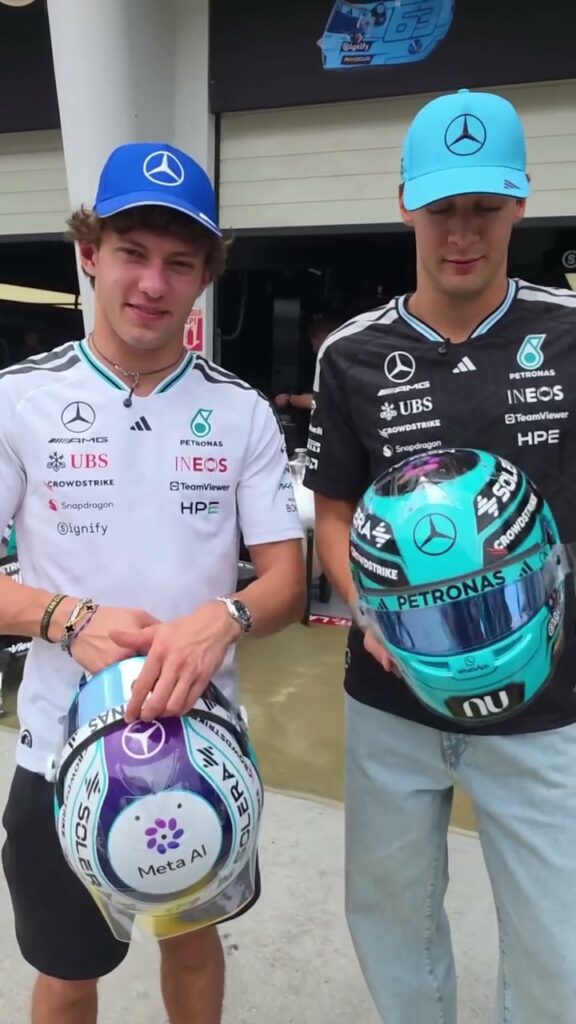
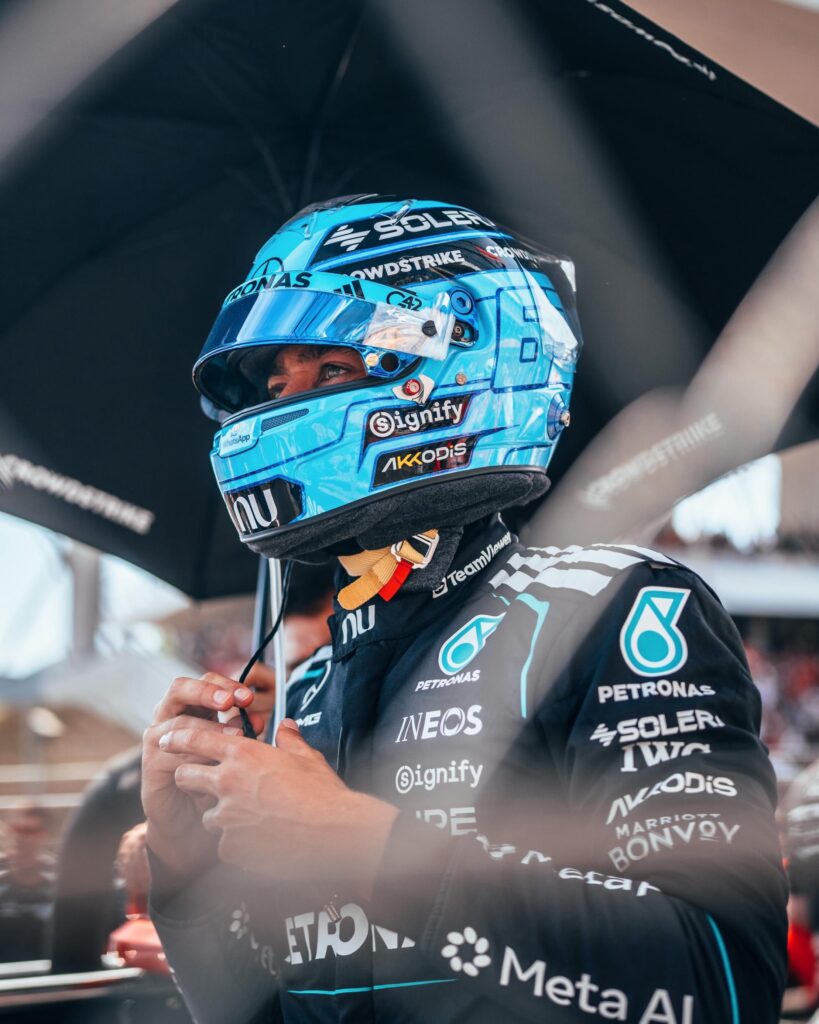
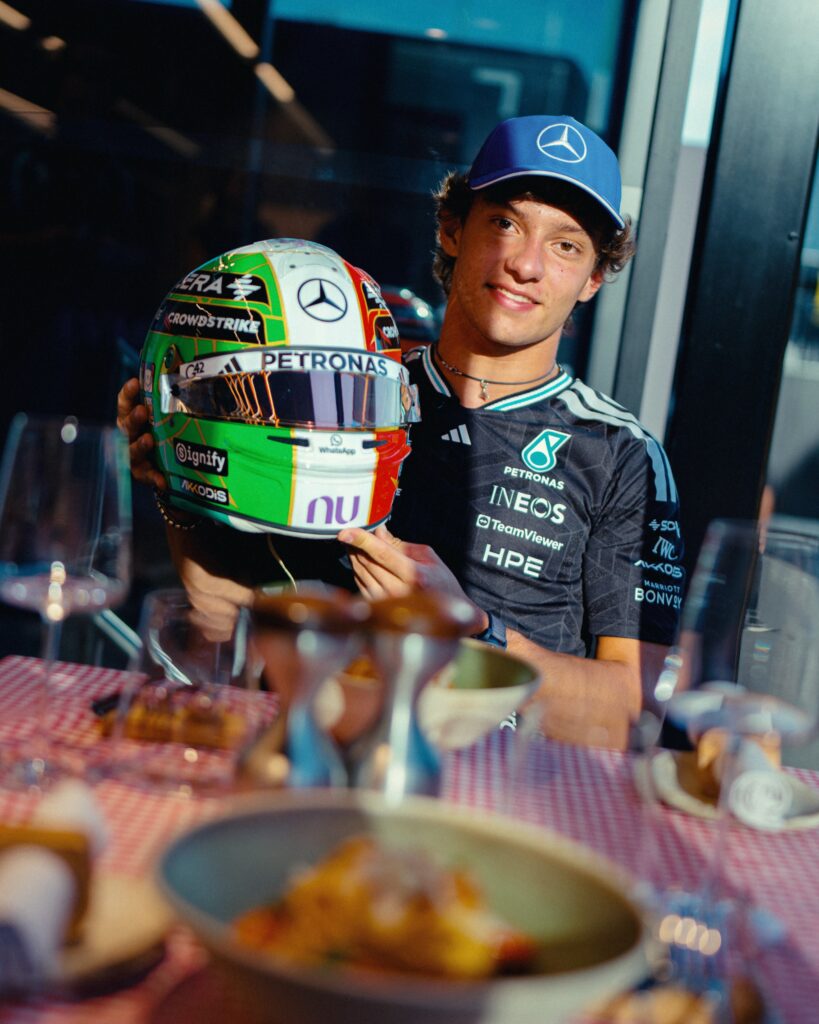
Russell’s home-race helmet for the 2026 British Grand Prix carries additional design elements tied to the Silverstone weekend, sitting on top of his usual Mercedes-Petronas silver and turquoise base shell. Home races are traditionally where drivers add personal flourishes — national color accents, extra graphic detail on the crown, or reworked visor surrounds — and Russell’s Silverstone lid followed that pattern, giving the shell a distinct look compared to his standard-season design.
For collectors, a home-race helmet from a podium weekend carries specific appeal. It marks a single event rather than a full season, it ties directly to a result with a story attached, and it now carries the added cultural weight of the Wolff radio exchange being replayed across broadcast and podcast coverage. A full-size 1:1 display replica of that shell captures the crown graphics, visor strip detailing and base livery exactly as raced, making it a fixed point in a driver’s season rather than a generic year-round design.
The design reveal side of this story is straightforward: nothing about the shell itself changed because of a radio comment, but the demand around it did. A podium finish at a home Grand Prix, paired with a viral team-radio exchange, is precisely the kind of moment that turns a specific helmet into a collector target rather than just another race-weekend variant.
Why Collectors Are Paying Attention Now
Collectors are paying attention to Russell’s 2026 British Grand Prix helmet because the moment now has both an on-track result and an off-track quote attached to it. A second-place finish at Silverstone is notable on its own; a Toto Wolff line being compared to Mark Webber’s 2010 remark by a Formula 1 broadcaster gives the same weekend a second, separate reason to be remembered.
That combination is exactly what pushes race-specific helmets from background merchandise into memorable display pieces. The shell references a real result — second place, inherited through Antonelli’s drop to 15th and a pass on Hamilton during a safety car period — while the radio exchange gives the piece a story fans can point to when the helmet sits in a case or on a shelf. Full-size 1:1 replicas of this kind of helmet are built to reproduce the exact graphics, colorway and finish from the raced weekend, which is what separates an exhibition-quality collector item from a generic team-branded product.
With Fred Vasseur already steering Ferrari’s attention toward Spa rather than title talk, and the paddock still discussing whether the British GP finish should change safety car rules, the Silverstone weekend is shaping up as one of the more heavily discussed rounds of the 2026 season — and Russell’s helmet from that race is positioned right in the middle of that conversation.
“The spiciest slapback on a victory lap radio since Mark Webber said, ‘Not bad for a number two driver.'”
— Alex Jacques, F1 Nation podcast
“He knows the rule book. He plays the games. And he’s thinking about it. He knows he’s not performing at a level he wants.”
— Jolyon Palmer, F1 Nation podcast
FAQ
Q: What did Toto Wolff say to George Russell after the British GP?
Toto Wolff told Russell over team radio, “No, the straightline speed’s fine,” shutting down Russell’s in-lap complaint about a lack of top-speed pace during the 2026 British Grand Prix weekend.
Q: Why is Wolff’s comment being compared to Mark Webber?
Commentator Alex Jacques compared it to Mark Webber’s 2010 “not bad for a number two driver” line because both were unfiltered, loaded radio comments delivered live in the moment of a race result, becoming instantly memorable soundbites.
Q: How did George Russell finish second at the British GP?
Russell inherited second place after team-mate Kimi Antonelli dropped to 15th due to a dislodged wheel shield and a track limits penalty, then Russell passed Lewis Hamilton when the Ferrari driver pitted under the safety car.
Q: What happened to Kimi Antonelli at the British GP?
Antonelli fell to 15th position after suffering a dislodged wheel shield and receiving a track limits penalty during the race, and he was later spotted with Roger Federer at Wimbledon following what has been called a difficult weekend.
Q: Is Russell’s British GP helmet available as a display replica?
Yes, full-size 1:1 collector replicas reproducing home-race liveries like Russell’s Silverstone shell are offered as exhibition-quality display pieces, built to match the graphics and finish from the raced weekend rather than a generic season design.
Shop Mercedes Helmets
Display and collector replicas only. Not certified for protective use. Full-size 1:1 scale.
This article was written with the help of AI tools. Editorial policy