Blog
Russell’s Perfectionist Edge: 2026 Austrian GP Recap
 123Helmets Editorial Team
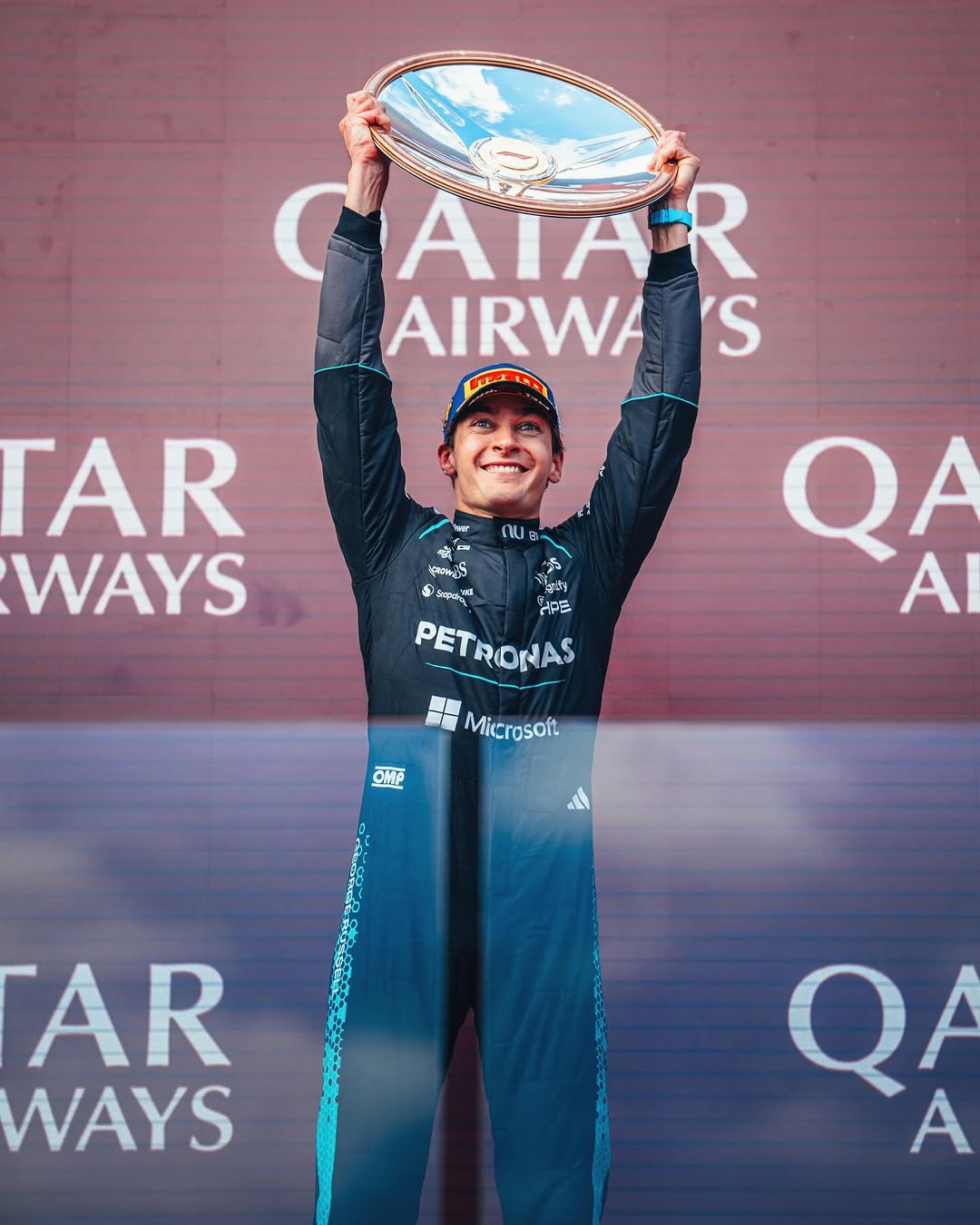
George Russell won the 2026 Austrian Grand Prix by holding his nerve when it counted most — and his former Williams boss Claire Williams says that same perfectionist mindset gives him a genuine psychological edge over championship-leading teammate Kimi Antonelli.
Key Takeaways
Russell won the 2026 Austrian Grand Prix and moved to second in the Drivers’ Championship, closing the gap on Antonelli.
Kimi Antonelli led the standings but dropped points after a qualifying mistake unsettled his entire race weekend.
Claire Williams identified Russell’s self-awareness and daily marginal-gain thinking as the attributes that could win him a world title.
The Antonelli vs Russell helmet and livery contrast at the podium made Austria one of 2026’s most display-worthy visual moments for collectors.
Austria 2026: How Russell Took the Win
George Russell won the 2026 Austrian Grand Prix by managing pressure across every lap at the Red Bull Ring, finishing ahead of two rivals who each held a realistic shot at victory at various points in the race. The win moved him to second in the Drivers’ Championship standings, trimming the gap to his Mercedes teammate Kimi Antonelli, who entered the weekend as points leader but left it having conceded ground after a troubled first stint.
Antonelli’s difficulties stemmed directly from qualifying. A mistake on what would have been his quickest lap forced him to abort the run, costing him a potential front-row start. That frustration carried visibly into the opening corner, where he ran wide enough to compromise his first stint rhythm entirely. By the time he had settled into a clean pace, Russell had already built the kind of buffer that does not evaporate under normal racing conditions.
The gap between the two Mercedes drivers in the final classification reflected not just one bad corner but the accumulated cost of a rattled mental state — exactly the kind of detail that Claire Williams, Russell’s former team principal at Williams F1, says he is uniquely positioned to exploit over a full season.
Claire Williams on the Perfectionist Mindset
Claire Williams stated plainly that Russell has the psychological tools to win a championship battle against a teammate, drawing on her direct experience managing him during his three seasons at Williams between 2019 and 2021.
“From my experience of George, I think he is perfectly capable of winning that psychological battle when it comes to trying to win a world championship, competing for that against your team-mate, who is invariably going to be the hardest competitor or rival that you have, because you’re in the same equipment,” Williams told select media including Motorsport.com.
The core of her argument is not raw speed but self-directed analysis. “What he’s good at — he’s quite self-aware, George — he’ll be sitting there thinking each and every day, ‘What do I need to do in order to surpass my team-mate? How can I win that battle?'” she said.
Williams drew a direct comparison to the 2016 title fight between Lewis Hamilton and Nico Rosberg, where Rosberg’s relentless focus on closing every marginal gap ultimately delivered the championship. “Invariably, in those championships, where team-mates are racing one another — similar to when Lewis and Nico were going up against each other and Nico took it — it’s the psychological battle that wins the war.”
What makes Russell’s case particularly interesting in 2026 is that the gap he needs to close exists against a teammate who is nine years his junior and in only his second full Formula 1 season. Antonelli’s natural speed is not in question. His ability to manage a full season of pressure — qualifying mistakes, pit-wall tension, the weight of a points lead — is still being written.
Antonelli’s Championship Lead and Its Fragility
Kimi Antonelli holds the 2026 Drivers’ Championship lead entering the summer phase of the season, but Austria demonstrated that his margin is not yet insulated against self-inflicted errors. The qualifying mistake that caused him to abort his fastest lap attempt was a single moment, but its effect rippled through Sunday’s entire race. When a driver arrives at the grid having already lost something in qualifying, the deficit is not only in grid position — it is in confidence and composure at the first braking zone.
The first corner incident that compounded Antonelli’s problems was not a racing-contact moment caused by another driver. It was a continuation of an unsettled mental state that Russell — by contrast — did not share. Russell qualified cleanly, started cleanly, and executed his race without the kind of reactive decision-making that tends to produce further errors.
That contrast is what Williams was pointing at. The psychological edge she attributes to Russell is not about intimidating Antonelli or playing mind games. It is about Russell’s daily habit of identifying exactly where he is losing time or position and eliminating that deficit with a precision that his former boss described as the defining characteristic of his approach to the sport.
For Antonelli, Austria is a one-race data point, not a verdict. He remains championship leader. But the gap narrowed, and the mechanism by which it narrowed — his own qualifying error cascading into race-day damage — is the kind of pattern Russell will have catalogued and filed.
Podium Visuals: Helmet and Livery Highlights for Collectors
The 2026 Austrian Grand Prix podium produced one of the season’s strongest collector-display moments, with the Mercedes Silver Arrow livery on the W16 catching the Spielberg afternoon light in a way that made the top step an exhibition-quality visual. For those building a display around this race, the helmet contrast between the two Mercedes drivers on the same podium represents exactly the kind of paired collector narrative that turns a shelf into a story.
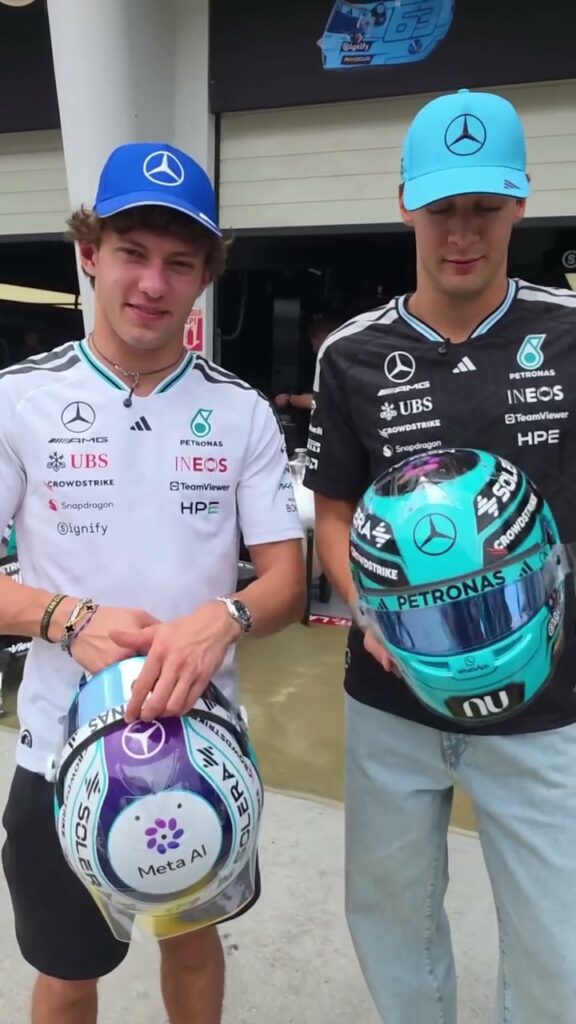
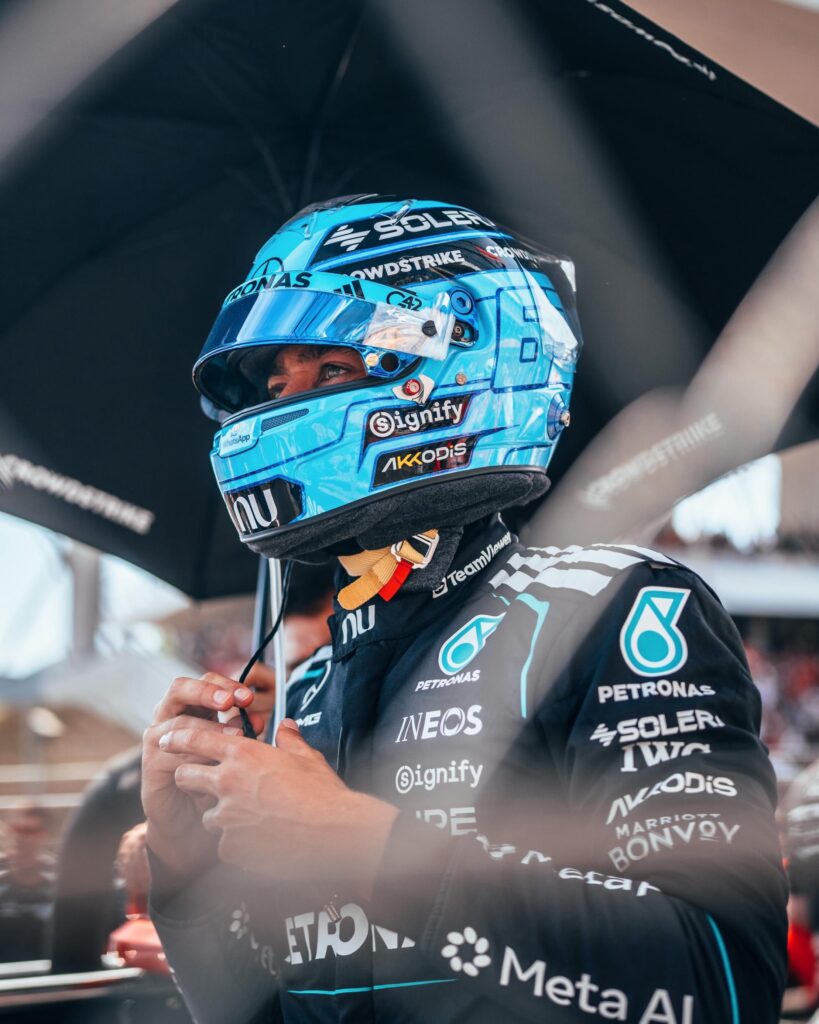
Russell’s race helmet for Austria carried the core silver-and-teal Mercedes identity that has defined his 2026 campaign, with the number 63 rendered in high-contrast white on both sides of the shell. The full-size 1:1 collector replica replicates these graphics at true scale — the standard collector shell sits at approximately 29 × 25 × 35 cm footprint and weighs around 1.2–1.5 kg, making it stable on any display stand without additional mounting hardware.
Antonelli’s helmet, worn across a race that included his recovery drive from a compromised start, carries its own 2026 narrative weight for collectors. The pairing of Russell’s winner’s lid with Antonelli’s championship-leader helmet from the same event creates a display that captures the title fight at a specific, dateable moment: 2026-06-29, Red Bull Ring, Spielberg, Austria.
The visual gap between a race winner’s helmet and a championship leader’s helmet placed side by side is exactly the kind of contextual storytelling that makes display replicas more than decorative objects. Each piece is a full-size 1:1 exhibition-quality replica, not certified for any protective use — these are collector items made to be seen, not worn.
For anyone tracking the George Russell collector range or the broader Mercedes helmet lineup, Austria 2026 represents a win-dated piece with a clear championship narrative attached to it.
The Hamilton–Rosberg Template: What History Says
The 2016 World Championship is the closest modern template for what Russell and Antonelli are building toward in 2026 — two teammates in equal machinery, separated by psychology as much as pace. Claire Williams invoked it deliberately. Nico Rosberg entered 2016 knowing he was operating in the shadow of a driver widely considered one of the greatest in the sport’s history, and he won the championship anyway by refusing to let that shadow dictate his daily decision-making.
Russell’s situation in 2026 has an inverted structure. He is the experienced driver — now in his eighth full Formula 1 season — facing a younger teammate whose natural talent has already put him into the championship lead. The pressure Williams describes is not the pressure of being the underdog. It is the pressure of being the driver who was supposed to have the edge by virtue of experience, and who is currently behind.
That particular psychological pressure — watching someone younger close gaps that experience was supposed to prevent — is the version that breaks some drivers and focuses others. Williams’ point is that Russell belongs to the second category. His response to being behind is not agitation; it is systematic analysis and daily marginal correction. Austria was one output of that process. The second half of the 2026 season will determine whether the process is enough.
From a collector standpoint, the Hamilton–Rosberg narrative added permanent value to every helmet produced from that 2016 season. The parallel with Russell and Antonelli in 2026 is not a guarantee of equivalent historical weight, but the structural similarity is close enough that pieces tied to this specific championship moment — Austria 2026, the weekend Russell moved to second — have a clear story to tell decades from now.
Why Austria 2026 Belongs in a Display Collection
The 2026 Austrian Grand Prix is a collector-tier event because it marks the moment the Mercedes intra-team title fight became publicly, numerically real. Before Austria, Antonelli’s lead was intact and Russell was a threat in theory. After Austria, the gap closed, the qualifying-mistake narrative was established, and the psychological framing from Claire Williams gave the contest a named dynamic: the perfectionist versus the prodigy.
That kind of named, dateable narrative is what separates a helmet bought in 2026 from one that accumulates meaning as the season resolves. The George Russell Austria race winner replica and the Mercedes team display pieces from this event sit at the intersection of a live championship story and a clearly defined psychological subplot.
Every full-size 1:1 collector replica in the 123Helmets range is an exhibition-quality display piece. None are certified for protective use, road use, or track use. They exist to capture a moment at true scale — and Austria 2026, with its title-fight subtext and podium-quality visuals, is a moment worth capturing.
“From my experience of George, I think he is perfectly capable of winning that psychological battle when it comes to trying to win a world championship, competing for that against your team-mate, who is invariably going to be the hardest competitor or rival that you have, because you’re in the same equipment.”
— Claire Williams, former Williams F1 Team Principal
“What he’s good at — he’s quite self-aware, George — he’ll be sitting there thinking each and every day, ‘What do I need to do in order to surpass my team-mate? How can I win that battle?'”
— Claire Williams, former Williams F1 Team Principal
“Invariably, in those championships, where team-mates are racing one another — similar to when Lewis and Nico were going up against each other and Nico took it — it’s the psychological battle that wins the war.”
— Claire Williams, former Williams F1 Team Principal
FAQ
Q: Who won the 2026 Austrian Grand Prix?
George Russell won the 2026 Austrian Grand Prix, driving for Mercedes. The win moved him to second in the Drivers’ Championship, narrowing the gap on teammate and points leader Kimi Antonelli.
Q: Why did Kimi Antonelli struggle at the 2026 Austrian GP?
Antonelli made a qualifying mistake that forced him to abort his fastest lap, costing him a potential front-row start. That error carried into Sunday’s race, where an untidy first corner compounded his first-stint difficulties and he finished behind Russell.
Q: What did Claire Williams say about Russell’s psychological edge?
Claire Williams said Russell’s self-awareness and daily habit of identifying exactly what he needs to do to surpass his teammate give him the ability to win the psychological battle of a championship fight. She drew a direct parallel to how Nico Rosberg beat Lewis Hamilton in 2016.
Q: Are the George Russell Austria 2026 helmets at 123Helmets wearable?
No. Every helmet in the 123Helmets range is a full-size 1:1 collector and display replica only. They are exhibition-quality pieces and are not certified for protective, road, or track use.
Q: What are the display dimensions of a full-size F1 helmet replica?
A standard full-size 1:1 F1 helmet replica has a footprint of approximately 29 × 25 × 35 cm and weighs around 1.2–1.5 kg, making it stable on most display surfaces without additional mounting hardware.
Shop Mercedes Helmets — add a piece of the 2026 title fight to your collection. Full-size 1:1 display replicas, exhibition quality, not for protective use.
Display and collector replicas only. Not certified for protective use. Full-size 1:1 scale.
This article was written with the help of AI tools. Editorial policy