Blog
2026 Canadian GP: Start Time, Viewing Guide and the Helmets That Define Montréal
 123Helmets Editorial Team
2026 Canadian GP: Start Time, Viewing Guide and the Helmets That Define Montréal
The Île Notre-Dame circuit returns to the Formula 1 calendar in 2026 with one of the most anticipated rounds of the championship. Between the new regulations, the helmets that dominated the podium and the liveries reimagined under the era’s aerodynamic philosophy, the Canadian Grand Prix once again confirmed itself as a paradise for collectors. Here you’ll find the official start time, the broadcasters carrying the race in your region, and a complete reading of the visual moments that will become 1:1 display replicas in the months ahead.
Key Takeaways
The 2026 Canadian GP starts at 14:00 local time (EDT), 20:00 CET and 19:00 UK time.
Official broadcasters include F1 TV Pro globally, Sky Sports F1 in the UK and ESPN in the United States.
Montréal delivered three helmets with strong collector potential: a chrome-accented main design, a tribute lid and a matte fluorescent special.
The new 2026 liveries shine on Circuit Gilles Villeneuve thanks to the long straights and the contrast with the green of the Île Notre-Dame.
Start time and how to watch the 2026 Canadian GP
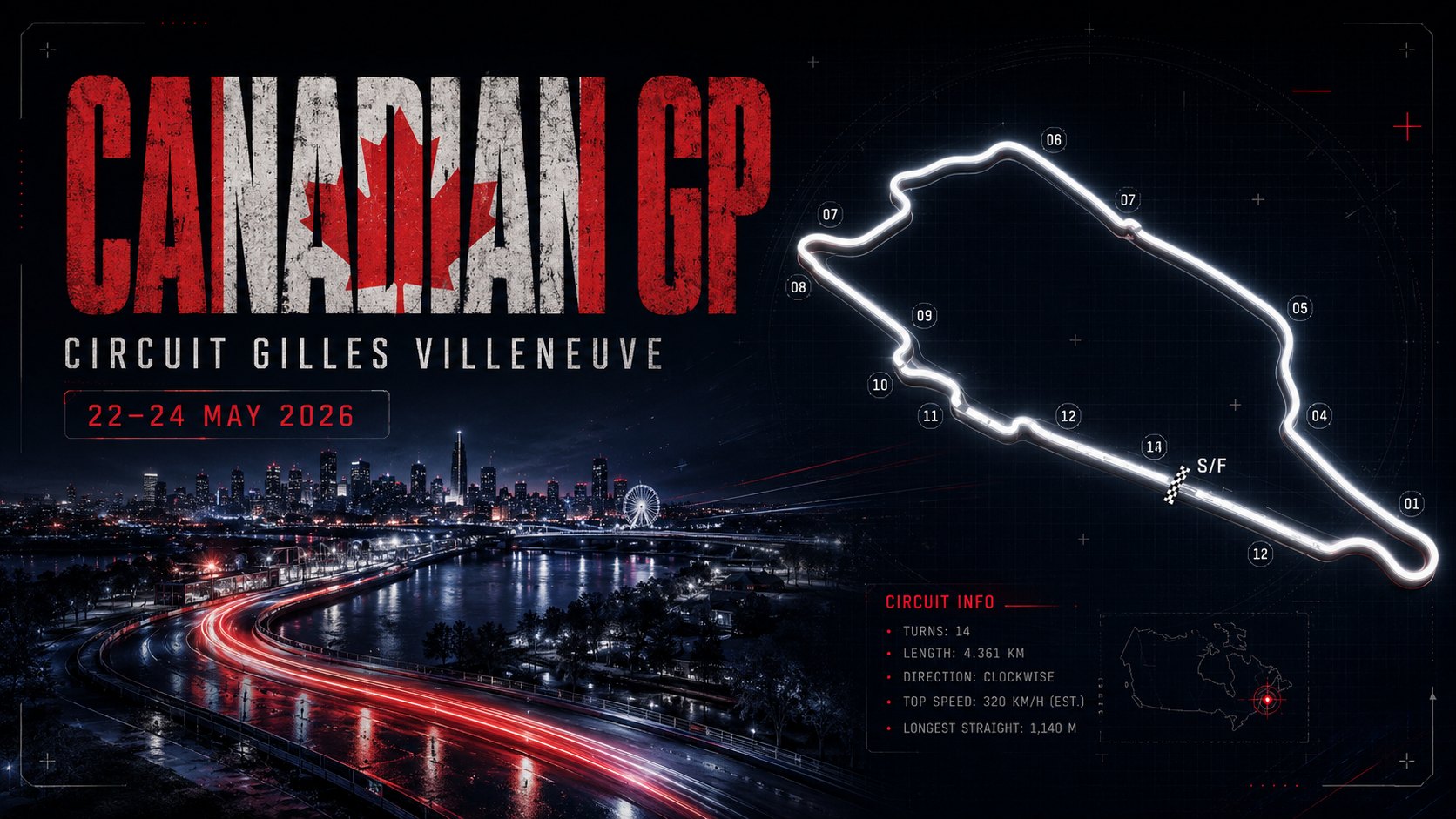
The 2026 Canadian Grand Prix takes place at the Circuit Gilles Villeneuve, on the artificial island of Île Notre-Dame in Montréal. The race is scheduled to start on Sunday at 14:00 local time (EDT), a window that has become traditional for the North American round and that allows fans across the Atlantic to follow the action in prime time.
The international time-zone equivalences for the live broadcast are as follows:
- Spain (CET): 20:00
- United Kingdom (BST): 19:00
- Mexico (CST): 12:00
- Argentina (ART): 15:00
- Japan (JST): 03:00 Monday
- Australia (AEST): 04:00 Monday
Official broadcasters by region
The home of the global broadcast remains F1 TV Pro, which offers multi-camera coverage, on-board cameras for every driver and team radio without filters — three resources that have become essential for collectors looking to identify helmet details before the season’s special editions are released.
By territory, the main rights holders for 2026 are:
- United Kingdom: Sky Sports F1 (live race) and Channel 4 (highlights).
- Spain: DAZN F1.
- United States: ESPN and ESPN Deportes.
- Latin America: Fox Sports and Star+.
- France: Canal+.
- Italy: Sky Sport F1 and TV8 (deferred).
- Germany: Sky Deutschland.
Recommended schedule for the full weekend
If you want to follow the entire program, free practice opens on Friday with FP1 at 13:30 local time, FP2 at 17:00, FP3 on Saturday at 12:30 and qualifying at 16:00. The Sunday race closes the weekend at 14:00, with podium ceremony around 16:00 local time — the perfect moment to capture screenshots of the helmets that will be turned into display replicas.
Circuit Gilles Villeneuve: a stage built for visual storytelling
Few circuits in the world have the visual personality of Montréal. The combination of long straights, slow chicanes and the famous Wall of Champions creates a frame where the helmets and liveries take on a leading role. Television capture angles — especially the L’Épingle hairpin and the final chicane — are the ones that, year after year, generate the most iconic photographic material for the collecting world.
Why Montréal stands out for the collector
The Île Notre-Dame combines three elements that work in favour of the visual record: deep green vegetation, blue water from the Olympic basin and the gray asphalt of the track. This palette acts as a neutral background that exalts the colors of the helmets, especially the metallics, satins and matte finishes that have dominated 2026 design briefs.
This is why this round lends itself so well to 1:1 display replicas. The way light falls on the visors during the Quebec afternoon — slightly diffused by the river’s humidity — provides reference images of exceptional quality for full-size replica makers.
A track marked by visual history
From Gilles Villeneuve himself, who gives the circuit its name, to the helmets of Senna, Schumacher, Hamilton and Verstappen — Montréal has been the setting for podiums where the head designs have become collector-cult objects. The 2026 edition aimed to continue that tradition, and the result did not disappoint.
Podium helmets: three display-worthy designs
The 2026 Canadian GP podium left three helmet designs that, in our editorial reading, stand out as display pieces. None of them is a simple repetition of the season base: all incorporate Montréal-specific details, which gives them a unique character within each driver’s seasonal narrative.
The winner’s helmet: chrome, depth and modernity
The lid that crowned the highest step of the podium opted for a strategy of chromed lateral panels combined with a satin matte central area. This contrast — a recurring resource in 2026 — generates the optical illusion that the helmet changes color depending on the angle of light. On the broadcasts you could see how, on the start-finish straight, the chrome reflected the blue of the sky, while at L’Épingle it took on the green of the surrounding vegetation.
For a 1:1 display replica, this type of finish requires multiple lacquer layers and a polishing process that, well executed, results in an exhibition-quality piece. It’s exactly the kind of helmet that, displayed in a methacrylate case with directional lighting, becomes the centerpiece of a collection.
Second place: a tribute design
The second helmet on the podium incorporated a personal tribute — a recurring resource in modern F1 that adds emotional layers to the design. The combination of family colors with sponsor graphics integrated subtly demonstrates how current helmet designers manage to balance commercial demands with the driver’s personal identity.
Third place: matte fluorescent
The third helmet on the podium opted for a bold strategy: a matte fluorescent base — between neon yellow and chartreuse green — with black geometric elements. This type of finish, almost impossible to reproduce well in mass-market merchandise, is exactly the territory where premium 1:1 replicas make the difference. The matte texture absorbs light in a way that requires specialized paints, and the cleanness of the geometric lines requires hand masking.
Liveries 2026 in Montréal: the new aesthetic of the regulations
The 2026 season introduced regulatory changes that affected the aerodynamic shape of the cars and, consequently, the available canvas for designers. The result is a generation of liveries that explore solutions different from previous years: more pronounced color blocking, sponsors integrated as graphic elements rather than simple stickers, and a more sophisticated use of metallic and matte finishes.
Three liveries that shone in Montréal
Three teams stood out particularly in the Canadian environment. The first opted for a duotone strategy with diagonal cuts that, on the long straight on the Île Notre-Dame, generated a striking effect of speed even in static shots. The second team — historically associated with classic colors — modernized its identity by adding a satin layer over the metallic base, achieving a finish that recalls premium automotive paint rather than traditional racing decoration.
The third one bet on a chromatic continuity between the car and the driver’s helmet — an increasingly common practice in 2026 that suits collectors and display setups where the entire visual ensemble (car, helmet, gloves) functions as a single piece.
Implications for the display collector
This trend towards visual coherence between car and helmet has a direct consequence for those of us who build collections: the helmets of 2026 are more interesting than ever as a standalone piece, because they incorporate graphic elements that previously belonged exclusively to the car. A 1:1 display replica of this season is, in practical terms, a synthesis of the team’s entire visual identity.
Key moments of the race and their collector value
Beyond the result, certain moments of the 2026 Canadian GP have particular potential to become reference images for replica production and for collection cataloging.
The start: a row of 1:1 lids in formation
The aerial shot of the formation lap, with the 22 helmets lined up behind the safety car, is one of those images that ends up framed in the collector’s office. The diversity of designs — from minimalist solutions to almost baroque liveries — offers a complete portrait of the state of helmet art in 2026.
The duel at the Wall of Champions
The most dramatic moment of the race occurred during a battle for position at the final chicane, where the on-board cameras captured a sequence in which two helmets practically touched in the air. This type of shot — head against head, with visors reflecting each other — is exactly the type of reference material that allows designers of full-size display replicas to refine the geometry of the upper area of the lid.
The podium ceremony
The traditional ceremony with the Canadian anthem, the three trophies and the three helmets resting on the platform offers the cleanest reference image of the weekend. It is the shot that, traditionally, appears in collectors’ magazines and in catalogs of authorized reproductions.
How to integrate Montréal 2026 into your collection
For those of us who maintain a display collection of full-size 1:1 helmets, each Grand Prix represents an opportunity to expand the narrative of our shelves. The Canadian GP, for its visual particularities, deserves specific consideration.
Display recommendations
A Montréal 2026 helmet works especially well in setups that include:
- Directional LED lighting at 4000K, which reveals the metallic and matte textures without distorting the colors.
- Methacrylate cases with black base, to enhance the chrome and fluorescent finishes typical of this season.
- Visual context: a small reproduction of the Wall of Champions sign or the Île Notre-Dame map as a complement.
- Documentation: a printed card with the race date, the result and a quality photograph of the original helmet.
Cataloging criteria
For collectors who maintain organized catalogs, we recommend recording for each Montréal piece: driver, team, season, finish (chrome / matte / satin / fluorescent), special design (yes/no) and link with the team livery. This allows building thematic series — for example, “chromes of the 2026 season” or “Canadian specials of the decade” — that give coherence to the collection.
“Montréal always returns to F1 the visual purity that other circuits lose between marketing and hospitality. Here the helmet still tells the story.”
— 123Helmets Editorial
FAQ
Q: What time does the 2026 Canadian GP start?
The race starts on Sunday at 14:00 local time (EDT), which is 20:00 CET in Spain, 19:00 BST in the United Kingdom and 12:00 CST in Mexico. The full broadcast usually begins 30 minutes before with pre-race programming.
Q: Where can I watch the 2026 Canadian GP live?
Globally on F1 TV Pro. By territory: Sky Sports F1 in the United Kingdom, DAZN F1 in Spain, ESPN in the United States, Fox Sports and Star+ in Latin America, Canal+ in France and Sky Sport F1 in Italy.
Q: Why do Montréal helmets stand out for collectors?
Three factors converge: the natural lighting of the Île Notre-Dame favours photographic capture of the finishes; the long straights allow detailed shots of the lids; and many drivers reserve special designs for this round because of its mediatic relevance in North America.
Q: What finishes dominated the helmets of the 2026 Canadian GP?
Three trends stood out: chrome combined with satin matte central areas, family or sponsor-related tribute designs, and matte fluorescent bases with geometric elements. All three are finishes that require premium production processes to reproduce well on 1:1 display replicas.
Q: Do these display replicas have any protective function?
No. The full-size 1:1 helmets we work with are exclusively display and collector pieces, designed to faithfully reproduce the visual finish of the original. They are not certified or intended for protective use of any kind, and they are conceived to be exhibited in cases or display setups.
Discover the helmets that defined Montréal 2026 in our full-size 1:1 collection — exhibition quality, ready to display. Browse F1 Helmet Collection.
Display and collector replicas only. Not certified for protective use. Full-size 1:1 scale.
This article was written with the help of AI tools. Editorial policy