Blog
Who Impressed Our Judges in Canada? Antonelli’s Montreal Statement
 123Helmets Editorial Team
Who Impressed Our Judges in Canada? Antonelli’s Montreal Statement
Montreal delivered one of the season’s most visually striking weekends, and at the heart of it stood Kimi Antonelli — the Italian rookie whose composure, racecraft and unmistakable helmet design earned a place in our judges’ top picks. From the cinematic glow of the Île Notre-Dame paddock to the podium silhouettes under Quebec skies, this was a Grand Prix that begged to be framed, displayed and remembered.
Key Takeaways
Kimi Antonelli delivered a composed, mature drive in Montreal that impressed our judging panel on craft and presentation
His helmet livery in Canada showcased display-worthy contrast, with bold graphics built for collector lighting
The Île Notre-Dame paddock produced some of the most photogenic podium visuals of the 2025 season
Montreal reinforced why full-size 1:1 replica helmets remain the centerpiece of any serious F1 display collection
A Montreal weekend made for the display cabinet
There are races that pass quietly into the archive, and there are races that immediately announce themselves as future collector touchstones. The Canadian Grand Prix belonged firmly in the second category. From the moment the cars rolled out for opening practice, the Île Notre-Dame circuit framed every helmet, every visor strip and every sponsor decal in that distinctive Montreal light — a low, silvered glow filtered through the St. Lawrence waterway that turns ordinary liveries into gallery pieces.
Our editorial judges spent the weekend logging the moments most likely to translate into striking display narratives back home. We watched for the angles a collector would instinctively recognise: the helmet leaving the garage, the visor closing on the grid, the post-session walk back through the paddock. Canada produced an unusual abundance of those frames, and one driver in particular kept appearing in our notebooks.
Kimi Antonelli arrived in Montreal carrying the kind of expectation that bends most rookies out of shape. Instead, the Italian seemed to expand into it. His weekend wasn’t flawless — no rookie weekend ever is — but the way he handled the pressure, the visual identity he projected, and the maturity of his on-track decisions made him the clear focus of our judging panel’s Canadian review.
Why Montreal flatters helmet design
Few circuits work as hard for helmet photography as Circuit Gilles Villeneuve. The barrier-lined chicanes, the famous Wall of Champions, the long pit straight bordered by the metallic Casino de Montréal — every backdrop offers contrast. Dark helmets pop. Fluorescent accents glow. Matte finishes catch the diffused light in a way that no studio render can replicate. For collectors who track helmet aesthetics race by race, Canada is essential viewing.
Antonelli’s helmet: youth, identity and collector appeal
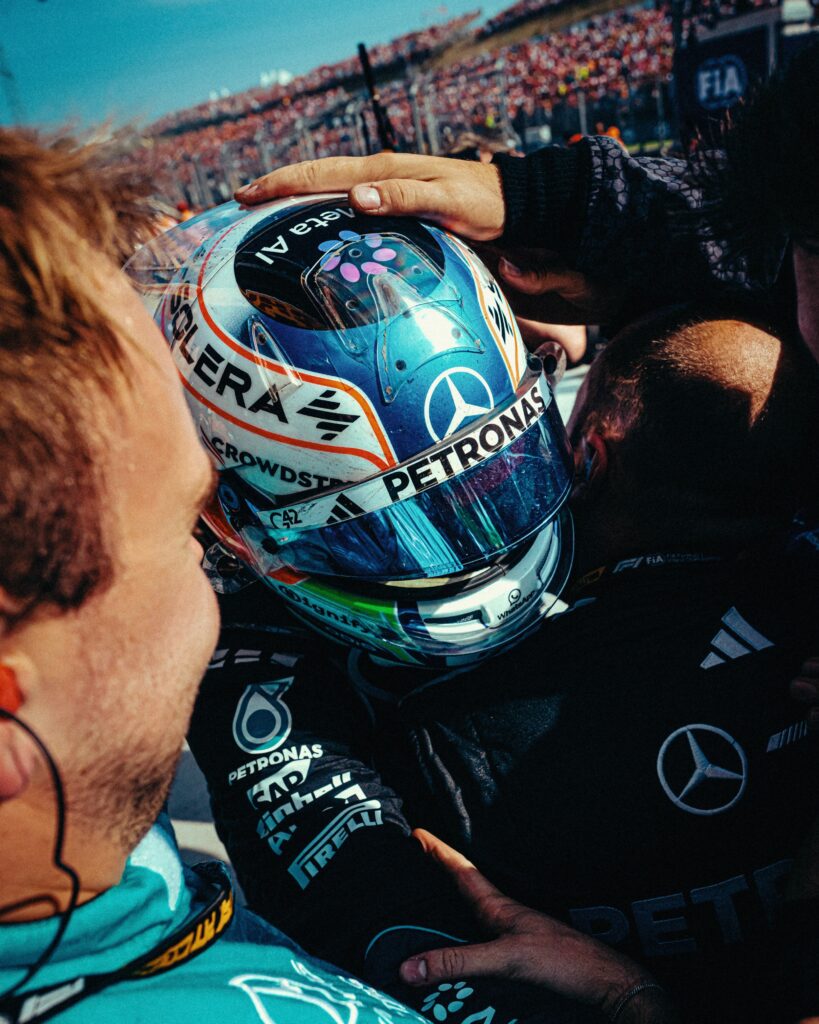
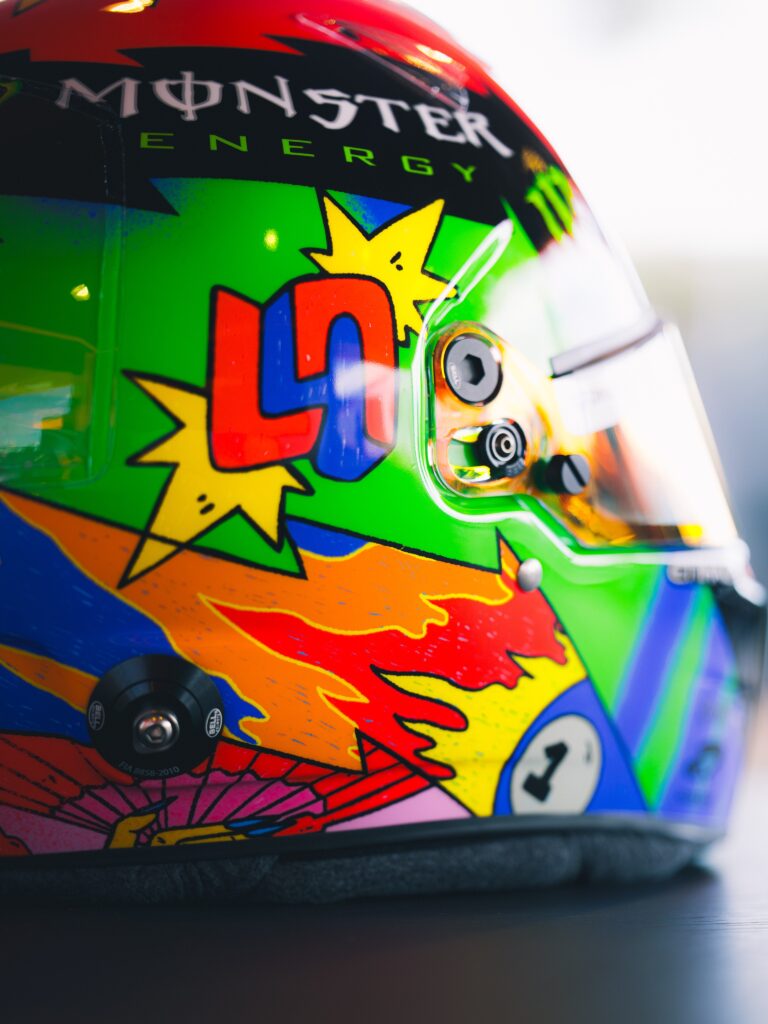
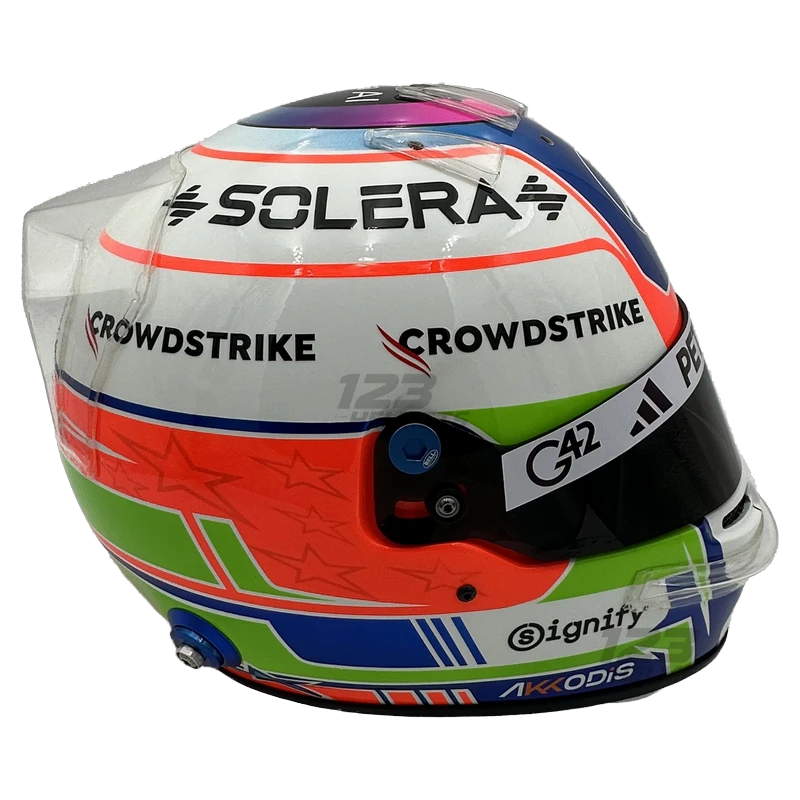
The Antonelli helmet that appeared in Montreal continues to refine a visual identity that’s quickly becoming one of the most recognisable on the current grid. Without revealing every design element — collectors will want to study the details themselves — the overall composition leans on clean geometric blocks, a strong central spine and a contrast palette that reads instantly from television to trackside to display shelf.
What our judges valued most was the discipline of the design. Modern F1 helmets are increasingly cluttered, sometimes carrying so many sponsor obligations that the underlying personality of the driver disappears. Antonelli’s approach resists that drift. The negative space is intentional. The typography is restrained. The lines flow with the curvature of the shell rather than fighting it. This is exactly the kind of design language that translates beautifully into a full-size 1:1 replica intended for long-term display.
Reading a helmet like a collector
When we assess a helmet for collector merit, we ask four questions. Does it photograph well from multiple angles? Does the colour palette hold up under both warm and cool display lighting? Are the graphics balanced from above, the angle most often seen on a shelf or in a display case? And does the design carry narrative — a story, a heritage cue, a personal symbol — that rewards repeated viewing?
Antonelli’s Montreal helmet ticked every box. The top-down view, in particular, is one of the most considered on the grid, which matters enormously for collectors who position their replicas on plinths or open shelving. It’s a design that earns its space rather than simply occupying it.
Visor strip and finishing details
The visor strip remains one of the most overlooked signature elements in modern helmet design. Antonelli’s choice in Canada continued a season-long thread of subtle personalisation, the kind of detail that separates a casual viewer from a true collector. On a 1:1 replica, this is the element your eye returns to every time you walk past the cabinet.
The drive that won the judges over
Helmet aesthetics open the conversation, but on-track performance closes it. Antonelli’s Canadian weekend was a study in measured aggression. He didn’t chase headlines in qualifying with a single ragged lap; he built his sessions methodically, banking laps, learning the circuit’s notorious low-grip braking zones and gradually unlocking pace as conditions evolved.
The race itself rewarded that approach. Montreal punishes drivers who arrive on race day still searching for confidence. Antonelli arrived with it already secured. His opening laps were clean, his tyre management on the medium compound was notably patient, and his communication with the pit wall — judging by the snippets broadcast — carried the calm cadence of a far more experienced driver.
Wheel-to-wheel maturity
Two moments in particular stood out to our judges. The first was a defensive sequence through the final chicane where Antonelli held his line without overreacting, denying the move while preserving his exit speed. The second was a measured overtake into the hairpin, executed with the kind of late-braking precision that usually takes a driver a full season to develop. Neither moment was spectacular in the highlight-reel sense, but both were precisely the kind of craft that collectors and connoisseurs notice.
This is what separates an impressive rookie season from a notable one. Antonelli isn’t merely surviving Formula 1 — he’s already shaping races. Montreal was the clearest evidence yet.
Podium visuals and paddock atmosphere
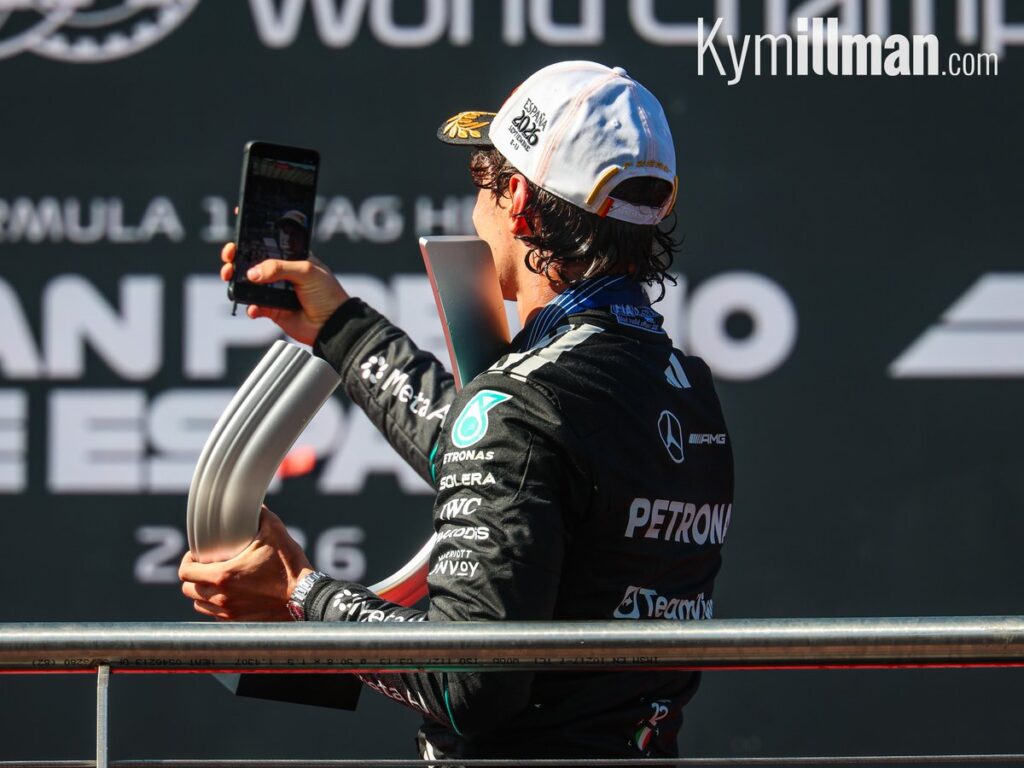
The Canadian podium ceremony is one of the sport’s most photogenic, set against the lattice of the original podium architecture and the deep green of the surrounding parkland. Even on weekends when the racing itself is uneven, the podium imagery from Montreal tends to age beautifully — and 2025 was no exception.
Our judges spent considerable time reviewing the podium frames for display-worthy moments. The way helmets are removed and held, the angle of the trophies, the spray of celebratory liquid catching the late-afternoon sun — all of it contributes to the narrative that a serious collector eventually builds around a season. A full-size 1:1 replica on a shelf becomes far more meaningful when it’s anchored to a specific memory, a specific frame, a specific Sunday.
Why Canada matters for the collector calendar
Among the twenty-four rounds of a modern F1 season, only a handful deliver this combination of architectural backdrop, natural lighting and circuit character. Monaco offers glamour. Suzuka offers heritage. Spa offers drama. Montreal offers something subtler — a North American elegance that flatters every helmet design that passes through it. For collectors building themed displays around specific venues, Canadian Grand Prix imagery is among the most reliably beautiful in the calendar.
Antonelli’s paddock presence
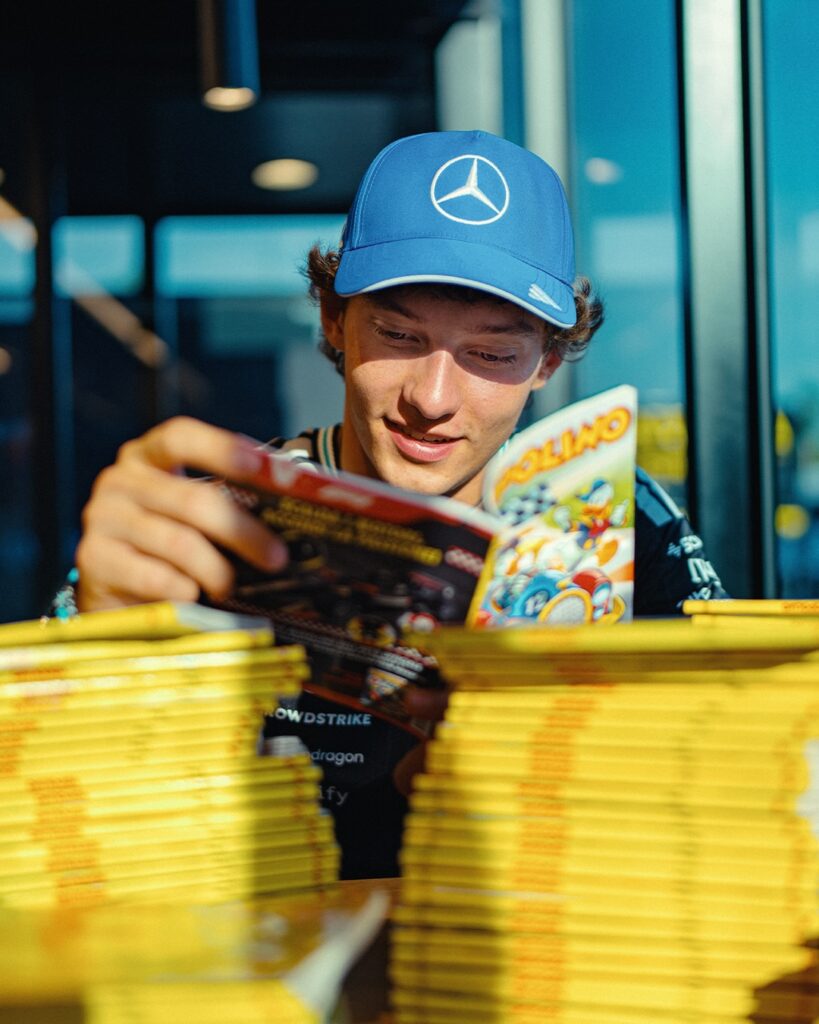
Beyond the racing, Antonelli’s paddock conduct continued to impress. The composure with media, the relaxed body language with engineers, the visible bond with his mechanics — these are the off-track signals that suggest a driver settling into the sport rather than being overwhelmed by it. Display collectors often underestimate how much these intangibles influence the long-term collectibility of a driver’s helmet line. They shouldn’t.
What our judges considered, and how Antonelli ranked
Our Canadian Grand Prix judging framework rests on four pillars: on-track craft, helmet design coherence, weekend narrative and display translatability. Each driver under consideration is scored on how well their weekend, viewed as a complete visual and competitive package, would reward a collector who chose to commemorate it.
The four pillars in detail
On-track craft measures the quality of the driving itself — racecraft, tyre management, qualifying execution, error count. Antonelli scored highly here, with our panel noting the consistency of his sector times and the discipline of his racing lines.
Helmet design coherence assesses how well the helmet works as a standalone object. Would it look striking under cabinet lighting? Does the design hold up at every angle? Antonelli’s Montreal helmet scored among the highest of the weekend on this measure.
Weekend narrative captures the story arc — the progression from Friday to Sunday, the moments of pressure handled or fumbled, the sense that something memorable occurred. Antonelli’s arc through the weekend was textbook: build, refine, deliver.
Display translatability is our most collector-specific criterion. It asks whether the weekend’s defining image could anchor a display — whether a 1:1 replica helmet, positioned beneath a framed print of a key moment, would create a coherent and emotionally resonant exhibit. Antonelli’s Canadian weekend offered multiple such images.
Where he landed
The final ranking placed Antonelli firmly among the weekend’s standout figures. Not necessarily because his result was the highest on paper, but because the combination of craft, identity and presentation reached a standard that few of his rivals matched. For a rookie, in Montreal, this was a significant statement.
Building a Canadian Grand Prix display around Antonelli
For collectors inspired by what Montreal produced, there’s a clear path to building a meaningful display around this weekend. Start with the helmet — a full-size 1:1 replica remains the anchor of any serious F1 exhibit. Position it at eye level if possible, with lighting that flatters both the matte and gloss elements of the finish. Use warm-cool mixed lighting rather than a single source, which tends to flatten the design.
Framing the narrative
Around the helmet, build context. Framed prints of key Montreal moments, a printed circuit map, perhaps a small plaque noting the date and key statistics. Avoid clutter — the helmet itself should remain the focal point, the gravitational centre that everything else orbits.
Collectors often ask how many replicas a single driver’s career justifies. There’s no fixed answer, but Antonelli’s first full season is already producing the kind of weekend-defining helmet imagery that suggests several display-worthy moments still to come. Montreal will not be the last.
A note on authenticity and presentation
Whatever you choose to display, the principle remains constant: presentation matters. A 1:1 replica helmet treated as the centrepiece of a considered exhibit communicates something entirely different from one left casually on a desk. The helmet is the artefact. The display is the storytelling. Antonelli’s Canadian weekend gave collectors plenty of material for both.
“The Montreal light flatters certain helmet designs in a way no studio render can replicate — Antonelli’s livery seemed engineered for it.”
— 123Helmets Editorial Panel
“What separates a strong rookie weekend from a notable one isn’t the highlight reel — it’s the craft visible only to those watching closely.”
— Senior Judge, Canadian GP Review
FAQ
Q: What made Kimi Antonelli stand out at the Canadian Grand Prix?
Our judges highlighted the combination of mature racecraft, composed wheel-to-wheel decisions and a helmet design that translates exceptionally well into collector display. Montreal showcased him as a complete package rather than simply a fast rookie.
Q: Why is the Canadian Grand Prix considered photogenic for helmet collectors?
Circuit Gilles Villeneuve offers diffused Montreal light, varied architectural backdrops and a famously cinematic podium setting. These elements flatter helmet liveries and produce imagery that translates beautifully into long-term display references.
Q: What should I look for in a 1:1 replica helmet for display?
Focus on finish quality, design accuracy from every angle (especially top-down, where it sits in a cabinet), visor strip detailing and how the colour palette behaves under your intended display lighting. These are full-size collector pieces intended for exhibition, not protective use.
Q: How do your judges evaluate a driver’s Grand Prix weekend?
We use four pillars: on-track craft, helmet design coherence, weekend narrative and display translatability. Each measures how well the weekend, as a complete visual and competitive package, rewards a collector commemorating it.
Q: Is Antonelli’s helmet design a strong choice for a collector display?
In our judges’ view, yes. The disciplined use of negative space, balanced top-down composition and restrained typography make it one of the more display-friendly designs on the current grid — ideal for cabinet lighting and themed exhibits.
Explore display-worthy 1:1 replica helmets inspired by the season’s standout moments. Browse F1 Helmet Collection.
Display and collector replicas only. Not certified for protective use. Full-size 1:1 scale.