
Blog
Leclerc’s Toughest Weekend: How Ferrari and Hamilton Plot the Recovery Arc
 123Helmets Editorial Team
Leclerc’s Toughest Weekend: How Ferrari and Hamilton Plot the Recovery Arc
Charles Leclerc called it the most difficult weekend of his Formula 1 career, and the Ferrari garage reflected that tension from Saturday qualifying through Sunday’s checkered flag. Yet inside the same red walls, Lewis Hamilton’s helmet — that unmistakable yellow lid now framed by Maranello scarlet — offered a different narrative: composure, experience, and a long-game perspective. This recap looks at how Ferrari recovers, what Hamilton’s body language told us, and why this weekend already belongs in the collector’s memory as a defining chapter of the Scuderia’s modern era.
Key Takeaways
Leclerc described the weekend as the most difficult of his F1 career, citing pace deficit and strategy fallout.
Lewis Hamilton’s yellow helmet against Ferrari red continues to define the most photographed visual pairing of the season.
Ferrari’s recovery plan focuses on setup direction, tyre management and internal communication ahead of the next round.
The weekend produced several display-worthy podium and parc fermé frames now circulating among 1:1 replica collectors.
A weekend Leclerc will not forget
When Charles Leclerc stepped out of his SF-25 on Sunday evening, the words came slowly and carefully. “Probably the most difficult weekend of my career,” he admitted to the assembled media, his prancing horse helmet tucked under one arm. The Monegasque is not a driver prone to hyperbole, which is precisely why the statement landed so heavily inside the Ferrari hospitality and across the paddock.
The difficulty, as Leclerc explained, was layered. It was not a single mistake, a single corner, or a single radio message. It was the accumulation: a qualifying lap that never quite came together, a race start that compromised his strategic window, and a stint pace that simply refused to match the leading group. For a driver who has built his reputation on extracting tenths from cars that should not produce them, Sunday felt like pushing against a closed door.
Inside the garage, engineers were already pivoting toward analysis mode before the cars had cooled. The Ferrari debrief, traditionally one of the longest on the grid, stretched well past sundown. Telemetry overlays between Leclerc and Hamilton became the central exhibit — not as a comparison of blame, but as a map of where the car’s narrow operating window had collapsed under Leclerc’s specific setup direction.
What “difficult” actually means in F1 terms
For collectors and long-time fans, it is worth pausing on the language. Drivers describe weekends as “tricky,” “compromised,” “frustrating.” Reaching for “most difficult of my career” is a different register entirely. It signals that the internal benchmark — the driver’s own sense of control over the car — was breached. That admission, raw and public, is part of what makes this weekend already historically charged for those who archive F1 memorabilia season by season.
Hamilton’s quiet weekend in Ferrari red
While Leclerc absorbed the spotlight of struggle, Lewis Hamilton’s race ran on a different emotional frequency. The seven-time World Champion has now logged enough Grands Prix in Ferrari overalls to make the imagery feel less like a transplant and more like a continuation. His helmet — the yellow base color first worn in his karting years, refined across two decades of top-flight competition — stood out vividly above the Scuderia’s deep red headrest in every onboard frame.
Hamilton’s pace was not headline-grabbing, but it was instructive. He extracted a finishing position that, while not on the podium, kept Ferrari’s constructors’ tally moving in the right direction. More importantly, his post-race comments struck the tone of a senior figure stabilizing the room: acknowledging the team’s pain, sharing accountability, and pointing forward to specific corners and specific phases where lap time remains accessible.
The helmet that anchors every shot
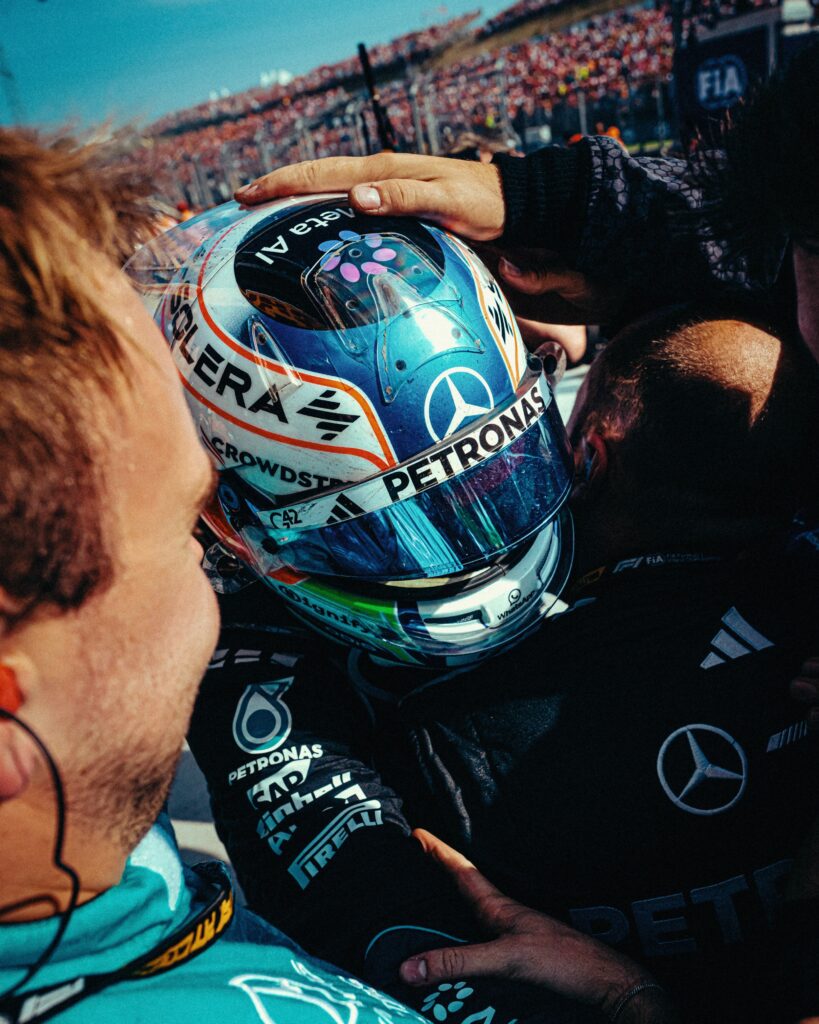
From a visual and collector perspective, Hamilton’s lid continues to do extraordinary work. The yellow is unmistakable in long-lens trackside photography. Against Ferrari’s matte red and carbon-black halo, the contrast produces frames that print beautifully and display even better. Several images from this weekend — Hamilton emerging from the cockpit, helmet still on, eyes fixed forward — are already being flagged within the collector community as candidates for full-size 1:1 replica display reference. These are exhibition-quality moments, the kind that justify a dedicated shelf or lit cabinet.
It is also a reminder that Hamilton’s helmet program, even within Ferrari’s strict visual identity, retains its personal signature. The base yellow is not a Ferrari color. It is a Hamilton color. Pairing the two on every grid walk is, in itself, a piece of motorsport history that collectors are now actively documenting.
How Ferrari plans to recover
Recovery, in modern Formula 1, is rarely a single dramatic upgrade. It is a sequence of small, coordinated decisions. Speaking to media after the race, Ferrari’s senior engineering voices outlined a recovery pathway built on three pillars.
1. Re-anchoring Leclerc’s setup direction
The first task is to walk Leclerc back through the setup tree and identify where his preferred balance diverged from where the SF-25 actually wants to operate this season. Hamilton’s data provides a useful reference point here — not as a template to copy, but as a second axis to triangulate against.
2. Tyre window management
The second pillar is tyre preparation, particularly out-lap procedure in qualifying and the first three laps of each race stint. Several rivals have demonstrated wider operating windows on the current compounds, and Ferrari’s analysis suggests the SF-25 is leaving lap time on the table during these transitional phases.
3. Communication discipline
The third, less visible pillar is radio and strategy communication. The weekend produced at least two moments where the conversation between Leclerc and his race engineer could have been crisper. Ferrari has invested heavily in this area over the past two seasons, and the team intends to keep tightening it.
None of these are headline-grabbing fixes. Together, however, they form the kind of methodical recovery that has historically defined Ferrari’s strongest comeback campaigns.
Livery, light and the visuals collectors will keep
Beyond the championship implications, this weekend produced a strong set of display-worthy images. Ferrari’s current livery, with its layered reds and selective matte-gloss interplay, photographs differently depending on track lighting. On Sunday, the late-afternoon sun pushed the car into a deeper, almost burgundy register, while the polished surfaces of both drivers’ helmets caught direct light in ways that flattered every podium-adjacent frame.
For collectors building a curated display, three visual motifs from the weekend stand out:
- Hamilton’s helmet in profile against the SF-25 sidepod — a clean composition that translates beautifully into a full-size 1:1 replica showcase.
- Leclerc’s helmet resting on the pit wall — a quieter image, emotionally loaded, ideal for monochrome print treatment.
- The two Ferraris in parc fermé — a wide composition where livery, helmet and team branding align in a single frame.
These are the kinds of references that elevate a home display from a collection of objects to a curated exhibition. A 1:1 helmet replica gains weight, literally and figuratively, when it is paired with the photographic context of the weekend it represents.
Why this weekend will be archived
Difficult weekends, paradoxically, often produce the most resonant memorabilia. The triumphant Sundays generate the most replicas sold in the immediate aftermath, but the difficult Sundays generate the items that age into significance. A Leclerc helmet replica from this season will, in five years, carry the story of recovery. A Hamilton-at-Ferrari helmet from this same weekend will carry the story of a champion settling into a new chapter. Both belong in the same display, side by side.
What to watch for at the next round
The next Grand Prix will function as a referendum on Ferrari’s recovery plan. Three specific markers are worth tracking.
First, watch Leclerc’s Friday long-run pace. If the SF-25 shows improved tyre degradation in race-trim simulations, the setup re-anchoring is working. Second, watch Hamilton’s qualifying delta to Leclerc. A converging gap suggests the team has found a more universal balance window. Third, watch the radio traffic in the final stint — clarity and brevity will indicate that the communication discipline pillar is taking hold.
For the broader narrative, watch Leclerc’s body language in the paddock on Thursday. Drivers process difficult weekends in different ways, and Leclerc has historically rebounded with some of his most committed laps. The Monegasque has earned the benefit of the doubt many times over. Expect him to arrive with the same yellow-and-red helmet, the same prancing horse, and a renewed appetite for the lap time the car is, somewhere, still hiding.
And expect Hamilton, as he has all season, to anchor the other side of the garage with the quiet authority that has made his helmet one of the most photographed objects in sport.
“Probably the most difficult weekend of my career.”
— Charles Leclerc, post-race media
“We share the result as a team. There is lap time in this car and we will go find it.”
— Lewis Hamilton, Ferrari
FAQ
Q: Why did Charles Leclerc call this the most difficult weekend of his F1 career?
Leclerc cited a combination of qualifying pace deficit, compromised race start, and stint pace that never matched the leading group. The cumulative nature of the struggle, rather than a single error, is what pushed him to use such strong language in his post-race comments.
Q: How did Lewis Hamilton perform at the same Grand Prix?
Hamilton ran a more measured race, finishing in a points-scoring position and contributing to Ferrari’s constructors’ tally. His post-race tone focused on team accountability and identifying specific areas where lap time remains accessible at upcoming rounds.
Q: What does Hamilton’s helmet look like at Ferrari?
Hamilton has retained his signature yellow base color, a design rooted in his karting years and refined across his career. Paired with Ferrari’s red car and team branding, it creates one of the most visually distinctive driver-team combinations on the current grid — ideal as a full-size 1:1 replica display piece.
Q: What is Ferrari’s plan to recover before the next race?
The recovery plan focuses on three areas: re-anchoring Leclerc’s setup direction using Hamilton’s data as a reference, improving tyre window management in qualifying out-laps and early race stints, and tightening radio and strategy communication discipline.
Q: Why are difficult weekends still meaningful for collectors?
Difficult Grands Prix often produce the most resonant memorabilia over time. A helmet replica from a recovery arc carries narrative weight that a routine podium does not. For collectors building curated displays, items linked to defining emotional moments tend to age into greater significance.
Shop Lewis Hamilton Collection
Display and collector replicas only. Not certified for protective use. Full-size 1:1 scale.