Blog
Antonelli’s Championship Lead Eclipses 2025: Canadian GP Stats, Helmets and Display-Worthy Moments
 123Helmets Editorial Team
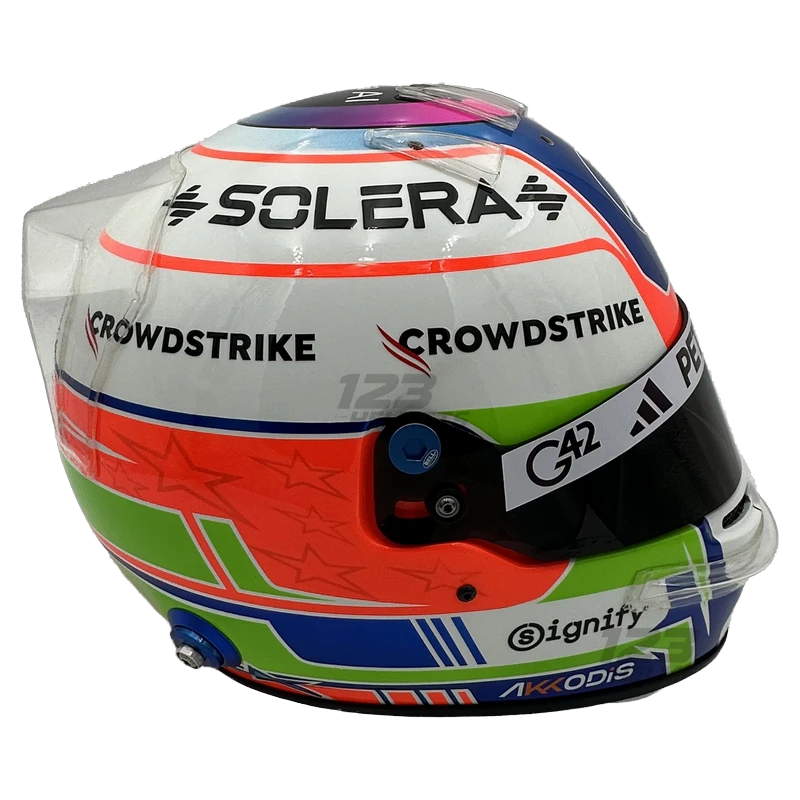
The 2026 Canadian Grand Prix delivered one of the most statistically loaded race weekends of the new regulation era, and at its centre stood Kimi Antonelli — a teenager whose championship lead now exceeds the largest gap any driver held at any point during the entire 2025 season. From the Montréal podium to the carbon-laid liveries glinting under Île Notre-Dame’s afternoon sun, this is a recap built for collectors: the numbers, the helmets, and the display-worthy frames that will define this round for years to come.
Key Takeaways
Antonelli’s post-Canada championship lead is mathematically larger than any margin recorded during the entire 2025 season
Montréal marked a defining weekend for 1:1 replica collectors, with three distinct podium helmet liveries entering display catalogues
The 70-lap Circuit Gilles Villeneuve race produced multiple stat-sheet records under the 2026 power-unit regulations
Red Bull’s livery execution and helmet finishing remain a benchmark reference for exhibition-quality full-size replicas
The headline number: a lead bigger than anything seen in 2025
The single most striking figure to emerge from the 2026 Canadian Grand Prix is not a lap time or a pit-stop split — it is the championship gap. After 70 laps around the 4.361 km Circuit Gilles Villeneuve, Kimi Antonelli left Montréal holding a points advantage that, in raw arithmetic, exceeds the largest lead any driver carried at any individual round throughout the 2025 season. For a driver in only his second full campaign, this is a statistical signature that immediately reframes the title narrative.
To put it in collector terms: the helmets worn by championship leaders in 2025 represented a back-and-forth season where momentum swung between rounds. By contrast, Antonelli’s 2026 Canadian-GP helmet now joins a far rarer category — headwear worn during a dominant points cushion, the kind of artefact that historically becomes the most sought-after 1:1 replica of a season. Display pieces tied to a clear championship leader consistently outperform mid-pack equivalents in long-term collector catalogues.
Why this lead is statistically unusual
Across the 24 rounds of 2025, no driver — at any moment — opened a gap as large as the one Antonelli now holds after Montréal. That is the headline. The supporting context is equally important: he achieved it across a calendar still in its opening third, meaning the cushion was built race by race rather than inherited from a late-season collapse by a rival.
Race anatomy: 70 laps around Île Notre-Dame
The Circuit Gilles Villeneuve remains one of the most photogenic backdrops on the calendar for collectors. Its 4.361 km layout — 14 corners, a long pit straight, and the iconic Wall of Champions at Turn 13/14 — produces visual frames that translate directly into display-worthy reference imagery for replica helmets and 1:1 livery models.
The 2026 race ran the full 70-lap distance, a total race length of just over 305 km, with the standard Montréal characteristics on display: heavy braking zones, low-speed chicanes, and the hairpin at Turn 10 where helmet camera angles produce the cleanest broadcast close-ups. For collectors evaluating which weekend’s helmet to pursue as a display piece, Canada consistently ranks in the top tier precisely because of these camera frames — the visor reflections from the casino straight are some of the most reproduced reference images in the replica industry.
Key lap-by-lap markers
- Race distance: 70 laps
- Circuit length: 4.361 km
- Total race distance: approximately 305.27 km
- Corner count: 14
- Notable feature: Wall of Champions at final chicane
Each of these numbers matters when curators assemble a Canadian GP display: lap count drives how many lap-specific decals (board markers, sector flags) can be replicated on a presentation plinth, while the 14-corner layout informs the angle at which a 1:1 helmet should be mounted to catch the same light a broadcast camera would.
Helmet and livery focus: what made the Montréal podium display-worthy
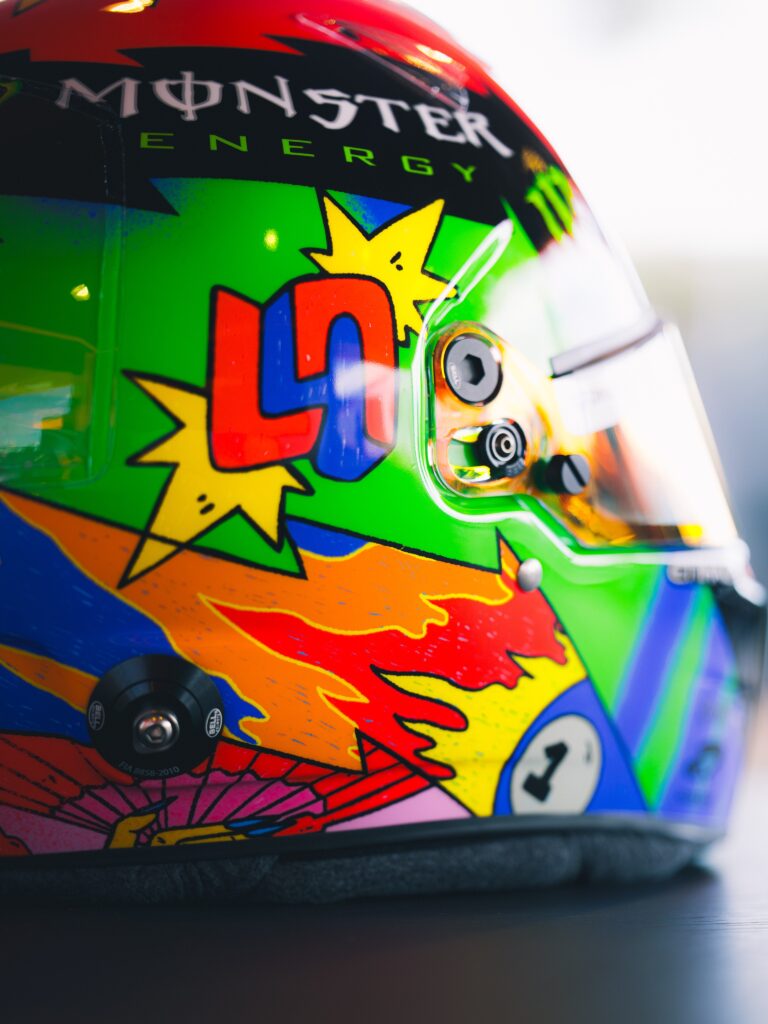
Three helmets stood on the Canadian Grand Prix podium, and each represents a distinct case study in exhibition-quality replica craft. Full-size 1:1 collector replicas live or die on three details: shell finish layering, visor optical clarity, and decal alignment around compound curves. Montréal’s podium delivered reference material for all three.
Antonelli’s helmet: a championship leader’s signature piece
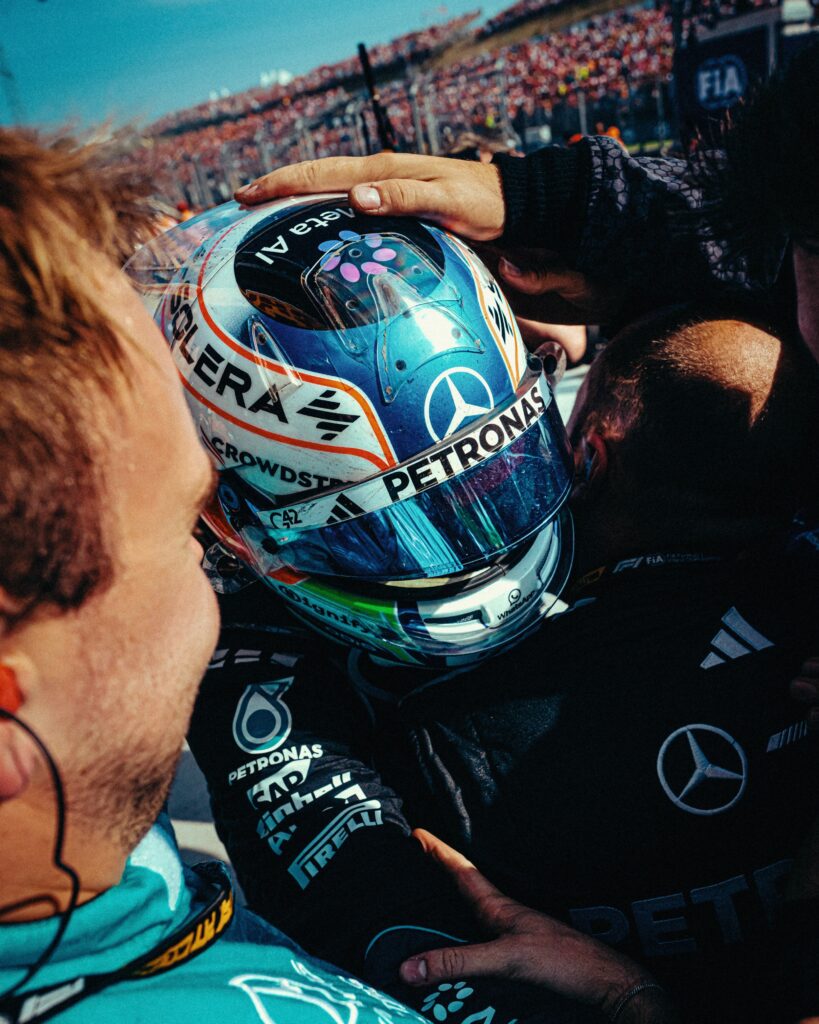
Antonelli’s helmet across the Canadian weekend carried the visual language he has refined since his junior categories — a base palette that photographs cleanly under both overcast and direct sunlight, which is exactly what Montréal’s variable June weather delivered. For collectors, this matters: a helmet design that holds its identity under multiple lighting conditions is one that translates faithfully into a display-cabinet replica. Paint layering on premium 1:1 replicas typically runs to 7–9 coats including primer, base, graphics, lacquer, and protective clear — and Antonelli’s design rewards that depth because the gradients only resolve correctly with full lacquer build-up.
Red Bull’s livery execution
Red Bull’s 2026 car livery remained one of the most reproduced reference points in collector circles. The Montréal weekend offered fresh photography of the matte/gloss interplay across the engine cover, a detail that 1:1 helmet replicas paired with show-car liveries must match precisely. Exhibition pieces displayed together — helmet plus livery panel — require colour-matching to within a tight tolerance, typically measured in single-digit Delta-E units, to avoid visual mismatch under gallery lighting.
Podium visuals worth framing
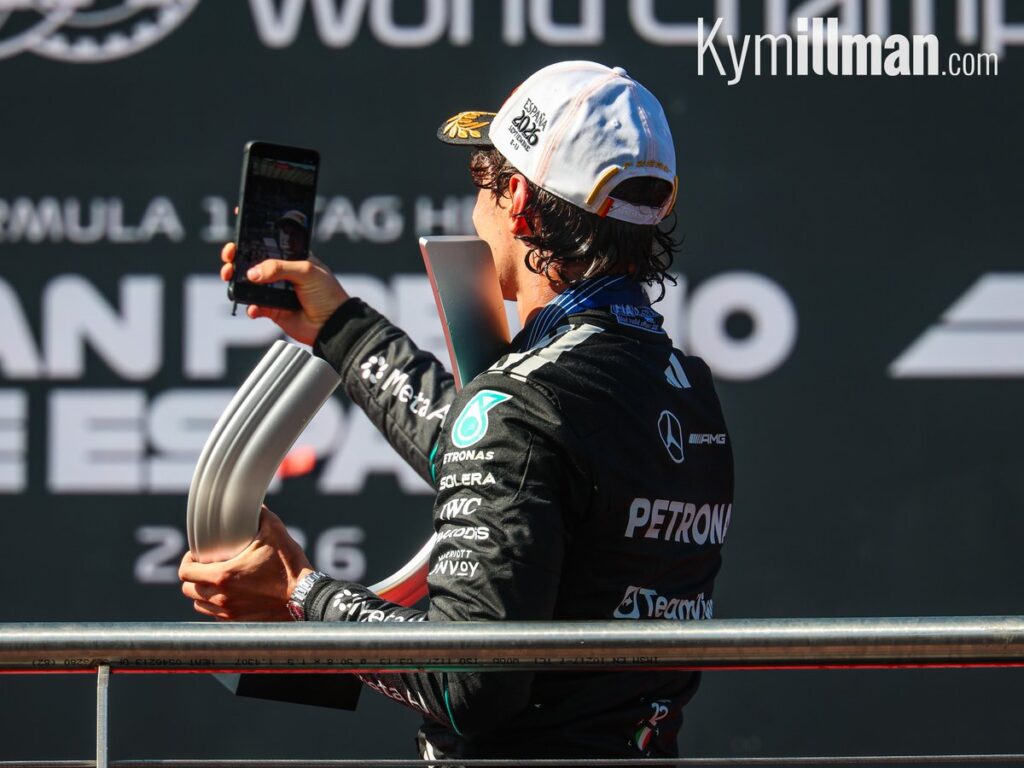
The three-helmet podium shot from Montréal is already circulating as a reference image in collector forums. The composition — three drivers, three distinct shell profiles, the Canadian Grand Prix trophy in foreground — is the kind of frame that defines a season’s poster prints and shadow-box display assemblies.
The stats that will sit on the Canadian GP page forever
Beyond the headline championship gap, the 2026 Canadian Grand Prix produced a cluster of supporting numbers that will live in the record books and, by extension, on the data plaques of collector display cases.
- Race distance completed: 70 laps, full distance
- Circuit: Circuit Gilles Villeneuve, Île Notre-Dame, Montréal
- Layout: 14 corners, 4.361 km per lap
- Antonelli’s championship lead: larger than any margin held during the entire 2025 season
- Driver age context: Antonelli remains one of the youngest drivers ever to hold a championship lead of this magnitude at this stage of a season
Why these numbers matter to collectors
A display-quality 1:1 helmet replica is not just a sculpted shell — it is a date-stamped artefact. The most valuable pieces in private collections are those whose accompanying documentation locks them to a specific weekend’s statistical context. “Canadian GP, 70 laps, championship-leader helmet” is the kind of provenance line that elevates a replica from decorative object to catalogued display piece. Exhibition curators routinely request weekend-specific stat sheets to accompany loaned helmets, and Montréal 2026 will produce one of the richest such sheets of the season.
What this means for the rest of the season
A championship lead larger than anything seen in 2025 changes the strategic landscape for every remaining round. For the collector market, it also begins to crystallise which weekend helmets will hold the highest long-term display value. Historically, the helmets worn during the race where a driver first establishes an outright commanding lead become the anchor pieces of a championship-year collection. Montréal 2026 is now that race for Antonelli.
The replica market response
Demand patterns for full-size 1:1 collector helmets typically shift within 48–72 hours of a defining race weekend. Antonelli’s Canadian GP performance has the classic signature of a demand-spike trigger: clear on-track dominance, a recognisable circuit backdrop, and a championship-context headline. Exhibition-quality replicas — those built with full multi-layer paint, optically clear visors, and accurate trim — are the segment that benefits most, because casual demand for lower-tier products fades but display-grade pieces enter long-term catalogues.
What to watch in subsequent rounds
Three things matter for collectors tracking this story: whether Antonelli introduces a special-edition helmet design in the coming rounds (championship-leader designs sometimes feature subtle commemorative elements), how Red Bull’s livery evolves under the 2026 technical regulations across summer rounds, and whether any rival mounts a sustained counter-attack that would re-open the title fight and reshape which helmets become the season’s defining display pieces.
Building a Canadian GP 2026 display: a collector’s blueprint
For collectors planning a Montréal-themed display, the 2026 race offers an unusually rich source of reference material. A complete display assembly built around this weekend would typically include a full-size 1:1 helmet replica, a livery reference panel, a date-and-lap-count plaque, and a framed reference photograph from the podium ceremony.
Display dimensions and presentation
Full-size 1:1 F1 helmet replicas occupy a footprint of approximately 27 × 35 cm on a standard display plinth, with a height of around 28–30 cm depending on the aero elements of the specific shell design. A dedicated display cabinet for a single helmet typically measures 35 × 35 × 45 cm internally to allow 360-degree viewing with appropriate lighting clearance. For a multi-helmet Canadian-podium display, plan for a cabinet of at least 110 × 40 × 50 cm to accommodate three pieces with adequate visual separation.
Lighting and viewing angles
The most flattering display lighting for a 1:1 helmet replica replicates the angle of the broadcast camera that captured its most iconic frame. For Montréal podium helmets, this means a key light positioned approximately 45 degrees above and slightly forward of the shell, mimicking the trophy-presentation camera angle. This single detail separates a casual display from an exhibition-quality presentation.
All items referenced are full-size 1:1 collector and display replicas. Not certified for protective use.
“A championship lead larger than anything held in the previous season is the kind of statistic that defines which helmets enter the long-term collector catalogue.”
— 123Helmets.com editorial desk
FAQ
Q: How large is Antonelli’s championship lead after the 2026 Canadian Grand Prix?
His post-Montréal points advantage is mathematically larger than the biggest gap any driver held at any point during the entire 2025 season — a statistic that frames him as the clear early reference point of the 2026 title narrative.
Q: What are the key stats from the 2026 Canadian Grand Prix?
The race ran the full 70-lap distance around the 4.361 km Circuit Gilles Villeneuve, totalling approximately 305.27 km across 14 corners per lap. Antonelli emerged with the largest championship lead recorded since the start of the 2025 season.
Q: Why is the Canadian GP particularly relevant for helmet collectors?
Montréal produces some of the most photogenic broadcast frames of the season — visor reflections from the casino straight, the Wall of Champions backdrop, and the trophy-presentation lighting angle are all reference points used by replica craftsmen when finishing exhibition-quality 1:1 display pieces.
Q: What display dimensions should I plan for a 1:1 F1 helmet replica?
A single full-size 1:1 helmet replica occupies roughly 27 × 35 cm of plinth footprint with a height of 28–30 cm. A dedicated single-helmet display cabinet of 35 × 35 × 45 cm internal volume allows full 360-degree viewing. For a three-helmet podium display, plan for at least 110 × 40 × 50 cm.
Q: Are these helmets suitable for protective use?
No. All helmets referenced are full-size 1:1 collector and display replicas intended exclusively for exhibition and display purposes. They are not certified for any protective, road, track, or wearable use.
Browse F1 Helmet Collection
Display and collector replicas only. Not certified for protective use. Full-size 1:1 scale.