Blog
Live Coverage: The Canada Sprint Through a Collector’s Lens — Liveries, Helmets and Podium Visuals
 123Helmets Editorial Team
Live Coverage: The Canada Sprint Through a Collector’s Lens — Liveries, Helmets and Podium Visuals
Montreal’s Circuit Gilles Villeneuve turned the Sprint into a parade of color, contrast and character. From the maple-leaf graphics catching the St. Lawrence light to the helmets glinting under the grandstand floods, this was a Sprint built for the collector’s eye. Here is our live-coverage recap, written for those who care less about tenths and more about how a livery, a visor band or a podium frame becomes a piece worth displaying.
Key Takeaways
Montreal’s lighting gave matte and gloss liveries completely different on-track personalities — a key reference for display lighting at home.
Helmet visor tear-offs and dust patterns from the Sprint create the kind of authentic detail collectors look for in 1:1 replicas.
The podium framing in Canada — flags, champagne arc and trophy shape — is one of the most photogenic of the season.
Sprint formats compress the narrative, making single-session helmet designs and one-off liveries more visible than ever.
The Sprint Setting: Why Montreal Looks Different on Camera
Few circuits flatter a Formula 1 car the way Circuit Gilles Villeneuve does. The trees behind the hairpin, the concrete walls lining the back straight, the river shimmering beyond the pit complex — every frame is composed. For a collector watching with display in mind, the Sprint in Canada is less a 100-kilometer dash and more a high-resolution showcase of how 2024-era liveries behave in real light.
The Saturday session opened under shifting cloud cover, which is the ideal lighting condition for spotting livery depth. Matte finishes absorbed the diffuse light and revealed their carbon weave underneath, while gloss schemes flickered between studio sheen and aggressive metallic flare depending on the cloud break. That contrast matters when you are deciding which 1:1 replica helmet earns the top shelf at home and which one belongs angled toward a warmer lamp.
Light, color and the collector’s eye
Montreal’s particular trick is the late-afternoon sun cutting low across the pit lane. It turns red liveries into deep burgundy, makes blue schemes shift toward navy, and gives white sections an almost paper-like softness. If you have ever wondered why your display helmet looks different at 9 a.m. versus 5 p.m., the Canadian Sprint is a televised lesson in why lighting design is half the battle of a great collection.
Helmet Watch: The Designs That Stole the Sprint
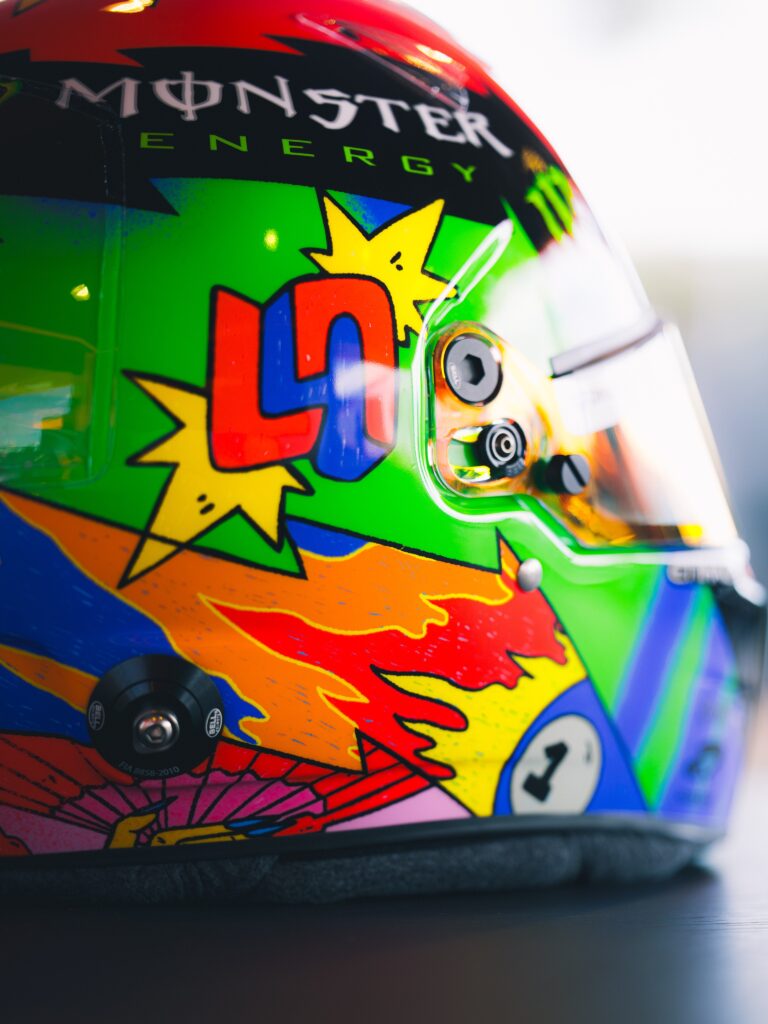
Sprints have become the unofficial laboratory for one-off helmet designs. Drivers and their painters know that a Sprint weekend gives a design twice the camera time of a standard Friday, and Canada was no exception. Several drivers arrived with subtle Montreal nods — maple-leaf graphics tucked into the chin bar, fleur-de-lis motifs around the visor surround, and small French-language tributes painted near the base ring.
Visor bands and the Montreal palette
The visor band remains the single most important element for collectors. It is the first thing the eye finds on a shelf, and in Montreal we saw a clear trend toward high-contrast bands — black on chrome, white on red, gold on matte navy. These are the bands that photograph cleanly and translate well to a full-size 1:1 replica sitting on a lit plinth.
Details worth noting
- Hand-painted maple-leaf clusters along the rear crown — almost impossible to appreciate on broadcast, stunning in person on a display piece.
- Brushed-metal accents around the air intake, which catch ambient room light beautifully on a collector shelf.
- Subtle name script in cursive near the jawline, a recurring motif for drivers paying tribute to family in Canada.
For collectors, the takeaway is simple: a Sprint helmet often carries more storytelling per square centimeter than a standard-race lid. That density of detail is exactly what makes a 1:1 replica feel like an exhibition piece rather than a souvenir.
Livery Focus: How Each Car Read on Camera
Walking the pit wall on a Sprint Saturday is a livery designer’s dream. The cars sit still long enough between sessions for every panel to be examined, and the Sprint’s compressed schedule means teams resist the temptation to over-tape or over-patch. What you see is closer to the launch render than at almost any other point in the weekend.
Matte versus gloss in the Montreal air
Montreal’s humidity does interesting things to paint. Matte schemes appeared deeper and more velvet-like than they do in dry European rounds, while gloss schemes picked up reflections from the grandstands and the river beyond. From a display standpoint, this is worth noting: a matte 1:1 replica helmet pairs beautifully with a livery diorama in a humid, atmospheric room; a gloss replica wants drier, brighter, more directional lighting.
The decals that matter to collectors
Sprint weekends often introduce one-off sponsor placements — small commemorative decals, charity logos, or local-market partners. These are the details that, twenty years from now, will identify a specific session. When evaluating a display-quality replica, look for accuracy in the smallest stickers, not just the headline logos. That is where the best collector items separate themselves.
Podium Visuals: Framing the Sprint Result
The Canadian Sprint podium is one of the most underrated visual compositions of the season. The structure sits low, the flags fall in a wide arc behind the drivers, and the lighting is almost always favorable. For collectors, the podium is the moment that defines which helmet becomes the helmet of the weekend — the one whose 1:1 replica earns pride of place.
The trophy, the champagne, the helmet line-up
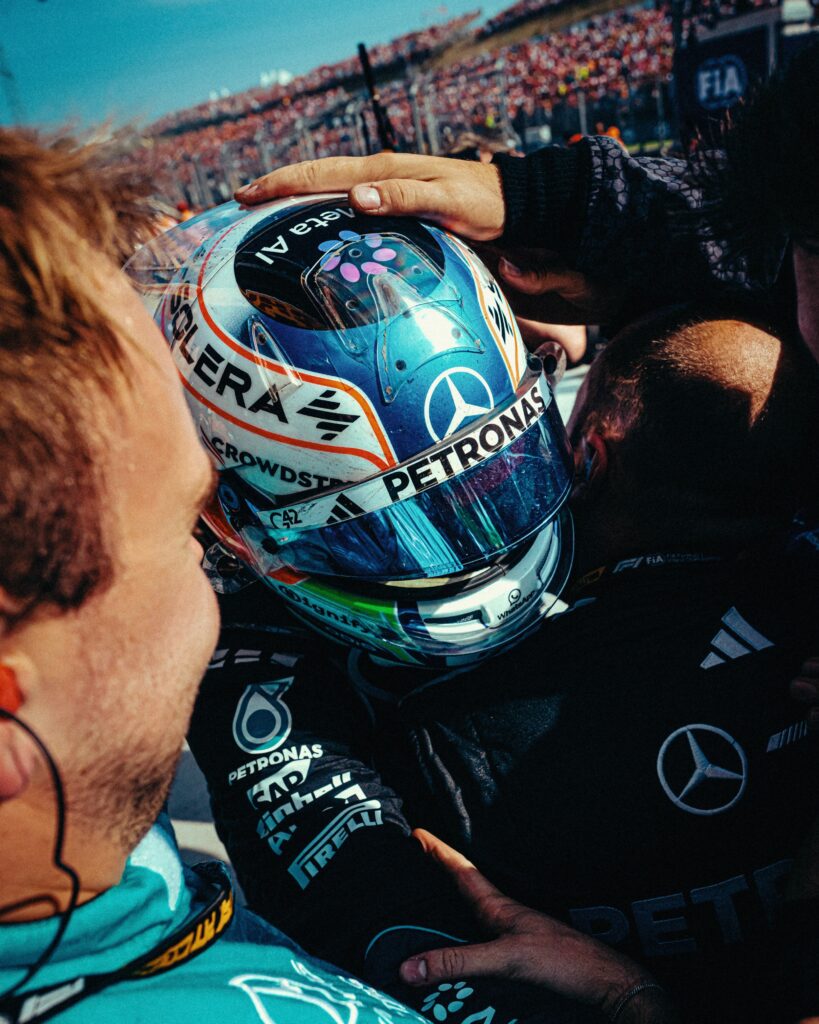
Watch the moment the top three lift their helmets onto the podium step. That brief tableau — three lids, three liveries, one trophy — is the single best reference image for anyone building a podium-themed display at home. Note the angle: helmets almost always face slightly inward, visors catching the camera lights. Replicate that angle on your shelf and the entire display gains broadcast-grade presence.
Composition tips for home display
- Three helmets in a stepped arrangement, mirroring the podium tiers.
- Lighting from above and slightly forward, never from directly overhead.
- A neutral backdrop — matte black, deep grey, or warm walnut — to let the liveries do the talking.
This is exhibition-quality presentation, and it is achievable in any living room with a single shelf and two small lamps.
Display-Worthy Moments: Beyond the Podium
Not every collectible moment happens on the rostrum. The Sprint in Canada delivered several frames that will live on in photo archives — a slow walk back to the garage with helmet under arm, a quiet visor lift on the grid, a teammate handshake in the pit lane with both lids still on. These are the images that inspire the most evocative displays.
The helmet-under-arm shot
It is the most enduring pose in motorsport. A driver, helmeted or unhelmeted, lid tucked beneath the elbow, walking through the paddock. Replicating this on a shelf is simple: angle the 1:1 replica slightly forward, tilt it five degrees, and place it on a low plinth. The result feels candid, lived-in, and far more compelling than a perfectly squared display.
The grid-walk close-up
Broadcasters love the pre-race close-up — a slow pan across the visor, catching the reflection of the grid. For a collector, this is the argument for keeping a replica clean but not sterile. A faint dust pattern, a deliberate light scuff on the chin bar, all of it adds narrative. A 1:1 display helmet is not a museum artifact behind glass; it is a storytelling object.
What the Canada Sprint Tells Us About 2024 Collecting
If there is one through-line from this Sprint, it is that the helmet has reclaimed its place as the most expressive object in Formula 1. Cars are increasingly constrained by aerodynamic regulation; liveries are increasingly constrained by sponsor architecture. The helmet remains the one canvas where a driver’s personality, a designer’s craft, and a weekend’s narrative all converge.
Why 1:1 replicas matter now
Scale models have their place, but the full-size 1:1 replica is the only format that captures the true presence of a helmet. The weight of the shell in the hand, the depth of the paintwork, the way light catches the visor band at eye level — none of it translates at smaller scales. Canada’s Sprint, with its dense detail and photogenic podium, is exactly the kind of weekend that justifies the investment in a true full-size display piece.
Building a Sprint-themed shelf
If you are tempted to build a Sprint-specific display, Canada is a strong anchor point. Pair a 1:1 replica from this weekend with a framed podium photograph, a small Canadian flag, and a single warm spotlight. That is exhibition quality on a domestic budget — and a permanent reminder of a Sprint Saturday that gave collectors more than its share of memorable frames.
“Helmets are the last truly personal canvas in Formula 1 — every Sprint weekend proves it again.”
— 123Helmets editorial desk
“A 1:1 replica is not a souvenir. It is a storytelling object, and Montreal gave us a season’s worth of stories in one Saturday.”
— Collector’s note, Canada Sprint
FAQ
Q: What makes a Sprint weekend especially interesting for helmet collectors?
Sprint formats compress the on-track action into fewer sessions, which means designers and drivers often debut one-off helmet designs or commemorative liveries that get more camera time per minute than during a standard weekend. For collectors building a display, those one-off designs are exactly the kind of pieces that stand out on a shelf.
Q: Why does the Canadian Grand Prix produce such photogenic podium visuals?
Circuit Gilles Villeneuve sits on an island in the St. Lawrence River, with a low podium structure, wide flag arc and favorable late-afternoon light. The combination creates frames that translate beautifully into reference images for home displays and for choosing which 1:1 replica helmet to highlight.
Q: How should I display a full-size 1:1 replica helmet at home?
Use a low plinth or floating shelf, light from above and slightly forward (never directly overhead), and choose a neutral backdrop — matte black, deep grey, or warm walnut — so the livery and visor band do the talking. Angle the helmet five degrees off-square for a more candid, exhibition-quality look.
Q: Are these replicas suitable for any kind of protective use?
No. Every helmet we cover is a display and collector replica only — full-size 1:1 scale for exhibition purposes. They are not certified for any protective application and should be enjoyed strictly as collector items.
Q: What details should I look for in a high-quality 1:1 replica?
Focus on the smallest decals, the accuracy of the visor band, the depth of the paintwork (matte versus gloss), and the fidelity of hand-painted motifs around the crown and chin bar. The headline logos are almost always correct on a quality replica; it is the small commemorative stickers and session-specific details that separate exhibition-grade pieces from generic ones.
Browse F1 Helmet Collection
Display and collector replicas only. Not certified for protective use. Full-size 1:1 scale.