Blog
Daniel Ricciardo Says Life Feels “More Real” After Abrupt F1 Exit: A Collector’s Look Back at the Honey Badger’s Helmet Legacy
 123Helmets Editorial Team
Daniel Ricciardo Says Life Feels “More Real” After Abrupt F1 Exit: A Collector’s Look Back at the Honey Badger’s Helmet Legacy
Months after his unexpected departure from the Formula 1 grid at the 2024 Singapore Grand Prix, Daniel Ricciardo has opened up about the strange, peaceful feeling of stepping away from the paddock. The Australian admits life now feels “more real” — and for collectors who followed every iteration of his vivid honey-badger helmet designs, his words invite us to revisit the visual legacy he leaves behind on display shelves around the world.
Key Takeaways
Ricciardo’s helmet evolution from Toro Rosso rookie to McLaren race-winner offers one of the richest collecting arcs of the modern era
His signature yellow-and-black honey badger crest became one of the most recognizable display motifs of the 2010s and 2020s
Career-defining podiums — Monaco, Monza, Baku, and the Nürburgring shoey moment — each carry distinct helmet variations prized by collectors
1:1 full-size replica helmets capture every detail of his livery progression for exhibition-quality display
The Quiet After the Storm
When Daniel Ricciardo climbed out of his RB cockpit in Singapore in September 2024, few realized it would be the last time the Australian would race in Formula 1. There was no farewell tour, no podium send-off, no choreographed retirement weekend. Just a quiet exit from a paddock he had inhabited for over thirteen seasons.
Speaking publicly months later, Ricciardo described the transition in disarmingly simple terms. Life, he said, feels “more real” now — slower, less curated, less governed by motorhome schedules and tyre compounds. For a driver whose smile carried an entire generation of fans, the reflection feels both bittersweet and grounding.
For collectors and enthusiasts who built shelves around his helmet evolution, his words carry a different weight. Each helmet on display is no longer just a tribute to an active driver — it is a chapter in a completed story. And that completeness is what transforms a replica from memorabilia into a true collector’s artifact.
Why His Exit Matters to the Display Community
Ricciardo’s career spanned an extraordinarily photogenic era of Formula 1 — the move from V8s to hybrid V6 turbos, the transition from traditional helmet shells to the modern aero profiles, and the rise of bespoke driver branding. His helmets were never anonymous. They were canvases.
The Honey Badger Crest: A Display Icon
Few modern drivers built a personal brand into their helmet livery the way Ricciardo did. The honey badger — that fearless, impulsive animal he adopted as a personal mascot — became central to nearly every helmet design from his Red Bull years onward.
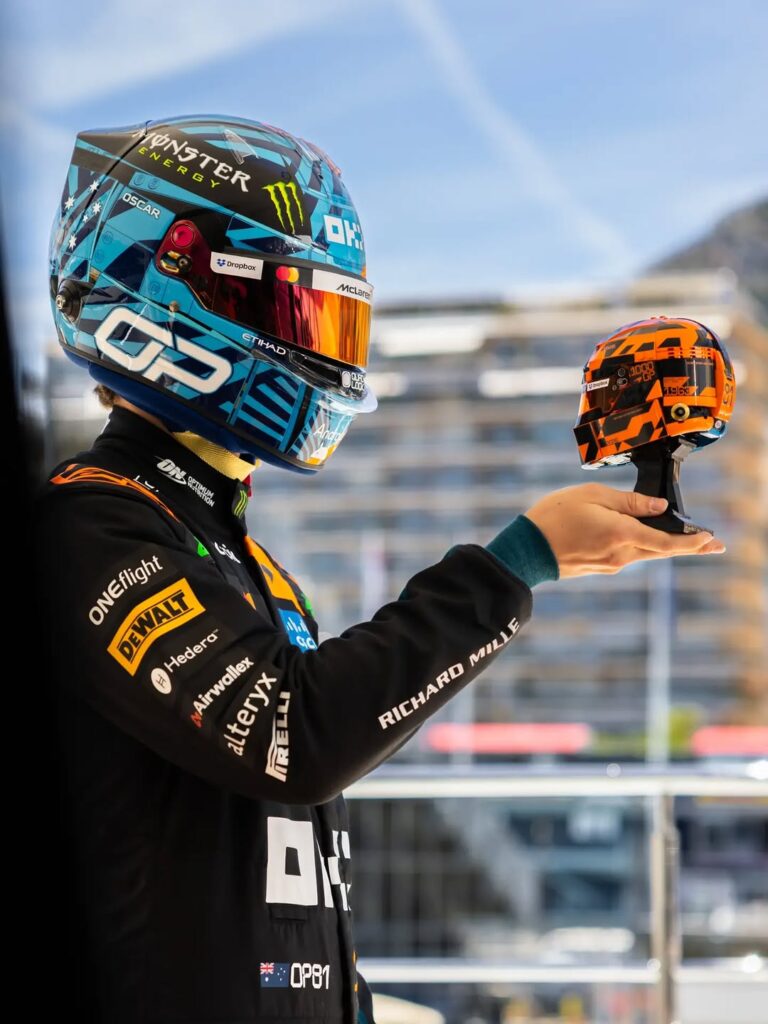
The crest itself evolved across seasons. Early Red Bull-era helmets featured a stylized badger silhouette tucked discreetly along the side panel. By the time he reached McLaren in 2021, the badger had grown bolder, often rendered in metallic finishes and integrated into the crown design. The papaya-and-blue McLaren palette gave the motif a striking new context — a visual that translates beautifully to a 1:1 full-size collector replica under display lighting.
Color Stories Across Teams
One of the joys of collecting Ricciardo helmets is the dramatic palette shift across his career chapters:
- Toro Rosso (2012–2013): Navy, red, and silver — clean, restrained, with the first hints of his personal stylings emerging.
- Red Bull (2014–2018): The classic yellow, black, and white combination that became his signature. The bumblebee-inspired pattern remains arguably his most iconic look.
- Renault (2019–2020): Bold yellow and black panels punctuated by neon accents — a livery that paired hauntingly well with the Renault works colors.
- McLaren (2021–2022): Papaya integration with retro-inspired chrome detailing — a fan favorite for shelf display.
- AlphaTauri / RB (2023–2024): A more matured palette, often with throwback nods to his earlier eras.
Each transition produced helmet variants that exhibition-quality replicas faithfully reproduce, allowing collectors to assemble a complete visual timeline of one driver’s career on a single shelf.
Podium Moments Worth Displaying
Ricciardo’s eight career victories and 32 podiums produced some of the most celebrated visual moments of the 2010s. For collectors, certain races stand out not just for the results, but for the helmet variations he wore.
Monaco 2018: Redemption in Yellow and Black
After heartbreak in 2016, Ricciardo’s 2018 Monaco win — managed with a wounded MGU-K — became one of the great drives of the hybrid era. His Red Bull-era helmet, gleaming under the Monte Carlo sun, remains a benchmark of livery design. Replicas of this configuration are perennial favorites for display cabinets.
Monza 2021: The McLaren Comeback
Perhaps the most cinematic moment of his career. After more than three years without a win, Ricciardo led home a McLaren one-two at the Temple of Speed. His helmet that weekend carried subtle commemorative detailing, and the papaya palette against the Italian autumn light produced photographs that have become collector reference images.
The Shoey at the Nürburgring
His 2020 Eifel Grand Prix podium — and the famous shoey shared with Cyril Abiteboul — encapsulated everything fans loved about him. The Renault-era helmet from that weekend, with its sharp yellow geometry, remains a centerpiece of many collections.
Baku 2017 and the Improbable Win
Few races have produced more chaos than the 2017 Azerbaijan Grand Prix, and Ricciardo emerged from it victorious in his classic Red Bull bumblebee helmet — a livery that defines an era.
Why 1:1 Replicas Capture the Era
The appeal of a full-size 1:1 collector replica lies in scale and presence. A photograph flattens a livery; a quarter-scale model abstracts it. But a full-size display helmet, sitting on a stand at eye level, restores the design to the exact dimensions intended by the artists who painted it.
Ricciardo’s helmets are particularly suited to this format. The honey badger detailing, the metallic accents along the chin bar, the carbon-effect trim around the visor aperture — these details only fully register at true scale. Exhibition-quality replicas reproduce the paint depth, decal placement, and finish texture that make each design distinctive.
Display Considerations for Ricciardo Replicas
Collectors building a Ricciardo-themed display often consider:
- Lighting: Warm directional light enhances the depth of yellow and papaya tones, while cool light flatters the chrome and metallic accents.
- Stand orientation: Three-quarter angle showcases both the front crest and the side honey badger detailing.
- Grouping: Pairing replicas from different team eras creates a visual narrative arc.
- Backdrops: Neutral matte surfaces let the livery speak without competing.
These are display pieces and collector items — full-size 1:1 replicas intended for exhibition, not protective or wearable use. Their value lies entirely in their visual fidelity to the originals.
A Legacy in Paint and Personality
What made Ricciardo collectible was never just trophies or wins. It was the marriage of personality and visual identity — a driver whose helmet always looked like it belonged to him and no one else. Even in his final season with RB, when results had become elusive, his helmet designs retained their distinct character.
His admission that life feels “more real” away from the paddock reflects something many athletes describe after departure. The performance environment, with its travel, sponsorship obligations, and constant scrutiny, can compress identity. Stepping away allows it to expand again.
The Collector’s Perspective
For those who curate F1 helmet displays, Ricciardo’s exit creates a kind of canonical closure. His complete career — every team, every livery iteration, every special-edition design — is now fixed in time. New designs will not emerge to update the collection. What exists is what will always exist.
This permanence is, paradoxically, what makes display replicas of recently retired drivers so compelling. A collection becomes a tribute rather than a running commentary. Each helmet on the shelf represents a chapter that is fully written.
Whether you favor the bumblebee Red Bull years, the neon Renault era, or the papaya McLaren chapter, the visual heritage Ricciardo leaves behind is among the richest of his generation. His helmets will continue to appear in collector displays, exhibition cases, and personal shrines for decades to come — a fitting legacy for a driver whose smile, and whose paintwork, defined an era.
Building a Ricciardo-Themed Display
For collectors considering how to honor his career through display pieces, a few approaches stand out:
The Chronological Shelf
Arrange replicas in career order: Toro Rosso, Red Bull, Renault, McLaren, AlphaTauri/RB. This format tells the full story and invites visitors to trace the visual evolution from helmet to helmet.
The Victory Display
Focus on the eight race-winning configurations — from his maiden victory at the 2014 Canadian Grand Prix through Monza 2021. Each helmet represents a specific weekend, a specific result, a specific moment in F1 history.
The Signature Design
For collectors with limited space, a single iconic replica — most often the classic Red Bull-era bumblebee helmet — captures the essence of his career in one piece. Paired with appropriate lighting and a clean stand, it commands attention as a centerpiece.
The Color Story
Some collectors arrange by palette rather than chronology — yellow-and-black helmets together, papaya helmets together — creating a more abstract visual composition that emphasizes the artistry of livery design.
However you choose to display them, Ricciardo’s helmets reward careful curation. They were never anonymous corporate liveries; they were personal statements rendered in paint. And that personal quality is exactly what makes them endure as collector pieces.
“Life feels more real now. Slower, quieter — but real.”
— Daniel Ricciardo, reflecting on life after Formula 1
“The honey badger crest became one of the defining visual signatures of an entire F1 generation.”
— 123Helmets Editorial
FAQ
Q: Which Ricciardo helmet stands out for collectors?
The Red Bull-era yellow-and-black bumblebee design is the standout, alongside the 2021 McLaren papaya configuration he wore during his Monza victory weekend. Both translate beautifully to full-size 1:1 display replicas.
Q: Are these helmets suitable for any kind of protective use?
No. These are display pieces and collector items only — full-size 1:1 replicas intended exclusively for exhibition, shelf display, and visual collecting. They are not certified or designed for any protective, wearable, or track use.
Q: What scale are collector F1 helmets typically produced in?
The premium standard is full-size 1:1 scale, which reproduces the helmet at the same dimensions as the original. This scale captures every livery detail — paint depth, decal placement, finish texture — exactly as intended by the original designers.
Q: How should I display a Ricciardo replica helmet?
Use a stable display stand at approximately eye level, with warm directional lighting to enhance the yellow and papaya tones. A three-quarter front angle showcases both the central crest and the side honey badger detailing that defines his designs.
Q: Will Ricciardo return to Formula 1?
Ricciardo has spoken about his departure with a tone of acceptance and closure, describing life away from the paddock as feeling “more real.” No return has been announced, and his complete career — and complete helmet catalogue — is now treated by collectors as a closed canonical body of work.
Browse F1 Helmet Collection
Display and collector replicas only. Not certified for protective use. Full-size 1:1 scale.
This article was written with the help of AI tools. Editorial policy