Blog
Inside Ferrari and Red Bull’s ‘Macarena’ Wings: A Visual Race Story
 123Helmets Editorial Team
Inside Ferrari and Red Bull’s ‘Macarena’ Wings: A Visual Race Story
When the cameras zoomed in on the rear wings of Ferrari and Red Bull during the latest grand prix weekend, paddock watchers immediately christened them the ‘Macarena’ wings — flexing, dancing, and bending under load in a way that turned every onboard shot into a piece of moving art. Beyond the engineering debate, the visuals were spectacular: scarlet endplates flexing against Tifosi grandstands, matte navy bodywork glinting under floodlights, and helmets popping above cockpits in colour combinations made for display shelves. This recap looks at the race through that lens — the livery, the lids, the podium ceremonies, and the collector-worthy frames that emerged from a weekend dominated by aerodynamic intrigue.
Key Takeaways
The ‘Macarena’ wing controversy created some of the most visually striking onboard footage of the season, with Ferrari red and Red Bull navy bending in unison.
Charles Leclerc’s helmet design provided a perfect chromatic counterpoint to the SF-24 livery, ideal for full-size 1:1 replica display.
Podium ceremony framing — scarlet overalls, champagne arcs, and crew helmets in formation — delivered exhibition-quality reference imagery.
Collectors are increasingly drawn to weekends where technical drama and visual identity converge into a single, iconic display narrative.
The Weekend the Wings Danced
From the very first practice session, telephoto lenses in the paddock locked onto the rear of the Ferrari SF-24 and the Red Bull RB20. Under aerodynamic load down the longest straight, both wings exhibited a rhythmic, almost choreographed flex — a top edge rolling slightly backward, the trailing surface twisting in sympathy. Within hours, social media had baptised the phenomenon the ‘Macarena wing’, a nickname that stuck because the motion really did look like a synchronised dance.
For the engineers, it was a story about static load tests, deflection thresholds and the grey areas of the technical regulations. For us, the storytellers of livery and helmet culture, it was something else entirely: a weekend where the cars themselves became kinetic sculptures. Every onboard angle delivered a fresh composition — the scarlet of Maranello stretched and released, the deep navy of Milton Keynes pulsing in time with the throttle trace.
A Visual Gift for Collectors
When a car looks this dramatic in motion, the cascade effect on the collector market is immediate. Helmet designs photographed against flexing bodywork take on new resonance. Podium frames feel heavier, more historic. And the souvenirs of the weekend — the lids, the caps, the team-issue prints — gain an extra layer of context for anyone curating a full-size 1:1 replica display at home.
Ferrari’s Livery Under the Lights
Ferrari arrived with its now-familiar SF-24 palette: a deep, almost candy-coated Rosso Corsa, broken up by a band of matte yellow along the sidepod shoulder and accents of glossy black around the halo and airbox. Under the floodlights of the main straight, the gloss-on-matte contrast was extraordinary. When the rear wing began its trademark flex, the yellow highlight on the endplate caught the light like a brushstroke on a moving canvas.
The Tifosi-friendly visual identity is, of course, no accident. Ferrari’s design language is engineered to read instantly on a television screen, in a grandstand from 200 metres away, and — crucially for our world — on a shelf in a home study or a corporate lounge. That same colour story carries directly onto helmet shells, where the Rosso provides a base, and where personal flourishes from each driver complete the picture.
Why the SF-24 Era Photographs So Well
Three factors made this weekend’s Ferrari imagery particularly display-worthy. First, the contrast ratio between the deep red and the matte black halo gave photographers strong edges to work with. Second, the yellow accent — small but precisely placed — provided a natural focal point that the eye returns to. Third, the flexing wing introduced an element of motion blur on the rear deck that traditional, rigid bodywork simply cannot offer. The result: every press image looked like a poster waiting to be framed.
Helmets in the Spotlight
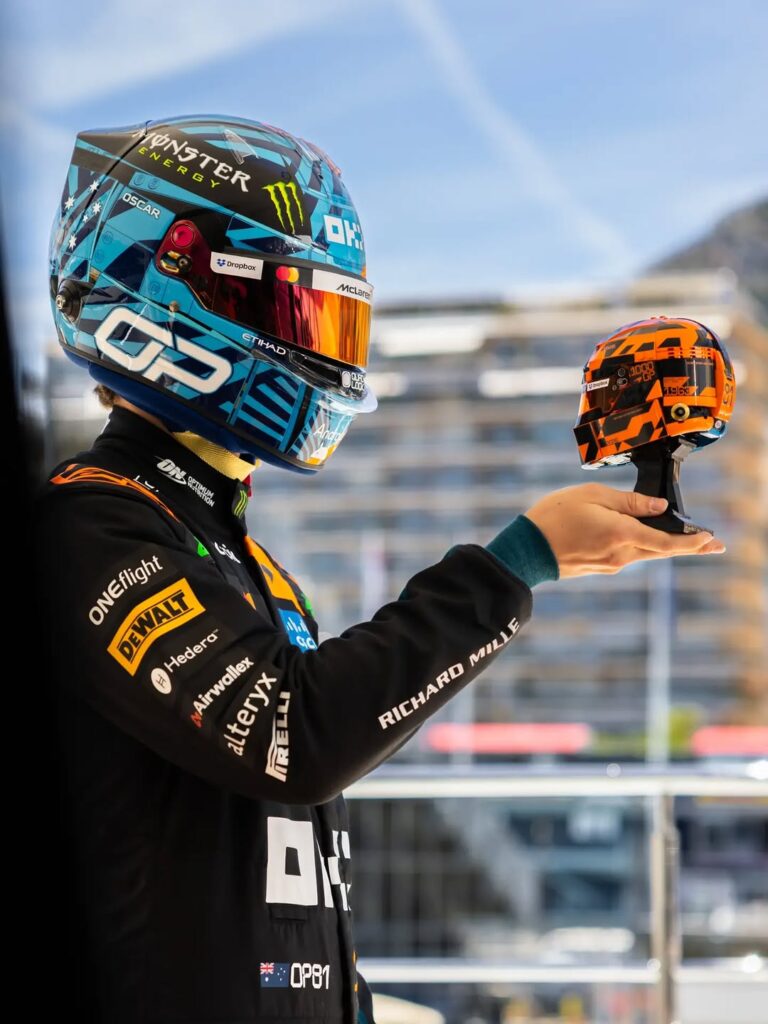
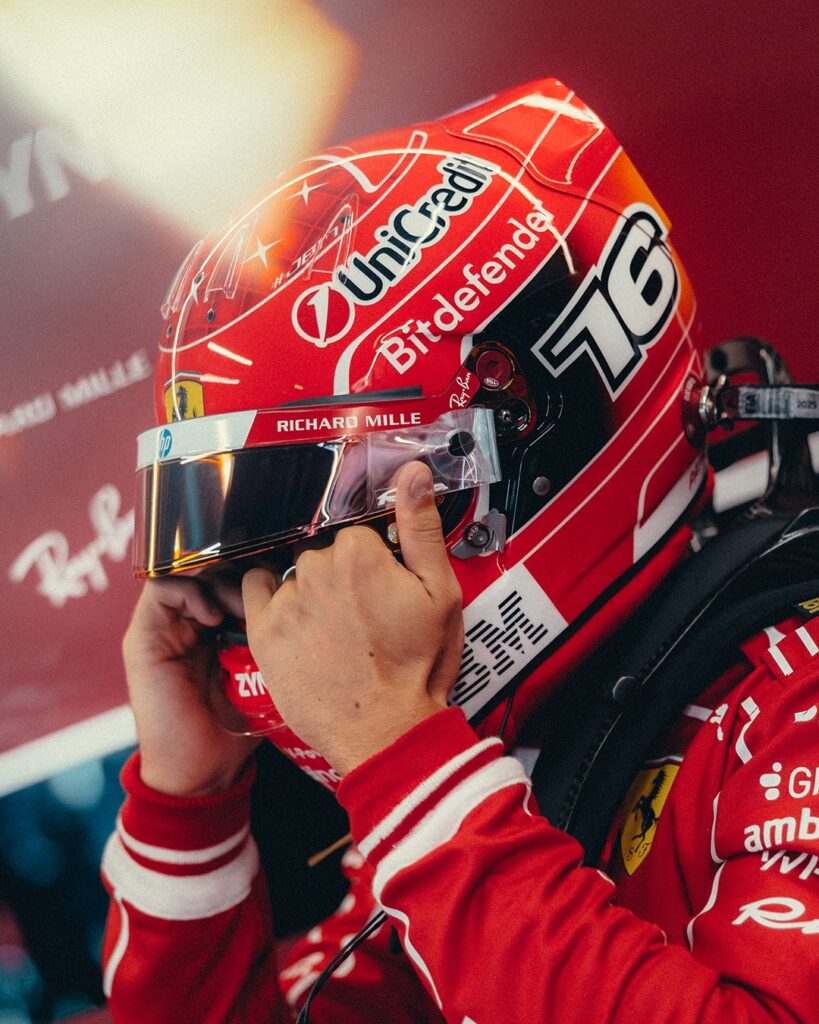
If the bodywork was the canvas, the helmets were the signatures. Charles Leclerc’s lid, with its Monégasque-inflected colour palette and intricate top-section detailing, sat above the SF-24 cockpit like a crown jewel. Every time he removed it on the grid, the camera caught a moment of stillness — sweat, focus, the badge of Maranello on his brow — that is exactly the kind of frame collectors chase when curating a full-size 1:1 replica display.
Carlos Sainz’s design, by contrast, leaned on a more graphic, almost architectural composition. The contrast between the two Ferrari helmets, both unmistakably scarlet at their base, demonstrated how teammates can share a team identity while broadcasting completely distinct personal signatures. For a collector deciding which 1:1 replica to place at eye level on a shelf, that distinction is everything.
Red Bull’s Counterpoint
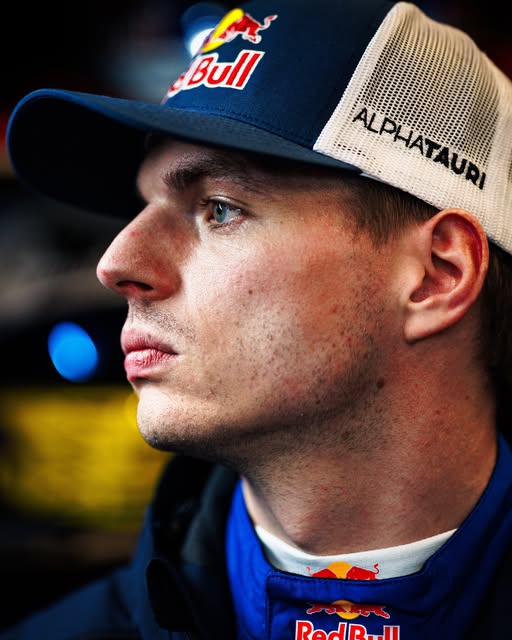
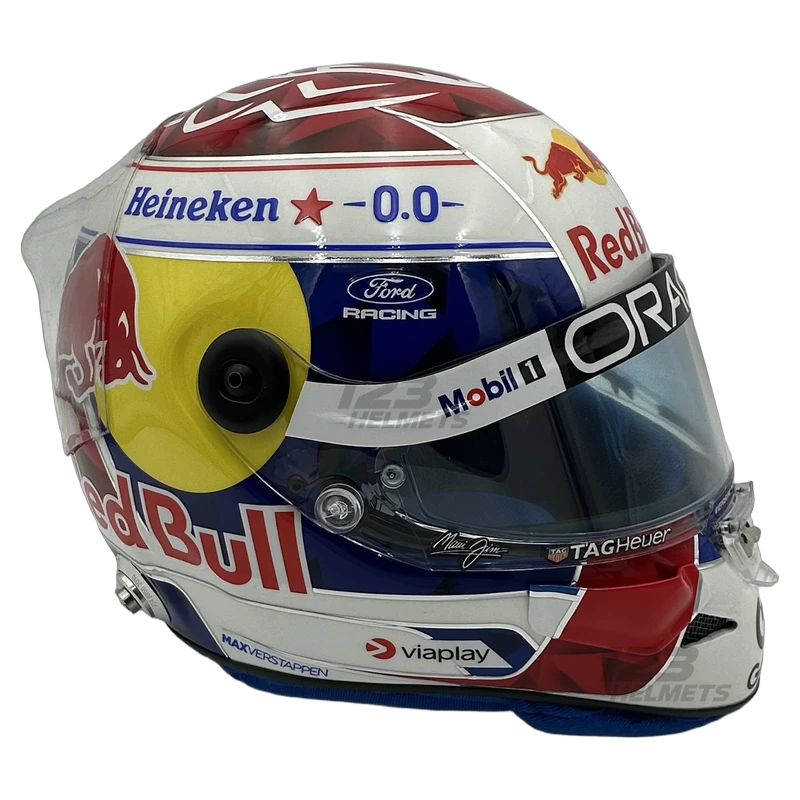
Across the garage divide, Max Verstappen’s helmet continued its tradition of bold geometric blocks in navy, red and yellow — a design that, juxtaposed against the matte RB20 livery, created one of the most photogenic team-driver combinations on the grid. Sergio Pérez’s design provided a warmer, more textured counterpoint. Together, the four helmets at the front of the grid this weekend formed a quartet of display-worthy objects, each telling its own story.
Race Day: From Lights Out to Chequered Flag
Lights out delivered exactly the visual chaos the weekend promised. The opening laps saw the scarlet and navy noses tangled through the first sector, wings flexing under braking and traction phases in a way that — for once — was visible to the naked eye on the broadcast. Photographers positioned at the apex of the long right-hander captured frame after frame of Ferrari and Red Bull side-by-side, their rear assemblies bowing in near-perfect mirror image.
By mid-race, the strategic battle had crystallised into a familiar pattern: Red Bull leveraging tyre management, Ferrari pushing hard on outright pace. But the real story for our audience was the consistency of the imagery. Every overhead shot, every onboard, every panning sequence reinforced the same compositional truth — these two cars, in these two colour stories, with these helmet designs above them, are the defining display tableau of the current era.
The Podium Frame
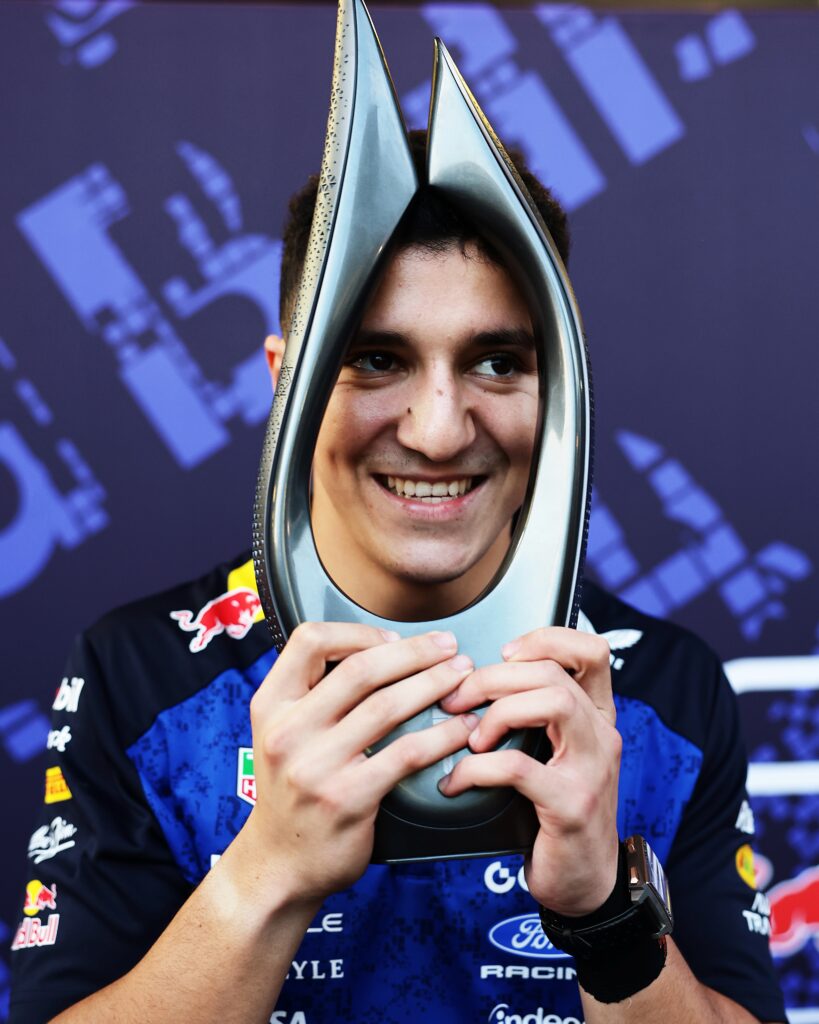
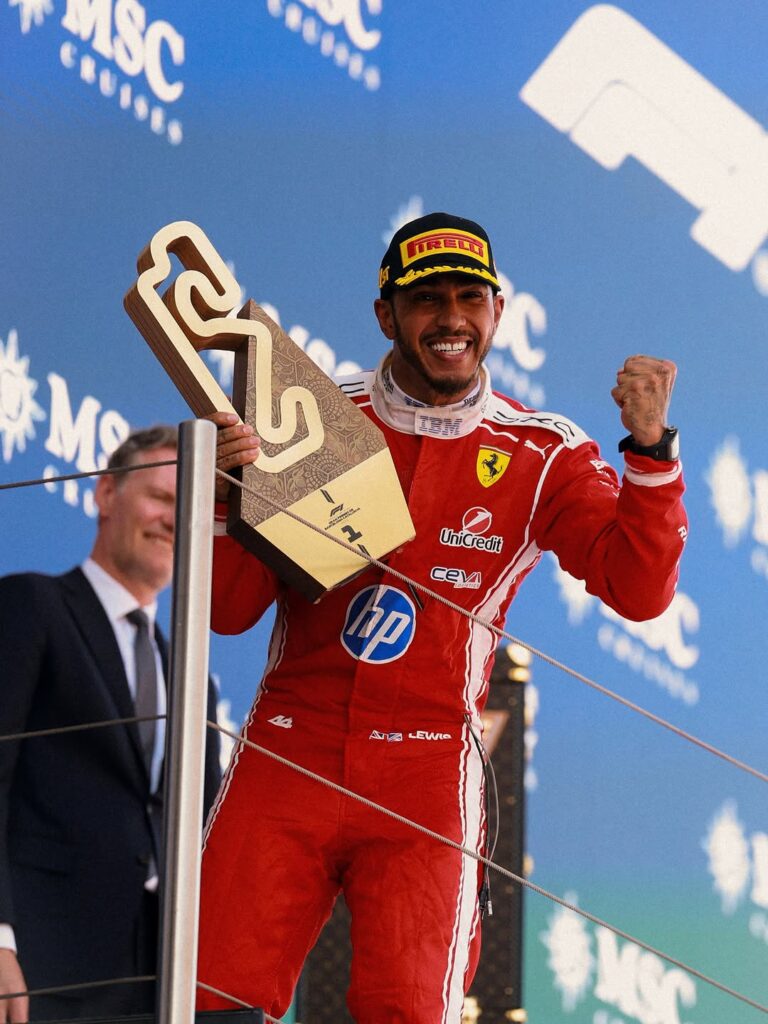
The podium ceremony delivered the inevitable payoff. Drivers in fireproofs that matched their cars, helmets cradled at hip height or placed on the front row of the rostrum, trophies catching the late-afternoon light. For a collector building a display narrative around this season, the photographs from this ceremony are gold: they tie together livery, helmet, trophy and human moment into a single composition.
Building a Display Around This Weekend
For collectors inspired by what they saw this weekend, the assembly logic is straightforward. Start with the helmet — a full-size 1:1 replica is the anchor of any serious display, because it sits at human eye level and commands attention. Position it on a plinth or shelf at roughly 150 to 160 centimetres from the floor, with a soft directional light angled from above to bring out the gloss and the detail work.
Surround the helmet with secondary objects that reinforce the story: a framed print of the podium ceremony, a model car in the same livery scale, a team cap or programme from the weekend. The key is to let the helmet breathe — give it space, give it light, and let the surrounding objects act as context rather than competition. This is exhibition quality thinking applied to a personal collection.
Why This Particular Weekend Matters
Not every grand prix earns a place in a display narrative. The ones that do tend to share two qualities: a technical or sporting story that will be referenced for years, and a set of images strong enough to carry that story visually. The ‘Macarena wing’ weekend qualified on both counts. Years from now, when collectors look at their Ferrari and Red Bull replicas side by side, this is one of the races they will point to as a moment when the sport’s visual identity reached a new peak.
Editorial Verdict
As a race recap, this weekend delivered everything a display-focused collector could ask for: bold liveries pushed to the edge of legality, helmet designs that earned their close-ups, and a podium ceremony framed for the history books. The ‘Macarena wing’ nickname will fade, but the imagery it produced will live on in prints, in replica displays, and in the collective memory of the Tifosi.
For collectors, the takeaway is simple. When a weekend produces this kind of convergence — technical drama, livery brilliance, and helmet artistry — it earns a permanent place in the curation calendar. Pull the relevant 1:1 replicas to the front of the shelf, refresh the lighting, and let this race become the centrepiece of your display until the next chapter writes itself.
“When the bodywork starts dancing on camera, you stop being an engineer and start being a spectator.”
— Paddock observation, race weekend
“A helmet on a podium tells you everything about a driver in a single frame — that is why collectors want them at eye level.”
— 123Helmets.com editorial desk
FAQ
Q: What is the ‘Macarena wing’ and why did it get that nickname?
It is the informal nickname given by paddock observers to the flexing rear wings seen on the Ferrari SF-24 and Red Bull RB20 during the race weekend. The name stuck because the rhythmic, synchronised motion of the wing under aerodynamic load resembled a dance — specifically the iconic synchronised steps of the Macarena.
Q: Are 123Helmets.com replicas suitable for protective use on track?
No. All helmets sold by 123Helmets.com are full-size 1:1 collector and display replicas, intended exclusively as exhibition pieces and display items for shelves, cabinets and curated collections. They are not certified for any protective or on-track use.
Q: Why is this particular race weekend significant for collectors?
Because it combined a memorable technical story — the flexing wings — with exceptional livery and helmet visuals. Weekends where engineering drama, team identity and podium imagery converge tend to become reference points that collectors build display narratives around for years afterwards.
Q: How should I display a Ferrari 1:1 helmet replica at home?
Position the replica at roughly eye level, around 150 to 160 centimetres from the floor, on a plinth or dedicated shelf. Use soft, directional lighting angled from above to highlight the gloss finish and the fine design details. Give the helmet space to breathe and use secondary objects like prints or models as supporting context.
Q: What makes Ferrari helmet designs particularly display-worthy this season?
The combination of a deep Rosso Corsa base, precise yellow and black accents on the bodywork, and highly individual driver designs above the cockpit creates a strong, photogenic identity. Both Charles Leclerc’s and Carlos Sainz’s helmets translate that team palette into distinct personal statements that work beautifully as full-size 1:1 replica display pieces.
Bring the drama of the ‘Macarena wing’ weekend home — explore our full-size 1:1 Ferrari display replicas and build a podium-worthy collection. Shop Ferrari Helmets.
Display and collector replicas only. Not certified for protective use. Full-size 1:1 scale.
This article was written with the help of AI tools. Editorial policy