
Blog
Hamilton Under Investigation: Canadian GP Impeding Drama and the Collector Helmet Story
 123Helmets Editorial Team
Hamilton Under Investigation: Canadian GP Impeding Drama and the Collector Helmet Story
A tense weekend in Montréal placed Lewis Hamilton at the centre of a stewards’ inquiry, with a possible grid penalty for impeding hanging over the closing stages of the Canadian Grand Prix. Beyond the procedural drama, the visual story — helmet design, garage livery, podium photography — gave collectors yet another chapter worth framing.
Key Takeaways
Hamilton was investigated for impeding during the Canadian GP weekend, raising grid penalty concerns
The Montréal weekend delivered standout helmet visuals worthy of any display shelf
Livery contrast against Circuit Gilles Villeneuve barriers created iconic photography moments
Full-size 1:1 replica helmets capture every detail seen on track in Canada
The Impeding Incident: How Montréal’s Tight Layout Caught Hamilton Out
Circuit Gilles Villeneuve has always been a track where space is at a premium. Narrow run-offs, tight chicanes and a single fast lap that requires absolute precision make Montréal one of the most demanding venues on the calendar — not only for drivers, but for the stewards tasked with policing on-track etiquette.
During the Canadian Grand Prix weekend, Lewis Hamilton found himself summoned to the stewards’ office after an incident that race control classified as potential impeding. The matter centred on a moment during a qualifying session when a faster car on a flying lap encountered Hamilton at an inopportune point on the circuit. With the stewards reviewing telemetry, radio communications and onboard footage, the threat of a grid penalty for the race itself loomed large.
Why Impeding Penalties Carry Such Weight
In modern Formula 1, an impeding offence is rarely brushed aside. The penalty matrix typically includes reprimands, grid drops of three or more places, and in some cases the loss of qualifying lap times. For a driver fighting for every position in a competitive midfield battle, even a three-place penalty can be the difference between points and anonymity.
The Montréal weekend showed once again how the smallest miscommunication between a driver and their engineer — a missed call about approaching traffic, a delayed instruction to move off the racing line — can spiral into a stewards’ investigation with championship implications.
Race Day Recap: Hamilton’s Fight Through the Field
Once the lights went out, the impeding drama gave way to pure racing. Hamilton’s start was characteristically clean, slotting his car into a rhythm that allowed him to manage tyre degradation through the opening stint. The Canadian Grand Prix has historically rewarded drivers who balance aggression with patience, and Hamilton’s lap chart told that story across all sixty-something tours of the circuit.
Strategy Calls and Safety Car Windows
The race featured a virtual safety car interlude that reshuffled the strategic order, forcing teams to react in real time. Hamilton’s pit wall opted for a measured approach, holding track position rather than gambling on an undercut. The decision paid dividends as later stints brought tyre warm-up challenges that caught out drivers who had pitted early.
The Wall of Champions
No Canadian GP recap is complete without acknowledging the final chicane — the famed Wall of Champions. Hamilton, like every driver on the grid, threaded his way past that intimidating concrete barrier lap after lap, each pass a reminder of why this circuit produces some of the most photogenic on-board footage of the season. For collectors, the visual signature of a Montréal weekend is unmistakable.
The Helmet Story: Design Details Worth Displaying
Hamilton’s helmet programme has long been one of the most studied in the paddock. From the yellow base that has become synonymous with his career to the special editions that mark milestone weekends, every design choice is dissected by collectors and design enthusiasts alike.
Colour Blocking and Graphic Language
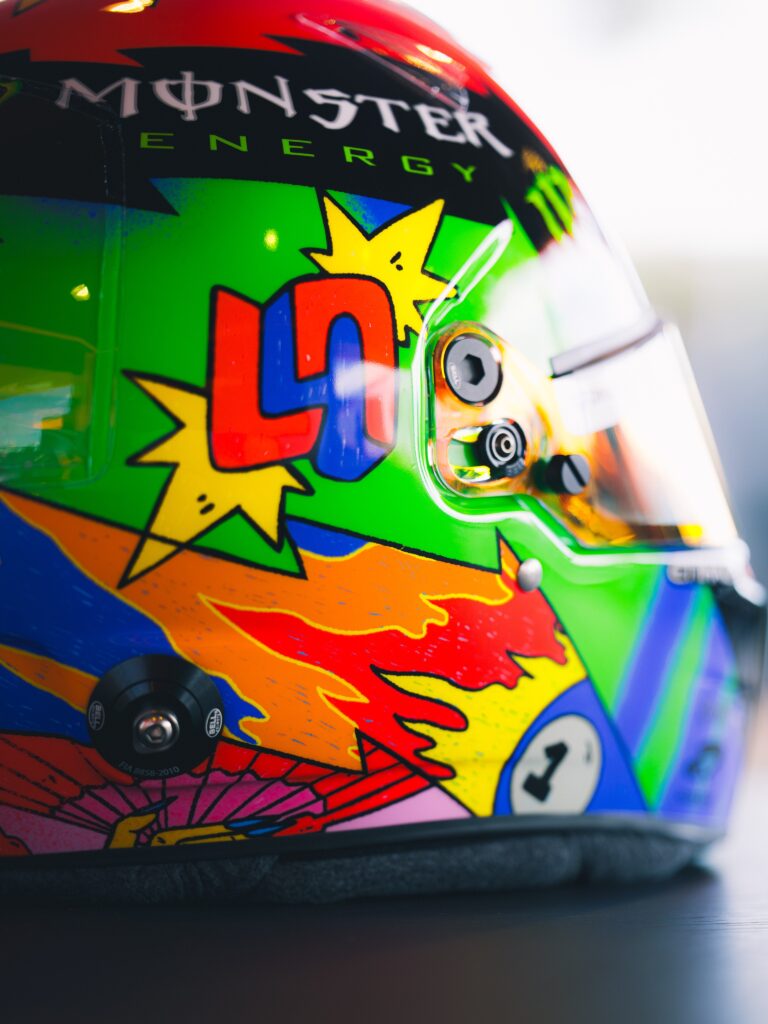
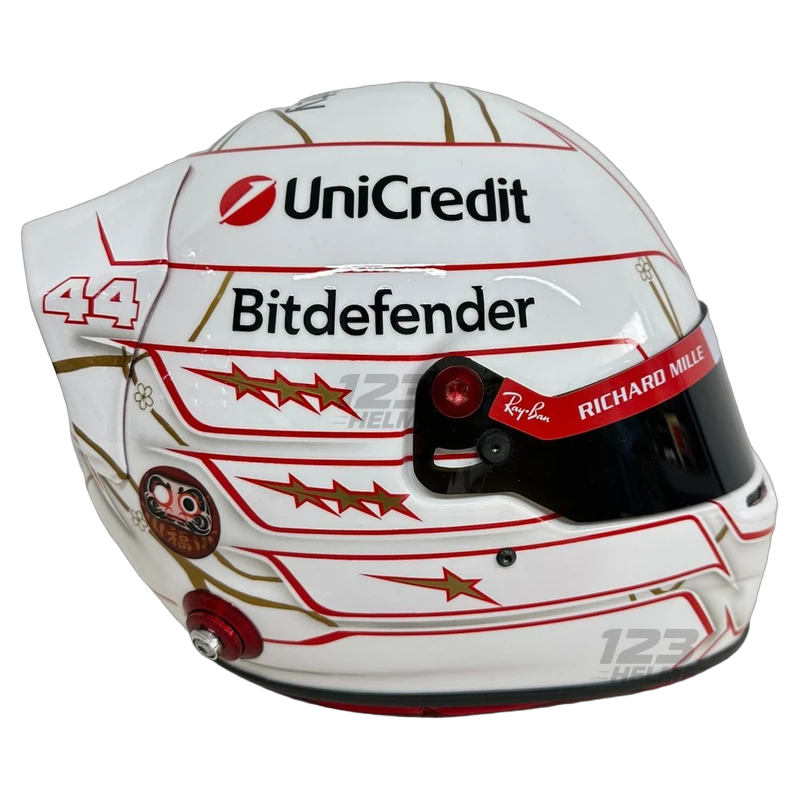
The Montréal helmet, viewed under the bright Québec sunlight, showcased the kind of contrast that translates beautifully to display environments. The interplay between the primary base colour, accent stripes and sponsor placements creates a visual rhythm that photographers chase from every angle — pit lane, parc fermé, and the podium itself.
For anyone curating a collection of full-size 1:1 replica helmets, the Canadian Grand Prix edition represents the kind of piece that anchors a shelf. The lacquer finish, the layered decals, and the visor tear-off tabs all combine to create an exhibition-quality object that rewards close inspection.
Why 1:1 Scale Matters for Collectors
Scale changes everything in a collector context. A miniature might capture the broad strokes of a design, but only a full-size 1:1 display replica delivers the presence that the original helmet commands in person. The proportions of the aero elements, the depth of the visor aperture, the placement of every logo — all of these read correctly only at true scale.
Livery Watch: How the Car Looked Under Montréal Light
Montréal’s lighting is one of the unsung heroes of Formula 1 photography. The angle of the sun across the Île Notre-Dame, the reflective surfaces of the St. Lawrence River, and the contrast of brightly painted bodywork against grey concrete barriers combine to produce frames that end up on workshop walls for decades.
Sponsor Placements and Visual Identity
The livery seen during the Canadian GP carried all the signature elements collectors look for: bold primary panels, carefully positioned partner logos, and the kind of crisp graphic execution that distinguishes a championship-calibre operation from the rest of the field. The way the colours wrapped around the sidepods and trailing edges created moments of pure design satisfaction whenever the car braked into the hairpin.
Photography Moments to Frame
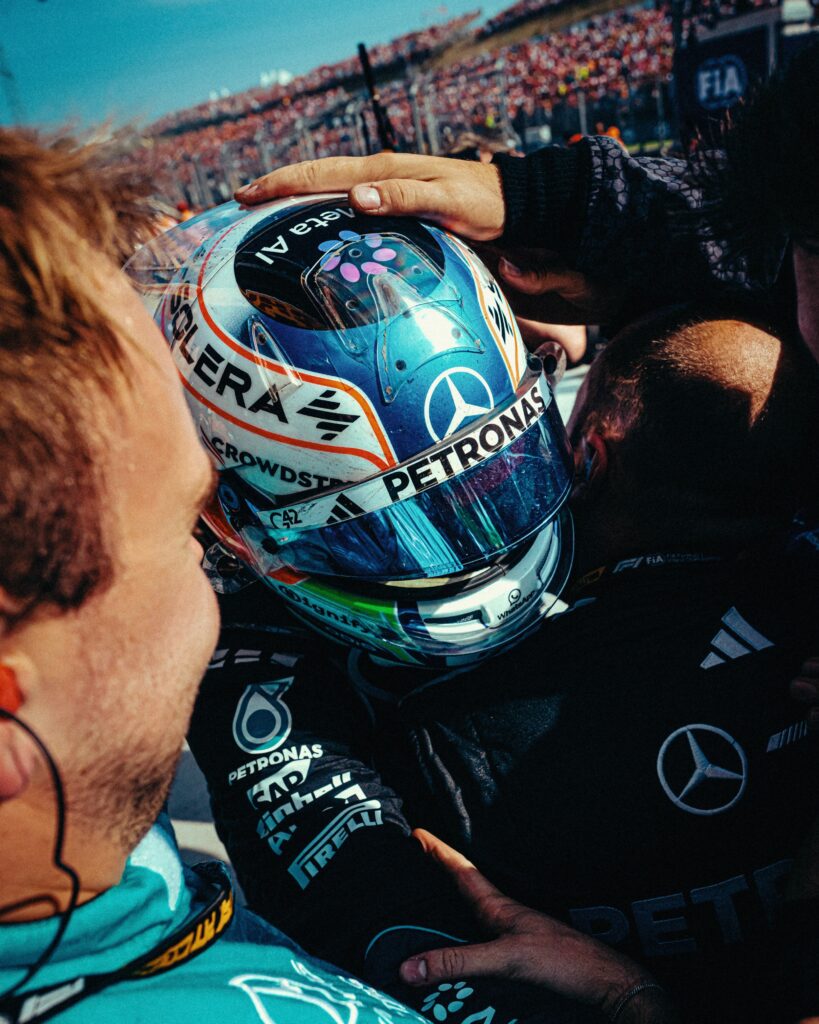
Three frames defined the weekend visually. The first: Hamilton’s car silhouetted against the grandstand during qualifying, the helmet just visible above the halo. The second: a pit lane release with the front jack lifting clear, the entire crew choreographed in matching team kit. The third: the podium ceremony itself, with confetti drifting through the air and the helmet held aloft. Each of these images is exactly the sort of reference material a serious collector consults when arranging a display.
What This Weekend Means for the Championship Picture
Beyond the stewards’ room and the photography opportunities, the Canadian Grand Prix carries weight in the broader championship narrative. Mid-season races in North America have historically been pivot points — moments where momentum shifts, where strategic gambles either reward or punish teams, and where driver pairings recalibrate their internal dynamics.
Looking Ahead to the European Summer
The Montréal result feeds directly into the European stretch of the calendar. Tracks like Spielberg, Silverstone and Spa each demand different car setups and reward different driving styles. The data gathered in Canada — tyre behaviour, brake duct configurations, power unit modes — informs everything teams do in the weeks that follow.
For Hamilton, the impeding investigation, whatever its final outcome, becomes part of the season’s storyline. It joins the catalogue of moments that collectors and historians will reference when they look back on this campaign years from now. And every one of those moments has a helmet design, a livery iteration, and a podium frame attached to it.
The Collector’s Verdict: Why This Weekend Belongs on Your Shelf
Every Grand Prix produces collectibles, but only certain weekends produce defining display pieces. The combination of off-track drama, on-track narrative, and strong visual identity makes the Canadian GP weekend an obvious candidate for collectors who curate their shelves with intention rather than completism.
Building a Hamilton Display
A well-constructed Hamilton display tells a story. It might begin with an early-career replica, move through the championship years, and arrive at recent editions like the one seen in Montréal. Each full-size 1:1 collector helmet acts as a chapter heading, and the visual continuity between them creates an exhibition that rewards both casual viewers and dedicated fans.
Care and Presentation
Display pieces deserve display conditions. UV-filtered cases, controlled humidity, dust-free environments and considered lighting all extend the visual life of a collector replica. These are not items to leave on a garage shelf — they are exhibition-grade objects that earn their place in a dedicated room.
“Montréal always rewards precision — on the steering wheel and in the design studio.”
— 123Helmets editorial desk
“A full-size 1:1 collector helmet is the only way to truly appreciate the craft behind a Grand Prix design.”
— Collector commentary
FAQ
Q: Did Hamilton actually receive a grid penalty in Canada?
Hamilton was investigated by the stewards for potential impeding during the Canadian GP weekend. The threat of a grid penalty was real, and the outcome depended on stewards’ review of telemetry and onboard footage.
Q: What makes the Canadian GP weekend special for helmet collectors?
Montréal’s lighting, the iconic Wall of Champions, and the strong podium photography traditions combine to create visually rich reference material. Helmets seen under Québec sunlight tend to photograph beautifully, making them prized display pieces.
Q: Are 123Helmets replicas full-size?
Yes. Every helmet in our collection is a full-size 1:1 scale display and collector replica, crafted to exhibition quality. They are intended for display purposes only and are not certified for protective use.
Q: How should I display a Hamilton collector helmet?
We recommend UV-filtered display cases, controlled humidity, dust-free environments, and considered lighting. Group multiple helmets chronologically to tell a career story across your shelf.
Q: What is impeding in Formula 1?
Impeding occurs when a driver unnecessarily obstructs another car, typically during a qualifying flying lap. Penalties can range from reprimands to grid drops of three or more places, depending on severity.
Shop Lewis Hamilton Collection
Display and collector replicas only. Not certified for protective use. Full-size 1:1 scale.